
The Lord commands Ezekiel to make Jerusalem’s danger visible: a city drawn on a brick, a siege built around it, a prophet bound beside it, bread weighed and water measured. The acts are severe because Jerusalem’s false confidence is severe. Yet judgment is announced before it falls. That is mercy: God makes the truth visible while repentance is still possible.
Siege means hunger, collapse, fear, disease, and violence. Famine means families suffering what no family should suffer. The Lord wounds false hope so that repentance remains possible; He does not teach His people to enjoy another person’s suffering.
Previous: Ezekiel 3:16-27 · Next: Ezekiel 5
Historical and Scriptural Context
The signs follow the watchman charge. Ezekiel has seen the glory in exile and eaten the scroll. Now the word enters his public actions. Jerusalem’s fall is drawn and enacted before it comes. The next sign will touch his own head and beard.
Historically, Ezekiel speaks among the exiles in Babylonia while Jerusalem still stands. Many exiles could have believed that the city and temple guaranteed a quick reversal. Ezekiel’s sign-acts destroy that false confidence. Religious memory cannot protect a city that has rejected God’s ordinances. This is hard mercy: the exiles are taught how to interpret the coming catastrophe before Babylon’s armies and Jerusalem’s famine appear to be the final word.
Within the book, these chapters begin the enacted judgment sequence that intensifies through chapters 6-7 and reaches the temple visions of chapters 8-11. Ezekiel’s body becomes a living commentary on the city: confinement, scarcity, impurity, and scattering are shown before they are fully experienced.
Geographical Significance ⛰️
The geography centers on Jerusalem, but the prophet acts from exile. Jerusalem is the covenant center, associated with temple, altar, priesthood, memory, kingship, and prayer. Yet the word about Jerusalem is performed in Babylonia, among those already displaced. The distance itself becomes part of the message: the Lord can judge Jerusalem from exile because His throne is not trapped inside Jerusalem.
The brick in Ezekiel 4 represents a city under siege. Around it are siegeworks, mound, camps, and engines. Jerusalem will not merely have a spiritual problem. Its gates, food supply, water supply, families, and bodies will feel judgment. The iron pan becomes a wall of judgment. The city that presumed nearness to God now sees a barrier.
The Characters 👥
- The Lord: He commands and interprets the signs, limits Ezekiel’s uncleanness when the prophet pleads, and declares judgment. His severity is covenantal, not arbitrary.
- Ezekiel, son of man: The priest-prophet becomes a sign in his own body. He draws, besieges, lies down, eats, drinks, protests, shaves, weighs, burns, cuts, scatters, and preserves.
- Jerusalem: The city is the target of the sign-acts. She has been set in the midst of the nations, but she has rejected the Lord’s ordinances.
- The house of Israel and the house of Judah: Ezekiel bears the sign of their iniquities. The divided people share one need: truthful repentance before the Lord.
The brick, the siege, and the prophet bound to the sign (Ezekiel 4:1-8)
Text note: Brenton gives Israel 150 days in 4:4, names 190 in 4:5 and 4:9, and gives Judah 40 in 4:6. The NKJV, following the Hebrew text, has no number in 4:4 and gives Israel 390 in 4:5 and 4:9; it also gives Judah 40. Brenton’s 150 and 40 make 190, the period named for the bread. The Hebrew figures make 430, recalling the 430 years in Exodus 12:40. These are different forms of the text, not numbers to combine into a prediction about our own age.
1 And thou, son of man, take thee a brick, and thou shalt set it before thy face, and shalt portray on it the city, even Jerusalem. 2 And thou shalt besiege it, and build works against it, and throw up a mound round about it, and pitch camps against it, and set up engines round about. 3 And take thou to thyself an iron pan, and thou shalt set it for an iron wall between thee and the city: and thou shalt set thy face against it, and it shall be in a siege, and thou shalt besiege it. This is a sign to the children of Israel. 4 And thou shalt lie upon thy left side, and lay the iniquities of the house of Israel upon it, according to the number of the hundred and fifty days during which thou shalt lie upon it: and thou shalt bear their iniquities. 5 For I have appointed thee their iniquities for a number of days, for a hundred and ninety days: so thou shalt bear the iniquities of the house of Israel. 6 And thou shalt accomplish this, and then shalt lie on thy right side, and shalt bear the iniquities of the house of Juda forty days: I have appointed thee a day for a year. 7 So thou shalt set thy face to the siege of Jerusalem, and shalt strengthen thine arm, and shalt prophesy against it. 8 And, behold, I have prepared bonds for thee, and thou mayest not turn from thy one side to the other, until the days of thy siege shall be accomplished.
The first sign begins with a brick. Ezekiel portrays Jerusalem on it, then builds the siege around it. The city becomes small enough to be held in view, drawn, surrounded, and judged. Jerusalem had imagined itself secure because of temple memory and covenant language. The brick says that the city can become an object lesson when it refuses to become a holy dwelling.
The iron pan is severe. It stands between the prophet and the city as an iron wall. Ezekiel’s face is set against Jerusalem. This is not personal rage. The prophet is acting out the Lord’s judicial opposition to a city that has made holiness into cover for rebellion. When God sets His face against sin, religious vocabulary cannot make sin safe.
Then Ezekiel must lie on his sides and bear the iniquities of Israel and Judah in sign form. The numbers say that iniquity has length, and judgment has measure. Iniquity has weight, duration, and consequence. Sin is not vapor. It binds bodies and creates a future of suffering.
The bonds in verse 8 prevent the prophet from turning freely. The watchman who speaks from God’s mouth also shares, in a sign, the burden of those he warns. Ezekiel’s obedience is costly. He does not watch judgment from a comfortable distance.
Ezekiel bears Israel’s iniquity in a sign; Christ bears our sins in His own body (1 Peter 2:24), as the sinless One. He does not merely announce judgment from outside the suffering of His people. He enters it for their salvation. He later weeps over Jerusalem and names the days when enemies will surround her (Luke 19:41-44), words heard within Luke 19:29-48 at the Liturgy of Palm Sunday.1 His tears reveal the love from which truthful warning comes.
Measured bread, measured water, and the humiliation of impurity (Ezekiel 4:9-17)
9 Take thou also to thee wheat, and barley, and beans, and lentiles, and millet, and bread-corn; and thou shalt cast them into one earthen vessel, and shalt make them into loaves for thyself; and thou shalt eat them a hundred and ninety days, according to the number of the days during which thou sleepest on thy side. 10 And thou shalt eat thy food by weight, twenty shekels a day: from time to time shalt thou eat them. 11 And thou shalt drink water by measure, even from time to time thou shalt drink the sixth part of a hin. 12 And thou shalt eat them as a barley cake: thou shalt bake them before their eyes in man’s dung. 13 And thou shalt say, Thus saith the Lord God of Israel; Thus shall the children of Israel eat unclean things among the Gentiles. 14 Then I said, Not so, Lord God of Israel: surely my soul has not been defiled with uncleanness; nor have I eaten that which died of itself or was torn of beasts from my birth until now; neither has any corrupt flesh entered into my mouth. 15 And he said to me, Behold, I have given thee dung of oxen instead of man’s dung, and thou shalt prepare thy loaves upon it. 16 And he said to me, Son of man, behold, I break the support of bread in Jerusalem: and they shall eat bread by weight and in want; and shall drink water by measure, and in a state of ruin: 17 that they may want bread and water; and a man and his brother shall be brought to ruin, and they shall pine away in their iniquities.
The second sign is famine made visible. Grains and legumes are thrown together in one vessel, not as a wholesome recipe for abundance, but as scarcity food. Bread is weighed. Water is measured. Eating and drinking become acts of survival. The language is blunt because siege is blunt. When a city is surrounded, hunger enters the house before the enemy enters the gate.
The Lord says He will break the support of bread in Jerusalem. Bread is daily life: children asking for food, families dividing small portions, neighbors watching one another weaken. The passage forces the reader to see what covenant rebellion finally does to bodies. Sin can create public ruin.
The uncleanness sign is also direct. Ezekiel is commanded to bake in a way that displays Israel’s coming humiliation among the Gentiles. The priest-prophet recoils: his soul has not been defiled in that way from youth. The Lord grants a mitigation, allowing ox dung instead of human dung. That mercy does not cancel the sign. It shows that God hears His servant’s reverent protest while still revealing the severity of exile.
The point is not disgust for its own sake. It is the collapse of covenant order. The people called to be holy will eat unclean things among the nations because they have defiled holy things at home.
Christ enters the place of uncleanness without becoming unclean. He touches lepers, receives sinners, is crucified outside the gate, and sanctifies the people through His own blood, as Hebrews 13:12-14 teaches. He does not bless impurity as harmless. He enters our shame to cleanse it. Ezekiel’s protest, “Not so, Lord God,” makes us feel the horror of defilement. Christ’s Cross shows the greater mercy: the Holy One comes near to the unclean in order to make them clean.
These signs do not make famine holy or turn hunger into proof of someone’s guilt. Christ feeds the hungry; His people must do the same. To fast freely while another person goes hungry unwillingly is a summons to share bread, not to offer them a diagnosis.
Gems from the Fathers 💎
St John Chrysostom, preaching about Nineveh’s repentance, refuses to equate fasting with an empty stomach. Its honor lies “not in abstinence from food, but in withdrawing from sinful practices”.2 He makes the application concrete: mercy toward the poor, freedom from envy, and restraint in speech. Ezekiel’s measured bread makes deprivation visible; Nineveh shows the turning of life that a fast is meant to serve.
The Church’s Voice in Worship ⛪
On Palm Sunday, the Liturgy’s Luke 19:29-48 brings the Lord’s tears over Jerusalem into the Church’s praise.1 On the day Christ is welcomed with palms, Jerusalem also hears a warning of siege. Hosanna does not make repentance unnecessary; it calls us to receive the King who loves enough to tell the truth.
In the Fast of Nineveh before Great Lent, the Church joins fasting to return.3 Ezekiel’s bread is scarcity forced by siege; Christian fasting is a freely received discipline of repentance and hope. The two are not interchangeable. Voluntary hunger should open the hand toward someone who lacks bread, never explain their deprivation as deserved. Warning and tears belong together. Fasting that makes us cruel has contradicted the mercy for which we pray.
Iconography Connection 🖼️
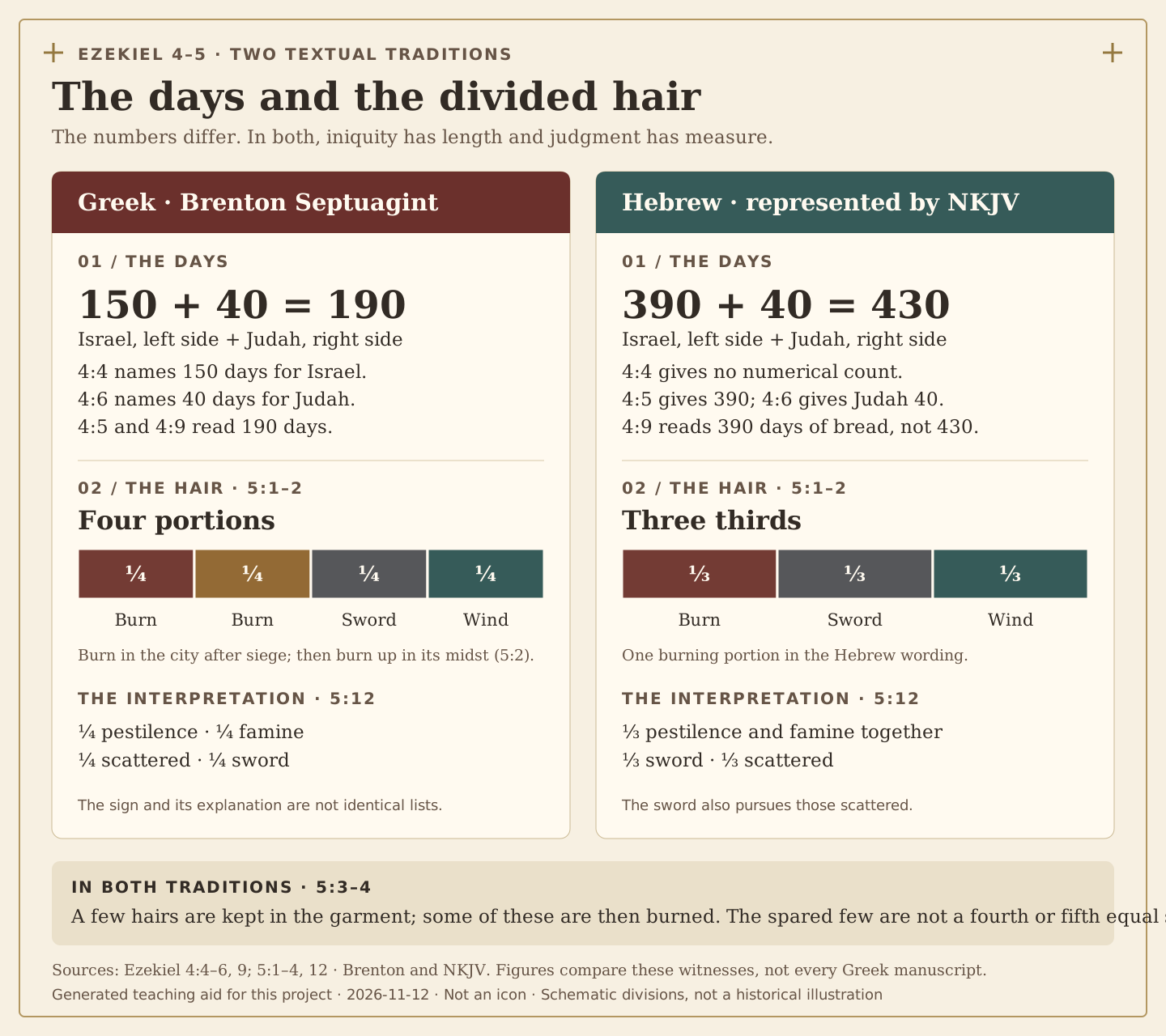
The two textual forms give judgment measure without making the numbers interchangeable. In the Hebrew, 430 is the combined sign-duration, while the bread instruction names 390 days.
The prophet’s body and gestures become a living image of warning. Mouth, side, hands, food, and face are placed at the service of the word. An image of Ezekiel with his scroll recalls that the painful signs do not originate in a taste for catastrophe: he has first received what he must bear.
Spiritual Fruit 🍇
-
Let God make hidden sin visible before it becomes ruin. Ezekiel’s sign-acts are frightening, but they come before the final fall. In prayer, ask what God has already shown clearly that you keep treating as vague.
-
Receive discipline as a gift of return. Measured bread and water show scarcity forced by siege. Fasting, prayer rules, confession, and almsgiving teach the soul to return before sin enslaves it. They are medicines received with grace and guidance, not a bargain that guarantees freedom from illness or hardship. A fast should honor health, capacity, and pastoral counsel.
Teaching Notes
Ezekiel 4:1-8 - The brick, the siege, and the prophet bound to the sign
- Ask: Why does the Lord use a brick and iron pan to portray Jerusalem under siege?
- Emphasize: The sign is mercy before disaster. God makes Jerusalem’s danger visible before the city finally falls.
- Watch for: Turning the numbers into speculation. Keep the focus on embodied warning, covenant accountability, and the weight of iniquity.
- Connect: Ezekiel’s sign-bearing points toward Christ who bears our sins in His body.
- Practice: Name one warning already made plain to you, and take a safe, concrete step of obedience before Sunday.
Ezekiel 4:9-17 - Measured bread, measured water, and the humiliation of impurity
- Ask: What does baking in dung (mitigated to ox dung) reveal about the cost of covenant rebellion?
- Emphasize: Famine is not softened in Scripture. The Lord names the bodily cost of sin so that His people will stop calling rebellion harmless.
- Watch for: Making impurity a joke or a merely ancient taboo. Treat it as a covenant sign of holiness, exile, shame, and the need for cleansing.
- Connect: Christ enters the place of uncleanness without becoming unclean to cleanse us.
- Practice: Keep the Church’s fast according to your health and pastoral guidance; join it to one act of mercy and one restraint from harmful speech.
Glossary
- Sign-act: A prophetic action commanded by God that makes the message visible. Ezekiel’s signs are not performances for attention, but embodied words.
- Siege: Military surrounding of a city to cut off movement, food, water, and help until the city falls.
- Iniquity: Sin considered as guilt, distortion, and burden before God. In Ezekiel 4 it is something the prophet bears in sign form.
- Uncleanness: A covenant category concerning holiness, worship, bodily life, death, and separation. In this passage it also becomes a sign of exile among the nations.
- Septuagint: The ancient Greek translation of the Old Testament, central in Orthodox liturgical and theological reception.
Translation and Source Notes
Embedded Scripture is from Brenton’s English Septuagint (LXX).
The day counts differ from the Hebrew text and are explained before 4:1-8. The iniquity is borne in a commanded prophetic sign; the saving self-offering of the sinless Christ exceeds it.
Sources
Coptic Katameros, Palm Sunday Liturgy, Luke 19:29-48, readings.
Coptic calendar, Fast of Nineveh before Great Lent; published calendar and reading tables.
St John Chrysostom, Homilies on the Statues 3 §§10-12: newadvent.org.
Brenton, Ezekiel 4: ebible.org.
Luke 19:41-44; 1 Peter 2:24; Hebrews 13:12-14; Exodus 12:40.
NKJV, Ezekiel 4, for comparison with the Hebrew-based day counts.
Footnotes
-
Coptic Katameros, Palm Sunday Liturgy, Luke 19:29-48, readings. ↩ ↩2
-
St John Chrysostom, Homilies on the Statues 3 §11, newadvent.org. ↩
-
Coptic calendar, Fast of Nineveh before Great Lent; published calendar and reading tables. ↩