


Ezekiel 37 is one of the great resurrection chapters of Scripture. The Lord brings Ezekiel into a plain full of dry human bones, commands him to prophesy, sends breath into the dead, opens graves, puts His Spirit within His people, and then shows Judah and Joseph becoming one stick in the prophet’s hand. The chapter is not only about political return from exile, and it is not only a private image of life after death. It holds both together: Israel’s national restoration is described in resurrection-shaped language, and the Church hears in it the deeper promise of the resurrection by the Spirit.
The thesis is simple and weighty: the Lord speaks life into the valley of death, opens the graves of despair, gives the Spirit, and reunites His people under one Shepherd. Hope does not come from the bones. Hope comes from the word of God and the breath of God. Restoration is not a self-improvement project; it is a divine act that raises the dead and gathers the scattered into one covenant people.
Geographical Significance ⛰️
The vision happens in a plain
or valley, not in the temple court. Ezekiel is already a prophet among the exiles by the river of Chobar, and here the Spirit sets him in a place that feels like a battlefield after every mourner has gone home. The location is theological more than cartographic. God brings His prophet to the place where human life has been reduced to disconnected remains, and He shows that His word is not helpless outside Jerusalem.
The land still matters. The Lord promises, I will bring you into the land of Israel
and I will place you upon your own land.
This means the chapter cannot be reduced to a generic spiritual metaphor. Exile from the land is part of Israel’s wound. At the same time, the land promise is joined to cleansing from idols, one Shepherd, a covenant of peace, and the sanctuary of God in the midst of the people. The chapter’s geography moves from valley to graves to land to sanctuary. It is the movement from death to embodied worship.
For teaching, keep the map simple: Babylonian exile, the lost land of Israel, the divided memory of Judah and Ephraim, and the promised mountains of Israel. Do not turn this into a modern political proof-text. Ezekiel is speaking first about the Lord’s covenant restoration after judgment, and the Church reads that restoration through Christ, the resurrection, the Spirit, and the one people gathered in Him.
The Characters 👥
The Lord speaks, commands, opens graves, breathes life, gathers His people, makes covenant peace, and places His sanctuary among them. The chapter is a display of divine initiative from beginning to end.
The Spirit, breath, and wind are central. The same field of meaning stands behind wind, breath, and Spirit. Brenton uses
Spiritandbreathin ways that make the theological point clear: Israel does not merely need reassembly; Israel needs life from God.Ezekiel, son of man is commanded to prophesy to bones, breath, and people. He does not create life. He obeys the word. The prophet’s ministry becomes the place where God’s command addresses death itself.
The dry bones are interpreted by the Lord as
the whole house of Israel.They represent despairing Israel in exile, but the image is so deliberately bodily, grave-centered, and Spirit-filled that the Church has always heard resurrection hope in it.Judah, Joseph, and Ephraim represent the divided people of God. Judah stands for the southern kingdom and Davidic promise. Joseph and Ephraim recall the northern kingdom and the wider tribes of Israel. Their union into one stick answers the scandal of divided covenant life.
David, the servant and prince points beyond the historical David, who had long died, toward the promised Davidic King. In Christian reading, this promise finds its fullness in Christ, the Son of David and the Good Shepherd.
The nations watch the Lord sanctify His people. They are not the main actors, but they learn that the Lord sanctifies Israel when His sanctuary stands in their midst.
The word and Spirit in the valley of bones (Ezekiel 37:1-10)
1 And the hand of the Lord came upon me, and the Lord brought me forth by the Spirit, and set me in the midst of the plain, and it was full of human bones. 2 And he led me round about them every way: and, behold, there were very many on the face of the plain, very dry. 3 And he said to me, Son of man, will these bones live? and I said, O Lord God, thou knowest this. 4 And he said to me, Prophesy upon these bones, and thou shalt say to them, Ye dry bones, hear the word of the Lord. 5 Thus saith the Lord to these bones; Behold, I will bring upon you the breath of life: 6 and I will lay sinews upon you, and will bring up flesh upon you, and will spread skin upon you, and will put my Spirit into you, and ye shall live; and ye shall know that I am the Lord. 7 So I prophesied as the Lord commanded me: and it came to pass while I was prophesying, that, behold, there was a shaking, and the bones approached each one to his joint. 8 And I looked, and, behold, sinews and flesh grew upon them, and skin came upon them above: but there was no breath in them. 9 And he said to me, Prophesy to the wind, prophesy, son of man, and say to the wind, Thus saith the Lord; Come from the four winds, and breathe upon these dead men, and let them live. 10 So I prophesied as he commanded me, and the breath entered into them, and they lived, and stood upon their feet, a very great congregation.
The vision begins with the hand of the Lord and the Spirit of the Lord. Ezekiel is not imagining possibilities for national renewal. He is carried by God into a place where ordinary hope has no material to work with. The bones are many, exposed, human, and very dry. This last detail matters. These are not newly dead bodies waiting for urgent medicine. They are remains beyond human recovery.
The Lord’s question, will these bones live?
, is not asked because God lacks knowledge. It draws Ezekiel into the boundary between human sight and divine power. Ezekiel’s answer is the right answer for every servant standing before impossible death: O Lord God, thou knowest this.
He does not deny the death. He does not pretend to possess resurrection power. He places the answer in God’s knowledge and then obeys the command to speak.
The order of the miracle is striking. First the bones hear the word of the Lord. Then bones come together, sinews and flesh grow, and skin covers them. Yet bodies assembled without breath remain dead. The vision refuses both materialism and disembodied spirituality. God does not save Israel as an idea. He raises bodies. But bodies without the breath of God do not live. Restoration requires form and Spirit, peoplehood and divine life, structure and breath.
Gems from the Fathers 💎
St. Cyril of Jerusalem invokes Ezekiel’s valley while teaching the resurrection of the flesh. Decay is no obstacle to the God who first gave the body life. At the beginning of that catechesis he explains why this hope matters for daily conduct: “The root of all good works is the hope of the Resurrection.”1 The body entrusted to us is neither disposable nor our final possession. Hope in its resurrection encourages chastity, mercy, patient care of the sick, and reverence for the departed. Cyril’s Christian reception deepens the vision without displacing the Lord’s own identification of the bones as Israel.
Christological reading begins here with Christ’s own Resurrection, but it also includes the Spirit’s work in the Church. Romans 8 teaches that the Spirit who raised Jesus from the dead gives life to mortal bodies. John 5 says the hour is coming, and now is, when the dead will hear the voice of the Son of God. Ezekiel sees this in prophetic image: dead bones hear, breath comes, and a congregation stands. The Church hears in this the life of baptism, chrismation, repentance, and final resurrection. The Lord’s word reaches what is dead. The Lord’s Spirit makes the raised body live.
The graves opened and the Spirit within (Ezekiel 37:11-14)
11 And the Lord spoke to me, saying, Son of man, these bones are the whole house of Israel: and they say, Our bones are become dry, our hope has perished, we are quite spent. 12 Therefore prophesy and say, Thus saith the Lord; Behold, I will open your tombs, and will bring you up out of your tombs, and will bring you into the land of Israel. 13 And ye shall know that I am the Lord, when I have opened your graves, that I may bring up my people from their graves. 14 And I will put my Spirit within you, and ye shall live, and I will place you upon your own land: and ye shall know that I am the Lord; I have spoken, and will do it, saith the Lord.
The Lord interprets the vision before anyone else can control it. The bones are the whole house of Israel
, and their spoken despair is the key: Our bones are become dry, our hope has perished, we are quite spent.
This is more than sadness. It is covenant exhaustion. The people think their story has ended. Their land is gone, their temple ruined, their monarchy broken, their sins exposed, and their future sealed.
God’s answer is not, Your situation is not so bad.
It is, I will open your tombs.
That is stronger and more honest. The Lord names the people’s condition in grave-language and answers it with grave-opening promise. He will bring them up, bring them into the land, put His Spirit within them, and make them live. The repeated phrase ye shall know that I am the Lord
shows the purpose: resurrection-shaped restoration reveals who God is.
This is the hard-text balance. If we read Ezekiel 37 only as national restoration, we flatten the vision and miss why the Church has treasured it at funerals and Pascha. If we read it only as individual afterlife, we ignore the Lord’s own interpretation about the whole house of Israel and return to the land. The passage holds national restoration and resurrection hope together. Israel’s return from exile becomes an icon of God’s greater victory over death. The same Lord who restores His people from historical ruin will raise the dead.
St. Cyril’s resurrection catechesis helps us hold that balance. He begins from Ezekiel and moves through creation, nature, Scripture, Lazarus, Christ’s Resurrection, and Paul’s teaching in 1 Corinthians 15. His point is not that Ezekiel has no historical meaning. His point is that the God who can open Israel’s graves is not defeated by bodily decay. For Cyril, the resurrection of the flesh belongs to the Church’s confession and shapes moral life now.
The New Testament brings the same hope to fullness. Christ says in John 5 that the dead will hear His voice and come forth. In John 11 He tells Martha, I am the resurrection and the life.
Romans 8 joins life in the Spirit to the future life of mortal bodies. 1 Corinthians 15 teaches that corruption will put on incorruption and mortality will put on immortality. Ezekiel 37 does not give the whole later Christian doctrine in systematic form, but it gives the prophetic image that the Church can never forget: the Lord opens graves and puts His Spirit within His people.
The Church’s Voice in Worship ⛪
The General Funeral prayed after the Palm Sunday liturgy appoints Ezekiel 37:1–14. As the Church enters Holy Pascha, the valley’s promise lets her entrust the departed to the Lord who opens graves. This is not a denial of tears or a claim that grief proves weak faith. The prophecy places death before God’s word, and the Passion and Resurrection reveal the One in whom that hope stands. The Coptic commemoration of Ezekiel on 5 Baramouda also remembers his prophecy of the common resurrection.
Two sticks made one in the prophet’s hand (Ezekiel 37:15-23)
15 And the word of the Lord came to me, saying, 16 Son of man, take for thyself a rod, and write upon it, Juda, and the children of Israel his adherents; and thou shalt take for thyself another rod, and thou shalt inscribe it for Joseph, the rod of Ephraim, and all the children of Israel that belong to him. 17 And thou shalt join them together for thyself, so as that they should bind themselves into one stick; and they shall be in thine hand. 18 And it shall come to pass, when the children of thy people shall say to thee, Wilt thou not tell us what thou meanest by these things? 19 Then shalt thou say to them, Thus saith the Lord; Behold, I will take the tribe of Joseph, which is in the hand of Ephraim, and the tribes of Israel that belong to him, and I will add them to the tribe of Juda, and they shall become one rod in the hand of Juda. 20 And the rods on which thou didst write shall be in thine hand in their presence. 21 And thou shalt say to them, Thus saith the Lord God; Behold, I will take the whole house of Israel out of the midst of the nations, among whom they have gone, and I will gather them from all that are round about them, and I will bring them into the land of Israel. 22 And I will make them a nation in my land, even on the mountains of Israel; and they shall have one prince: and they shall be no more two nations, neither shall they be divided any more at all into two kingdoms: 23 that they may no more defile themselves with their idols; and I will deliver them from all their transgressions whereby they have sinned, and will cleanse them; and they shall be to me a people, and I the Lord will be to them a God.
After the valley of bones, Ezekiel receives a sign-act. He must take one rod for Judah and those joined to Judah, and another for Joseph, Ephraim, and the tribes joined to him. The divided kingdom had been one of Israel’s great wounds. The northern kingdom had fallen to Assyria long before Ezekiel. Judah has now fallen to Babylon. The people of God are not only dead-looking; they are divided, scattered, and defiled.
The Lord commands Ezekiel to join the rods in his hand. This sign is not nostalgia for a political golden age. It is a promise that God Himself will gather, cleanse, and unite. Verse 23 is crucial: unity is not merely administrative. The people must no longer defile themselves with idols. The Lord will deliver them from transgressions and cleanse them. Only then can the covenant formula be spoken again: they shall be to me a people, and I the Lord will be to them a God.
This unit guards us from a shallow idea of unity. The Lord does not say that division is healed by pretending idolatry does not matter. He also does not say that purity is achieved by permanent fragmentation. He gathers and cleanses. The two sticks become one in the prophet’s hand because God’s restoration heals both separation from God and separation within the people of God. The emphasis on two becoming one is essential: the wound of division is as real as the wound of death, and the promise addresses both.
The Christian reading of the reunited people is illuminated by the Good Shepherd’s promise. In John 10, Christ speaks of other sheep who are not of this fold and says they will hear His voice. St. John Chrysostom, commenting on that passage, emphasizes the certainty of Christ gathering those who were scattered and bringing them into one flock. That is not a direct commentary on Ezekiel’s sticks, but it is a strong canonical and patristic anchor for reading the promised unity through Christ the Shepherd.
For Orthodox teaching, this passage should deepen our sense of the Church. The Church is not a voluntary association built by shared preference. She is the people gathered by the Lord, cleansed from idols, and made one under the King. This matters in parish life. Unity cannot be reduced to politeness, ethnic comfort, musical taste, or avoiding hard truth. Ezekiel’s unity is cleansed unity, covenant unity, worshipping unity.
One Shepherd, covenant of peace, and sanctuary forever (Ezekiel 37:24-28)
24 And my servant David shall be a prince in the midst of them: there shall be one shepherd of them all; for they shall walk in mine ordinances, and keep my judgments, and do them. 25 And they shall dwell in their land, which I have given to my servant Jacob, where their fathers dwelt; and they shall dwell upon it: and David my servant shall be their prince for ever. 26 And I will make with them a covenant of peace; it shall be an everlasting covenant with them; and I will establish my sanctuary in the midst of them for ever. 27 And my tabernacle shall be among them; and I will be to them a God, and they shall be my people. 28 And the nations shall know that I am the Lord that sanctifies them, when my sanctuary is in the midst of them for ever.
The chapter ends with David, one Shepherd, covenant peace, and the sanctuary of God. Since David had died centuries before Ezekiel, my servant David
points to the promised Davidic ruler, not to a simple return of the old monarchy. The Lord is promising a King who gathers, shepherds, orders obedience, and establishes peace.
Notice how full the promise is. The people are not merely returned to land. They walk in God’s ordinances. They live under one Shepherd. They receive an everlasting covenant of peace. God’s sanctuary and tabernacle are in their midst forever. The nations learn that the Lord sanctifies His people. Restoration is therefore resurrection-shaped, covenant-shaped, and worship-shaped. The goal is not survival alone. The goal is holy communion with God.
This is where Ezekiel 34 and 37 meet. In chapter 34, the Lord condemned shepherds who fed themselves and promised to shepherd His flock. In chapter 37, the one Shepherd stands in the midst of a reunited people. Christ fulfills this without becoming a mere political symbol. He is the Son of David, the Good Shepherd who lays down His life for the sheep, the risen Lord who gathers His flock by His voice, and the King whose peace is not built on denial of sin but on His Cross and Resurrection.
The sanctuary promise also matters. Ezekiel’s book began with glory appearing outside Jerusalem and moved through glory departing the defiled temple. Here the Lord promises His sanctuary in the midst of His people forever. Later chapters will expand this into the visionary temple and the returning glory. Christian reading sees the fulfillment in Christ, the Church as His Body, the indwelling Spirit, and the worshipping life of the people of God. But again, this must be disciplined. We do not erase Israel’s hope. We read it to its fullness in the Messiah.
The final verse says that the nations will know the Lord when His sanctuary is among His people. Holiness becomes witness. A raised, cleansed, united, shepherded people is a revelation to the world. The Church’s unity and holiness are therefore not private virtues only. They proclaim whether we believe the Lord has truly opened graves, given the Spirit, and placed His dwelling among us.
Iconography Connection 🖼️
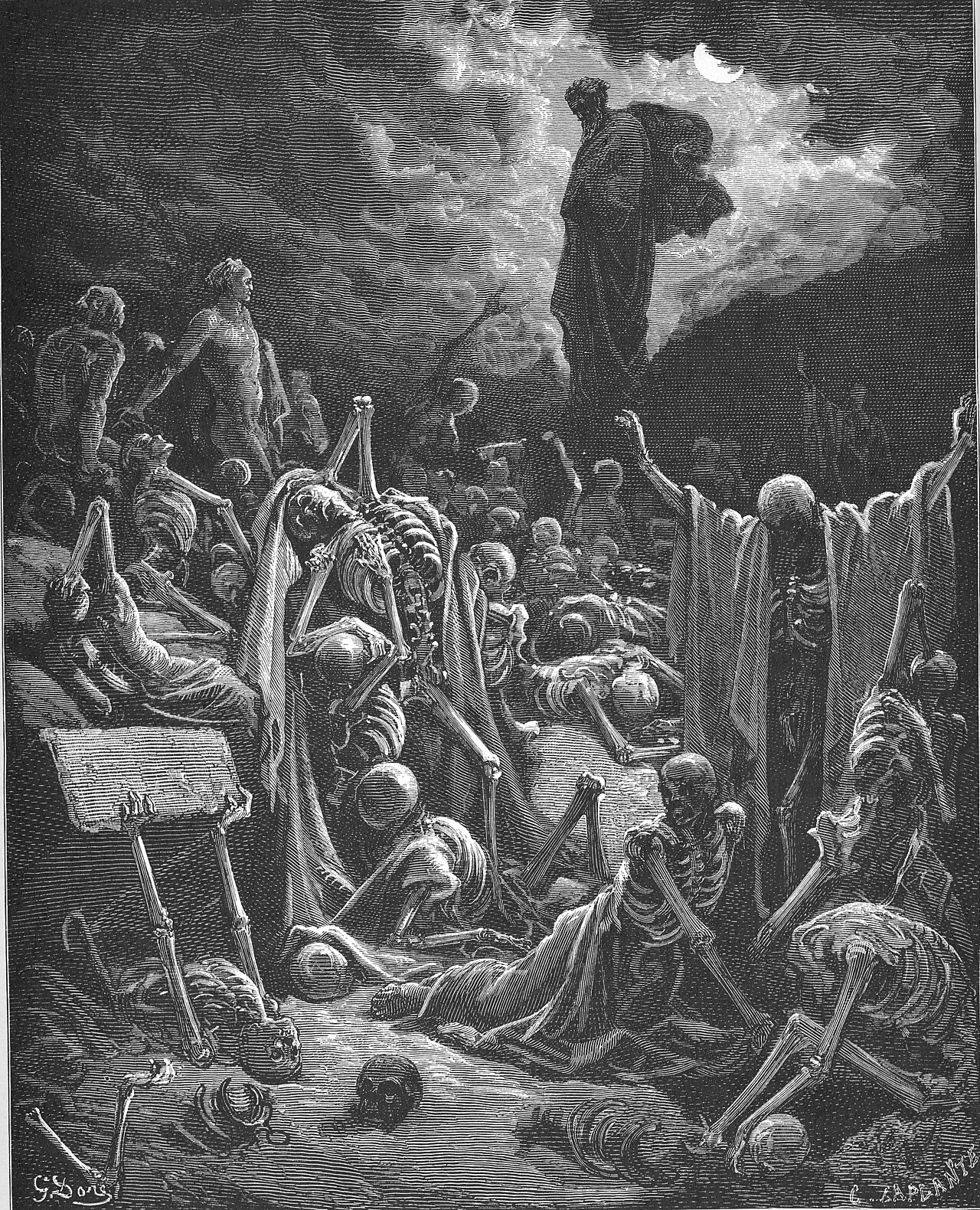 Source: Gustave Dore, Ezekiels Vision of the Valley of Dry Bones, public domain, Wikimedia Commons, https://commons.wikimedia.org/wiki/File:127.Ezekiel’s_Vision_of_the_Valley_of_Dry_Bones.jpg
Dore’s illustration is dramatic, but the guide should keep the theological center clear: the word of God and the breath of God give life where hope has perished. The image serves resurrection hope, not spectacle.
The safest iconographic starting point is the icon of the Prophet Ezekiel. He is not a fantasy figure or an end-times mascot. He is the priest-prophet who sees the glory of God in exile, speaks judgment, and receives visions of restoration. The Orthodox Church in America page on the Prophet Ezekiel is useful as a reception source, especially because it connects Ezekiel’s visions, including the dry bones, to resurrection hope and Orthodox iconographic memory.
The dry bones vision can also be taught beside the icon of the Resurrection, the Anastasis. In that icon, Christ stands over broken gates and raises Adam and Eve from the tombs. Ezekiel 37 is not the same image, but the spiritual line is clear: the Lord opens graves and brings His people up. This pairing helps students see that Christian resurrection is not a vague survival of the soul. Christ raises embodied humanity.
For the two sticks and one Shepherd, use images carefully. A Good Shepherd image may help, but it should not become sentimental. Pair the shepherd theme with Christ’s Cross or with an icon that shows His authority and self-giving love. The one Shepherd gathers by laying down His life, not by domination. Avoid political symbols, nationalist maps, or triumphalist imagery. Ezekiel’s sign is about the Lord gathering and cleansing His covenant people.
Spiritual Fruit 🍇
-
Bring despair to God without dressing it up. Israel says,
Our hope has perished.
The Lord does not crush them for saying it. He answers with resurrection promise. In prayer, tell the truth about dry bones, spiritual exhaustion, grief, and failure. Then let God’s word answer more deeply than your despair speaks. -
Listen for the word before looking for strength. The bones live because they hear the word of the Lord and receive breath from God. When the soul feels dead, begin with obedience to the word you have been given: repent, pray, confess, forgive, return to the sacraments, keep the commandment in front of you.
-
Do not confuse reassembly with life. Ezekiel sees bodies formed before breath enters them. A parish, family, or person can look organized and still need the Spirit. Ask not only,
Are things in place?
Ask,Is the breath of God here? Is there repentance, prayer, mercy, and love?
-
Seek unity that includes cleansing. The two sticks become one, but the Lord also delivers His people from idols and transgressions. Real unity is not pretending sin does not matter. It is the Lord gathering people into truth, repentance, forgiveness, and shared worship.
-
Let resurrection hope shape bodily holiness. Cyril of Jerusalem teaches that hope in the resurrection strengthens good works. Your body is not disposable. It is called to be raised. Use the body for prayer, fasting, prostration, chastity, mercy, work, and receiving the Eucharist with reverence.
The bones have no strength to offer, yet the Lord addresses them. Bring Him the deadened hope and the division you cannot heal alone. Christ, our risen Shepherd, gather us without falsehood, breathe life into our obedience, and keep our bodies and souls in the hope of Your resurrection.
Teaching Notes
Ezekiel 37:1-10 - The word and Spirit in the valley of bones
- Ask: Where do we see dry bones in our own spiritual life or parish?
- Emphasize: The vision is bodily and spiritual at the same time. God restores real people by His Spirit. The bones hear the word before they live.
- Watch for: Turning the passage into motivational language about human potential. The point is divine resurrection power.
- Connect: The order (word, form, then breath) protects against both despair and presumption.
Ezekiel 37:11-14 - The graves opened and the Spirit within
- Ask: What does it mean that God answers despair with “I will open your tombs” rather than minimizing the grave?
- Emphasize: Exile despair, national restoration, and resurrection hope must be taught together. The Lord’s interpretation controls the image.
- Watch for: Shaming people for grief. The Lord hears the people’s despair and answers it with promise.
- Connect: This is read at the General Funeral after Palm Sunday, placing death before the word that opens graves.
Ezekiel 37:15-23 - Two sticks made one in the prophet’s hand
- Ask: What idols prevent unity in the Church today?
- Emphasize: The two sticks answer the wound of divided covenant life and point toward one people in Christ. Unity requires cleansing from idols and transgressions.
- Watch for: Using this sign as a modern political slogan or as a way to ignore idolatry and repentance.
- Connect: The Lord gathers and cleanses; unity without cleansing is not Ezekiel’s promise.
Ezekiel 37:24-28 - One Shepherd, covenant of peace, and sanctuary forever
- Ask: How does resurrection hope lead to one Shepherd and sanctuary in our midst?
- Emphasize: The chapter ends not with bones, but with sanctuary. Life is restored for communion with God under one Shepherd.
- Watch for: Separating Christ the Good Shepherd from His Cross, His Resurrection, and the holiness of His people.
- Connect: This prepares for the temple vision and returning glory in chapters 40-48.
Glossary
- Dry bones: The Lord’s image for the whole house of Israel in despair, and a prophetic image the Church reads toward resurrection.
- Spirit, breath, wind: A shared biblical field of meaning. In this chapter, life comes when breath or Spirit from God enters the dead.
- Whole house of Israel: The covenant people viewed as a whole, including the divided and scattered tribes.
- Judah: The southern kingdom, tied to Jerusalem and the Davidic promise.
- Joseph / Ephraim: Names associated with the northern kingdom and tribes separated from Judah after the division of the monarchy.
- One stick / one rod: Ezekiel’s sign-act showing the Lord making the divided people one in His hand.
- My servant David: The promised Davidic ruler. Christian reading sees the fullness of this promise in Christ, the Son of David.
- Covenant of peace: God’s restored covenant communion, not merely absence of conflict.
- Sanctuary / tabernacle: God’s dwelling among His people. In Ezekiel, this prepares for the final temple vision and the return of glory.
- Anastasis: The icon and feast-theme of Christ’s Resurrection, often showing Him raising Adam and Eve from the realm of death.
Translation and Source Notes
Embedded Scripture is from Brenton’s English Septuagint (LXX).
The chapter was quoted in four natural blocks: Ezekiel 37:1-10, 37:11-14, 37:15-23, and 37:24-28. No special Brenton numbering issue was noted for this chapter.
The language of breath, wind, and Spirit is central to the chapter. Brenton’s wording lets the reader hear both bodily life and divine Spirit. This guide treats the valley literally as a vision about the whole house of Israel in exile and theologically as resurrection-shaped hope fulfilled in Christ.
New Testament anchors are cited by reference rather than long quotation: John 5:25-29; Romans 8:9-11; 1 Corinthians 15:51-54; John 10:14-16; John 11:25-26. Patristic support is paraphrased by default. The one direct Cyril quotation in the exposition is short and source-verified.
Sources
Primary Scripture
- Brenton, The Septuagint Version of the Old Testament, Ezekiel 37, public domain.
- New Testament anchors: John 5:25-29; Romans 8:9-11; 1 Corinthians 15:51-54; John 10:14-16; John 11:25-26.
Patristic and liturgical sources
- Cyril of Jerusalem, Catechetical Lectures, Lecture 18, on Ezekiel 37 and the resurrection of the flesh. CCEL: https://www.ccel.org/ccel/schaff/npnf207.ii.xxii.html
- Cyril of Jerusalem, Catechetical Lectures, Lecture 18.1, for the moral force of resurrection hope. CCEL deep link: https://www.ccel.org/ccel/schaff/npnf207.ii.xxii.html#ii.xxii-p5
- Cyril of Jerusalem, Catechetical Lectures, Lecture 18.18-19, for the transformed resurrection body and 1 Corinthians 15. CCEL deep link: https://www.ccel.org/ccel/schaff/npnf207.ii.xxii.html#ii.xxii-p79
- John Chrysostom, Homilies on John, on John 10:14-16, for Christ the Good Shepherd gathering one flock. CCEL: https://www.ccel.org/ccel/schaff/npnf114.iv.lxii.html
- Coptic Orthodox lectionary references, special-service reading tables: Ezekiel 37:1-14 as the prophecy reading for the General Funeral prayed after Palm Sunday liturgy before Holy Pascha.
- Rites and Readings of Palm Sunday, Procession and General Funeral, St. Bishoy source PDF: https://saintbishoy.ca/wp-content/uploads/Rites_Palm_Sunday_And_General_Funeral_Readings_Procession.pdf
- Orthodox Church in America,
Prophet Ezekiel, for Orthodox reception and iconography starting point: https://www.oca.org/saints/lives/2000/07/21/102064-prophet-ezekielSecondary academic and reference works for further reading
Daniel I. Block, The Book of Ezekiel, Chapters 25-48, New International Commentary on the Old Testament.
Walther Zimmerli, Ezekiel 2: A Commentary on the Book of the Prophet Ezekiel, Chapters 25-48, Hermeneia.
Iain M. Duguid, Ezekiel, NIV Application Commentary.
Footnotes
-
Cyril of Jerusalem, Catechetical Lectures 18.1, trans. Charles Gordon Browne and James Edward Swallow, NPNF2 7, CCEL, https://www.ccel.org/ccel/schaff/npnf207.ii.xxii.html#ii.xxii-p5 ↩