


Ezekiel begins with the heavens opening in exile. The prophet is not in Jerusalem, not serving before the visible temple, and not surrounded by the ordinary signs of priestly stability. He is among the captives by the river of Chobar, and there the hand of the Lord comes upon him. The first lesson of the book is therefore severe and merciful at once: judgment has truly fallen, but God has not been defeated, confined, or made absent.
The vision of the living creatures, wheels, fire, crystal firmament, sapphire throne, rainbow, and human likeness is not given so that readers can solve a puzzle. It is given so that Israel, and the Church after Israel, may fall silent before the glory of God. The Lord sees all, moves where He wills, speaks from above the heavenly powers, and reveals Himself through likeness and appearance without exposing His divine essence. Read in Christ, the human likeness above the throne points the heart toward the Incarnation, where the invisible God is made known in the flesh.
Historical and Scriptural Context
Ezekiel is a priest and the son of Buzi. The opening date places him among the deported Judeans in Babylon, after the captivity connected with King Jehoiachin or Jeconiah. Brenton’s text says the fifth year of the captivity of king Joakim, preserving the Septuagint wording used in the Scripture blocks below. The “thirtieth year” has received several interpretations, and the text does not explicitly identify its starting point. If it marks Ezekiel’s age, the vision comes at the time when a priest might expect mature temple service. Instead, his priesthood is transformed into prophetic witness far from Jerusalem.
This chapter begins the first movement of the book, Ezekiel 1-3. The throne appears before the commission, because the prophet must speak from revelation, not from personality or private anger. Chapters 2-3 will send him to a rebellious house and command him to eat the scroll. Chapters 8-11 will later show why the temple can be judged, and chapters 43-44 will show the glory returning. Ezekiel 1 is the root of that whole glory-spine: the Lord is already present with His exiled people before the city fully falls.
Canonically, Ezekiel 1 stands near other great theophanies: Sinai with cloud and fire, Isaiah seeing the Lord high and lifted up, Daniel seeing the Ancient of Days, and Revelation 4 echoing throne, living creatures, and worship. Revelation 4 is used here as canonical resonance, not as the patristic source base. The Christian center of the reading is not curiosity about heavenly mechanics, but the confession that the glory of God is revealed truly and personally in the Son.
Geographical Significance ⛰️
The river of Chobar, often called Chebar or Kebar in English references, belongs to the land of the Chaldeans. It is commonly identified with a Babylonian canal system near Nippur, not with the Habor river of northern Mesopotamia. This matters because Ezekiel’s first vision is given in the infrastructure of exile: canals, settlements, imperial power, and displaced families trying to live after catastrophe.
The place teaches theology. Israel may be away from Zion, but the Lord is not away from His people. Holy geography is real, but it cannot imprison God or protect unrepentance. Jerusalem can be judged, Babylon can be humbled, and Chobar can become the place where heaven opens. For a class, the geography should not become an archaeological lecture. It should lead to one spiritual question: where have I assumed God cannot meet me?
A useful location source for the teacher is the BiblicalTraining entry on Kebar, which summarizes the canal identification and the Nippur connection. The OCA Prophet Ezekiel page also places the prophet in captivity by the River Chebar and gives the broader Orthodox reception of his vision.
The Characters 👥
- The Lord of glory: He is not described directly in His essence. Ezekiel sees likeness, appearance, brightness, fire, throne, rainbow, and a human likeness. The vision protects reverence even while revealing God truly.
- Ezekiel: A priest in exile, called to become a prophet. What he loses in temple service becomes the setting for a deeper obedience to the word of the Lord.
- The captives: The exiled community by Chobar. They are under judgment, but the vision shows that judgment has not canceled God’s covenant concern.
- The four living creatures: Heavenly beings later identified in Ezekiel 10 with cherubim. Their four faces and straight movement signify living, intelligent, obedient service before the throne.
- The wheels full of eyes: The moving throne’s earthward sign. They show that God’s glory is not stuck in one place and that His sight reaches where His movement goes.
- The human likeness above the throne: The vision’s highest visible form. Orthodox reception reads this as a sign pointing toward the Incarnation, in which the Son of God truly becomes man without ceasing to be God.
Heaven opens in exile (Ezekiel 1:1-3)
1 Now it came to pass in the thirtieth year, in the fourth month, on the fifth day of the month, that I was in the midst of the captivity by the river of Chobar; and the heavens were opened, and I saw visions of God. 2 On the fifth day of the month; this was the fifth year of the captivity of king Joakim. 3 And the word of the Lord came to Jezekiel the priest, the son of Buzi, in the land of the Chaldeans, by the river of Chobar; and the hand of the Lord was upon me.
The opening repeats the date and location because both matter. Ezekiel is not dreaming in private detachment. He is in captivity. He is by Chobar. He is in the land of the Chaldeans. Scripture names the humiliation before it names the vision, because the vision is God’s answer to humiliation.
The heavens are opened, the word of the Lord comes, and the hand of the Lord is upon him. These three phrases prepare the whole prophetic calling. Ezekiel will not speak from resentment, patriotism, nostalgia, or personal grief alone. He will speak because the Lord has opened heaven, given His word, and laid His hand on the prophet.
The opening of the book gives this pastoral assurance: the Lord follows His wounded people with prophetic witness, even when exile is the fruit of sin. The opening of Ezekiel is therefore not comfort without repentance. It is mercy pursuing people in the place where repentance must become truthful.
In Christ, this movement reaches its fullness. The Word does not merely send a prophet into exile. The Word Himself enters our exile, takes flesh, bears our griefs, and speaks life where death has claimed authority. Ezekiel’s opened heavens prepare the Christian heart to receive the Gospel’s greater opening: the Son reveals the Father.
Wind, fire, and the four living creatures (Ezekiel 1:4-13)
4 And I looked, and, behold, a sweeping wind came from the north, and a great cloud on it, and there was brightness round about it, and gleaming fire, and in the midst of it as it were the appearance of amber in the midst of the fire, and brightness in it. 5 And in the midst as it were the likeness of four living creatures. And this was their appearance; the likeness of a man was upon them. 6 And each one had four faces, and each one had four wings. 7 And their legs were straight; and their feet were winged, and there were sparks, like gleaming brass, and their wings were light. 8 And the hand of a man was under their wings on their four sides. 9 And the faces of them four turned not when they went; they went every one straight forward. 10 And the likeness of their faces was the face of a man, and the face of a lion on the right to the four; and the face of a calf on the left to the four; and the face of an eagle to the four. 11 And the four had their wings spread out above; each one had two joined to one another, and two covered their bodies. 12 And each one went straight forward: wherever the spirit was going they went, and turned not back. 13 And in the midst of the living creatures there was an appearance as of burning coals of fire, as an appearance of lamps turning among the living creatures; and the brightness of fire, and out of the fire came forth lightning.
The vision comes from the north with wind, cloud, brightness, and fire. In Ezekiel, the north will also be the direction from which judgment comes. But here judgment is not impersonal disaster. It is caught up in the revelation of the Lord’s glory. The same God who judges also speaks, purifies, and restores.
Ezekiel keeps saying “likeness” and “appearance.” That language is not uncertainty in the weak sense. It is reverent accuracy. The prophet reports what God permits him to see without pretending that created language can contain the uncreated God. St John Chrysostom makes this point when discussing John 1:18: Isaiah, Ezekiel, Daniel, Moses, and others truly received visions, but these were divine condescensions and similitudes, not the naked vision of God’s essence. The Church therefore reads Ezekiel with awe and restraint.
The living creatures move straight forward wherever the spirit goes. They are full of motion, but not restless. They have many faces, but no divided will. They do not turn aside from obedience. This is one of the most practical images in the chapter. The soul ruled by passions darts from desire to fear to anger to distraction. The creature before the throne moves straight because it moves by the spirit.
The four faces also become a major iconographic doorway. Irenaeus is an early witness that the four living creatures are connected to the fourfold Gospel and the one Christ proclaimed under four aspects. His exact assignments of the creatures differ from the later common iconographic pattern, but his witness is important: the Church did not receive the creatures as mere heavenly curiosities. It received them as signs that the Gospel is one, living, and Spirit-breathed.
Wheels, eyes, and the spirit of life (Ezekiel 1:15-21)
15 And I looked, and, behold, the four had each one wheel on the ground near the living creatures. 16 And the appearance of the wheels was as the appearance of beryl: and the four had one likeness: and their work was as it were a wheel in a wheel. 17 They went on their four sides: they turned not as they went; 18 neither did their backs turn: and they were high: and I beheld them, and the backs of them four were full of eyes round about. 19 And when the living creatures went, the wheels went by them: and when the living creatures lifted themselves off the earth, the wheels were lifted off. 20 Wherever the cloud happened to be, there was the spirit ready to go: the wheels went and were lifted up with them; because the spirit of life was in the wheels. 21 When those went, the wheels went; and when those stood, the wheels stood; and when those lifted themselves off the earth, they were lifted off with them: for the spirit of life was in the wheels.
The wheels are on the ground, near the living creatures. The vision joins heaven and earth without confusing them. Above, the creatures serve before the throne. Below, the wheels move on the earth. The glory of God is not trapped in heaven as an idea, and it is not trapped in Jerusalem as a local possession. It moves with sovereign freedom.
The wheels are full of eyes. This is not a grotesque detail for shock. It is the language of total perception. God sees the exile, the temple, the hidden idols, the city, the nations, and the grief of His prophet. Nothing is outside His sight. This is comfort to the repentant and terror to the unrepentant.
The phrase “spirit of life” is especially rich. The wheels move because the spirit of life is in them. Ezekiel will later speak to dry bones and see breath enter the slain. The same book that begins with the spirit of life in the wheels will later proclaim that bones can live when the Lord speaks and breathes. The first vision already hints that restoration will not come from human strength. Life belongs to the Spirit of God.
For the Christian reader, the moving throne also guards against a false idea of worship. Holy places matter, but the living God is not a household idol carried by human control. He is the Lord who comes, goes, judges, fills, departs, returns, and sends His Spirit. The Church does not possess Him by ritual correctness while the heart remains hard. The Church is possessed by Him when she repents, worships, and follows.
The throne, the human likeness, and the rainbow (Ezekiel 1:22-28)
22 And the likeness over the heads of the living creatures was as a firmament, as the appearance of crystal, spread out over their wings above. 23 And their wings were spread out under the firmament, reaching one to the other; two wings to each, covering their bodies. 24 And I heard the sound of their wings when they went, as the sound of much water: and when they stood, their wings were let down. 25 And lo! a voice from above the firmament 26 that was over their head, there was as the appearance of a sapphire stone, and the likeness of a throne upon it: and upon the likeness of the throne was the likeness as an appearance of a man above. 27 And I saw as it were the resemblance of amber from the appearance of the loins and upwards, and from the appearance of the loins and under I saw an appearance of fire, and the brightness thereof round about. 28 As the appearance of the bow when it is in the cloud in days of rain, so was the form of the brightness round about.
The vision ascends. Over the living creatures is a crystal-like firmament. Above the firmament is a sapphire throne. Above the throne is the likeness as an appearance of a man. Around the brightness is the appearance of the bow in the cloud after rain. The movement of the passage is from storm to throne, from fire to voice, from mystery to mercy.
The voice comes from above the firmament. The living creatures are glorious, but they are not the final object of attention. The wheels are wonderful, but they are not the center. The throne is central, and the voice from above the throne rules the scene. This ordering protects the teacher from making the class fascinated by secondary details while losing the Lord who speaks.
The human likeness is the chapter’s strongest Christological opening. Orthodox reception sees here a sign toward the Incarnation. The invisible God is not reduced to human form in Ezekiel, but the vision prepares the faithful to understand that God will make Himself known in a human life. John 1:18 gives the Christian boundary and fulfillment: no one has seen God at any time; the Only-begotten Son declares Him. The Son reveals the Father without making the divine essence a created object.
The rainbow recalls mercy after judgment. Genesis gives the bow after the flood as the sign that judgment will not be the final word. Ezekiel sees the bow around the glory before much of the book’s judgment is announced. The vision therefore holds holiness and mercy together from the beginning. God will expose sin. God will judge the city. But His glory is circled by covenant mercy.
The Church’s Voice in Worship ⛪
The chapter belongs naturally to the worshipping mind of the Church. Every Divine Liturgy stands before the throne with angels, archangels, cherubim, seraphim, and all heavenly powers. Ezekiel’s vision helps the class understand that earthly worship is not a closed human ceremony. It is participation, by grace, in the praise of heaven.
The broader Orthodox calendar also remembers the Prophet Ezekiel. The Orthodox Church in America commemorates him on July 21 and preserves a short life that summarizes the Chobar vision, the living creatures, the throne, the human likeness, and the later visions of temple and dry bones. That page is used here as Orthodox reception, not as a substitute for direct patristic commentary.
For prayer, the safest liturgical application is reverence. Ezekiel falls before glory. The Church does not approach God casually. Yet she also approaches with confidence, because the One above the throne has come near in Christ and has opened heaven to His Body.
Iconography Connection 🖼️
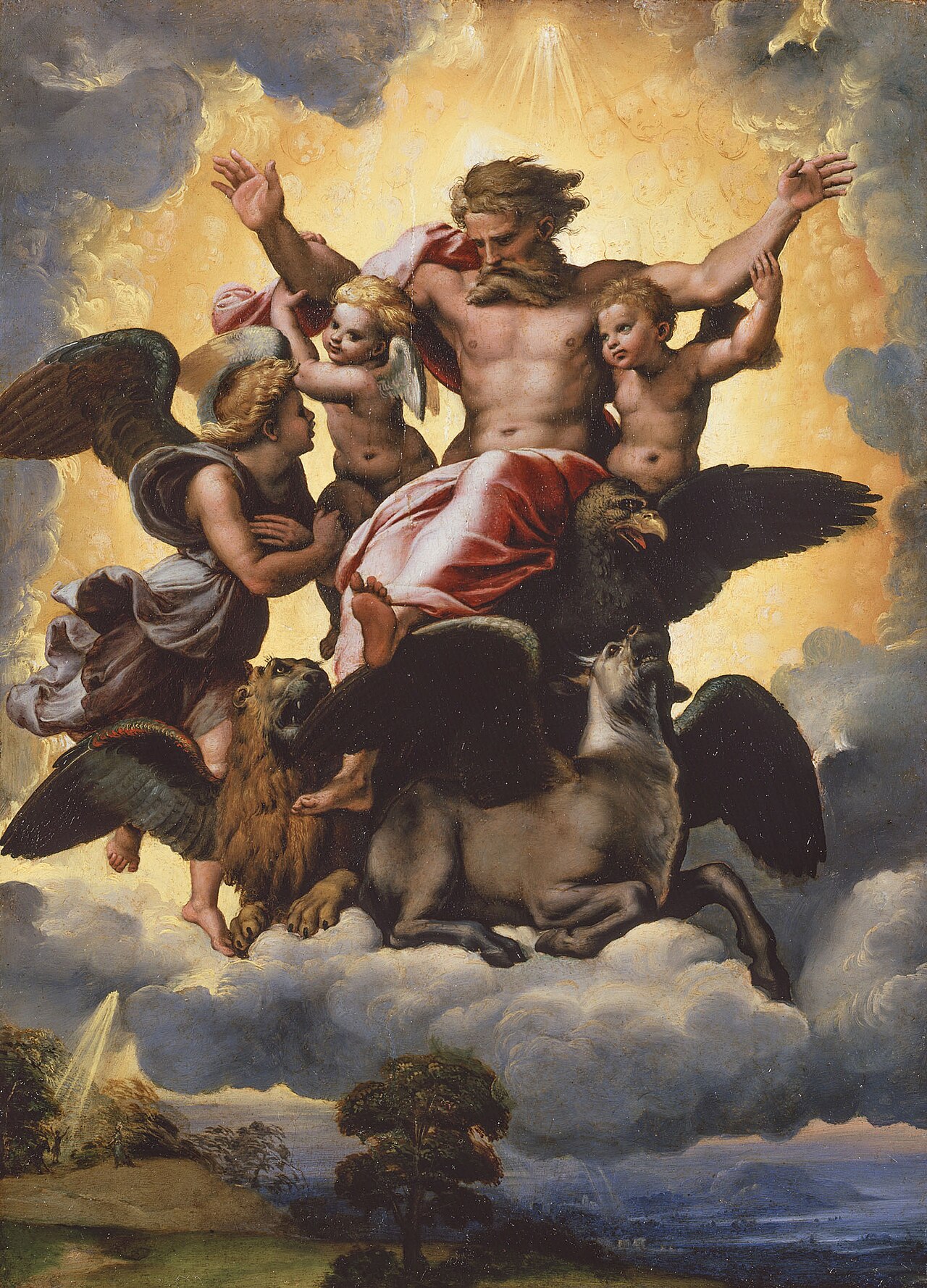 Source: Raphael, Ezekiels Vision, public domain, Wikimedia Commons, https://commons.wikimedia.org/wiki/File:Raphael_-_Ezekiel’s_Vision.jpg
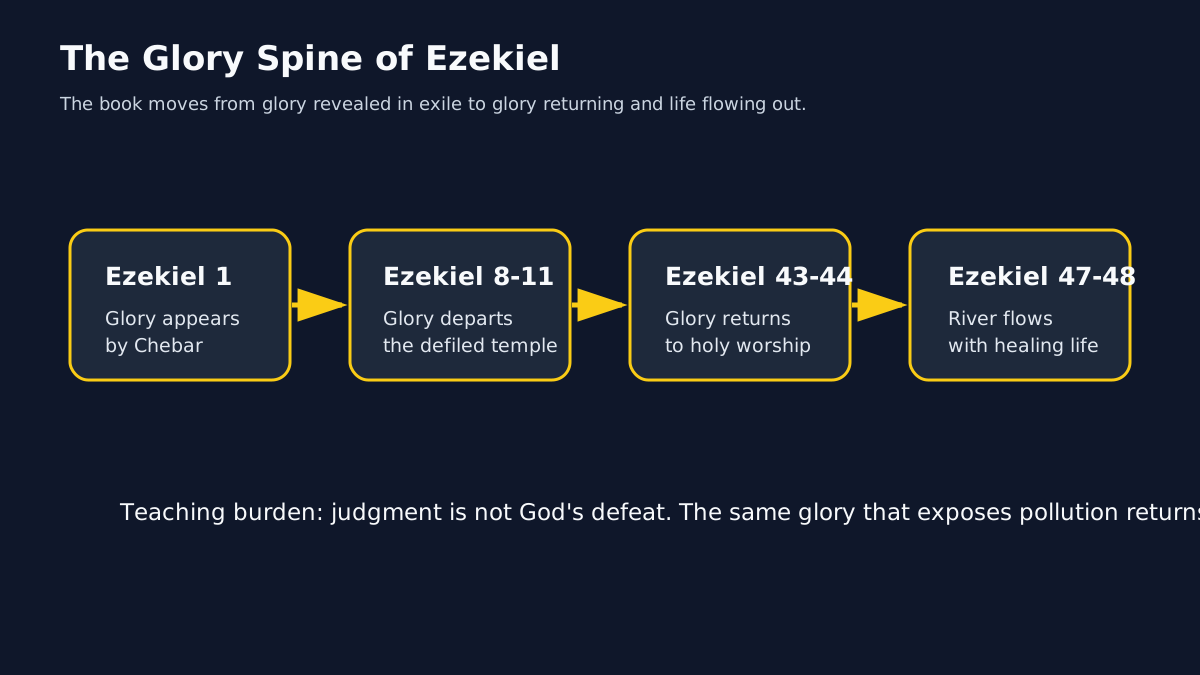 Source: Hermes schematic, 2026-06-19.
Raphael’s painting is useful as a famous Western reception image, but it should not be treated as an Orthodox icon. For Orthodox reception, use the Prophet Ezekiel source linked in the Resources note and keep the class before the biblical vision itself: opened heavens, living creatures, wheels full of eyes, throne, rainbow, and the human likeness above the throne. The image should deepen awe, not turn the vision into a puzzle to solve.
Ezekiel 1 is one of the great biblical roots of the tetramorph, the four living creatures received in Christian art as symbols of the four Evangelists. In common Orthodox iconography, the man signifies Matthew, the lion signifies Mark, the ox or calf signifies Luke, and the eagle signifies John. These symbols often appear around Christ enthroned, in Gospel books, domes, icon corners, and manuscript decoration.
The Orthodox reception recorded on the OCA Prophet Ezekiel page follows that common iconographic pattern. It also reads the human likeness on the sapphire throne as pointing to the Incarnation of the Son of God, and speaks of the Theotokos as the living throne because from her the Word took flesh. This is a visual and ecclesial reception of Ezekiel, not a license to claim that every iconographic detail is a verse-by-verse patristic proof.
Irenaeus gives an early patristic anchor for connecting the living creatures with the fourfold Gospel. In Against Heresies, he argues that the Gospel is fittingly fourfold, like the four living creatures, and that the one Christ is proclaimed under these aspects. His assignments of the creatures are not identical to the later common iconographic pattern, so the teacher should not smooth over the difference. The deeper agreement is more important: the living creatures are received as a Gospel sign centered on Christ.
For a slide or handout, the OCA icon image of the Prophet Ezekiel is a useful Orthodox visual source: https://images.oca.org/icons/lg/july/0721prophetezekiel.jpg. When using tetramorph images, choose icons that place the Evangelist symbols around Christ or the Gospel, not fantasy art that isolates the creatures from worship.
Spiritual Fruit 🍇
-
Pray from the place of exile. Do not wait until life feels normal before turning to God. Ezekiel sees the heavens opened by Chobar. Begin prayer from the actual place: grief, displacement, failure, confusion, or repentance.
-
Let mystery produce reverence, not speculation. The living creatures and wheels are meant to bring the soul before glory. When Scripture is difficult, ask first, “How does this teach me to worship?” before asking, “Can I explain every detail?”
-
Move straight where the Spirit leads. The creatures do not turn back. A concrete practice for this week is to choose one obedience you already know, confession, reconciliation, guarded speech, prayer before sleep, or fasting with humility, and do it without bargaining.
-
Remember that God sees completely. The wheels full of eyes are comfort and warning. Bring hidden sin to confession and hidden grief to prayer. Nothing is invisible to the Lord, but His sight is not cruel. It is the sight that heals truthfully.
-
Hold judgment and mercy together. The chapter begins a book of hard judgment, yet the glory is surrounded by the bow of covenant mercy. Do not call sin harmless, and do not call repentance hopeless. The enthroned Lord is holy and merciful.
Teaching Notes
Ezekiel 1:1-3 - Heaven opens in exile
- Ask: What does it mean that the heavens open in captivity rather than in the temple?
- Emphasize: Exile is real judgment, but it is not divine absence. The Lord follows His people with His word.
- Watch for: Treating the vision as spectacle before feeling the mercy of heaven opening in humiliation.
- Connect: This prepares the heart for the Incarnation, where the Son enters our exile.
Ezekiel 1:4-13 - Wind, fire, and the four living creatures
- Ask: Why does the vision emphasize “likeness” and “appearance” rather than direct description?
- Emphasize: Reverence and obedience before the throne. The creatures move straight because they move by the spirit.
- Watch for: Turning the four faces into a puzzle instead of a sign of Gospel fullness.
- Connect: Irenaeus connects them to the fourfold Gospel; the Church receives them as signs of the one Christ.
Ezekiel 1:15-21 - Wheels, eyes, and the spirit of life
- Ask: What does the spirit of life in the wheels teach about where life comes from?
- Emphasize: God sees and moves freely. Exile cannot block His presence, and temple privilege cannot control Him.
- Watch for: Mechanical speculation about the wheels instead of their theological force of movement, sight, and life.
- Connect: The same book that begins with the spirit of life will later raise dry bones.
Ezekiel 1:22-28 - The throne, the human likeness, and the rainbow
- Ask: Why does the vision rise from storm to throne to rainbow?
- Emphasize: The whole vision rises toward the enthroned Lord and toward mercy in judgment.
- Watch for: Flattening the human likeness into a simple visual prediction.
- Connect: The bow recalls Genesis mercy after judgment; the human likeness points toward the Incarnation.
Glossary
- Chobar / Chebar / Kebar: The river or canal in Babylonia where Ezekiel saw the vision. It is often connected with a canal system near Nippur.
- Chaldeans: A biblical term associated here with Babylonia, the land of exile.
- Theophany: A manifestation of God. In Ezekiel 1, the vision is true revelation through likeness and appearance, not an unveiled sight of God’s essence.
- Cherubim: Heavenly beings associated with God’s throne and glory. Ezekiel 10 identifies the living creatures with cherubim.
- Tetramorph: The fourfold living-creature symbolism received in Christian art as signs of the four Evangelists.
- Firmament: The expanse over the living creatures, described here like crystal, under the throne vision.
- Beryl: A precious stone used in Brenton’s translation to describe the wheels’ appearance.
- Condescension: God’s merciful self-adaptation to created weakness, revealing Himself truly in ways creatures can bear.
- Brenton Septuagint: A public-domain English translation of the Septuagint used for embedded Old Testament Scripture in this guide.
Translation and Source Notes
Embedded Scripture is from Brenton’s English Septuagint (LXX).
Embedded Old Testament Scripture in this guide uses Brenton’s English Septuagint, public domain. The Scripture blocks preserve Brenton’s spellings such as Chobar, Jezekiel, and Joakim. The commentary uses the more familiar English forms Chebar, Ezekiel, and Jehoiachin or Jeconiah where needed for clarity.
The local Brenton extraction omits Ezekiel 1:14. This guide quotes Ezekiel 1:1-13 and Ezekiel 1:15-28 in separate units and does not invent verse 14 text.
Patristic support used here is limited and source-specific. John Chrysostom is used for the teaching that prophetic visions are divine condescensions rather than an unveiled sight of the divine essence. Irenaeus is used as an early witness to the connection between the four living creatures and the fourfold Gospel.
Revelation 4 is treated as canonical resonance only. It is not the patristic source base for this guide. The fulfillment language is therefore framed through throne and glory, the human likeness as a sign toward the Incarnation, Christ enthroned, and the Church’s received iconography of the four Evangelists.
Sources
Primary Scripture
- Ezekiel 1, Brenton Septuagint, public domain.
- Genesis 9:8-17, for the bow in the cloud and covenant mercy.
- Daniel 7:9-14, for canonical resonance with throne and human figure imagery.
- John 1:14 and John 1:18, for the Incarnation and the Son revealing the Father.
- Revelation 4, used only as canonical resonance with throne and living-creature imagery.
Patristic and ancient Christian sources
- St John Chrysostom, Homilies on John, on John 1:18, especially the discussion of Isaiah, Ezekiel, Daniel, Moses, and prophetic visions as condescension. CCEL: https://www.ccel.org/ccel/schaff/npnf114.iv.xvii.html#iv.xvii-p3.
- St Irenaeus of Lyons, Against Heresies 3.11.8, on the fourfold Gospel and the living creatures. CCEL ANF volume page: https://www.ccel.org/ccel/schaff/anf01.html.
Orthodox reception and iconography
- Orthodox Church in America, “Prophet Ezekiel”: https://www.oca.org/saints/lives/2000/07/21/102064-prophet-ezekiel.
- OCA Prophet Ezekiel icon image: https://images.oca.org/icons/lg/july/0721prophetezekiel.jpg.
Geography and historical background
- BiblicalTraining Library, “Kebar,” summarizing the Chebar or Kebar canal identification near Nippur: https://www.biblicaltraining.org/library/kebar.
Recommended academic commentaries
- Daniel I. Block, The Book of Ezekiel, Chapters 1-24, New International Commentary on the Old Testament.
- Walther Zimmerli, Ezekiel 1, Hermeneia.
- Leslie C. Allen, Ezekiel 1-19, Word Biblical Commentary.