


Ezekiel 45-46 shows what happens after glory returns and holiness is reordered. The final vision does not move from the temple to vague inspiration. It moves into land, weights, offerings, feast days, gates, inheritance, and kitchens. Restored worship includes holiness, justice, truthful measures, restrained leadership, and ordered offering. The worship of God cannot be separated from justice in the land.
This unit is practical holiness. The Lord gives priests their holy portion, limits the prince, commands honest measures, orders offerings, opens and shuts the gate according to holy time, and protects ordinary families from royal confiscation. Christians read it with restraint: Christ is the true Prince, the just King, and the offering given in love. He orders worship in spirit and truth without abolishing concrete obedience.
Geographical Significance ⛰️
The geography is visionary, but it is not decorative. The holy portion is placed first. Land is measured around the sanctuary, priests, Levites, the city, and the prince’s portion. The map of restored Israel is drawn from the center outward, and the center is the Lord’s dwelling. This reverses the older disorder, where the temple could be treated as a religious symbol while the land itself remained filled with violence and exploitation.
The prince’s land is especially important. He receives a defined possession. That gift is also a restraint. He has enough, therefore he must not seize the inheritance of the people. The geography teaches moral limits. A ruler who knows where his land begins and ends has no excuse for devouring the land of others.
The gates in chapter 46 also teach holy geography. The eastward inner gate is shut on working days and opened on Sabbaths and new moons. During feasts, worshippers enter through one gate and leave through the opposite gate. The movement of the body through holy space becomes a lesson in reverence, order, and transformation.
The Characters 👥
The Lord God is the speaker and orderer of the restored community. He is not only concerned with sacrifices. He commands justice, limits rulers, appoints holy space, and governs time.
Ezekiel receives and records the vision. The priest-prophet sees final restoration as worship made truthful again.
The prince is a central figure in these chapters. He is not allowed to be an ancient tyrant dressed in religious language. He receives land, provides offerings, worships at the gate, enters and exits with the people, and is forbidden to oppress them. He points beyond himself toward Christ, but within Ezekiel’s vision he remains a restrained leader under God.
The priests and Levites receive holy places and handle offerings. Their service is not glamorous. It includes drawing near, preparing sacrifices, guarding what is holy, and even cooking in appointed places.
The people of the land are not spectators. They bring offerings, worship at the gate, observe Sabbaths, new moons, and feasts, and receive protected inheritance. Restored worship includes the whole people.
Sons and servants of the prince appear in the inheritance law. Their presence matters because royal generosity must not become a way to alienate the people’s land. Even gifts are governed by justice.
The holy portion and the prince’s land (Ezekiel 45:1-8)
1 And when ye measure the land for inheritance, ye shall set apart first-fruits to the Lord, a holy space of the land, in length twenty and five thousand reeds, and in breadth twenty thousand; it shall be holy in all the borders thereof round about. 2 And there shall be a sanctuary out of this, five hundred reeds in length by five hundred in breadth, a square round about; and there shall be a vacant space beyond this of fifty cubits round about. 3 And out of this measurement shalt thou measure the length five and twenty thousand, and the breadth twenty thousand: and in it shall be the holy of holies. 4 Of the land shall be a portion for the priests that minister in the holy place, and it shall be for them that draw nigh to minister to the Lord: and it shall be to them a place for houses set apart for their sacred office; 5 the length shall be twenty-five thousand, and the breadth twenty thousand: and the Levites that attend the house, they shall have cities to dwell in for a possession. 6 And ye shall appoint for the possession of the city five thousand in breadth, and in length twenty-five thousand: after the manner of the first-fruits of the holy portion, they shall be for all the house of Israel. 7 And the prince shall have a portion out of this, and out of this there shall be a portion for the first-fruits of the sanctuary, and for the possession of the city, in front of the first-fruits of the sanctuary, and in front of the possession of the city westward, and from the western parts eastward: and the length shall be equal to one of the parts of the western borders, and the length shall be to the eastern borders of the land. 8 And he shall have it for a possession in Israel: and the princes of Israel shall no more oppress my people; but the house of Israel shall inherit the land according to their tribes.
The first act in the distribution of land is not private possession. It is first-fruits to the Lord. The land for inheritance begins by being offered. This is the deep logic of the passage. Israel receives land, but Israel does not own the land as if God were absent. The holy portion declares that all inheritance is received under the Lord’s presence.
The measurements are spiritually serious. Priests, Levites, the city, and the prince all receive defined places. Holiness creates order, and order protects. When the holy portion is first, everyone’s portion can be named without fear.
The prince’s land is both gift and boundary. He is not erased from the restored community, but he is restrained. The Lord does not say, “There will be no leadership.” He says leadership must no longer oppress. In verse 8 the prince receives his possession so that the princes of Israel will no more oppress the people. The land allocation itself becomes a remedy for royal abuse.
This is one reason the passage must not be flattened into legalism. God heals political sin with concrete limits, not only with good intentions.
Christ is the true Prince in a way that judges every false prince. He does not seize the inheritance of His people. He gives His own inheritance to them. Yet this Christian reading should not make us ignore Ezekiel’s concrete justice. A parish, family, ministry, or society cannot invoke Christ while devouring the portion of the weak.
Just measures and ordered offerings (Ezekiel 45:9-17)
9 Thus saith the Lord God; Let it suffice you, ye princes of Israel: remove injustice and misery, execute judgment and justice; take away oppression from my people, saith the Lord God. 10 Ye shall have a just balance, and a just measure, and a just chœnix for measure. 11 And in like manner there shall be one chœnix as a measure of capacity; the tenth of the gomor shall be the chœnix, and the tenth of the gomor shall be in fair proportion to the gomor. 12 And the weights shall be twenty oboli, your pound shall be five shekels, fifteen shekels and fifty shekels. 13 And these are the first-fruits which ye shall offer; a sixth part of a gomor of wheat, and the sixth part of it shall consist of an ephah of a cor of barley. 14 And ye shall give as the appointed measure of oil one bath of oil out of ten baths; for ten baths are a gomor. 15 And one sheep from the flock out of ten, as an oblation from all the tribes of Israel, for sacrifices, and for whole-burnt-offerings, and for peace-offerings, to make atonement for you, saith the Lord God. 16 And all the people shall give these first-fruits to the prince of Israel. 17 And through the prince shall be offered the whole-burnt-offerings and the meat-offerings, and the drink-offerings in the feasts, and at the new moons, and on the sabbaths; and in all the feasts of the house of Israel: he shall offer the sin-offerings, and the meat-offering, and the whole-burnt-offerings, and the peace-offerings, to make atonement for the house of Israel.
The Lord’s command begins with a sharp rebuke: “Let it suffice you.” Enough oppression. Enough injustice. Enough misery. The restored temple cannot stand beside crooked rule. Before the text lists offerings, it commands judgment and justice.
Then Ezekiel speaks about balances, measures, a chœnix, a gomor, oboli, shekels, wheat, barley, oil, and sheep. These details may seem technical, but they are the daily places where righteousness becomes visible. A false measure is a lie in physical form. It says one thing while giving another. It steals without looking like violence.
This is why worship and economics are joined. Offerings are measured, but so is trade. If the same person brings oil to the Lord and cheats the poor in oil measures, the offering has become a witness against him. The God who sees the altar sees the scale.
The prince has a role in the offerings, but again his authority is ordered. The people bring first-fruits; the prince is responsible for offering what belongs to the appointed feasts, new moons, Sabbaths, and atonement. Leadership here is not privilege first. It is responsibility before God for the worship of the people.
The exact measures also protect the people from religious manipulation. Holiness is not vagueness controlled by the powerful. It is truthful order before the Lord.
The Christian anchor is not that sacrifices become meaningless. Ephesians 5:2 presents Christ’s self-giving as the offering that fulfills the pattern of fragrant sacrifice. The true Prince does not merely organize offerings from others. He gives Himself. Because of Him, Christian worship cannot be bribery, performance, or religious taxation. It becomes thanksgiving rooted in His offering.
Cleansing, Passover, and feast order (Ezekiel 45:18-25)
18 Thus saith the Lord God; In the first month, on the first day of the month, ye shall take a calf without blemish out of the herd, to make atonement for the holy place. 19 And the priest shall take of the blood of the atonement, and put it on the thresholds of the house, and upon the four corners of the temple, and upon the altar, and upon the thresholds of the gate of the inner court. 20 And thus shalt thou do in the seventh month; on the first day of the month thou shalt take a rate from each one; and ye shall make atonement for the house. 21 And in the first month, on the fourteenth day of the month, ye shall have the feast of the passover; seven days shall ye eat unleavened bread. 22 And the prince shall offer in that day a calf for a sin-offering for himself, and the house, and for all the people of the land. 23 And for the seven days of the feast he shall offer as whole-burnt-offerings to the Lord seven calves and seven rams without blemish daily for the seven days; and a kid of the goats daily for a sin-offering, and a meat-offering. 24 And thou shalt prepare a cake for the calf, and cakes for the ram, and a hin of oil for the cake. 25 And in the seventh month, on the fifteenth day of the month, thou shalt sacrifice in the feast in the same way seven days, as they sacrificed the sin-offerings, and the whole-burnt-offerings, and the freewill-offering, and the oil.
The holy place is not assumed clean simply because it has been measured. It must be atoned for. Blood is placed on thresholds, corners, altar, and gate. The places of entry and approach are cleansed because worship has a history. Ezekiel has already shown a temple defiled by abomination. Restoration must answer that defilement truthfully.
The feasts are also restored. Passover returns in the first month, with unleavened bread for seven days. The seventh-month feast also appears. The exile had broken the people’s public worship, but God’s restoration gives time back to them. Holy time becomes a school of memory. The people remember deliverance, cleansing, dependence, and thanksgiving.
The offerings are detailed after exile because a wounded people need more than the idea of worship. Ordered offering trains the heart. It tells the people when to gather, what to bring, what must be cleansed, and who carries responsibility.
The prince offers for himself, the house, and all the people of the land. This is not yet Christ in the full sense, because this prince needs atonement. The detail protects the passage from careless allegory. Ezekiel’s prince is under sin and under command. Christ fulfills the pattern by being the sinless Prince and the offering Himself.
The Christian reading must be restrained and strong. We do not recreate Ezekiel’s sacrifices as if Christ has not come. We also do not despise them as empty ritual. They teach cleansing, memory, gift, and ordered gratitude fulfilled in Christ.
Sabbath, new moon, movement, and daily offering (Ezekiel 46:1-15)
1 Thus saith the Lord God; The gate that is in the inner court, that looks eastward, shall be shut the six working days; but let it be opened on the sabbath-day, and it shall be opened on the day of the new moon. 2 And the prince shall enter by the way of the porch of the inner gate, and shall stand at the entrance of the gate, and the priests shall prepare his whole-burnt-offerings and his peace-offerings, and he shall worship at the entrance of the gate: then shall he come forth; but the gate shall not be shut till evening. 3 And the people of the land shall worship at the entrance of that gate, both on the sabbaths and at the new moons, before the Lord. 4 And the prince shall offer whole-burnt-offerings to the Lord on the sabbath-day, six lambs without blemish, and a ram without blemish; 5 and a freewill-offering, a meat-offering for the ram, and a meat-offering for the lambs, the gift of his hand, and a hin of oil for the meat-offering. 6 And on the day of the new moon a calf without blemish, and six lambs, and there shall be a ram without blemish; 7 and a meat-offering for the ram, and there shall be a meat-offering for the calf as a freewill-offering, and for the lambs, according as his hand can furnish, and there shall be a hin of oil for the cake. 8 And when the prince goes in, he shall go in by the way of the porch of the gate, and he shall go forth by the way of the gate. 9 And whenever the people of the land shall go in before the Lord at the feasts, he that goes in by the way of the north gate to worship shall go forth by the way of the south gate; and he that goes in by the way of the south gate shall go forth by the way of the north gate: he shall not return by the gate by which he entered, but he shall go forth opposite it. 10 And the prince shall enter with them in the midst of them when they go in; and when they go forth, he shall go forth. 11 And in the feasts and in the general assemblies the freewill oblation shall be a meat-offering for the calf, and a meat-offering for the ram, and for the lambs, as his hand can furnish, and a hin of oil for the meat-offering. 12 And if the prince should prepare as a thanksgiving a whole-burnt-peace-offering to the Lord, and should open for himself the gate looking eastward, and offer his whole-burnt-offering, and his peace-offerings, as he does on the sabbath-day; then shall he go out, and shall shut the doors after he has gone out. 13 And he shall prepare daily as a whole-burnt-offering to the Lord a lamb of a year old without blemish: in the morning shall he prepare it. 14 And he shall prepare a freewill-offering for it in the morning, the sixth part of a measure of flour, and a third part of a hin of oil to mix therewith the fine flour, as a freewill-offering to the Lord, a perpetual ordinance. 15 Ye shall prepare the lamb, and the freewill-offering, and the oil in the morning, for a perpetual whole-burnt-sacrifice.
Chapter 46 orders holy time and holy movement. The gate is shut on working days and opened on Sabbath and new moon. The prince does not wander freely through the sanctuary. He stands at the entrance, worships, and comes forth. The people worship at the gate. Their approach is real, but it is ordered.
The movement through the gates is striking. At feasts, a person who enters by the north gate leaves by the south, and one who enters by the south leaves by the north. The worshipper does not simply go back by the same way. The body is taught that worship changes direction. To come before the Lord is not to return unchanged to the old path.
The prince enters with the people and exits with them. This is a beautiful restraint. He is distinguished by office, yet he is not detached from the worshipping body. He stands under the same Lord. In a restored community, leadership worships with the people, not above them as an isolated class.
The daily morning lamb makes holiness ordinary. A community cannot live only by festival intensity. It needs repeated morning surrender, a daily remembering that life begins before God.
John 4:23-24 helps Christians hear this rightly. Worship in spirit and truth does not mean worship without order, time, body, or obedience. It means worship made truthful by the Spirit, freed from falsehood, and directed to the Father. Romans 12:1 gives the Christian shape of this offering: the body itself becomes a living sacrifice. St. John Chrysostom, preaching on that verse, teaches that this living sacrifice is not reduced to smoke, knife, and animal blood, but is shaped by the Holy Spirit’s work in the passions and the heart. Ezekiel’s ordered offerings therefore lead Christians toward embodied, disciplined, spiritual worship, not toward disembodied feeling.
The prince’s inheritance and the temple kitchens (Ezekiel 46:16-24)
16 Thus saith the Lord God; If the prince shall give a gift to one of his sons out of his inheritance, this shall be to his sons a possession as an inheritance. 17 But if he give a gift to one of his servants, then it shall belong to him until the year of release; and then he shall restore it to the prince: but of the inheritance of his sons the possession shall continue to them. 18 And the prince shall by no means take of the inheritance of the people, to oppress them: he shall give an inheritance to his sons out of his own possession: that my people be not scattered, every one from his possession. 19 And he brought me into the entrance of the place behind the gate, into the chamber of the sanctuary belonging to the priests, that looks toward the north: and, behold, there was a place set apart. 20 And he said to me, This is the place where the priests shall boil the trespass-offerings and the sin-offerings, and there shall they bake the meat-offering always; so as not to carry them out into the outer court, to sanctify the people. 21 And he brought me into the outer court, and led me round upon the four sides of the court; and, behold, there was a court on each of the sides of the court, 22 on every side a court, even a court for all the four sides, and each little court belonging to the court was in length forty cubits, and in breadth thirty cubits, there was one measure to the four. 23 And there were chambers in them round about, round about the four, and cooking-places formed under the chambers round about. 24 And he said to me, These are the cooks’ houses, where they that serve the house shall boil the sacrifices of the people.
The last unit joins royal inheritance law with temple kitchens. The restored order must protect both the people’s land and the holiness of offerings.
The prince may give from his own inheritance. He may not take from the people. Verse 18 is one of the clearest justice statements in the final vision: the prince must not oppress by confiscation, so that the people are not scattered from their possessions. The old story of royal power taking land is answered here by a law of restraint.
This matters pastorally. Religious leadership can use holy language to hide control. Ezekiel does the opposite. The prince who worships, offers, and receives land is also told, “Do not take.” Worship forbids exploitation.
Then Ezekiel is shown places for boiling and baking offerings. Even kitchens have a holy order. The handling of sacrifices is not casual, and holy things are not dragged into common space in a way that confuses the people. The details teach reverence. The servants of the house need practical places to prepare what belongs to worship.
For Christian readers, this corrects two errors: worship as only interior, where preparation and order do not matter, and holy order as domination. Ezekiel rejects both.
The true Prince gives gifts without theft. He feeds His people without scattering them. He orders the house without turning order into oppression. In Him, worship becomes the place where justice is not forgotten but healed.
The Church’s Voice in Worship ⛪
The themes resonate strongly with Orthodox worship. The Divine Liturgy has ordered entrances, appointed offerings, priestly service, holy vessels, prayers of reconciliation, and a clear distinction between common and set apart. Yet Ezekiel adds a warning: ordered worship is not enough if justice is false.
John 4:23-24 is the needed Christian lens. The Father seeks worshippers in spirit and truth. Spirit and truth do not cancel the Church’s order. They purify it. They require that liturgy, fasting, offerings, service, business, family responsibility, and treatment of the poor all belong to one life before God.
Romans 12:1 also belongs here. The Christian does not leave sacrifice behind as if worship has become less serious. Rather, the sacrifice moves into the whole body and life. The hands that receive the Eucharist must not cheat by false measures. The mouth that sings must not devour another’s inheritance. The heart that bows at the gate must leave by another way.
Iconography Connection 🖼️
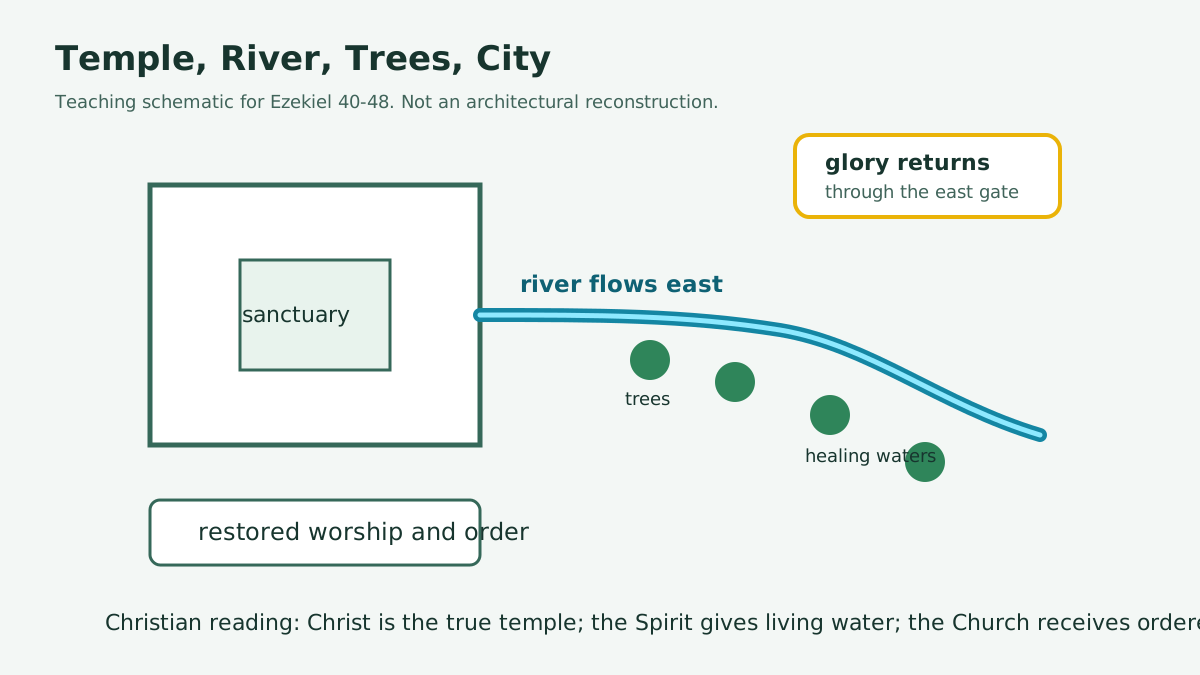 Source: Hermes schematic, 2026-06-19.
This schematic is intentionally not an architectural reconstruction. It keeps the teaching emphasis on ordered holiness, the return of glory, the life-giving river, and the restored city. Avoid making the class solve cubits; help them see that God orders worship around His presence and sends healing life outward.
A lesson on Ezekiel 45-46 can use an icon of the Prophet Ezekiel to keep the guide anchored in the prophetic vision rather than in speculative temple diagrams. The prophet holds the word that reorders worship after judgment.
Christ Pantocrator or Christ the King can also be used carefully. Ezekiel’s prince is restrained, responsible, and under command. Christ is the true King who does not oppress His people, but gives Himself for them. If a teacher uses an image of an Orthodox sanctuary, altar, or prepared gifts, it should serve the theme of reverence and ordered offering, not curiosity about architectural reconstruction.
Avoid sensational images of a future temple blueprint, political reconstructions, or charts that make the chapter a timetable. Also avoid images that detach worship from justice. A simple visual pairing can be powerful: the Prophet Ezekiel, Christ the King, and a just balance. The image teaches the chapter’s thesis: God’s worship and God’s justice stand together.
Spiritual Fruit 🍇
-
Give God the first portion. The holy portion comes before private inheritance. Begin the day, money, attention, and decisions with God, not with leftovers.
-
Refuse false measures. Ask where you are tempted to give less than you promise: in work, time, apology, prayer, generosity, listening, or money. A just balance begins in the heart before it appears in the marketplace.
-
Receive limits as mercy. The prince is blessed with a portion and restrained by it. Not every limit is humiliation. Some limits protect others from our appetite.
-
Leave worship by another gate. Do not come to prayer and return unchanged to the same resentment, greed, hurry, or control. Let worship give direction to the body and the will.
-
Honor practical service. The kitchens matter. The hidden work of preparation, cleaning, arranging, cooking, counting, and carrying can be holy when it serves God without pride.
-
Join worship to justice. Before bringing a religious gift, ask whether anyone’s portion has been taken, ignored, or made unsafe by your choices. Ezekiel will not let the altar excuse oppression.
Teaching Notes
Ezekiel 45:1-8 - The holy portion and the prince’s land
- Ask: Why does the holy portion come first in the land distribution?
- Emphasize: The land for inheritance begins by being offered to the Lord. Holiness creates order that protects everyone’s portion.
- Watch for: Flattening the prince into a simple Christ figure without noting his limits and the call to justice.
- Connect: The Church receives all things as from the Lord; leadership is restrained so the people are not scattered.
Ezekiel 45:9-17 - Just measures and ordered offerings
- Ask: What does “Let it suffice you” tell us about the connection between worship and justice?
- Emphasize: A false measure is a lie in physical form. The same God who receives offerings sees the scales.
- Watch for: Treating just weights as a minor ethical aside rather than part of restored worship.
- Connect: The altar and the marketplace stand before the same Lord. Christian worship cannot excuse cheating.
Ezekiel 45:18-25 - Cleansing, Passover, and feast order
- Ask: Why must the holy place be atoned for even after measurement?
- Emphasize: Restoration must answer defilement truthfully with blood on thresholds, corners, altar, and gate.
- Watch for: Dismissing the detailed feasts as empty ritual; they give memory and ordered gratitude back to a wounded people.
- Connect: The prince offers for himself and the people; Christ fulfills as the sinless Prince and offering.
Ezekiel 46:1-15 - Sabbath, new moon, movement, and daily offering
- Ask: What does it mean that the worshipper does not return by the same gate?
- Emphasize: Ordered worship teaches the body. The prince enters and exits with the people; daily lamb makes holiness ordinary.
- Watch for: Contrasting “spirit and truth” with liturgical order; truthful worship is embodied and obedient.
- Connect: Worship changes us; we leave by another way. The Church’s liturgy moves the body in reverence.
Ezekiel 46:16-24 - The prince’s inheritance and the temple kitchens
- Ask: Why are royal restraint and temple kitchens placed side by side?
- Emphasize: The prince may give from his own inheritance; he may not take from the people. Practical service in the kitchens is holy.
- Watch for: Using holy order to excuse controlling leadership or dismissing kitchens as irrelevant.
- Connect: Holiness touches both justice and preparation. The true Prince gives without theft and orders the house without oppression.
Glossary
Holy portion: The land set apart first for the Lord, including sanctuary-related space, priestly and Levitical portions, and the city’s possession.
First-fruits: The first and set-apart portion offered to God, showing that all the rest is received from Him.
Prince: The restored leader in Ezekiel’s vision. He has worship responsibilities and land, but his power is limited so he cannot oppress the people.
Chœnix: A measure of capacity in Brenton’s rendering. In the passage it stands for truthful measurement before God.
Gomor: A larger measure used to relate measures of grain and oil. The exact ancient conversion is less important for this lesson than the command for fair proportion.
Oboli and shekels: Weight terms used in the just-measure section. They show that justice must reach into commerce and offering.
Hin: A liquid measure used for oil in offerings.
Whole-burnt-offering: An offering wholly given to God, associated with complete surrender and worship.
Meat-offering: In older English, a grain or food offering, not necessarily meat in the modern sense.
Peace-offering: An offering associated with communion, thanksgiving, and fellowship before God.
New moon: The beginning of the month, marked in Ezekiel’s restored worship by opened gate and appointed offering.
Year of release: A release pattern that prevents permanent alienation in certain cases and protects inheritance from endless loss.
Temple kitchens: Appointed preparation places for holy food and sacrifices, showing that practical service and holy boundaries belong together.
Translation and Source Notes
Embedded Scripture is from Brenton’s English Septuagint (LXX).
The quoted units are natural sense-units from Ezekiel 45-46. No special Brenton helper omission was found for these selected ranges. Brenton’s measure terms, such as chœnix, gomor, oboli, and hin, should be taught as part of the passage’s concern for truthful proportion rather than as material for speculative reconstruction.
Sources
Primary sources
- Brenton, The Septuagint Version of the Old Testament, Ezekiel 45-46, public domain English Septuagint.
- The Gospel according to John 4:23-24, used as the primary New Testament anchor for worship in spirit and truth.
- Romans 12:1, used for the Christian offering of the body as a living sacrifice.
- Ephesians 5:2, used for Christ’s self-giving as offering and sacrifice.
Patristic sources used by paraphrase
- St. John Chrysostom, Homilies on Romans, Homily on Romans 12:1, CCEL source: https://www.ccel.org/ccel/schaff/npnf111.vii.xxii.html#vii.xxii-p3
- St. John Chrysostom, Homilies on John, material indexed around Romans 12:1 and Ephesians 5:2, CCEL source examples: https://www.ccel.org/ccel/schaff/npnf114.iv.lxxvi.html#iv.lxxvi-p31 and https://www.ccel.org/ccel/schaff/npnf114.iv.lxxi.html#iv.lxxi-p29
- St. Athanasius of Alexandria, On the Opinion of Dionysius, material indexed around John 4:24, CCEL source: https://www.ccel.org/ccel/schaff/npnf204.xv.ii.html#xv.ii-p39
Local project and lectionary sources
- Ezekiel Series Plan, local project note.
- Ezekiel - Overview, local project note.
- Resources Used - Ezekiel, local project note.
- Local Coptic Orthodox lectionary reference data in the Coptic Orthodox lectionary references.
Iconography and teaching visuals
- Orthodox Church in America, “Prophet Ezekiel,” useful for iconographic reception and a lesson-ready Prophet Ezekiel icon source: https://www.oca.org/saints/lives/2000/07/21/102064-prophet-ezekiel
- For classroom visuals, consider an icon of the Prophet Ezekiel, Christ Pantocrator or Christ the King, a simple image of a just balance, and a restrained Orthodox sanctuary or altar image. Use these to teach reverence and justice, not speculative reconstruction.