


Ezekiel 17 teaches that political cunning cannot escape covenant accountability. Jerusalem’s king may think he is only balancing Babylon against Egypt, but the Lord says that oath-breaking is not merely diplomacy. A covenant made under oath stands before God, even when it was made in a humiliating political situation.
The chapter begins as a riddle about two eagles, a cedar, and a weak vine. Then the Lord interprets the riddle: Babylon carried away Jerusalem’s king and princes, set up a dependent ruler, and bound him by oath. That ruler turned toward Egypt for horses and soldiers. The result is not liberation but deeper judgment, because he broke covenant and profaned the oath.
Yet the chapter does not end with Babylon, Egypt, or Zedekiah. It ends with the Lord planting a tender cedar on a high mountain. Human kings break oaths, empires uproot trees, and frightened rulers seek rescue in the wrong place, but God Himself plants the King and Kingdom that will shelter the nations.
Historical and Scriptural Context
This guide is part of a deliberate re-segmentation of the old Ezekiel 15-17 material. Chapter 15 now belongs with the preceding unit on false hope and the useless vine. Chapter 16 stands alone because of its severe unfaithful-bride allegory. Ezekiel 17 is also standalone because its riddle, historical explanation, oath accountability, and tender cedar promise form a complete teaching movement.
Historically, Ezekiel is speaking among the exiles in Babylon before Jerusalem’s final fall. In 597 BC, Nebuchadnezzar took King Jehoiachin, the royal household, and leading citizens to Babylon, and placed Zedekiah on the throne in Jerusalem as a vassal king. Zedekiah later rebelled and sought Egyptian support. Scripture elsewhere notes that he had been bound by oath, and that his rebellion against Babylon was also rebellion against the God before whom the oath stood. Ezekiel 17 is not asking the class to admire Babylon. It is teaching that humiliation does not cancel truth, and that fear does not make betrayal holy.
The immediate problem is not abstract international politics. It is the temptation to call distrust wisdom. Jerusalem still wants the benefits of covenant identity while refusing covenant truthfulness. The Lord exposes a king who tries to live by clever arrangements instead of repentance, obedience, and honest dependence on God.
Geographical Significance ⛰️
The riddle moves across the political map of the late kingdom of Judah. Lebanon, called Libanus in Brenton, supplies the cedar image. Babylon is the first great eagle, the imperial power that takes the top branches and carries them away. Jerusalem is the planted vine, a small and dependent kingdom left in the land. Egypt is the second eagle, the old southern power from which Judah hopes to receive horses and military help.
The geography matters because every direction carries a temptation. Babylon to the east represents humiliation, exile, and the loss of royal pride. Egypt to the southwest represents the old fantasy that Israel can be saved by horses, chariots, and remembered imperial strength. Jerusalem sits between them, trying to survive through calculation while refusing the deeper call to repent.
The last place in the chapter is the high mountain of Israel. This is not merely a change of scenery. The Lord moves the hope of the chapter away from the courts of empire and back to His own planting. The future does not come from Egypt’s army or Babylon’s permission. It comes from God’s act on His mountain, where the low tree is exalted and the dry tree flourishes.
The Characters 👥
- The Lord God: He is the giver of the riddle, the interpreter of history, the judge of oath-breaking, and the planter of the final cedar. He is not trapped by imperial politics.
- Ezekiel, son of man: The prophet must speak a parable to a people who think political explanations are enough. His task is to reveal the divine meaning behind events.
- The first great eagle: Babylon, and especially Nebuchadnezzar, who removes the royal top branches and makes Judah a dependent vine.
- The cedar and its top branches: The Davidic royal house and its leading figures, especially the king and princes carried into exile.
- The seed of the land, the weak vine: Zedekiah and the remaining kingdom of Judah, planted in the land as a low vassal kingdom under oath.
- The second great eagle: Egypt and Pharaoh, the hoped-for rescuer whose horses and soldiers cannot save Jerusalem from covenant judgment.
- The tender cedar planted by God: The Lord’s own promised royal planting. Christians read this with restraint toward Christ the humble King, the Son of David, and the Kingdom that shelters the nations.
- The provoking house: The covenant people who must learn that an oath before God is not a disposable political tool.
The riddle of the eagles, cedar, and vine (Ezekiel 17:1-10)
1 And the word of the Lord came to me, saying, 2 Son of man, relate a tale, and speak a parable to the house of Israel: 3 and thou shalt say, Thus saith the Lord; A great eagle with large wings, spreading them out very far, with many claws, which has the design of entering into Libanus—and he took the choice branches of the cedar: 4 he cropped off the ends of the tender twigs, and brought them into the land of Chanaan; he laid them up in a walled city. 5 And he took of the seed of the land, and sowed it in a field planted by much water; he set it in a conspicuous place. 6 And it sprang up, and became a weak and little vine, so that the branches thereof appeared upon it, and its roots were under it: and it became a vine, and put forth shoots, and sent forth its tendrils. 7 And there was another great eagle, with great wings and many claws: and, behold, this vine bent itself round toward him, and her roots were turned towards him, and she sent forth her branches towards him, that he might water her together with the growth of her plantation. 8 She thrives in a fair field by much water, to produce shoots and bear fruit, that she might become a great vine. 9 Therefore say, Thus saith the Lord; Shall it prosper? shall not the roots of her tender stem and her fruit be blighted? yea, all her early shoots shall be dried up, and that not by a mighty arm, nor by many people, to tear her up from her roots. 10 And, behold, it thrives: shall it prosper? shall it not wither as soon as the east wind touches it? it shall be withered together with the growth of its shoots.
Ezekiel is told to speak a tale and a parable. The Lord does not begin with a political report. He begins with an image. A great eagle comes to Lebanon and takes the choice branches of a cedar. He carries them away and plants seed in a well-watered field. The seed grows, but it does not become a proud cedar. It becomes a weak and little vine, low to the ground, with roots beneath it. Then another eagle appears, and the vine bends toward him for water.
The image is deliberately humiliating. Judah wants to imagine itself as a cedar, high, royal, and secure. In the riddle it is reduced to a low vine, alive but dependent. The first eagle has not destroyed it completely. He has planted it in a place where it can live if it accepts its low condition. The vine’s problem is not that it has no water. The problem is that it turns its roots toward another eagle.
The Lord’s question is severe: shall it prosper? The answer is no. The east wind will wither it. In Scripture, the east wind often carries the sense of scorching judgment and destruction. Here it exposes the fragility of a kingdom that seems to be surviving by cleverness. The vine can look green for a time and still be doomed at the root.
The spiritual lesson begins before the historical explanation. A soul can be planted by God in a low place and still resent the low place. A family, parish, servant, or leader can think that dependence is humiliation rather than mercy. The vine bends toward the second eagle because it wants a stronger-looking source of life. It forgets that the first question is not, Where can I get more power?
but, Where has God called me to be faithful?
Zedekiah, Egypt, and the profaned oath (Ezekiel 17:11-21)
11 Moreover the word of the Lord came to me, saying, 12 Son of man, say now to the provoking house, Know ye not what these things were? say to them, Whenever the king of Babylon shall come against Jerusalem, then he shall take her king and her princes, and shall take them home to Babylon. 13 And he shall take of the seed royal, and shall make a covenant with him, and shall bind him with an oath: and he shall take the princes of the land: 14 that it may become a weak kingdom, so as never to lift itself up, that he may keep his covenant, and establish it. 15 And if he shall revolt from him, to send his messengers into Egypt, that they may give him horses and much people; shall he prosper? shall he that acts as an adversary be preserved? and shall he that transgresses the covenant be preserved? 16 As I live, saith the Lord, verily in the same place where the king is that made him king, who dishonoured my oath, and who broke my covenant, shall he die with him in the midst of Babylon. 17 And Pharao shall make war upon him not with a large force or great multitude, in throwing up a mound, and in building of forts, to cut off souls. 18 Whereas he has profaned the oath so as to break the covenant, when, behold, I engaged his hand, and he has done all these things to him, he shall not escape. 19 Therefore say, Thus saith the Lord; As I live, surely mine oath which he has profaned, and my covenant which he has transgressed, I will even recompense it upon his head. 20 And I will spread a net upon him, and he shall be caught in its snare. 21 In every battle of his they shall fall by the sword, and I will scatter his remnant to every wind: and ye shall know that I the Lord have spoken it.
The Lord now interprets the riddle. The first eagle is the king of Babylon. He comes against Jerusalem, removes her king and princes, and takes them to Babylon. He then takes a member of the royal seed, Zedekiah, and binds him by covenant and oath. Judah becomes a weak kingdom, not free and glorious, but still able to stand if it keeps the covenant imposed upon it.
This is hard to hear because the covenant is politically humiliating. It is made under Babylonian domination. Yet Ezekiel insists that the oath is not morally empty. Zedekiah is not merely breaking a foreign treaty. The Lord calls it my oath
and my covenant
, because the king’s pledged word stands before God. When a person swears falsely, even in a difficult situation, he is not only manipulating another human being. He is profaning truth.
The appeal to Egypt makes the sin clearer. Egypt offers horses and much people. It looks like a practical alternative to weakness. But Egypt cannot undo what God has judged, and Egypt cannot rescue a king who has made falsehood his strategy. Pharaoh’s help will not be enough. Zedekiah’s plan will not prosper. The king will be caught in the Lord’s net and die in Babylon.
This passage must be handled without romanticizing oppression. Babylon is not righteous because it is powerful. Nebuchadnezzar remains an imperial conqueror. But the Lord is able to hold His people accountable even in the tangled conditions of conquest, fear, and humiliation. Hard circumstances do not give the covenant people permission to become false.
For parish teaching, this is the central hard text. We often want a version of holiness that applies only when the situation is fair. Ezekiel 17 refuses that escape. A servant who gives his word, a spouse who makes vows, a leader who accepts responsibility, a Christian who confesses faith, all stand before God in truth. Repentance may require wisdom, counsel, and sometimes release from an unjust arrangement, but it never blesses deceit as spiritual maturity.
The chapter also confronts failed trust in Egypt. Egypt is an old symbol of bondage and false rescue in Israel’s memory. To turn back toward Egypt for salvation is to forget the Exodus. The heart does this often. It returns to old patterns because they feel strong: control, flattery, secrecy, anger, money, status, manipulation, or alliances that promise safety without repentance. Ezekiel’s question remains: shall it prosper?
The Lord plants the tender cedar (Ezekiel 17:22-24)
22 For thus saith the Lord; I will even take of the choice branches of the cedar from the top thereof, I will crop off their hearts, and I will plant it on a high mountain: 23 and I will hang it on a lofty mountain of Israel: yea, I will plant it, and it shall put forth shoots, and shall bear fruit, and it shall be a great cedar: and every bird shall rest beneath it, even every fowl shall rest under its shadow: its branches shall be restored. 24 And all the trees of the field shall know that I am the Lord that bring low the high tree, and exalt the low tree, and wither the green tree, and cause the dry tree to flourish: I the Lord have spoken, and will do it.
The final word of Ezekiel 17 is not Zedekiah’s failure. The Lord Himself takes from the cedar and plants it on a high mountain. This new planting becomes a great cedar, fruitful and sheltering. Birds rest beneath it. Every tree learns that the Lord brings low the high tree and exalts the low tree, withers the green tree and causes the dry tree to flourish.
The contrast is exact. The first eagle takes. The second eagle attracts. The vine turns. Zedekiah breaks. But the Lord plants. Human politics in the chapter is full of grasping, bargaining, oath-breaking, and fear. God’s promise is quiet and sovereign. He does not need Egypt’s horses or Babylon’s permission to preserve His purpose.
The tender cedar points first to the Lord’s restoration of His people and His royal promise. The Davidic house appears cut down, but God is not finished with it. Christians read this with a restrained Christological hope. Luke 1:32-33 announces that the child born of Mary will receive the throne of David and reign over the house of Jacob forever. Acts 13:22-23 speaks of God bringing to Israel a Savior, Jesus, from David’s seed. Mark 4:30-32 gives a kingdom image of smallness becoming shelter, as the mustard seed grows so that birds may nest under its shade. These passages do not erase Ezekiel’s historical meaning. They show the fullness toward which the promise moves.
This promise also corrects our imagination of strength. The Lord does not say, I will find a taller tree.
He takes the tender part and plants it. The Kingdom comes in humility. Christ does not arrive as a second Pharaoh or a more efficient Nebuchadnezzar. He comes as the humble King, the Son of David, the One whose Cross looks like defeat and whose Resurrection becomes shelter for the nations.
The birds under the branches matter spiritually. The Kingdom is not planted for private prestige. It becomes a resting place. The Church receives this as a call to be sheltered by Christ and to become, in Him, a place where the weary may find shade. True covenant faithfulness does not produce a proud cedar that crushes the small. It produces fruit, branches, and refuge.
The Church’s Voice in Worship ⛪
Even without a verified Coptic placement, the chapter speaks in a deeply liturgical key. In worship, the Church repeatedly confesses that God is the one who raises the lowly, judges falsehood, remembers covenant, and plants hope where human power has failed. The contrast between Egypt’s horses and God’s planting resonates with every prayer that renounces self-reliance and asks for mercy, truth, and deliverance.
The oath theme also belongs near the Church’s sacramental seriousness. Baptismal renunciation, confession of faith, marriage vows, ordination promises, monastic commitment, and every Eucharistic approach to the covenant table train Christians to treat words before God as holy. Ezekiel 17 is not merely about an ancient king. It asks whether the worshiping community still believes that pledged truth matters.
Iconography Connection 🖼️
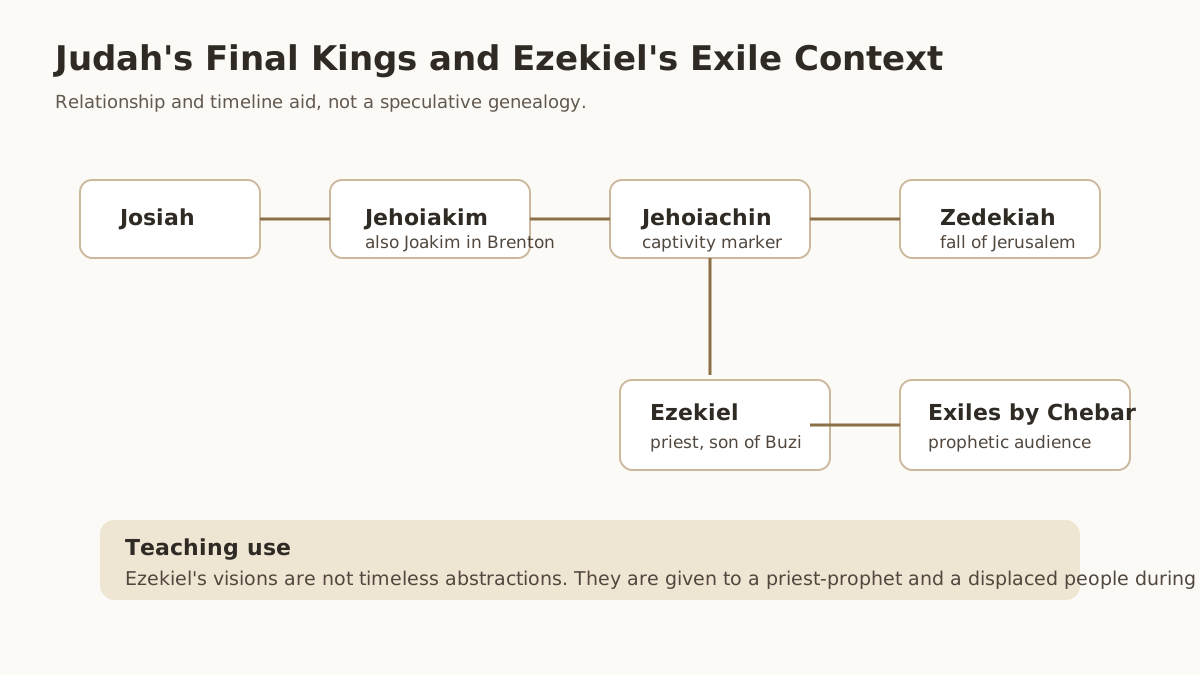 Source: Hermes schematic, 2026-06-19.
The relationship tree helps keep the eagle and covenant imagery grounded in Judah’s final royal crisis. It should not replace the parable. It simply reminds the reader that the tender cedar promise rises from a real history of failed kings, broken oaths, and divine mercy.
There is no widely used Orthodox iconographic cycle for the two eagles of Ezekiel 17 in ordinary parish teaching. The safest iconographic connection is the Prophet Ezekiel himself, usually shown with a scroll, because the chapter is a prophetic riddle interpreted by the word of the Lord.
For teaching, the strongest visual pairing is not an invented icon of the eagles but a sober image of a cedar or tree set beside an icon of Christ the King or Christ Pantocrator. The cedar image should lead the class to God’s own planting, not to fascination with Babylonian or Egyptian power. If a slide is used, keep the contrast simple: two eagles and a bent vine for human strategy, then a tender cedar on the mountain for divine promise.
The final cedar can also be connected cautiously to Kingdom imagery in the Gospels. The point is shelter, humility, and divine growth. The Church does not need to paint Zedekiah’s failed politics as sacred. She needs to show Christ as the King who gives rest under His shadow.
Spiritual Fruit 🍇
-
Tell the truth even when weakness makes falsehood tempting. Zedekiah’s oath was made under pressure, but the Lord still judged oath-breaking. Ask where fear has made you treat words lightly: promises to family, commitments in service, confession before God, or quiet agreements you now resent.
-
Do not call Egypt wisdom when it is really distrust. Egypt looked useful because it had horses and people. Many old dependencies look useful because they offer quick relief. The question is whether they draw the roots of the heart away from obedience.
-
Accept lowliness when God uses it to preserve life. The weak vine was not glorious, but it could have lived. Sometimes the low place is not punishment only; it is a mercy that keeps pride from ruling. Pray before trying to escape every humiliation.
-
Let Christ redefine strength. The tender cedar promise teaches that God’s Kingdom begins in humility and becomes shelter. Do not measure faithfulness by visible power alone. The Cross looked like a dry tree, yet from it God gives life to the nations.
-
Become a place of shade. If God shelters you under Christ, your life should become less harsh for others. Covenant truth should make a servant more reliable, a parent more safe, a leader more honest, and a parish more restful for the weary.
Teaching Notes
Ezekiel 17:1-10 - The riddle of the eagles, cedar, and vine
- Ask: Why does the Lord begin with a riddle rather than a political report?
- Emphasize: A vine can look alive while its roots are turning away.
- Watch for: Turning the passage into admiration for Babylon. The issue is covenant faithfulness before God.
- Connect: The riddle exposes misplaced trust before it explains political history.
Ezekiel 17:11-21 - Zedekiah, Egypt, and the profaned oath
- Ask: Why does the Lord treat Zedekiah’s political oath as
my oathandmy covenant?- Emphasize: An oath made in weakness still belongs before God.
- Watch for: Teaching this as passive acceptance of every abusive or unjust power. Teach it as accountability for falsehood before God.
- Connect: Zedekiah’s sin is not strategy alone; it is profaned truth and covenant-breaking.
Ezekiel 17:22-24 - The Lord plants the tender cedar
- Ask: How does the chapter move from human failure to God’s planting?
- Emphasize: Empires uproot, but the Lord plants.
- Watch for: Forcing every detail into allegory. Let the main movement stand: God preserves His royal promise by His own action.
- Connect: The tender cedar is hope after judgment, fulfilled for Christians in Christ the humble King and His sheltering Kingdom.
Glossary
- Allegory or riddle: A prophetic image that requires interpretation. Ezekiel 17 uses eagle, cedar, vine, and planting imagery to reveal the meaning of political events.
- Covenant: A binding relationship or agreement before God, involving promise, loyalty, truthfulness, and accountability.
- Oath: A solemn pledged word. In this chapter, breaking the oath is treated as profaning what belongs before the Lord.
- Vassal king: A ruler allowed to reign under the authority of a greater empire, often bound by tribute and treaty obligations.
- Zedekiah: The last king of Judah, installed under Babylonian authority and later judged for rebellion and oath-breaking.
- Nebuchadnezzar: King of Babylon, represented by the first eagle in the chapter.
- Pharaoh: King of Egypt, represented by the second eagle, whose promised support cannot save Jerusalem.
- Tender cedar: The Lord’s promised royal planting, read by Christians in light of Christ the humble Davidic King and His Kingdom.
- East wind: A biblical image often associated with scorching, withering judgment.
Translation and Source Notes
Embedded Scripture is from Brenton’s English Septuagint (LXX).
Embedded Old Testament Scripture is Brenton’s English Septuagint, public domain, extracted in three natural ranges: Ezekiel 17:1-10, 17:11-21, and 17:22-24. The chapter divides cleanly into riddle, interpretation with judgment, and promise.
Brenton uses forms such as
Libanusfor Lebanon andPharaofor Pharaoh. Verse 4 describes the place of exile as the land of Chanaan and a walled city; other English traditions often render the phrase with merchant or trading-city language. Verse 22 has the unusual phraseI will crop off their hearts; in the flow of the passage, the image concerns the Lord taking from the top or tender part of the cedar and planting it Himself. The guide preserves Brenton’s wording and explains the main image without importing a different translation into the Scripture block.
Sources
Primary Scripture
- Ezekiel 17, Brenton English Septuagint, public domain.
- 2 Kings 24:8-25:7 and 2 Chronicles 36:10-13 for Jehoiachin, Zedekiah, Babylon, Egypt, and the oath background.
- Luke 1:32-33 and Acts 13:22-23 for the Davidic promise fulfilled in Christ.
- Mark 4:30-32 for restrained canonical resonance between small beginning, Kingdom growth, and sheltering branches.
Local project sources
- Ezekiel Series Plan, local project planning note.
- Ezekiel - Overview
- Source guide split for this unit: Ezekiel 15-17 - Vine, adulterous bride, and eagles (pre-Phase 2 source)
Patristic and Orthodox reception
- No direct patristic commentary is quoted for Ezekiel 17.
- Orthodox reception of Ezekiel as prophet and witness to divine judgment and restoration is used here at the level of book theology, not as a fabricated verse-by-verse patristic citation.
Teaching and pastoral background
Historical background from the biblical accounts of Judah’s final kings and the Babylonian exile, especially 2 Kings 24-25 and 2 Chronicles 36.
Read Ezekiel 16 before this guide as a separate pastoral unit on the unfaithful bride.
Brenton, Ezekiel 17, displayed Scripture edition.