
Five sisters stand before Israel’s priest and leader with a remembered promise. Their words are specific: God commanded Moses to give them an inheritance among their brethren. They receive it. Later, Joseph’s descendants stand before Joshua with a different appeal: they are a great people, so why is their portion so small? Joshua answers their claim with work. These chapters teach the difference between seeking justice according to God’s word and using God’s blessing as a reason to avoid costly obedience.
Historical and Scriptural Context
The border of Joseph’s house introduces Ephraim and Manasseh together in 16:1-4; their distinct allotments then follow. Jacob had received Joseph’s sons as his own in Genesis 48:5, giving Joseph’s house two tribal portions. Genesis 48:22 remembers a special gift to Joseph; Brenton names “Sicima,” Shechem, where Joseph’s bones will later be buried in Joshua 24:32. First Chronicles 5:1-2 distinguishes Joseph’s birthright from Judah’s ruling place, helping explain why these two great houses dominate the earlier western allotments.
The daughters’ claim comes from Numbers 27:1-11, with the tribal inheritance arrangements continued in Numbers 36. Joshua’s distribution makes that earlier command effective in practice. Around this act of justice, the chapter records unfinished possession at Gezer and among Manasseh’s cities. Judges 1:27-29 continues the story. A promised inheritance therefore includes both a claim to be honored and a responsibility to be carried.
Geographical Significance ⛰️
- Ephraim and western Manasseh: the central inheritance of Joseph’s house, extending from the Jordan toward the sea.
- Gezer / Gazer: the city Ephraim leaves unpossessed, remembered in the Greek with its later Egyptian conquest.
- Beth-shean, Dor, and Megiddo: important cities named within Manasseh’s portion but remaining difficult to possess.
- The forested hill country: Joshua’s answer to the demand for more territory, land requiring labor.
The Characters 👥
- The Lord: keeper of the promise and source of the strength that carries responsibility.
- Joshua and Eleazar: leaders charged to enact the command given through Moses.
- Ephraim and Manasseh: Joseph’s sons whose houses receive distinct portions.
- Zelophehad / Salpaad: the father whose daughters inherit according to God’s command.
- Mahlah, Noah, Hoglah, Milcah, and Tirzah: the five sisters named by the NKJV, rendered Maala, Nua, Egla, Melcha, and Thersa in Brenton.
- The children of Joseph: recipients of blessing whom Joshua summons from complaint to courage.
Light from the Word 🕯️
Joshua 16:1-4 - Joseph receives a shared inheritance
1 And the borders of the children of Joseph were from Jordan by Jericho eastward; and they will go up from Jericho to the hill country, to the wilderness, to Bæthel Luza. 2 And they will go out to Bæthel, and will proceed to the borders of Achatarothi. 3 And they will go across to the sea to the borders of Aptalim, as far as the borders of Bæthoron the lower, and the going forth of them shall be to the sea. 4 And the sons of Joseph, Ephraim and Manasse, took their inheritance.
The house of Joseph is introduced as a major inheritance block, stretching from Jordan westward. Ephraim and Manasseh are distinguished, yet treated together in this opening notice. The chapter honors both their unity and their later internal differentiation.
“Took their inheritance” comes before the failures and complaints. This order protects gratitude from being swallowed by grievance. The family of Joseph has received something real. Christian prayer can begin in the same way: recognize the gifts already entrusted to you before listing everything that seems lacking. Thanksgiving makes us more truthful about both God’s generosity and the work ahead.
Joshua 16:5-10 - Ephraim’s border and the Canaanite left in Gezer
Before the reading. NKJV 16:10 ends with Gezer’s Canaanites living among Ephraim under forced labor; Brenton continues to Pharaoh’s conquest, the burning of the city, and its gift as his daughter’s dowry. Holmes reports the explanation of Hollenberg and Dillmann that this longer Greek notice was inserted from the account now found at 1 Kings 9:16, but he argues instead for older material retained in Greek and abbreviated in Hebrew.1 The two explanations show why a harmonizing addition is plausible without being a demonstrated history of the text. This note describes Brenton’s Greek form, not every Greek manuscript, and it makes the irony visible: the city Ephraim left unresolved was eventually taken by Egypt. In either form, the failure to possess Gezer remains part of the inheritance story.
5 And the borders of the children of Ephraim were according to their families, and the borders of their inheritance were eastward to Ataroth, and Eroc as far as Bæthoron the upper, and Gazara. 6 And the borders will proceed to the sea to Icasmon north of Therma; they will go round eastward to Thenasa, and Selles, and will pass on eastward to Janoca, 7 and to Macho, and Ataroth, and these are their villages; and they will come to Jericho, and will issue at Jordan. 8 And the borders will proceed from Tapho to the sea to Chelcana; and their termination will be at the sea; this is the inheritance of the tribe of Ephraim according to their families.
9 And the cities separated to the sons of Ephraim were in the midst of the inheritance of the sons of Manasse, all the cities and their villages. 10 And Ephraim did not destroy the Chananite who dwelt in Gazer; and the Chananite dwelt in Ephraim until this day, until Pharao the king of Egypt went up and took it, and burnt it with fire; and the Chananites, and Pherezites, and the dwellers in Gaza they destroyed, and Pharao gave them for a dowry to his daughter.
Ephraim receives a carefully described portion, with cities also situated within Manasseh’s inheritance. Yet its border account ends with the Canaanite still at Gezer. Brenton then carries the reader forward to Pharaoh’s destruction of the city and the dowry given to his daughter, an event remembered in 1 Kings 9:16. A list that looked settled becomes a record of an unresolved failure.
The spiritual application concerns the sins we accommodate, not the human beings we live beside. A temper kept because it makes others obey, or a dishonest habit retained because it brings profit, may appear useful. Usefulness is a poor measure of repentance. Christ reconciles persons to God; He calls us to turn from what wounds that communion.
Joshua 17:1-6 - Manasseh and the daughters of Zelophehad remembered in justice
1 And the borders of the tribe of the children of Manasse, (for he was the first-born of Joseph,) assigned to Machir the first-born of Manasse the father of Galaad, for he was a warrior, were in the land of Galaad and of Basan. 2 And there was land assigned to the other sons of Manasse according to their families; to the sons of Jezi, and to the sons of Kelez, and to the sons of Jeziel, and to the sons of Sychem, and to the sons of Symarim, and to the sons of Opher: these are the males according to their families.
3 And Salpaad the son of Opher had no sons but daughters: and these are the names of the daughters of Salpaad; Maala, and Nua, and Egla, and Melcha, and Thersa. 4 And they stood before Eleazar the priest, and before Joshua, and before the rulers, saying, God gave a charge by the hand of Moses, to give us an inheritance in the midst of our brethren: so there was given to them by the command of the Lord an inheritance among the brethren of their father. 5 And their lot fell to them from Anassa, and to the plain of Labec of the land of Galaad, which is beyond Jordan. 6 For the daughters of the sons of Manasse inherited a portion in the midst of their brethren, and the land of Galaad was assigned to the remainder of the sons of Manasse.
The narrative pauses the boundary material in order to remember a prior command of God. The daughters of Zelophehad stand before priest, leader, and rulers, appeal to Moses’s earlier judgment, and receive their inheritance lawfully. The allotment therefore includes not only territory, but covenant justice.
Their appeal is neither a vague protest nor an attempt to invent a new command. They can name what the Lord said and ask the leaders to carry it out. Numbers 27:1-11 tells the origin of this ruling; Numbers 36 protects its place within the tribal inheritance. Here the promise becomes land actually given. Administrators, parents, and servants can honor a principle in speech while forgetting the people it protects. These women test whether remembered justice has become concrete justice.
Christian boldness in prayer also remembers God’s promises. It joins reverence to truthful speech, rather than confusing humility with silence before an injustice. The sisters’ example gives courage to those who must ask for something right, and warns those entrusted with decisions to hear them fairly.
Joshua 17:7-13 - Manasseh’s cities and the tolerated Canaanite
7 And the borders of the sons of Manasse were Delanath, which is before the sons of Anath, and it proceeds to the borders even to Jamin and Jassib to the fountain of Thaphthoth. 8 It shall belong to Manasse, and Thapheth on the borders of Manasse shall belong to the sons of Ephraim. 9 And the borders shall go down to the valley of Carana southward by the valley of Jariel, (there is a turpentine tree belonging to Ephraim between that and the city of Manasse:) and the borders of Manasse are northward to the brook; and the sea shall be its termination. 10 Southward the land belongs to Ephraim, and northward to Manasse; and the sea shall be their coast; and northward they shall border upon Aseb, and eastward upon Issachar. 11 And Manasses shall have in the portion of Issachar and Aser Bæthsan and their villages, and the inhabitants of Dor, and its villages, and the inhabitants of Mageddo, and its villages, and the third part of Mapheta, and its villages.
12 And the sons of Manasse were not able to destroy these cities; and the Chananite began to dwell in that land. 13 And it came to pass that when the children of Israel were strong, they made the Chananites subject, but they did not utterly destroy them.
Manasseh receives a complex inheritance stretching across shared borders and strategically important cities. Yet the tribe cannot fully possess what is assigned. Later, when stronger, Israel subjects the Canaanites to forced service rather than driving them out.
The change from inability to tribute is searching. Once Israel becomes stronger, the unresolved presence is turned into an arrangement. Strength does not automatically bring fuller obedience; it may simply make compromise more profitable.
St John Cassian transmits Abba Serapion’s spiritual reading of the nations in Conferences 5.16-24. In 5.23 he describes faults as occupying corners of the heart; their defeat means patience replacing anger, humility replacing pride, and courage replacing listlessness.2 Applied spiritually here, the task is to let Christ heal the very place a vice occupied. Reduced symptoms alone are insufficient if the heart still cherishes the vice. This Christian ascetical reading authorizes no hostility toward nations or ethnic groups.
Joshua 17:14-18 - Joseph complains, Joshua commands labor
Before the reading. The NKJV speaks of “chariots of iron” in 17:16 and 17:18; Brenton gives “choice cavalry and iron” in verse 16 and “chosen cavalry” in verse 18. This contrast lies between the Masoretic wording translated by the NKJV and the Greek form represented by Brenton, not between two different Christian teachings about courage. Greenspoon cautions that the Greek translation of Joshua varies its renderings and that apparent differences must be distinguished from changes in the underlying text.3 Here a different rendering of the military expression is possible, but a precise account of how its terms developed cannot be established from that general discussion. Both readings describe intimidating military power, and Joshua’s answer calls the people to use the strength they claim rather than retreat into complaint.
14 And the sons of Joseph answered Joshua, saying, Wherefore hast thou caused us to inherit one inheritance, and one line? whereas I am a great people, and God has blessed me. 15 And Joshua said to them, If thou be a great people, go up to the forest, and clear the land for thyself, if mount Ephraim be too little for thee. 16 And they said, The mount of Ephraim does not please us, and the Chananite dwelling in it in Bæthsan, and in its villages, and in the valley of Jezrael, has choice cavalry and iron. 17 And Joshua said to the sons of Joseph, If thou art a great people, and hast great strength, thou shalt not have only one inheritance. 18 For thou shalt have the wood, for there is a wood, and thou shalt clear it, and the land shall be thine; even when thou shalt have utterly destroyed the Chananite, for he has chosen cavalry; yet thou art stronger than he.
The sons of Joseph say they are numerous and blessed, yet speak as if their allotment is too small. Joshua does not flatter them. He answers by directing them to the forest and to the difficult labor of clearing and conquering. Their appeal to greatness becomes a summons to act like a people who have received strength.
“I am a great people” meets “If thou be a great people.” Joshua takes their claim seriously enough to require something of it. There is tenderness in this refusal to endorse helplessness. The person who has received grace may need encouragement that sounds like a command: begin the work already within reach. A frightened heart can spend years seeking a larger portion while leaving the given field uncleared.
Gems from the Fathers 💎
Origen’s Philocalia 12.1-2, an excerpt from his twentieth Homily on Joshua, encourages readers to remain with these difficult allotment passages. His food comparison leads to a concrete conclusion: “We must, however, know that we often profit without perceiving it.”4 Patient Scripture reading can nourish a courage that immediate complaint never produces. The encouragement is to persevere in hearing God’s word while seeking understanding, rather than treating either obscurity or difficulty as proof that the gift is useless.
The Church’s Voice in Worship 📖
Joshua 16-17 has no appointment in the current verse-addressed Coptic lectionary. Its connection to worship is spiritual rather than an assigned service reading: in prayer we give thanks for the gift, ask for the strength to use it, and bring both neglected justice and tolerated sin before Christ.
Iconography and Visual Teaching 🖼️
The reconstructed tribal map locates Ephraim and Manasseh within the larger distribution. Their place beside other tribes helps make both their received portion and their complaint intelligible.
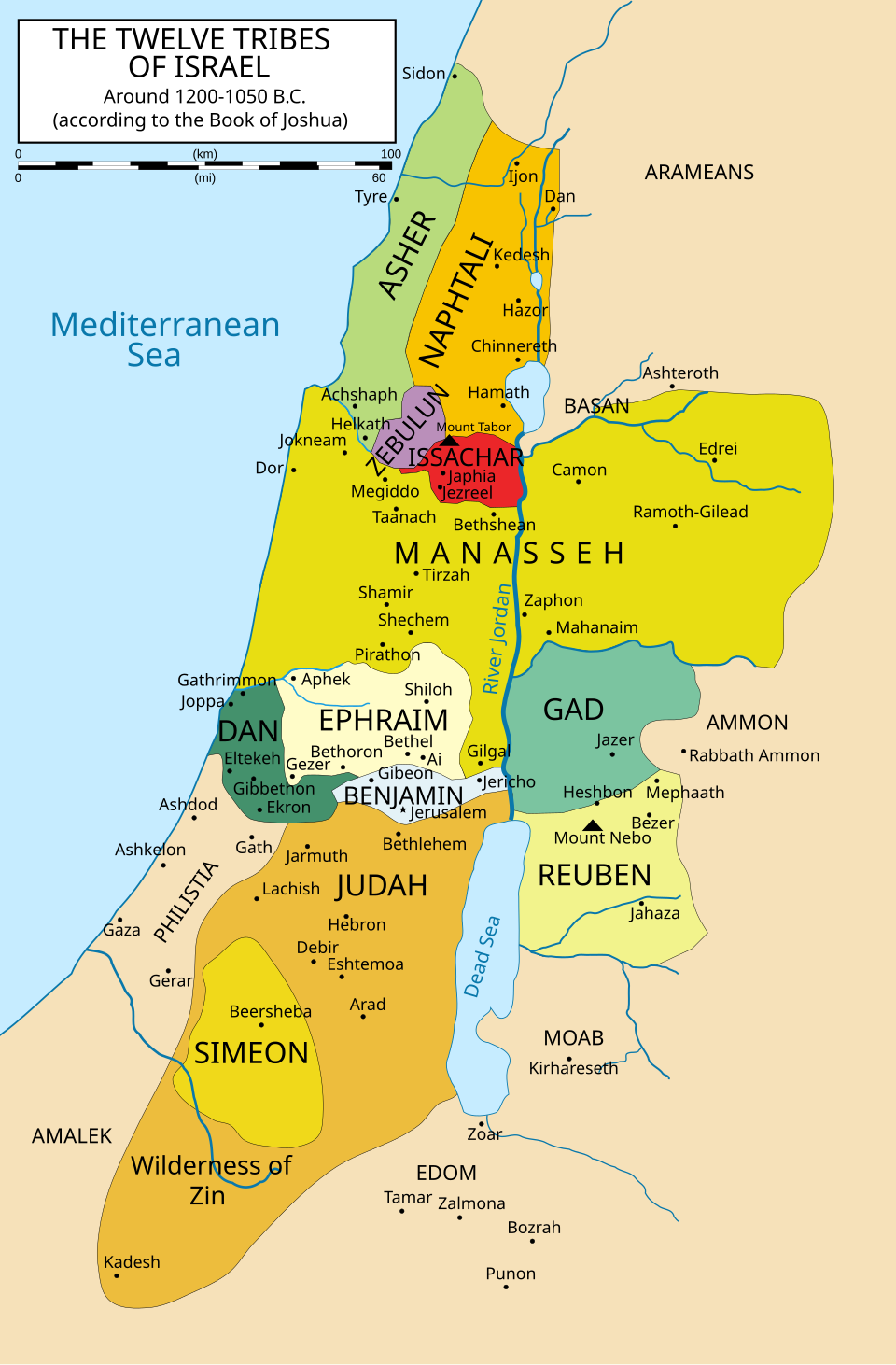 Source: 🔗 Wikimedia Commons, 12 tribus de Israel.svg translated by Kordas; 12 staemme israels heb.svg by user:יוסי; 12 staemme israels.png by user:Janz; derivative work Richardprins, CC BY-SA 3.0. Converted from SVG to PNG thumbnail with no substantive changes. Reconstructed tribal-allotment teaching map, not an ancient-period map and not to scale.
Spiritual Fruit 🍇
-
Begin with what has been given. Before a difficult conversation or a prayer dominated by lack, name three gifts already entrusted to you. Thanksgiving will not erase a real need. It will help you ask without treating God’s generosity as absent.
-
Complaint is not the same as courage. Joseph’s descendants say they are numerous and need more, but Joshua calls them to clear the forest and face the chariots. This is a sharp pastoral word. Sometimes we call ourselves trapped when we are really being summoned to work. Before blaming circumstances, ask: what obedience is already available but costly?
-
The daughters of Zelophehad show that justice must be remembered in administration. Their inheritance appears here because covenant faithfulness includes concrete fairness. Spiritual life is not only private prayer. It includes whether families, churches, and communities remember the vulnerable when decisions are made. The promised land must not be distributed in a way that forgets those God has already defended.
-
Replace the vice, not just its visible damage. Manasseh’s tribute makes the unresolved situation useful. In your own repentance, ask what good should fill the place of a tolerated habit. Put patience where anger once dictated speech; place an honest act where deception brought advantage. Ask Christ for the virtue that makes the old arrangement unnecessary.
Summary Table
| Text | Literal focus | Spiritual and Christological reading |
|---|---|---|
| Joshua 16:1-4 | Joseph’s sons receive their portion | Gratitude precedes grievance |
| Joshua 16:5-10 | Ephraim leaves Gezer unresolved | A useful compromise may still need repentance |
| Joshua 17:1-6 | Five daughters receive the commanded inheritance | Justice must become a concrete decision |
| Joshua 17:7-13 | Manasseh moves from inability to tribute | Strength can serve obedience or protect compromise |
| Joshua 17:14-18 | Joseph complains; Joshua directs labor | God’s blessing calls forth courage |
Closing Meditation
Hear the sisters’ appeal and Joseph’s complaint beside one another. One asks that God’s word be honored; the other is answered by a field still waiting to be cleared. Bring your need before Christ without disguising either injustice or reluctance. Receive the strength He gives, and take up the obedience already possible today. Complaint need not have the last word.
Teaching Notes
Joshua 16:1-4 - Joseph receives a shared inheritance
- Ask: What does the opening notice of inheritance keep us from forgetting?
- Emphasize: Ephraim and Manasseh receive distinct portions of one family inheritance.
- Watch for: Treating gratitude as a demand to ignore legitimate needs.
Joshua 16:5-10 - Ephraim’s border and the Canaanite left in Gezer
- Ask: What compromise have you defended because it seems useful?
- Emphasize: Brenton narrates a later event that the NKJV Joshua text does not include.
- Watch for: Presenting harmonization as a settled account of every Greek witness.
Joshua 17:1-6 - Manasseh and the daughters of Zelophehad remembered in justice
- Ask: Where can a principle of fairness remain true in speech but forgotten in practice?
- Emphasize: The daughters appeal to a specific command already given.
- Watch for: Replacing the passage’s command and continuity with a modern slogan.
Joshua 17:7-13 - Manasseh’s cities and the tolerated Canaanite
- Ask: How is making a vice useful different from letting Christ heal its place in the heart?
- Emphasize: Cassian’s reading is spiritual warfare against faults.
- Watch for: Applying the nations-as-vices reading to living peoples.
Joshua 17:14-18 - Joseph complains, Joshua commands labor
- Ask: What available obedience have you postponed while asking for better circumstances?
- Emphasize: Joshua tests claimed greatness by work.
- Watch for: Calling every exhausted or obstructed person lazy.
Sources
Embedded Scripture is from Brenton’s English Septuagint (LXX). Chapter and verse headings follow NKJV numbering; lettered markers identify material present in Brenton beyond the corresponding Hebrew verse.
Brenton, Joshua 16 and Joshua 17; Genesis 48:5,22; NKJV, Numbers 27:1-11; Numbers 36; 1 Kings 9:16; Judges 1:27-29; 1 Chronicles 5:1-2.
Origen, Philocalia 12.1-2, trans. George Lewis (1911).
St John Cassian, Conferences 5.16-24, especially 5.23.
Holmes, Joshua: The Hebrew and Greek Texts, pp. 63-64; Greenspoon, NETS Iesous, pp. 174-176.
Footnotes
-
S. Holmes, Joshua: The Hebrew and Greek Texts (1914), pp. 61-64, notes on 15:19, 15:59 and 16:10. Edition. ↩
-
St John Cassian, Conferences 5.16-24, especially 5.23, trans. C. S. Gibson, NPNF, second series, vol. 11. Direct text. ↩
-
Leonard J. Greenspoon, introduction to Iesous, A New English Translation of the Septuagint, pp. 174-176. Introduction and translation. ↩
-
Origen, Philocalia 12.1-2, excerpt headed as from the twentieth Homily on Joshua, trans. George Lewis (1911), pp. 54-57. Direct text. The section numbers here belong to the Philocalia excerpt. ↩