


This narration is from a previous version of the study and may include a combined recording of multiple chapters.
A man lives righteously, and the people around him find his goodness unbearable. A king has power, yet confesses that he cannot judge without a gift from heaven. A world full of beauty becomes the occasion either for thanksgiving or for slavery. Wisdom of Solomon brings these contradictions into the light of God. It asks how we can learn to see truly when success, suffering, pleasure, and death so often seem to tell the wrong story.
Its answer grows larger as we read. The heart must become truthful enough to receive Wisdom. The righteous person, apparently defeated, remains in God’s hand. The ruler must learn mercy from the Lord who could destroy but gives time for repentance. At the center stands Wisdom, making human beings friends of God; at the end stands creation itself, serving deliverance. Christians hear this book with their eyes on Jesus Christ, the righteous Son and the Wisdom of God (1 Corinthians 1:24).
A book received in the life of the Church
Wisdom of Solomon belongs to the Coptic Bible’s deuterocanonical books. Many familiar NKJV Bibles omit it because they print the Protestant Old Testament collection. The difference concerns which books an edition includes, rather than a defect in the NKJV translation. Here the book is read in Brenton’s English Septuagint, the Greek Old Testament in English. Chapter and verse numbers for Wisdom follow Brenton as displayed throughout this series.
The history deserves honesty. In his Festal Letter 39.7 (AD 367), St. Athanasius places Wisdom outside the canon proper in his own list, while naming it among the books appointed by the Fathers for the instruction of those newly entering the Church. His categories should neither be erased nor treated as a simple statement of every later Christian Bible’s contents.1 Yet this same Alexandrian Father cites Wisdom 2:23-24 in On the Incarnation 5.2 when explaining humanity’s creation for incorruption and the entrance of death through the devil’s envy. He introduces it with the words “as Wisdom also says”.2 A book could have an honored teaching role and carry weight in his theology without appearing in the first category of that particular list.
Today the Coptic Church receives Wisdom among the deuterocanonical books and reads it in Holy Pascha. Its place is heard as well as described: the call to righteousness, the plotting against the righteous Son, the radiance of divine Wisdom, and the mercy of sovereign power enter the Church’s worship at the approach of the Cross. We read with gratitude for this inheritance, without turning the history of the canon into a quarrel with other Christians.
The king who must ask
The book speaks in Solomon’s voice, especially in the prayer of chapter 9. Read beside 1 Kings 3:5-14 and 2 Chronicles 1:7-12, that voice has a recognizable spiritual shape: the king is entrusted with more than he can carry, and his greatness begins in asking. Its Greek language and engagement with Greek-speaking culture are commonly associated with a later Jewish setting, often Alexandria. That association is a historical proposal, not a named birthplace supplied by the book.
What the text makes unmistakable is the pressure on faith. Rhetoric can make cruelty sound reasonable. Public success can make a wasted life look enviable. Beauty can absorb the attention that should rise through it to God. The book answers such pressures with a richer account of reality, one in which God’s judgment and the hope of immortality expose how small our immediate verdicts can be.
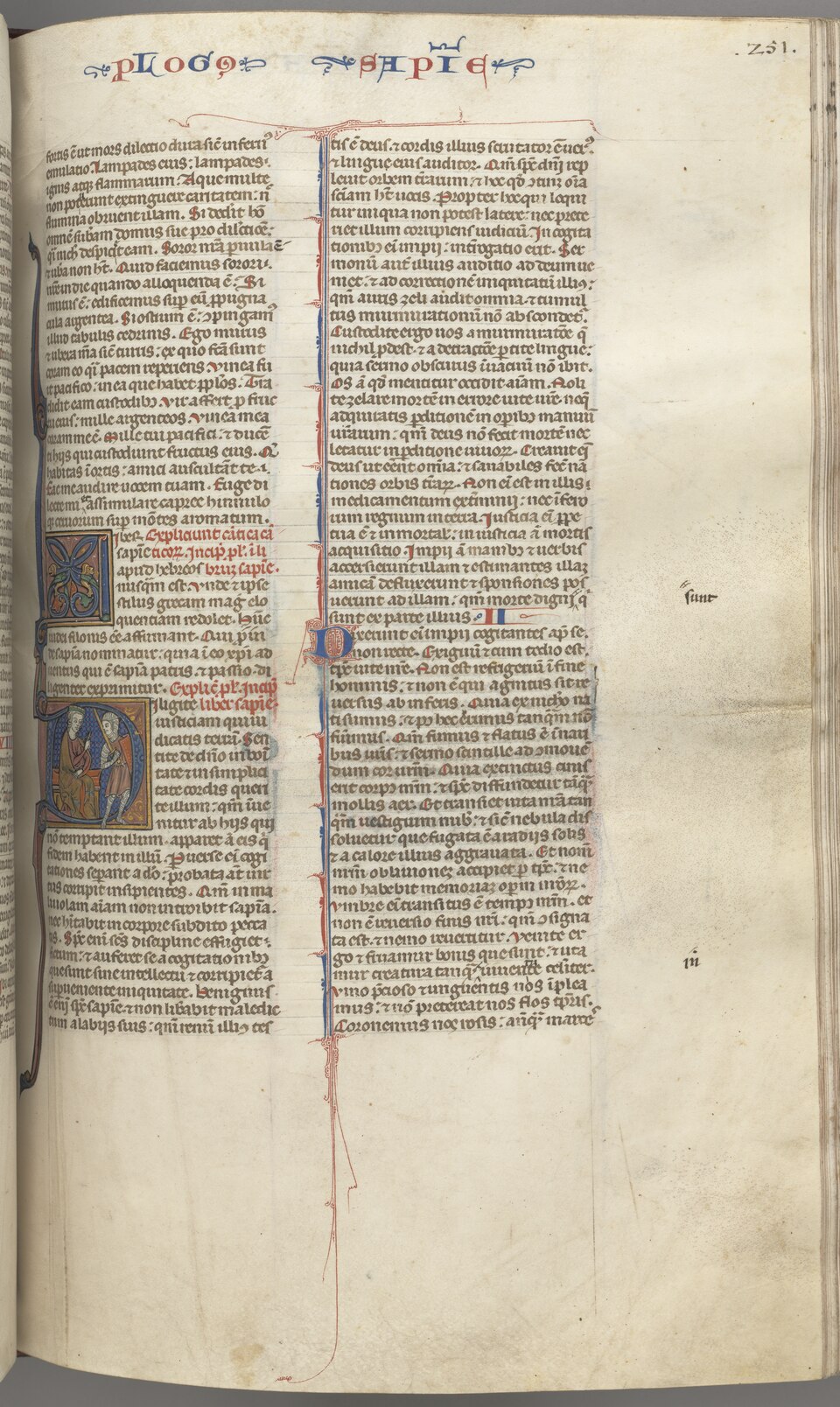 Source: Medieval manuscript leaf, southern France, Cleveland Museum of Art, fol. 251r, CC0, collection image.
The manuscript presents Wisdom as instruction worth receiving. Its medieval Western setting is distinct from the book’s ancient Jewish world and from Coptic iconography. It witnesses to the book’s long Christian reading life.
Light from the Word 🕯️
The heart that can receive Wisdom (Wisdom 1)
The first command addresses the judges of the earth, but it soon reaches the hidden court within each of us. What do we excuse? Whose reputation do we condemn? Can we ask God for light while keeping a deliberate lie? These selected verses name the conditions of a healed sight:
- Love righteousness, ye that be judges of the earth: think of the Lord with a good (heart,) and in simplicity of heart seek him.
- For into a malicious soul wisdom shall not enter: nor dwell in the body that is subject unto sin.
- For the Spirit of the Lord filleth the world: and that which containeth all things hath knowledge of the voice.
The first word is love. Intelligence can serve almost any desire; wisdom begins when the desire itself turns toward righteousness. The God who hears every voice exposes backbiting and also receives the prayer we scarcely dare to say aloud. His searching presence is an invitation to honesty. Confession brings the hidden life into the light where it can be healed.
The righteous Son and the shameful death (Wisdom 2)
The persecutors first describe a short life without lasting hope, then use that description to justify pleasure and oppression. Finally they meet a righteous man whose very existence disturbs their bargain. These are selected verses, not a continuous extract:
- Therefore let us lie in wait for the righteous; because he is not for our turn, and he is clean contrary to our doings: he upbraideth us with our offending the law, and objecteth to our infamy the transgressings of our education.
- For if the just man be the son of God, he will help him, and deliver him from the hand of his enemies.
- Let us condemn him with a shameful death: for by his own saying he shall be respected.
- Such things they did imagine, and were deceived: for their own wickedness hath blinded them.
The taunt becomes painfully familiar in Matthew 27:40: “If You are the Son of God, come down from the cross.” The closest echo of Wisdom 2:18 is Matthew 27:43, where the mockers appeal to His trust in God and His claim to be God’s Son. They make rescue on their terms the test of His truth. Christ’s willing obedience overturns that test. He remains on the Cross to save those who could never save themselves.
Gems from the Fathers 💎
St. Augustine reads Wisdom 2 directly as prophecy of the Passion. In The City of God XVII.20 he writes that in this book “the passion of Christ is most openly prophesied”, then quotes the persecutors’ speech.3 The Church’s Good Friday reading gives that recognition a worshiping voice. The righteous sufferer is seen most fully in Christ before the passage is applied to our own trials. His innocence also searches us: another person’s goodness may expose the resentment we have called discernment.
The hand that holds the departed (Wisdom 3-5)
- But the souls of the righteous are in the hand of God, and there shall no torment touch them.
- In the sight of the unwise they seemed to die: and their departure is taken for misery,
- and their going from us to be utter destruction: but they are in peace.
- For though they be punished in the sight of men, yet is their hope full of immortality.
Wisdom distinguishes what death looks like from what is true before God. The bereaved really experience a departure; the righteous really remain in His keeping. Hope does not make tears unfaithful. It gives tears somewhere to fall. Christ Himself wept at Lazarus’s tomb (John 11:35), and the Church’s prayer for the departed joins grief to expectation of the resurrection.
Chapters 3 and 4 also challenge the measurements by which a life is praised: many descendants, long years, public honor. A person denied these things is not denied God’s love. Infertility, miscarriage, childhood death, and premature bereavement must never become evidence that someone’s faith failed or that a hidden sin has been discovered. Wisdom is loosening the cruel arithmetic of appearances. Chapter 5 completes the reversal when those who despised the righteous discover that their own trophies could not give them life.
Authority under mercy (Wisdom 6)
The judges addressed at the beginning are now summoned to account for the power entrusted to them. Wisdom 6:3 belongs beside Christ’s words to Pilate in John 19:11: authority is received from above, and its holder answers to God. A parent, priest, teacher, or manager may have the power to silence a person without having the right to do so.
The remedy is as searching as the warning. Wisdom seeks those who seek her (Wisdom 6:12-16); love takes the form of obedience (Wisdom 6:17-20). God does not leave the ruler with an impossible demand and no help. He offers the gift that can turn authority from self-protection toward service. By the chapter’s end, received wisdom is being shared without envy. The wise person wants others to become wise too.
Radiance and friendship (Wisdom 7-8)
- For wisdom is more moving than any motion: she passeth and goeth through all things by reason of her pureness.
- For she is the breath of the power of God, and a pure influence flowing from the glory of the Almighty: therefore can no defiled thing fall into her.
- For she is the brightness of the everlasting light, the unspotted mirror of the power of God, and the image of his goodness.
- And being but one, she can do all things: and remaining in herself, she maketh all things new: and in all ages entering into holy souls, she maketh them friends of God, and prophets.
Hebrews 1:3 calls the Son the “brightness” of the Father’s glory. The Greek word, “apaugasma”, is the same one used for “brightness” in Wisdom 7:26. This is a strong verbal bridge between the poem and the New Testament’s confession of the Son.4 The language of radiance lets us contemplate light coming from light without imagining a creature manufactured outside God. The full confession of the Son’s divinity rests on the apostolic faith, not on a single shared word.
Then comes the astonishingly tender purpose: Wisdom enters holy souls and makes them friends of God. The divine light is fruitful in human communion. Christ calls His disciples friends in John 15:15; wisdom therefore reaches its Christian fullness in life with Him, received by the Holy Spirit. Prayer, purity, and virtue belong together because friendship cannot be sustained by a life that deliberately contradicts love.
Chapter 8 gives this desire the language of companionship and the shape of the virtues. Its ending makes the decisive turn: the speaker cannot obtain Wisdom unless God gives her (Wisdom 8:21). The next chapter is the prayer of someone who has understood his need.
The prayer beneath the work (Wisdom 9)
These selected verses retain their own verse numbers:
- O God of my fathers, and Lord of mercy, who hast made all things with thy word,
- give me wisdom, that sitteth by thy throne; and reject me not from among thy children:
- for I thy servant and son of thine handmaid am a feeble person, and of a short time, and too young for the understanding of judgment and laws.
- For though a man be never so perfect among the children of men, yet if thy wisdom be not with him, he shall be nothing regarded.
The king does not ask to appear wise. He asks because he is feeble and the work exceeds him. This is a liberating confession for anyone who serves. Competence has its place; dependence on God gives competence its proper place. We can prepare carefully and still ask to be taught. We can admit that we do not know without pretending that the entrusted work does not matter.
Wisdom 9:17 brings prayer for wisdom together with the gift of the Holy Spirit from above. The answer to our limits is communion with God, not an inflated opinion of ourselves. A wise decision may begin with the quiet admission that the person we are trying to correct needs to be heard first.
The Lover of souls (Wisdom 10-12)
Chapter 10 retells the history of the righteous largely without naming them. Adam, Noah, Abraham, Lot, Jacob, Joseph, Moses, and Israel are recognizable through their trials; Wisdom’s preserving action holds the sequence together. In the prison as well as beside the sea, God’s presence can be active before deliverance becomes visible. This is hope for the person whose faithfulness has brought no quick improvement.
Chapters 11 and 12 dwell on the manner of God’s judgment. The Lord who orders all things by measure, number, and weight is also the Lover of souls (Wisdom 11:20, 26). His patience gives sinners opportunity for repentance. The reason to turn back today is not that mercy might be absent, but that mercy is already giving us this day.
The severe account of Canaan’s sins must be read under that same Lordship. It supplies no permission for ethnic hatred or inherited moral contempt. Rahab, a Canaanite who turns to Israel’s God, is received into His people and appears in the genealogy of Christ (Joshua 6:25; Matthew 1:5). The righteous are called to learn mercy from God’s restraint, not to claim His judgment as a license for their anger.
Beauty that becomes thanksgiving (Wisdom 13-15)
These selected verses carry us from the works to their Maker:
- Surely vain are all men by nature, who are ignorant of God, and could not out of the good things that are seen know him that is: neither by considering the works did they acknowledge the workmaster;
- With whose beauty if they being delighted took them to be gods; let them know how much better the Lord of them is: for the first author of beauty hath created them.
- For by the greatness and beauty of the creatures proportionably the maker of them is seen.
The beauty of creation is genuinely beautiful. Its goodness makes idolatry tragic: something received as a gift is asked to become the giver of life. The book follows that confusion into the workshop, where a craftsman asks an object he has made to protect the person who made it. Its satire exposes a reversal of dependence.
We repeat that reversal when reputation, wealth, beauty, national belonging, or another person must secure the worth that only God can give. A gift begins to enslave us when we can no longer receive it freely or lose it without losing our reason to love. Yet grief over a good gift is not proof of idolatry. The question is whom we worship and obey, not whether we feel loss.
The Cross, icons, blessed oil, water, and the relics of the saints are received in relation to the living God. Christian reverence does not ask a created object to become an independent source of divinity. This distinction allows the book’s rebuke of idols to deepen our sacramental life rather than make us suspicious of matter. Chapter 15 turns from the helpless image toward the God whose mercy makes repentance possible.
Exodus, Pascha, and new creation (Wisdom 16-19)
The final chapters ask us to see water, fire, food, darkness, and the sea under the care of their Creator. The serpent does not heal by an independent power; God heals. Manna nourishes the body while teaching dependence on His word. Darkness exposes false security, yet the chapter’s account of guilty fear is no diagnosis of every frightened or traumatized person.
Wisdom 18 recalls the night of the firstborn. Exodus 4:22 supplies a crucial background: Israel is God’s son, His firstborn. The liberation of the enslaved son and the judgment of the oppressor belong to the same story. This is a grave history of divine judgment, not an occasion for delight in another family’s loss.
- For while all things were in quiet silence, and that night was in the midst of her swift course,
- thine Almighty word leaped from heaven out of thy royal throne, as a fierce man of war into the midst of a land of destruction,
- and brought thine unfeigned commandment as a sharp sword, and standing up filled all things with death; and it touched the heaven, but it stood upon the earth.
The scene is first the judgment in Egypt. Revelation 19:11-16 offers a powerful Christian comparison: the rider called the Word of God comes with a sharp sword. The image reveals that divine mercy never makes peace with the powers that destroy God’s creatures. In the same chapter of Wisdom, the priest stands between death and the living in intercession. Read in Christ, warrior and intercessor are not opposing saviors. The Lord who breaks bondage also gives Himself for the life of the world.
By chapter 19, creation is arranged afresh for the passage of God’s people. The sea’s deliverance opens toward baptism, in which we die and rise with Christ (Romans 6:3-4). Matter is not discarded; it serves life. The book that began by calling the judges to righteousness ends with God’s people upheld by His presence. Its final thanksgiving sounds naturally beside the risen Lord’s promise to remain with His disciples (Matthew 28:20).
The Church’s Voice in Worship ⛪
Four readings from Wisdom are found in the Coptic Holy Pascha lectionary followed here:
- Wisdom 1:1-9, Monday of Holy Pascha, Sixth Hour. The week begins with the purification of judgment and speech. We cannot contemplate the false accusations against Christ while exempting our own words from examination.
- Wisdom 7:24-30, Eve of Wednesday, Eleventh Hour, prayed Tuesday evening. The brightness of Wisdom stands against the approaching betrayal. John 13:30 records Judas going out into the night; John 1:5 confesses the light shining in darkness. This is a spiritual comparison, not a claim that the passages are appointed together.
- Wisdom 12:13-13:1, Thursday of the Covenant, Sixth Hour. The Lord of all exercises His strength with mercy. That sovereignty helps us contemplate Christ washing His disciples’ feet (John 13:3-5), an act of power freely made servant. The reading continues into the opening of chapter 13, where knowing the Maker becomes the issue.
- Wisdom 2:12-22, Good Friday, First Hour, among the prophecies. The righteous Son is mocked and condemned by those blinded by wickedness. The prophecy directs our gaze toward Christ’s willing Passion and brings our own need for repentance into His light.
These placements belong to a received Pascha source tradition. Their precise source status is explained below; they are not described here as newly confirmed in Coptic Reader.
Read the book chapter by chapter
Each study includes the complete chapter, close explanation, spiritual application, and Teaching Notes.
Glossary
- Deuterocanonical: A name used for books received in the Church’s Old Testament but not included in the Hebrew collection followed by most Protestant editions. The term concerns reception, not a lesser God or a lesser call to holiness.
- Septuagint (LXX): The Greek Old Testament tradition through which Wisdom has been received; Brenton is the English translation displayed here.
- Incorruption: Freedom from the ruin of death, received through communion with God. In the Christian confession, its fullness is bodily resurrection and life in Christ.
- Typology: Reading real persons and events in Israel’s history as preparing for their fulfillment in Christ, without erasing their first meaning.
- Pascha: The Passover fulfilled in Christ’s saving death and resurrection; Holy Pascha also names the Coptic services of Holy Week.
Spiritual Fruit 🍇
Begin with one truthful confession. Before asking for a better answer, name the resentment, deceit, or desire for control that could bend the answer. Wisdom 1 joins a clear mind to a heart willing to be healed. A small, honest confession is a better beginning than an impressive plan defended against God.
Let Christ correct the meaning of defeat. Wisdom 2 and 3 stand beside each other: the righteous one is condemned, and the righteous are in God’s hand. When goodness costs you approval, ask for the courage to remain faithful. When grief costs you strength, receive the prayers and company of the Church. Neither sorrow nor the need for help takes you outside His keeping.
Use power to make another person’s life less burdened. Wisdom 6 and 12 bring authority under judgment and mercy. Choose a concrete act: listen before deciding, correct without humiliation, acknowledge a mistake, or relinquish a privilege that makes service harder for someone else. The Lord’s restraint is a model of strength, not an excuse for ignoring harm.
Receive one good thing with thanksgiving. A meal, a skilled hand, a child’s company, an hour of quiet, a beautiful landscape: name the gift and thank its Maker. Wisdom 13 teaches the gaze to rise. Gratitude lets us enjoy creation without demanding that it bear the weight of being God.
The book leaves us beside a sea made passable. The way forward exists because the Creator has not abandoned His people. Bring the burden you cannot master into the prayer of Wisdom 9. Ask for the gift you cannot give yourself, and take the next faithful step in the presence of the One who gives it.
Teaching Notes
Canon, voice, and setting
- Ask: How does Athanasius’s distinction between a canonical list and books appointed for instruction help us speak honestly about reception?
- Emphasize: Preserve both Festal Letter 39.7 and his use of Wisdom in On the Incarnation 5.2; do not make one erase the other.
- Watch for: Anti-Protestant polemic, or presenting an Alexandrian setting proposal as the author’s own biographical claim.
- Show: Distinguish the medieval Western manuscript from Orthodox iconography. The earlier Finnish-labelled map is omitted.
Purity, persecution, and hope (Wisdom 1:1-5:23)
- Ask: Why does the book put the purification of our judgment before the story of the persecuted righteous man?
- Emphasize: Read the Passion through Christ first, then the disciple. Matthew 27:43 is the closest taunting echo of Wisdom 2:18.
- Watch for: Spiritual language that suppresses grief or assigns a cause to infertility, miscarriage, or early death.
Wisdom received in prayer (Wisdom 6:1-9:18)
- Ask: What changes when a person entrusted with authority asks for wisdom instead of defending an appearance of competence?
- Emphasize: Hebrews 1:3 and Wisdom 7:26 share the word for brightness; unfold the confession through the whole apostolic witness.
- Watch for: Treating poetic personification as a mechanical proof, or using Wisdom 8:19-20 to teach that souls existed before conception.
Mercy, creation, and worship (Wisdom 10:1-15:19)
- Ask: How does the Lover of souls teach us to hold together judgment and repentance?
- Emphasize: Keep Rahab beside the hard Canaan passages and the goodness of creation beside the rebuke of idols.
- Watch for: Ethnic contempt, contempt for grieving people, and confusing holy signs with independently divine objects.
Exodus and new creation (Wisdom 16:1-19:22)
- Ask: How does the sea’s deliverance help us hear Romans 6:3-4 without erasing the Exodus?
- Emphasize: Preserve the first historical sense before Christian fulfillment. Explain Exodus 4:22 and Revelation 19:11-16 in their own contexts.
- Watch for: Equating clinical anxiety with guilty fear, or treating the deaths in Egypt as an occasion for triumphalism.
Sources
Embedded Scripture is from Brenton’s English Septuagint (LXX). Numbered extracts above are selections; omitted verse numbers mark omitted verses. New Testament quotations in the explanations are from NKJV.
The four Wisdom appointments follow the Holy Pascha Katameros tradition represented in the readings used for this series, including St. Mary Coptic Orthodox Church, Ottawa’s witness for Wisdom 7:24-30. Coptic Reader confirmation has not been established for these four appointments. John 13 is recalled as the Gospel memory of Covenant Thursday, not asserted here as a newly verified current reading assignment.
Footnotes
-
St. Athanasius, Festal Letter 39.7, complete letter. ↩
-
St. Athanasius, On the Incarnation 5.2, complete work. He cites Wisdom 2:23-24 while explaining the grace of the Word and the entrance of corruption. ↩
-
St. Augustine, The City of God XVII.20, Book XVII. The phrase quoted is his interpretation, followed in the work by his quotation of Wisdom 2:12-21. ↩
-
Compare the actual wording in Wisdom 7:26 and Hebrews 1:3. ↩