


This narration is from a previous version of the study and may include a combined recording of multiple chapters.
“Give me wisdom” is the prayer of a king who knows that another person’s life cannot safely be governed by his confidence alone. Wisdom 9 turns the longing of the previous chapter into direct speech to God. Creation, royal responsibility, the temple, and the limits of mortal thought gather around this request. The one who asks is both an entrusted servant and a child who needs mercy.
Orientation
The Solomonic prayer recalls 1 Kings 3:5-12 and 2 Chronicles 1:7-12: wisdom is sought for God’s people rather than for the ruler’s display. After Wisdom 8:21, the prayer begins where desire has discovered its limits. God must give what the speaker cannot secure for himself.
Iconography Connection 🖼️
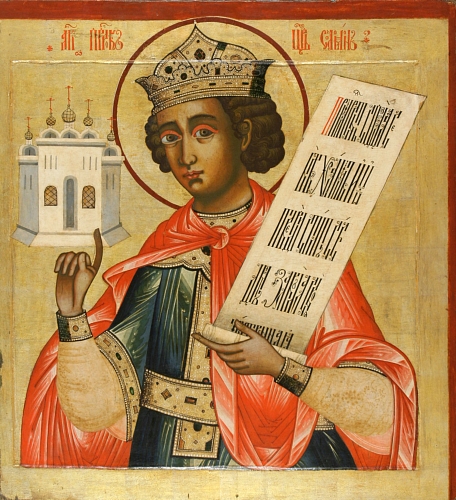 King Solomon, Russian icon. Public domain, Wikimedia Commons.
Solomon’s royal memory stands here beside the confession of a praying servant. The responsibility named in the chapter belongs to God before it belongs to the king.
The Lord of mercy and the confession of weakness (Wisdom 9:1-6)
1 O God of my fathers, and Lord of mercy, who hast made all things with thy word, 2 and ordained man through thy wisdom, that he should have dominion over the creatures which thou hast made, 3 and order the world according to equity and righteousness, and execute judgment with an upright heart: 4 give me wisdom, that sitteth by thy throne; and reject me not from among thy children: 5 for I thy servant and son of thine handmaid am a feeble person, and of a short time, and too young for the understanding of judgment and laws.
6 For though a man be never so perfect among the children of men, yet if thy wisdom be not with him, he shall be nothing regarded.
The prayer begins with God before it mentions Solomon’s need. He is the God of the fathers, the Lord of mercy, the Maker of all things by His word. The one who asks for wisdom is not speaking into emptiness. He stands before the God who created, ordered, and gave human beings a vocation within creation.
Verses 2 and 3 show that wisdom is built into the original human calling. Man was ordained through wisdom to have dominion, to order the world according to equity and righteousness, and to execute judgment with an upright heart. Dominion is not permission to possess people or exploit creation. It is stewardship under God. Judgment is not control. It is righteousness applied with an upright heart.
That is why verse 4 is so direct: “give me wisdom.” Solomon does not ask first for success, reputation, victory, money, influence, or visible fruit. He asks for Wisdom who sits by God’s throne. Authority is safe only when it remains near the throne of God. If wisdom is separated from worship, power begins to serve the passions.
The next line is tender: “reject me not from among thy children.” The king does not stand before God first as a ruler over others, but as a child before the Father. This is one of the deepest protections for Christian leadership. A servant who forgets that he is a child before God will eventually treat others as tools, burdens, rivals, or possessions. A parent may begin trying to save children by force; a teacher may use knowledge to dominate rather than to heal.
Solomon then names himself as servant and son of the handmaid. The title lowers him. He is king, but he is not self-made. He is bound to the Lord’s household. He is feeble, of short time, and too young for judgment and laws. The humility is not theatrical. It is accurate. Human life is brief. Human sight is partial. Human judgment is easily bent by fear, desire, anger, fatigue, favoritism, and the need to be admired.
Verse 6 removes every illusion: even if a man were perfect among human beings, without God’s wisdom he would be nothing regarded. Natural ability, experience, and charisma each need the wisdom that orders them toward God. A servant may know how to organize, speak, persuade, and lead a room, yet still lack the wisdom that discerns what is pleasing to God. The prayer begins by making the strongest person poor before mercy.
For Christians, this poverty is not despair. Christ is the Wisdom of God, and He does not despise the weak who ask. He took our weakness without sin, taught us to become as children, and made greatness in the Kingdom look like service. Wisdom 9 trains the heart to lead only as one who has first received mercy.
Creation by God’s word recalls Psalm 33:6 (LXX Psalm 32:6) and comes to Christian fullness in John 1:3, where all things come to be through the Word. The humble prayer therefore rests on a strong confession: the Lord whose counsel we need is the Maker who has already given us life. Calling oneself His servant and the son of His handmaid also recalls Psalm 116:16 (LXX Psalm 115:7). Dependence is belonging, not worthlessness.
Language insight: “that sitteth by thy throne”
Wisdom 9:4 describes Wisdom as πάρεδρον, the form of paredros used here for one seated beside another, a companion of the throne.1 The request is for wisdom that belongs in God’s presence, not merely the skill to occupy an earthly seat. Hebrews 1:3 and Hebrews 8:1 place the Son at the right hand of the Majesty. Those passages illuminate the Christian reading without making a shared seating image prove the whole doctrine. Solomon asks to receive wise judgment from the One whose throne is never governed by panic or vanity.
Gems from the Fathers 💎: The creature and the eternal Wisdom
St. Athanasius cites Wisdom 9:2 in Discourse II Against the Arians 45 as he distinguishes created beings from the eternal Son. Humans and the things entrusted to their care are creatures; calling Wisdom the agent of their ordering does not place the Son among the things made. He quotes the verse: “Having ordained man through Your wisdom, that he should have dominion over the creatures which You have made.”2 This is a direct use of Wisdom, in the English wording of the patristic translation. The distinction makes prayer both humble and hopeful. We need the Giver because we are creatures; His Wisdom is not another limited creature who also needs to borrow life.
Wisdom sent from the holy heavens for the work entrusted (Wisdom 9:7-12)
7 Thou hast chosen me to be a king of thy people, and a judge of thy sons and daughters: 8 thou hast commanded me to build a temple upon thy holy mount, and an altar in the city wherein thou dwellest, a resemblance of the holy tabernacle, which thou hast prepared from the beginning. 9 And wisdom was with thee: which knoweth thy works, and was present when thou madest the world, and knew what was acceptable in thy sight, and right in thy commandments. 10 O send her out of thy holy heavens, and from the throne of thy glory, that being present she may labour with me, that I may know what is pleasing unto thee. 11 For she knoweth and understandeth all things, and she shall lead me soberly in my doings, and preserve me in her power. 12 So shall my works be acceptable, and then shall I judge thy people righteously, and be worthy to sit in my father’s seat.
Solomon’s prayer does not deny that he has been chosen. He says, “Thou hast chosen me.” Humility is not pretending there is no calling, no authority, no responsibility, and no work to do. Fear can disguise itself as humility and become a reason to avoid service. True humility receives the work from God and then asks for the grace to do it without corrupting it.
The work entrusted to Solomon is royal, judicial, and liturgical. He is king of God’s people, judge of God’s sons and daughters, and builder of the temple upon the holy mount. These are not small tasks. They touch worship, justice, family, public order, and the place where God’s name dwells. That is why wisdom must be sent from above. Holy work cannot be done safely by an unillumined heart.
Verse 8 calls the temple a resemblance of the holy tabernacle prepared from the beginning. The earthly sanctuary is not an invention of Solomon’s religious imagination. It reflects a divine pattern. This teaches servants that ministry is not personal branding. The Church is not built according to our taste, anxiety, or need to leave a mark. We serve according to what God has revealed and prepared.
Verse 9 returns to creation. Wisdom was with God, knew His works, was present when He made the world, and knew what was acceptable in His sight. The servant’s problem is not only lack of information. It is lack of alignment with God’s will. We can know many facts about Scripture, personality, schedules, education, psychology, and group life, yet still not know what is acceptable in God’s sight in a particular moment.
The heart of this section is verse 10: “O send her out of thy holy heavens.” Solomon asks that Wisdom be present and labour with him. This phrase is precious. Wisdom is not merely an idea that Solomon can use. Wisdom is the gift of God working with the servant, shaping the work from within. The servant does not become owner of the gift. He becomes a co-laborer under grace.
This is especially important for parents and teachers. A parent may have authority over a child, but only God knows the child’s heart perfectly. A teacher may know the lesson, but only God knows when a word will heal, when silence is wiser, when firmness is needed, and when mercy must come first. A servant may have zeal, but only God can teach him not to turn zeal into pressure.
Verse 11 says Wisdom will lead him soberly in his doings and preserve him in her power. Sober leadership is one of the fruits of wisdom. It is not driven by panic, vanity, reaction, or the need to win every moment. It acts, but it acts under God. It speaks, but it does not rush to speak. It corrects, but it remembers mercy. It plans, but it does not worship plans.
Only then can Solomon say, “So shall my works be acceptable.” The work is not acceptable because it is impressive. It is acceptable because Wisdom has guided it toward what pleases God. This is the Christian measure for ministry. Its fruit must be judged by obedience and the good of those served, not simply by how visible, efficient, or successful it made the worker.
This is the place where servants must name the false substitutes plainly. Technique can organize a class, a meeting, or a household, but it cannot know what is pleasing to God. Personality can gather people, but it cannot purify the heart. Control can produce outward compliance, but it cannot create love. Wisdom from the holy heavens teaches when to speak, when to be silent, when to correct, when to wait, when firmness would heal, and when firmness would only defend the servant’s ego.
Therefore prayer is not an ornament added to preparation. It is the breath of the work. A servant who prays only after his own plan is fixed is often asking God to bless self-reliance. Solomon asks Wisdom to be present and to labor with him, which means he is willing for God’s wisdom to interrupt, correct, slow, simplify, or redirect the work entrusted to him.
Christ fulfills this pattern without confusion. He is greater than Solomon, the true Temple, the true Wisdom, and the Son who always does what pleases the Father. In Him, the Church becomes the dwelling place of God by the Spirit. Every servant building in the Church must therefore build in Him, not in the strength of personality or technique.
Exodus 25:9 and Exodus 25:40 give the sanctuary its revealed pattern. Hebrews 8:5 receives that pattern as a sign of heavenly realities, and Hebrews 9:24 sets the earthly sanctuary beside Christ’s entrance into heaven itself. Wisdom 9:8 belongs within that scriptural account of worship received from God. We cannot make His presence a product of our own taste, even when our intentions are sincere.
Wisdom’s presence at creation in verse 9 also recalls Proverbs 8:27-30 and prepares Christian readers to hear John 1:1-3. The Wisdom who knows the Maker’s works is the fitting companion for a creature called to work within them. Prayer for her to labor with us reaches beyond asking for an impressive result. It asks that our work itself be brought into the order and goodness of God’s will.
The counsel of God and the Holy Spirit from above (Wisdom 9:13-18)
13 For what man is he that can know the counsel of God? or who can think what the will of the Lord is? 14 For the thoughts of mortal men are miserable, and our devices are but uncertain. 15 For the corruptible body presseth down the soul, and the earthy tabernacle weigheth down the mind that museth upon many things. 16 And hardly do we guess aright at things that are upon earth, and with labour do we find the things that are before us: but the things that are in heaven who hath searched out? 17 And thy counsel who hath known, except thou give wisdom, and send thy Holy Spirit from above? 18 For so the ways of them which lived on the earth were reformed, and men were taught the things that are pleasing unto thee, and were saved through wisdom.
The final appeal explains why prayer for wisdom is necessary. Human beings cannot master the counsel of God by their own resources. We can reason, study, plan, and advise, but we cannot climb into God’s will by our own power. The question in verse 13 is humbling: who can know the counsel of God? The answer is not the clever person, the experienced person, or the confident person. The answer is the one to whom God gives wisdom.
Verse 14 is severe: the thoughts of mortal men are miserable, and our devices are uncertain. The word is not saying that every human thought is useless or that planning is evil. It says that mortality has wounded our judgment. We are unstable, limited, and easily deceived. We make plans from partial knowledge. We mistake urgency for importance. We call fear prudence, anger clarity, and control responsibility.
Verse 15 must be read carefully. The body is not evil. God made the human person, and the Christian faith confesses the resurrection of the body. Yet in our corruptible condition, bodily weakness, fatigue, passion, pain, hunger, sleep, illness, and mortality weigh on the mind. The earthy tabernacle presses down the soul that muses on many things. Anyone who has tried to make a wise decision while exhausted, wounded, afraid, flattered, or angry knows this verse is true.
This humility should make servants gentle. If our own judgment is pressed down and uncertain, we should be slow to crush others with overconfident judgments. A parent does not see everything. A teacher does not know every wound in the room. A servant may misread silence, resistance, enthusiasm, or tears. Wisdom begins by admitting that we hardly guess aright even at earthly things.
Verse 17 brings the prayer to its summit: God’s counsel is known only if He gives wisdom and sends the Holy Spirit from above. This is the bridge to the Gospel. James teaches that the one who lacks wisdom should ask God, but should ask with faith and not with a double-minded heart. Luke 11:13 teaches that the Father gives the Holy Spirit to those who ask Him. Wisdom 9 gathers both truths in Old Testament prayer: wisdom is given, and the Holy Spirit is sent from above.
This means that Christian discernment is not merely better thinking. It is life in the Spirit. The Holy Spirit does not make the servant careless about study, counsel, experience, or practical responsibility. He purifies and directs them. He teaches the heart what is pleasing to God. He reforms ways of life. He saves through wisdom, not by turning wisdom into technique, but by bringing the soul into communion with God.
To ask for the Holy Spirit from above is also to accept humility after the prayer. The Spirit may answer by exposing a motive, softening a harsh plan, sending a correction through another person, or revealing that the servant’s urgency was not God’s urgency. Wisdom 9 trains the minister, parent, teacher, and leader to prefer being corrected by God over being confirmed in control.
The last verse widens the prayer from Solomon to all who lived on the earth. Ways are reformed. People are taught what pleases God. They are saved through wisdom. The prayer is therefore not only for kings. It is for every person whose path needs reformation. It is for the servant whose method has become self-reliant, the parent whose fear has become control, the teacher whose knowledge has become pride, and the believer whose mind is scattered among many things.
The questions of Isaiah 40:13 and Romans 11:34 place a boundary around the presumption that we could instruct the Lord. Yet 1 Corinthians 2:10-16 announces what unaided reasoning cannot achieve: the Spirit searches the things of God and gives understanding of His gifts. John 3:12 likewise distinguishes our difficulty with earthly things from the greater reach of heavenly testimony. Wisdom 9’s answer to human limitation is revelation, not contempt for thought.
Language insight: “the earthy tabernacle”
The noun behind “tabernacle” in verse 15 is σκῆνος (skēnos), a tent or dwelling. The same noun appears in 2 Corinthians 5:1 and 2 Corinthians 5:4.3 Paul also speaks of being burdened, but his hope is that mortality will be overcome by life. That parallel guards the reading here. Bodily life is God’s creation, destined for resurrection; it is its present corruptibility that burdens us. Wisdom’s prayer gives an exhausted or ill person permission to acknowledge a real limit without treating the body as a spiritual enemy.
Gems from the Fathers 💎: Humility that still asks
St. Augustine quotes Wisdom 9:13-15 in City of God XII.15 while examining difficult questions about God and creation. He stops short of making his own limited understanding the measure of the Creator: “I shrink from making any assertion, remembering my own insignificance, and that it is written, What man is he that can know the counsel of God?”4 The sentence continues into the Wisdom citation. His restraint is an act of reverence rather than an abandonment of inquiry. The reader can search seriously and still refuse to present a guess as God’s counsel.
St. John Chrysostom, in Homily 36 on Acts, moves from Paul and Silas praying in prison to persistent, sincere prayer, citing Luke 11:13. He asks what it means to call upon God in truth and answers: “(To call) with purpose of heart, with earnestness, with a sincere mind; just as men say of perfumes, This is genuine, and has nothing spurious, so here.”5 This is a thematic witness to Solomon’s prayer. Accurate words become prayer as the heart consents to the mercy it requests. We ask for Wisdom so that our ways may be reformed, not merely so that our existing plans may receive a blessing.
Glossary
- Counsel of God: God’s will, purpose, and judgment, which human beings cannot master by unaided reasoning.
- Double-minded: The divided condition named in James 1, where a person asks God while remaining inwardly unstable or unwilling to trust Him.
- Earthy tabernacle: Brenton’s phrase for the mortal, bodily condition that weighs upon the mind. It does not mean the body is evil.
- Holy Spirit from above: Wisdom 9’s summit, where wisdom and the sending of the Spirit are joined in the reforming and saving of human life.
- Lord of mercy: The title by which Solomon addresses God at the beginning of the prayer. Wisdom is sought from mercy, not earned by competence.
- Soberly: The manner in which Wisdom leads the servant’s doings, with steadiness, clarity, restraint, and obedience to God.
- Temple resemblance: The earthly temple reflects a holy pattern prepared by God. Ministry should therefore follow God’s revelation, not private ambition.
Spiritual Fruit 🍇
Ask before the plan becomes immovable. Bring one responsibility to God while you are still willing to be corrected. Name the people affected by your decision. Ask what would please Him, then leave room for a slower answer than your anxiety wants.
Let weakness make you gentle. Hunger, fatigue, pain, and fear can narrow judgment. Delay one unnecessary confrontation until you can speak soberly, and receive appropriate rest or help. The body is a creature to care for, not an obstacle to despise.
Receive correction without calling your whole vocation a failure. Solomon knows that he has been chosen and also that he needs wisdom. A needed change in your method need not mean that your service was meaningless. It may be the very way Wisdom is beginning to labor with you.
Ask for the Holy Spirit with an undivided intention. When you pray for discernment, name the outcome you secretly refuse to surrender. Offer that attachment to God. His answer may first be the freedom to hear a truth you did not want.
The prayer begins at the throne of mercy and ends with lives made straight. Its purpose is larger than helping a king feel capable. Bring the scattered mind and the unfinished work into that prayer. The Lord who made us by His Word can teach us, by His Spirit, how to live before Him today.
Teaching Notes
The Lord of mercy and the confession of weakness (Wisdom 9:1-6)
- Ask: Why does Solomon begin with God’s mercy, creation, and his own weakness before speaking about leadership?
- Emphasize: Wisdom begins when the servant stands as a child before God, not as an expert before others.
- Watch for: Treating humility as low self-esteem. Solomon is not denying his calling. He is confessing that the calling cannot be fulfilled without wisdom from God.
- Connect: Link Wisdom 9 with 1 Kings 3:5-12, where Solomon asks for discernment because he is young and entrusted with God’s people.
- Show: Use the Solomon icon to introduce the king as a praying servant, then write the phrases “Lord of mercy,” “give me wisdom,” and “I thy servant” together so the class can see the order of prayer.
Wisdom sent from the holy heavens for the work entrusted (Wisdom 9:7-12)
- Ask: What changes when Solomon asks Wisdom not only to advise him, but to “labour with me”?
- Emphasize: Holy work must be done according to God’s pattern and by God’s gift, not by personal style or pressure.
- Watch for: Letting servants hear this only as leadership theory. Apply it concretely to parenting, teaching, confession preparation, church service, and difficult conversations.
- Connect: Christ is greater than Solomon, the true Temple and the Wisdom of God. Christian service builds only when it is done in Him.
- Show: Use the retained Solomon icon as a call to prayer rather than as a display of royal brilliance. Avoid attributing unverified visual details to the image.
The counsel of God and the Holy Spirit from above (Wisdom 9:13-18)
- Ask: Why does the prayer move from human uncertainty to the Holy Spirit from above?
- Emphasize: Discernment is not merely better thinking. It is wisdom given by God and life in the Spirit.
- Watch for: Misreading verse 15 as hatred of the body. The problem is corruptibility, mortality, and the passions weighing on judgment, not the goodness of the body as created by God.
- Connect: James 1:5-8 calls the one who lacks wisdom to ask God with faith; Luke 11:13 reveals the Father who gives the Holy Spirit to those who ask Him.
- Show: Invite the class to name one decision or responsibility where they need to stop controlling and begin asking for wisdom from above.
Sources
Embedded Scripture is from Brenton’s English Septuagint (LXX).
- Wisdom 9, Brenton, with Elpenor’s bilingual Greek chapter. The Greek page divides the final sentence differently; the embedded Brenton passage retains verses 1-18.
- Exodus 25:9-40; Proverbs 8:27-30; John 1:1-3; 1 Corinthians 2:10-16; Hebrews 8:1-5; Hebrews 9:24.
- St. Athanasius, St. Augustine, and St. John Chrysostom, specific primary passages below.
This passage does not appear in the Coptic lectionary readings we follow.
Footnotes
-
Elpenor, Wisdom 9:4, πάρεδρον σοφίαν, Wisdom seated beside God’s throne. ↩
-
St. Athanasius, Discourse II Against the Arians 45, NPNF, Second Series, vol. 4, primary text. ↩
-
Elpenor, Wisdom 9:15; compare 2 Corinthians 5:1 and 2 Corinthians 5:4. ↩
-
St. Augustine, City of God XII.15, NPNF numbering, primary text. The quoted clause introduces his citation of Wisdom 9:13-15. ↩
-
St. John Chrysostom, Homily 36 on Acts, on Acts 16:25-26 and sincere prayer, with Luke 11:13, NPNF, First Series, vol. 11, primary text. ↩