


This narration is from a previous version of the study and may include a combined recording of multiple chapters.
This central movement of the Song brings the bride from night-search into the public splendor of a royal wedding, then inward into the hidden beauty of the enclosed garden. The movement is not shallow celebration. It shows love guarded by holiness, beauty purified by the Cross, and the soul becoming a place where Christ finds fruit.
This study combines Song 3:6-5:1 because the procession, crown, praise of the bride, garden imagery, winds, spices, and banquet invitation form one ascent from public bridal glory to hidden communion. The previous study ended with the bride finding the Beloved after the night search and the second adjuration. The next study, Song 5:2-6:3, will show a crisis after this fullness: the bride delays when the Beloved knocks, loses the felt presence of the Beloved, is wounded by the watchmen, and is brought back to renewed belonging.
Historical and Scriptural Context
This unit begins where the night-search study ended. In Song 3:1-5 the bride sought the Beloved through darkness, found Him, and brought Him into the chamber. Song 3:6-5:1 now unfolds what that recovered communion means. The movement is not random. It rises in three clear stages: first a public bridal epiphany from the wilderness, then the Bridegroom’s long contemplation of the bride’s beauty, then the guarded garden opened into shared banquet. That is why this range must stay together. Song 5:2 begins a different movement altogether, the knock, the delay, and the renewed wound of absence.
The sequence also matters canonically. Psalm 45 (LXX Psalm 44), Isaiah 62, Ephesians 5, and Revelation 19 all teach the Church to hear bridal language as covenant joy fulfilled in Christ and His people. But this study is not only about a general biblical theme. It is about the theological center of the Song itself. The Bride is no longer merely longing or searching. She is being interpreted by the Bridegroom. Her beauty is described, her garden is named, and her fruit is invited into communion. Public procession, inward purity, and feast belong to one mystery here: Christ does not merely rescue the Bride. He adorns her, guards her, and makes her a place of delight.
The previous study ended with the bride holding the Beloved in the chamber. This study shows what the chamber is for. It is for transformation, not private emotion. The next study begins with the painful truth that even after communion vigilance can weaken. Song 3:6-5:1 therefore stands as the central bridal ascent of the book: recovered love becomes revealed beauty, guarded fruitfulness, and shared joy.
Geographical Significance ⛰️
The passage moves from wilderness to Zion, from Lebanon to Gilead, from Sinai-like danger to the enclosed garden. The wilderness is not only a place of barrenness. In Scripture, it is the place where God betroths His people again, feeds them, tests them, and leads them toward covenant. A bride coming up from the wilderness is therefore a deep image: the Church is drawn out of desolation and brought toward the King.
Lebanon, Hermon, Senir, Gilead, and the mountains of lions and leopards carry height, fragrance, danger, and fertility. The bride is called away from dangerous heights and beastly dens toward communion with the Bridegroom. Enclosed garden imagery then reverses wildness. What was exposed, threatened, and scattered becomes cultivated, guarded, watered, and fruitful.
The Characters 👥
The Bride. She appears both as the one coming from the wilderness and the one praised as beautiful, sister, spouse, enclosed garden, and sealed fountain. Spiritually, she is the Church and the soul made fruitful by grace.
The Beloved / King Solomon figure. The royal bridegroom appears through Solomon’s imagery, but the Church reads beyond Solomon to Christ the true King and Bridegroom. He praises, calls, gathers, and enters the garden.
The daughters of Zion / Jerusalem. They are called to behold the king crowned on the day of his espousals. They represent the witnessing community, those who must learn to behold the mystery of the Bridegroom rightly.
The sixty mighty men. They guard the bridal bed because love is precious and vulnerable. Spiritually, they can be read as watchfulness, virtues, angelic guardianship, apostolic defense of the faith, and the disciplined protection of the heart.
🕯️ Light from the Word
Song 3:6-11 - The procession from the wilderness and the crowned king
- Who is this that comes up from the wilderness as pillars of smoke, perfumed with myrrh and frankincense, with all powders of the perfumer?
- Behold Solomon’s bed; sixty mighty men of the mighty ones of Israel are round about it.
- They all hold a sword, being expert in war: every man has his sword upon his thigh because of fear by night.
- King Solomon made himself a litter of woods of Lebanon.
- He made the pillars of it silver, the bottom of it gold, the covering of it scarlet, in the midst of it a pavement of love, for the daughters of Jerusalem.
- Go forth, ye daughters of Sion, and behold king Solomon, with the crown wherewith his mother crowned him, in the day of his espousals, and in the day of the gladness of his heart.
The question, “Who is this that comes up from the wilderness?” is not idle curiosity. It marks a revelation. The bride who searched by night now appears in bridal procession, rising from wilderness as smoke and fragrance. The wilderness has not destroyed her. It has become the place from which she emerges perfumed.
Myrrh and frankincense hold the key. Myrrh is connected with burial, suffering, sacrifice, and costly love. Frankincense is connected with worship, priestly offering, and divine honor. St Gregory of Nyssa reads the myrrh and frankincense of this section in the light of Christ’s Passion and glory. Commenting on the bridegroom’s movement to the mountain of myrrh and hill of frankincense later in this passage, he says that myrrh shows “the passion,” and frankincense “the glory of the divinity.” This gives the procession its Christian shape. The Bride is fragrant because she belongs to the Crucified and Glorified One.
The sixty mighty men around Solomon’s bed are armed because love must be guarded. This is not insecurity. It is reverence. Holy communion is not casual. The heart needs guards: watchfulness, fasting, confession, wise friendships, humility, Scripture, and the remembrance of death. The Church also guards the bridal mystery through doctrine, liturgy, ascetic life, and sacramental order. A love that refuses guards quickly becomes prey.
The litter is made of Lebanon wood, with silver pillars, gold support, scarlet covering, and a pavement of love. The details are royal, but spiritually they point toward the Church as the place prepared for communion. Silver suggests tested speech and redemption. Gold suggests divine glory. Scarlet suggests blood and sacrifice. Lebanon wood suggests fragrance and durability. The pavement is love because the whole structure rests on love, not on aesthetics alone.
The daughters of Zion are told to behold the king crowned on the day of his espousals. For Christians, the true Bridegroom’s crown is seen most clearly in the Passion. The Bridegroom icon shows Him crowned with thorns. Human eyes see mockery. The Church sees bridal love. His espousals are fulfilled by the Cross, where He gives Himself for His Bride, and by the Resurrection, where the wedding feast begins to shine.
Procession, Incense, and Covenant Presence
The smoke and fragrance recall Exodus and temple worship: the cloud that led Israel, the incense rising before God, and the covenant people gathered around holy presence. The Church emerges from desolation not by self-display, but by being carried in the fragrance of worship. The armed guards should be read as watchfulness and protection of holy love, not coercive suspicion or control.
Song 4:1-7 - The Bridegroom praises the bride and declares her without blemish
- Behold, thou art fair, my companion; behold, thou art fair; thine eyes are doves, beside thy veil: thy hair is as flocks of goats, that have appeared from Galaad.
- Thy teeth are as flocks of shorn sheep, that have gone up from the washing; all of them bearing twins, and there is not a barren one among them.
- Thy lips are as a thread of scarlet, and thy speech is comely: like the rind of a pomegranate is thy cheek without thy veil.
- Thy neck is as the tower of David, that was built for an armoury: a thousand shields hang upon it, and all darts of mighty men.
- Thy two breasts are as two twin fawns, that feed among the lilies.
- Until the day dawn, and the shadows depart, I will betake me to the mountain of myrrh, and to the hill of frankincense.
- Thou art all fair, my companion, and there is no spot in thee.
This section must be read with reverence. The Bridegroom praises the bride’s eyes, hair, teeth, lips, speech, neck, and body. A vulgar reading turns the text into sensual inventory. A fearful reading becomes embarrassed by Scripture. The Church takes a third path: she honors the literal goodness of embodied love, then reads the praise spiritually as Christ delighting in the beauty He gives His Church.
The Bridegroom’s praise is not flattery. He names beauty where grace has made the soul whole. Eyes like doves point to simplicity, purity, and spiritual perception. Teeth washed and fruitful point to the soul’s ability to receive and break down the word of God for nourishment. Lips like scarlet thread point to speech marked by life, confession, and the blood of covenant. The neck as tower of David suggests strength, uprightness, and readiness for spiritual warfare.
The line “Thou art all fair, my companion, and there is no spot in thee” is one of the highest lines in this movement. The bride is not spotless by self-achievement. She is made spotless by the Lamb. Gregory of Nyssa is direct here: “it is not possible for human nature to be cleansed of blemish in any other way, unless the lamb who takes away the sin of the world has obliterated all wickedness through himself.” This protects the study from moralism. The Church is beautiful because Christ cleanses her.
This also connects strongly to Ephesians 5, where Christ loves the Church and gives Himself for her “that He might present her to Himself a glorious church, not having spot or wrinkle” (Ephesians 5:27, NKJV). The Song says, “no spot in thee.” St Paul shows the price: Christ gave Himself. Beauty is cruciform before it is radiant.
The mountain of myrrh and hill of frankincense again hold Passion and divinity together. Gregory says, “he who has shared with him in the myrrh will certainly also share in the frankincense; for he who suffers with him is also glorified with him.” The bride’s beauty is not the beauty of a comfortable life. It is the beauty of a soul sharing Christ’s death and therefore sharing His glory.
Song 4:8-15 - Come from Lebanon, my sister, my spouse, a garden enclosed
Before the reading: Brenton says “from the top of Faith.” The NKJV reads “from the top of Amana.” The Greek translators rendered the place name by its meaning, so the ascent begins in faith rather than in a name on a map. The Greek words for Lebanon and frankincense are nearly identical, which is why some readings hear a coming away from frankincense. Song 4:10 says “breasts,” where the NKJV reads “love,” the same textual path explained at Song 1:2. Brenton places the invitation for the kinsman to come into his garden at the start of Song 5:1. The NKJV ends Song 4:16 with that sentence. The verses below follow Brenton.
- Come from Libanus, my bride, come from Libanus: thou shalt come and pass from the top of Faith, from the top of Sanir and Hermon, from the lions’ dens, from the mountains of the leopards.
- My sister, my spouse, thou hast ravished my heart; thou hast ravished my heart with one of thine eyes, with one chain of thy neck.
- How beautiful are thy breasts, my sister, my spouse! how much more beautiful are thy breasts than wine, and the smell of thy garments than all spices!
- Thy lips drop honeycomb, my spouse: honey and milk are under thy tongue; and the smell of thy garments is as the smell of Libanus.
- My sister, my spouse is a garden enclosed; a garden enclosed, a fountain sealed.
- Thy shoots are a garden of pomegranates, with the fruit of choice berries; camphor, with spikenard:
- spikenard and saffron, calamus and cinnamon; with all woods of Libanus, myrrh, aloes, with all chief spices:
- a fountain of a garden, and a well of water springing and gurgling from Libanus.
The Bridegroom calls the bride from Lebanon, from Senir and Hermon, from lions’ dens and leopard mountains. The soul is called away from high but dangerous places. Not every height is holiness. Pride can be high. Ambition can be high. Religious self-confidence can be high. Christ calls the bride from dangerous heights into communion with Himself.
Gregory of Nyssa reads the call from Lebanon as a call not to stop even after real progress. He says that the Word urges the bride toward “the desire of the things that lie beyond,” and that the one ascending must not become complacent. This is important for mature Christians. Yesterday’s grace can become today’s temptation if we turn it into self-satisfaction. The Bridegroom praises the bride, then calls her higher.
The title “my sister, my spouse” holds kinship and union together. The Church becomes sister by doing the will of the Father, according to Christ’s own Gospel words, and spouse by union with the Word. This is not private spiritual romance. It is ecclesial and obedient love. The soul that wants bridal intimacy while resisting Christ’s commandments is imagining a false bridegroom.
The enclosed garden is the center of the passage. Gregory gives a rich interpretation: the garden is the soul planted with virtues and “secured on all sides by the fence of the commandments.” He says, “if one, therefore, is both a garden and secured, this one becomes a sister and bride of the one who said to such a soul that ‘A garden enclosed is my sister, my bride.’” This is a strong ascetical insight. The enclosure is not repression. It is protection for fruit.
The fountain sealed deepens the image. Gregory writes that “a spring is properly named, at least according to my account, the intellectual power of our soul, which gushes forth and springs up with all kinds of thoughts in us.” Then he explains that this spring becomes truly ours when the mind moves toward what helps the soul acquire good things. This is one of the most practical patristic insights in the passage: the sealed fountain is the guarded mind.
A mind left unsealed pours itself into strangers. It spends thought on resentment, fantasy, anxiety, comparison, lust, imagined arguments, and useless curiosity. A sealed fountain does not mean a dead mind. It means a consecrated mind. The waters are not wasted. They irrigate the garden of prayer, virtue, mercy, and discernment.
The garden is full of pomegranates, spikenard, saffron, calamus, cinnamon, myrrh, aloes, and chief spices. Gregory reads these as virtues and spiritual teachings, not as ornamental luxury. The Church’s life is meant to become fragrant with many virtues, not one-note piety. Some souls emphasize truth without gentleness. Others emphasize warmth without vigilance. The garden of the Bride has many spices because holiness is whole.
Boundaries Without Control
The enclosed garden must never be weaponized as surveillance, purity-control, male ownership, suspicion of the body, or silencing of wounded people. The garden is enclosed because love is freely consecrated to Christ, not because another human being owns it. Boundaries in the Christian life protect communion from passions; they are not tools for domination.
Living Water and the Sealed Fountain
Christ speaks of living water to the Samaritan woman and of rivers of living water flowing from the believer. The Song’s sealed fountain is therefore not sterile privacy. It is baptismal and prayerful life guarded so it can become living water for others.
Song 4:16-5:1 - The winds, the spices, and the banquet of communion
- Awake, O north wind; and come, O south; and blow through my garden, and let my spices flow out.
- Let my kinsman come down into his garden, and eat the fruit of his choice berries. I am come into my garden, my sister, my spouse: I have gathered my myrrh with my spices; I have eaten my bread with my honey; I have drunk my wine with my milk. Eat, O friends, and drink; yea, brethren, drink abundantly.
The enclosed garden now speaks. That matters. In the earlier verses the bride was named a garden enclosed and a sealed fountain. Here she consents to be opened by the right breath and for the right guest. This is not loss of purity. It is purity reaching its purpose. The garden is guarded, not so that life stays locked inside, but so that its fragrance may be offered without corruption.
Gregory of Nyssa reads the winds spiritually. In Homily 10 he treats the north and south winds as movements that either obstruct or release the soul’s fragrance. The mature soul does not simply endure whatever wind passes through it. It learns watchfulness. It rejects what chills and hardens the heart, and it welcomes the breath by which virtue becomes perceptible. The point is not weather imagery. The point is purification of the inner climate.
The bride invites the Beloved into his garden. That small word is decisive. What has been cultivated in her is already His gift and belongs to Him. The fruit is truly hers, yet never self-generated. Gregory presses this beautifully when he notes that the Bridegroom answers with more than she asked: “You see how he surpasses the request with his great gift.” She offers fruit; He speaks of myrrh, spices, bread, honey, wine, and milk. Divine communion does not merely inspect the soul’s offering. It fills the offering and overflows it.
The final invitation, “Eat, O friends, and drink,” prevents the whole scene from collapsing into private mysticism. What began as bridal intimacy opens into ecclesial feast. The banquet itself carries the logic of communion: Christ’s delight in the Bride becomes nourishment for the brethren. The Eucharistic resonance should be handled typologically, not mechanically, yet it is real. Bread, wine, shared joy, and invited companions belong to the Church’s sacramental imagination. The Song does not institute the Eucharist here, but it teaches us to recognize that love with the Bridegroom becomes food and gladness for others.
This is also why the study ends at 5:1. The procession has become garden, the garden has become banquet, and the banquet has become shared invitation. Song 5:2 starts a different spiritual lesson. After great grace, the soul can still delay. The Song is honest enough to place vigilance immediately after communion.
From Garden to Eucharistic Table
Hippolytus’ fragment on Song 4:16 hears the spices as mysteries of Christ, the Virgin Mary, the Word, and the Kingdom. That early Christian instinct is important: the fragrance of the garden does not end in private emotion. It is opened into the mysteries by which the Church is nourished. The invitation to friends and brethren widens bridal communion into the Eucharistic assembly, where consecrated fruit becomes shared joy.
The Church’s Voice in Worship 📖
The Coptic Church reads the Song of Songs at the Consecration of the Holy Myron, a rare rite celebrated by the Pope of Alexandria. Among the prophecies the whole book is read chapter by chapter: Song 1, Song 2, Song 3, Song 4, Song 5, Song 6, Song 7, and Song 8. The verses of this study fall within the Myron readings of Song 3, Song 4, and Song 5. The same rite also reads the making of the holy anointing oil (Exodus 30:22-33 and Exodus 30:22-38), the woman who poured costly spikenard on the Lord’s head (Mark 14:3-9), and Isaiah 61:1-11, the Spirit of the Lord upon the Anointed One. No daily, Sunday, feast, or Holy Week reading from the Song appears in the lectionary used here.
That appointment is more than a general echo of fragrance. The Church reads “thy name is ointment poured forth” (Song 1:3), “my spikenard gave forth its smell” (Song 1:12), and “Set me as a seal upon thy heart” (Song 8:6) at the rite in which she consecrates the oil with which the newly baptized are sealed. The connection is this study’s reading of the rite, not a claim that the service book explains the Song. It does not need to. The readings themselves place ointment, spikenard, and seal beside the oil.
The daughters of Zion are told to behold the king crowned on the day of his espousals. A Christian reading hears the crown of thorns in that line. That is this study’s reading, not a claim that an early Father is quoted for it here. The wedding day of the Church is not sentiment alone. It is the Cross, where Christ gives Himself for His Bride, and the feast that follows.
The enclosed garden and sealed fountain have often been sung of the Virgin in later Christian hymnography. This study does not claim a specific Coptic hymn for those titles. The main line remains Christ and His Bride. Fr. Tadros Malaty notes that many Fathers saw the Holy Virgin in the enclosed garden because she is the virgin Church devoted to the Lord alone, and he keeps her as the Church’s perfect member rather than a rival to the Church. Water, oil, incense, bread, and wine teach the same guarded fruitfulness in worship. Communion is gift, and it is consecration.
St. Hippolytus, commenting on Song 4:16, hears the spices as the place where new mysteries are manifested. Joseph was delighted with them. The Virgin was anointed with them and conceived the Word. Then, he says, “new secrets, and new truth, and a new kingdom” are made manifest. The garden’s fragrance opens into the Kingdom. “Eat, O friends, and drink” keeps the scene from collapsing into private mysticism. The Beloved gathers many to one table.
Iconography Connection 🖼️
The primary iconographic connection is Christ the Bridegroom. The king crowned on the day of espousals is fulfilled in the Lord crowned with thorns. The icon teaches the central paradox of the Song: the Bridegroom’s glory is sacrificial love.
A secondary connection is the Theotokos as enclosed garden and sealed fountain. In Orthodox iconography and hymnography, she is the pure dwelling of the Word, the one whose guarded holiness becomes fruitful for the salvation of the world. This should not replace the ecclesial reading, but it strengthens it: what the Church is called to be by grace, the Theotokos is in unique fullness by her obedient reception of the Word.
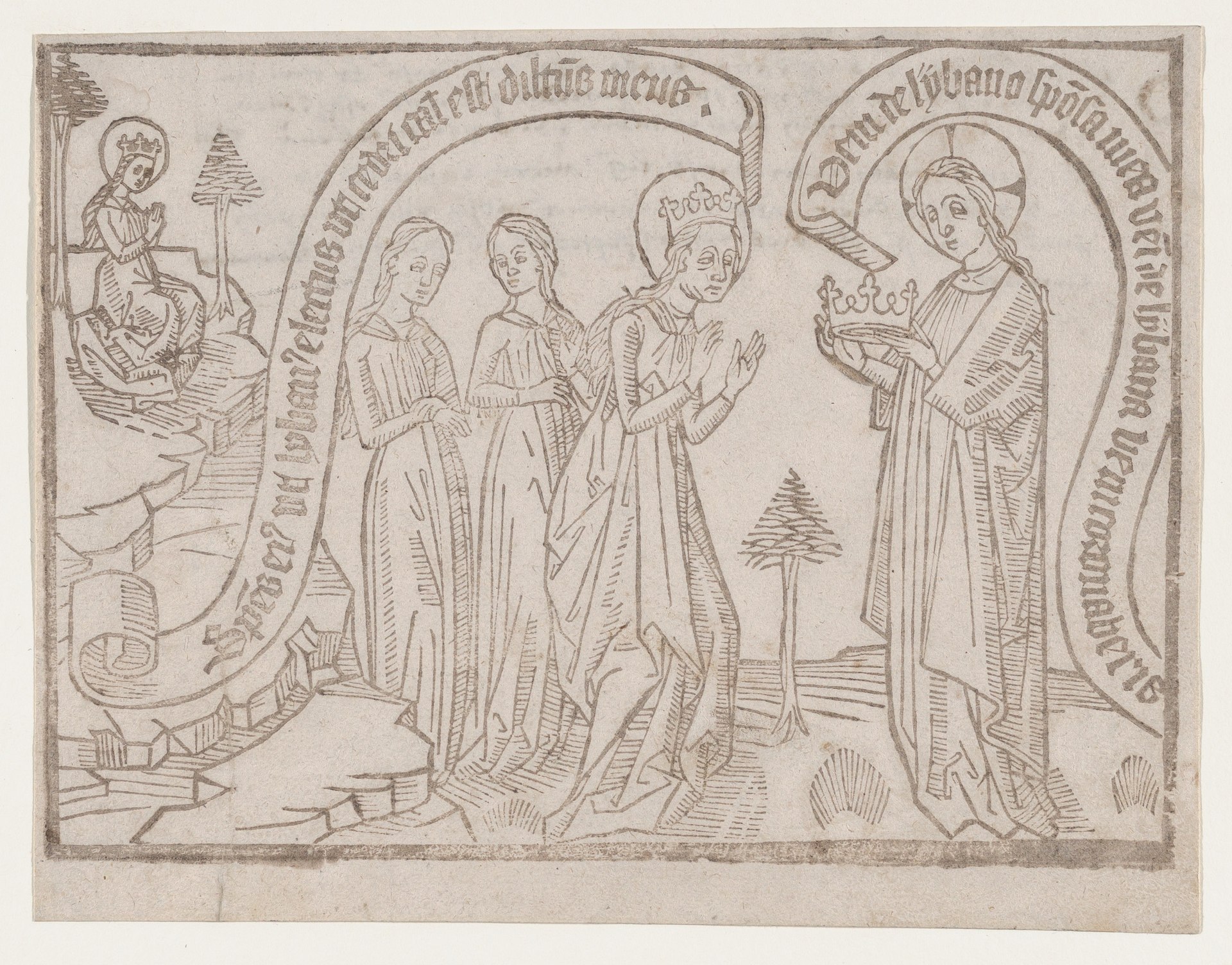 Source: The Bridegroom Offering a Crown to the Bride, Canticum Canticorum blockbook, Metropolitan Museum of Art, CC0 via Wikimedia Commons. Medieval Western biblical artwork, not Orthodox iconography; frame the crown through Christ’s sacrificial Bridegroom glory.
Spiritual Fruit 🍇
-
Let the wilderness become fragrance. The bride comes up from the wilderness perfumed. Suffering can make the heart harsh, theatrical, or tender. Bring wilderness places to Christ until repentance, patience, humility, and compassion begin to rise like myrrh and frankincense. Do not waste pain by converting it only into complaint.
-
Guard what is holy with real boundaries. The bridal bed is surrounded by armed men. Love for Christ needs guards. Choose one guard this week: a confession appointment, a screen boundary, a firmer prayer rule, a wiser bedtime, fasting with attention, or a hard stop to a recurring fantasy. Unprotected desire rarely stays pure by accident.
-
Receive beauty as grace, not ego. “There is no spot in thee” is not self-esteem language. It is the Lamb’s cleansing. When Christ praises the Bride, He praises His own work in her. Let grace make you grateful and humble, not pleased with yourself. The pure heart marvels more at the Bridegroom than at its own progress.
-
Fence the garden of the mind. The enclosed garden and sealed fountain ask a hard question: where does your thought-water go? If the mind irrigates lust, worry, anger, envy, or endless comparison, the garden dries. Turn the stream toward Scripture, prayer, repentance, silence, and mercy. The interior life becomes fruitful where attention becomes consecrated.
-
Bring Christ your fruit, then receive His feast. The bride invites the Beloved to eat the fruit of His garden, and He answers with bread, wine, honey, and milk. This is the logic of grace. Offer Him your small obedience, and He gives back communion. Bring Him something concrete this week, a reconciled relationship, a surrendered habit, a hidden alms, a kept vigil, and expect Him to make it larger than you offered.
Teaching Notes
Song 3:6-11 - The procession from the wilderness and the crowned king
- Key phrases: “The wilderness has not destroyed her”; “A love that refuses guards quickly becomes prey”; “This study hears the Bridegroom’s crown most clearly in the Passion. That is the study’s own reading.”
- Emphasize: The procession is bridal glory shaped by myrrh and frankincense, suffering and divine glory together.
- Avoid: Do not make the procession merely decorative. Tie beauty to guarded holiness and to Christ’s Cross.
- Show: Use the blockbook crown image to contrast ordinary bridal glory with Christ the Bridegroom, whose crown is finally revealed through the Passion.
Song 4:1-7 - The Bridegroom praises the bride and declares her without blemish
- Key phrases: “A vulgar reading turns the text into sensual inventory. A fearful reading becomes embarrassed by Scripture”; “The Church is beautiful because Christ cleanses her”; “Beauty is cruciform before it is radiant.”
- Emphasize: The Bridegroom’s praise is grace, not ego reinforcement.
- Avoid: Do not dwell on anatomical detail. Interpret the imagery through purity, speech, perception, spiritual strength, and Christ’s cleansing love.
Song 4:8-15 - Come from Lebanon, my sister, my spouse, a garden enclosed
- Key phrases: “Not every height is holiness”; “The enclosure is not repression. It is protection for fruit”; “The sealed fountain is the guarded mind.”
- Emphasize: The enclosed garden is one of the clearest images for Orthodox ascetic life: guarded, watered, fruitful, and fragrant.
- Avoid: Do not present commandments as mere restriction. Show them as the fence that protects love.
Song 4:16-5:1 - The winds, the spices, and the banquet of communion
- Key phrases: “Purity reaches its purpose”; “The bride invites the Beloved into his garden”; “Christ’s delight in the Bride becomes nourishment for the brethren.”
- Emphasize: The enclosed garden is not sterile withdrawal. It is holiness made fruitful and rightly offered.
- Avoid: Do not turn the banquet into either vague symbolism or a crude one-to-one sacramental proof text. Keep the Eucharistic resonance reverent and typological.
Suggested timing: 75 to 90 minutes.
- Opening and section rationale: 8 minutes.
- Song 3:6-11: 15 minutes. Linger on wilderness, fragrance, guards, crown, and Christ the Bridegroom.
- Song 4:1-7: 18 minutes. Handle bodily imagery reverently and move to Christ’s cleansing love.
- Song 4:8-15: 25 minutes. This is the deepest ascetical section. Linger on enclosed garden, sealed fountain, guarded mind, and commandments as protection.
- Song 4:16-5:1: 15 minutes. Linger on winds, fragrance, and Eucharistic resonance.
- Spiritual Fruit and closing: 10 minutes.
Key phrases to say slowly: “A love that refuses guards quickly becomes prey.” “The sealed fountain is the guarded mind.” “Beauty is cruciform before it is radiant.” “Divine communion always exceeds human preparation.”
Pastoral warnings: Do not let the intimate imagery become awkward or comic. Keep the tone reverent. Also avoid using the enclosed garden to shame wounded people or control them. The point is consecration and healing, not suspicion of the body.
Accuracy notes: Brenton’s English keeps several intimate phrases that modern translations may render differently. The teacher should acknowledge the inspired bodily imagery without dwelling on it. The passage is read spiritually through the Church’s Christological, ecclesial, and ascetical tradition.
Glossary
- Myrrh: Fragrant resin tied to costly love, burial, sacrifice, and the Passion of Christ.
- Frankincense: Fragrant offering associated with worship and divine honor.
- Lebanon / Libanus: Region associated with cedars, fragrance, height, and beauty.
- Senir and Hermon: Mountain names connected with northern heights and the region near the sources of the Jordan.
- Enclosed garden: Image of the soul and Church guarded by commandments and fruitful in virtue.
- Sealed fountain: Image of guarded inner life and consecrated thought.
- Bridegroom icon: Orthodox icon of Christ in His Passion, revealing divine love through humility and suffering.
Translation and Source Notes
Embedded Scripture is from Brenton’s English Septuagint (LXX). The study reads the Song reverently within the Church’s spiritual and sacramental interpretation, while noting translation differences only when they affect interpretation.
Sources
Primary sources
- Scripture, Song of Songs 3:6-5:1, Brenton Septuagint.
- St Gregory of Nyssa, Homilies on the Song of Songs, especially Homilies 8-10, accessed through the Richard A. Norris Jr.’s translation where a sentence is quoted; otherwise the homily is paraphrased.
- St Hippolytus of Rome, fragment on Song of Songs 4:16, in The Extant Works and Fragments of Hippolytus.
- Origen, Commentary on the Song of Songs, Prologue, trans. R. P. Lawson.
- New Testament cross-references: Ephesians 5:25-27; Revelation 19; Revelation 21-22.
Secondary academic sources
- J. Cheryl Exum, Song of Songs: A Commentary, Old Testament Library.
- Tremper Longman III, Song of Songs, New International Commentary on the Old Testament.
- Richard S. Hess, Song of Songs, Baker Commentary on the Old Testament Wisdom and Psalms.
- Marvin H. Pope, Song of Songs, Anchor Bible.
- Robert Alter, The Hebrew Bible: A Translation with Commentary, Song of Songs notes.
- Ancient Christian Commentary on Scripture: Proverbs, Ecclesiastes, Song of Solomon.
Coptic Orthodox / pastoral sources
- Fr Tadros Yacoub Malaty, The Song of Songs: A Patristic Commentary, St George’s Coptic Orthodox Church, Sporting, Alexandria, 2005.
- Orthodox Study Bible, notes on Song of Songs and bridal imagery.
Web pages and non-academic sources cited
- Origen, Commentary on the Song of Songs and Homilies on the Song of Songs, R. P. Lawson translation, Internet Archive: https://archive.org/details/origen_202001
- St Gregory of Nyssa, Homilies on the Song of Songs, English access copy: https://www.lectio-divina.org/images/nyssa/Commentary%20on%20the%20Song%20of%20Songs%201.pdf
- St Hippolytus of Rome, Exegetical Fragments, New Advent: https://www.newadvent.org/fathers/0502.htm
- Fr Tadros Yacoub Malaty, The Song of Songs: A Patristic Commentary, Coptic Treasures: https://ml.coptic-treasures.com/book/24-song-of-songs-fr-tadros-malaty/
- Christ the Bridegroom icon and Holy Week resonance, OrthodoxWiki: https://orthodoxwiki.org/Christ_the_Bridegroom
- Bridegroom services overview, Greek Orthodox Archdiocese of America: https://www.goarch.org/holyweek/-/asset_publisher/jmeEaN3ENwrl/content/the-services-of-the-bridegroom
Closing Meditation
The Bridegroom does not seek a wild field trampled by every passion. He seeks a garden, guarded and watered, full of fragrance. Let the commandments become a fence, not a prison. Let the mind become a sealed fountain, not a leaking cistern. Then invite Him into what is already His, and let Him make your small fruit into feast.