


This narration is from a previous version of the study and may include a combined recording of multiple chapters.
The second movement of the Song begins with the Beloved coming before the bride has gone looking for Him. He crosses mountains, stands behind the wall, looks through the lattice, and calls her to rise. Then the movement turns: the bride who was called by day must seek by night, learning that love matures not only through consolation but through faithful searching when the Beloved seems absent.
This section combines Song 2:8-3:5 because it forms one spiritual arc: visitation, invitation, vigilance over the vineyard, mutual belonging, night search, finding, holding, and the second adjuration. The previous study ended with the bride in the wine house and the first warning not to awaken love before its time. The next study, Song 3:6-5:1, moves from private search to public wedding procession and the enclosed garden.
Historical and Scriptural Context
The poem’s second movement shifts from interior chamber and banquet imagery to movement through the land. Mountains, hills, windows, lattice, flowers, fig tree, vines, rocks, foxes, city streets, and watchmen fill the scene. The language is not random decoration. The beloved’s arrival in springtime and the bride’s night search together teach the rhythm of divine love: grace comes first, but the soul must still rise, guard, seek, and cling.
In the wider canon, these images connect with major biblical patterns. God visits His people. The Lord calls Israel out of winter into covenant fruitfulness. The prophets speak of God wooing Israel back into the wilderness and renewing her as bride. The New Testament reveals Christ as the Bridegroom, whose voice awakens the dead and whose Resurrection turns winter into spring. Yet the Church also knows the night search: Mary Magdalene weeping at the tomb, the disciples on the road to Emmaus, and every soul that seeks Christ in dryness.
Geographical Significance ⛰️
This passage moves across mountains, hills, vineyards, rocks, and city streets. The beloved comes leaping over the mountains, which makes his approach feel impossible to stop. Barriers that look immovable to the bride are crossed by him with ease. Spiritually, Christ crosses the distance sin created. He comes through the Incarnation, through the Cross, through the sealed tomb, and through the closed doors where the disciples are hiding.
The bride is then addressed as a dove in the shelter of the rock, near the wall. The rock suggests refuge and hiddenness, but also distance. She is safe, yet concealed. The beloved calls for her face and voice. Love does not leave the soul hidden forever. It summons the soul into honest prayer.
The night search in the city gives a different geography. The bride leaves the bed, goes into streets and marketplaces, meets watchmen, and keeps searching. This is the geography of active repentance. When consolation is absent, the soul must not stay on the bed of passivity. It must rise and seek.
The Characters 👥
The Beloved / kinsman. He comes first, calls the bride, and speaks the language of spring, fruitfulness, and beauty. In the Church’s reading, he reveals Christ the Bridegroom who comes to the soul before the soul has earned His approach.
The Bride. She hears, remembers, responds, searches, and clings. Her love is real, but still being trained. She is called to arise by day and to seek by night.
The little foxes. They are small destroyers of the vineyard. Spiritually, they represent sins, distractions, compromises, resentments, habits, and fantasies that seem minor but ruin tender fruit.
The watchmen. They appear in the night search. They can represent the visible guardians of the city, and spiritually, those who may help or fail to help the searching soul. In this section they do not wound her, as they will later in Song 5, but they also do not satisfy her longing.
🕯️ Light from the Word
Song 2:8-13 - The voice over the mountains and the call to rise
Before the reading: Brenton includes “on the mountains of Bæthel” in Song 2:9. The Hebrew text behind the NKJV has no mountain phrase in that verse. At Song 2:17 the Hebrew name Bether appears in the Greek as “mountains of the ravines.” Song 2:12 says “the time of pruning has arrived.” The NKJV reads “the time of singing has come.” The pruning taught below depends on the Greek. Song 3:5 returns to the oath “by the powers and by the virtues of the field,” explained in the previous study.
- The voice of my kinsman! behold, he comes leaping over the mountains, bounding over the hills.
- My kinsman is like a roe or a young hart on the mountains of Bæthel: behold, he is behind our wall, looking through the windows, peeping through the lattices.
- My kinsman answers, and says to me, Rise up, come, my companion, my fair one, my dove.
- For, behold, the winter is past, the rain is gone, it has departed.
- The flowers are seen in the land; the time of pruning has arrived; the voice of the turtle-dove has been heard in our land.
- The fig-tree has put forth its young figs, the vines put forth the tender grape, they yield a smell: arise, come, my companion, my fair one, my dove; yea, come.
The bride hears the voice before she sees the face. This is often how grace begins. A word reaches the heart. A phrase from Scripture pierces. A hymn will not leave the mind. A quiet conviction returns during prayer. The Bridegroom’s voice arrives first, and the soul knows, even before full sight, that He is near.
The beloved comes “leaping over the mountains, bounding over the hills.” The mountains are not described as obstacles to him. They are the stage of his speed. In the Christian reading, this belongs to the mystery of Christ’s initiative. The Word crosses the distance between God and man. He leaps, as it were, from heaven to the womb of the Virgin, from the manger to the Jordan, from the wilderness to the Cross, from the Cross to Hades, from Hades to Resurrection. Nothing created can block the Bridegroom’s love.
Yet he stands “behind our wall,” looking through windows and lattice. He is near, but not yet fully manifest. This is spiritually exact. God often comes close enough to awaken desire but not in a way that abolishes freedom. He looks through the lattice. He calls. He does not violate the bride. Love summons, it does not coerce.
His command is simple: “Rise up, come.” The bride is called companion, fair one, dove. She is not summoned by insult. She is summoned by restored identity. The soul rises best when it hears who Christ says it is. Shame often paralyzes. Grace calls by name and restores movement.
The winter has passed. Flowers appear. The time of pruning has arrived. This is not only comfort. Spring brings both blossoms and pruning. When Christ calls the soul out of winter, He also begins to cut away what will prevent fruit. Repentance is spring work. It is not merely sorrow over dead branches. It is the pruning that lets living branches bear.
St Gregory of Nyssa’s interpretation of the Song as the soul being led toward spiritual marriage helps here. The call “Rise up, come” is not a one-time emotional invitation. It is the recurring summons of the Bridegroom as the soul grows. Each new nearness reveals another place that must rise, another winter that must end, another branch that must be pruned.
Grace Crossing Barriers
Brenton’s difficult phrase about the mountains of Baethel should not be overpressed into precise geography. The spiritual force is the swiftness of the Beloved crossing barriers the bride could not cross alone. Grace does not wait until the soul has solved every height and wall. Christ comes, calls, and makes rising possible.
Song 2:14-17 - The dove in the rock, the little foxes, and mutual belonging
- Thou art my dove, in the shelter of the rock, near the wall: shew me thy face, and cause me to hear thy voice; for thy voice is sweet, and thy countenance is beautiful.
- Take us the little foxes that spoil the vines: for our vines put forth tender grapes.
- My kinsman is mine, and I am his: he feeds his flock among the lilies.
- Until the day dawn, and the shadows depart, turn, my kinsman, be thou like to a roe or young hart on the mountains of the ravines.
The bride is a dove in the shelter of the rock. A dove suggests innocence, gentleness, and the Spirit’s presence. The rock suggests refuge. But the beloved asks to see her face and hear her voice. It is possible to hide even in religious safety. A person can use reverence, caution, tradition, or busyness as a wall behind which the face never appears and the voice never prays honestly.
“Shew me thy face, and cause me to hear thy voice” is one of the most tender commands in the passage. Christ wants the face, not the mask. He wants the voice, not only correct formulas recited without attention. This does not mean the Church’s prayers are unimportant. It means that the person praying them must be present. The Psalms, Agpeya, hymns, and liturgy are not hiding places from God. They are the place where the soul learns to show its face.
Then comes the command about the little foxes. This line is severe because the danger is small. The vines are tender, and tender fruit can be ruined by what seems harmless. Not every sin first appears as a wolf. Some arrive as small indulgences: a private resentment, a repeated fantasy, a little dishonesty, a secret contempt, a lazy delay in prayer, a sarcastic habit, a screen we keep returning to, a wound we refuse to bring to confession. The fox is small, but it knows how to spoil a vineyard.
This is especially important after the springtime call. When a person returns to prayer, begins confession, starts serving, or receives fresh grace, the earliest fruit is tender. The enemy often does not need to destroy the whole vineyard. He only needs to let the little foxes run long enough that tenderness never becomes maturity.
The bride then says, “My kinsman is mine, and I am his.” This mutual belonging is not possession in the fallen sense. It is covenant. In Christian terms, the Church belongs to Christ because Christ first gave Himself to the Church. St Paul says, “Christ also loved the church and gave Himself for her” (Ephesians 5:25, NKJV). The soul can say “I am His” only because He has already said, “You are Mine.”
The unit ends before dawn. “Until the day dawn, and the shadows depart” gives the whole Christian life an eschatological tension. We belong to Christ now, but shadows remain. We taste communion now, but we still pray for the full day. The bride’s cry for the beloved to turn like a young hart is the prayer of the Church between Resurrection and the Kingdom: come near again, until all shadows leave.
Pruning, Foxes, and the True Vine
The little foxes belong beside Christ’s word in John 15. The Father prunes the branches that bear fruit so they may bear more fruit. Pruning is not cruelty. It is mercy that removes what drains love before it ripens. Small compromises matter because they wound communion quietly.
Song 3:1-5 - The night search, the watchmen, and holding the Beloved
- By night on my bed I sought him whom my soul loves: I sought him, but found him not; I called him, but he hearkened not to me.
- I will rise now, and go about in the city, in the market-places, and in the streets, and I will seek him whom my soul loves: I sought him, but I found him not.
- The watchmen who go their rounds in the city found me. I said, Have ye seen him whom my soul loves?
- It was as a little while after I parted from them, that I found him whom my soul loves: I held him, and did not let him go, until I brought him into my mother’s house, and into the chamber of her that conceived me.
- I have charged you, O daughters of Jerusalem, by the powers and by the virtues of the field, that ye rouse not nor awake my love, until he please.
The bride was called by day, but now she seeks by night. This is the passage’s turn from consolation to testing. On the bed, she seeks but does not find. She calls, but no answer comes. The line is spiritually honest. Faithful people sometimes pray and feel no answer. They may call and seem unheard. The Song does not hide this. Mature love must learn to seek Christ when sweetness is absent.
The decisive phrase is, “I will rise now.” She does not stay on the bed of passive sorrow. She enters the city, the marketplaces, and the streets. The soul must sometimes seek God by changing its posture. Rise from bed. Open the Psalms. Go to confession. Return to liturgy. Ask counsel. Forgive. Stop the habit. Walk in the streets rather than feeding despair in private.
The watchmen find her. In the poem, they are guardians of the city. Spiritually, they remind us that the search for Christ passes through the Church’s visible life: clergy, elders, confessors, teachers, saints, and faithful friends. Yet the watchmen are not the Beloved. They can point, guard, and witness, but they cannot become Christ for the soul. A spiritual father can guide the search, but cannot replace the Bridegroom.
The bride finds him “a little while” after leaving the watchmen. That small phrase matters. Sometimes counsel brings us close, but the encounter remains personal. The soul must not stop at talking about prayer, reading about prayer, or receiving advice about prayer. It must seek Him whom the soul loves.
When she finds him, she holds him and does not let go. This language should be read in the light of resurrection. Mary Magdalene seeks Christ early while it is still dark, weeps near the tomb, and then hears her name. Christ tells her, “Do not cling to Me” (John 20:17, NKJV), not because love is rejected, but because His risen presence must be received in a new way. The Song’s bride clings because love has found what it sought. The Gospel purifies that clinging into apostolic witness: go and tell.
She brings him into her mother’s house and the chamber of the one who conceived her. The image is intimate and ancestral. Spiritually, the Church can hear the soul bringing Christ into the deepest place of origin, memory, and formation. Nothing in us should remain outside His presence: family wounds, childhood memories, inherited fears, hidden shame, old patterns, and the places where desire was first bent or broken. The Beloved must be brought there too.
The section ends with the second adjuration not to awaken love until he please. After the night search, the warning returns. Even true finding does not authorize spiritual impatience. The soul must not turn one encounter with grace into control. It must hold Christ faithfully, but still let love be governed by Him.
Origen’s warning about the Song belongs here again. Carnal reading wants to seize the text. Spiritual reading learns to be purified by it. St Gregory of Nyssa’s call to enter the bridal chamber with “pure and undefiled thoughts” is not an optional pious note. It is the only safe way to read the bride’s night search, her finding, and her holding.
Night Seeking Without Scrupulosity
The night search is perseverance in love, not obsessive anxiety. When grief, trauma, exhaustion, or depression darken the heart, the faithful need prayer, wise pastoral care, and practical help, not quick accusations. The bride teaches the soul to keep seeking Christ without turning absence into self-punishment.
The Mother’s House as Church
The motherly house is also the Church’s maternal life. Baptismal memory, confession, Eucharist, counsel, and the prayers of the saints teach personal love to remain inside communion. The soul finds the Beloved and brings that love into the whole house: memory, body, wounds, family, and future.
The Church’s Voice in Worship 📖
The Coptic Church reads the Song of Songs at the Consecration of the Holy Myron, a rare rite celebrated by the Pope of Alexandria. Among the prophecies the whole book is read chapter by chapter: Song 1, Song 2, Song 3, Song 4, Song 5, Song 6, Song 7, and Song 8. The verses of this study fall within the Myron readings of Song 2 and Song 3. The same rite also reads the making of the holy anointing oil (Exodus 30:22-33 and Exodus 30:22-38), the woman who poured costly spikenard on the Lord’s head (Mark 14:3-9), and Isaiah 61:1-11, the Spirit of the Lord upon the Anointed One. No daily, Sunday, feast, or Holy Week reading from the Song appears in the lectionary used here.
That appointment is more than a general echo of fragrance. The Church reads “thy name is ointment poured forth” (Song 1:3), “my spikenard gave forth its smell” (Song 1:12), and “Set me as a seal upon thy heart” (Song 8:6) at the rite in which she consecrates the oil with which the newly baptized are sealed. The connection is this study’s reading of the rite, not a claim that the service book explains the Song. It does not need to. The readings themselves place ointment, spikenard, and seal beside the oil.
“Rise up, come” is how Christ addresses a soul still wintering in herself. The night search should not be pinned to Midnight Praise. The verified Coptic vigil is the first watch of the Agpeya Midnight Prayer, and its Gospel is the ten virgins (Matthew 25:1-13). The Song is not appointed there. The likeness is real all the same. A soul can love the Bridegroom and still be found unready in the dark.
Fr. Tadros Malaty reads Song 3:1-5 in both directions at once: the Church seeking Christ, and the soul, as a member of the Church, holding Him and refusing to let Him go. When consolation withdraws, the Church does not teach self-pity. She teaches the soul to keep seeking through psalmody, prostration, confession, and patient presence at the services. The little foxes give the vigil its practical edge. Fasting seasons expose the small destroyers of love: irritation, vanity, curiosity, resentment, and wasted attention.
Iconography Connection 🖼️
Christ in His Passion remains the central image. The Byzantine Bridegroom icon shows the One who crosses every mountain of separation by humility and suffering. He stands near the wall of the human heart, not as a violator, but as the One who knocks. Revelation uses this same image: “Behold, I stand at the door and knock” (Revelation 3:20, NKJV).
The night search also resonates with icons of St Mary Magdalene at the tomb. She seeks the Lord while it is still dark, mistakes Him for the gardener, then recognizes Him when He speaks her name. This Gospel scene is not the same text, but it is a powerful Christian echo of the soul seeking Him whom it loves.
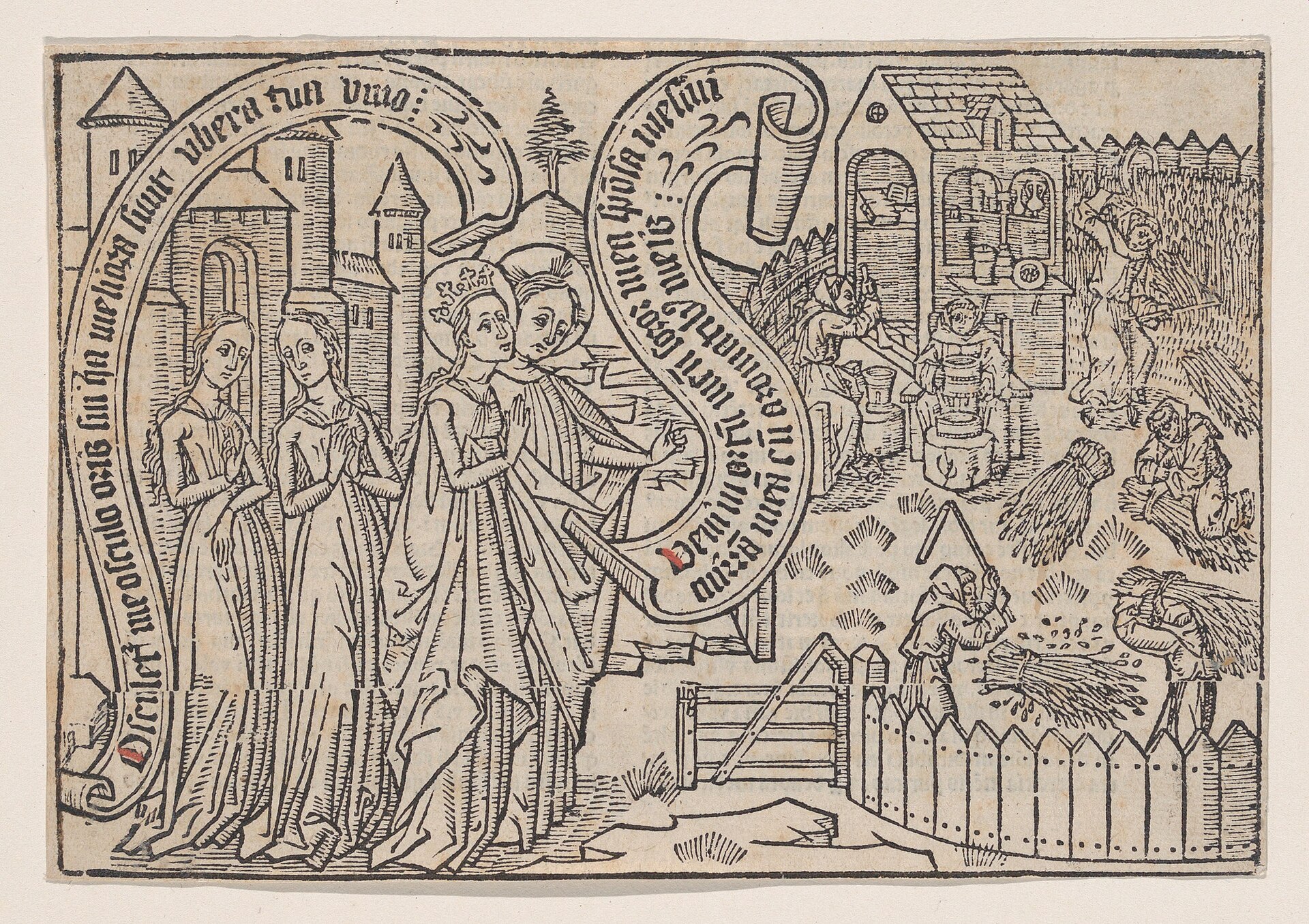 Source: The Bridegroom Showing the Bride His Land, Canticum Canticorum blockbook, Metropolitan Museum of Art, CC0 via Wikimedia Commons. Medieval Western biblical artwork, not Orthodox iconography; useful for the call to rise and behold the land.
Spiritual Fruit 🍇
-
Listen for the voice before demanding full sight. The bride first hears the beloved. Christ often gives enough light to obey before He gives enough light to feel secure. In Scripture, conscience, hymns, and the Church’s counsel, He is already saying, “Rise up, come.” Obey the voice you have rather than delaying until every fear is answered.
-
Let spring include pruning. If Christ is calling you out of winter, do not be surprised when He also cuts away dead wood. Fresh grace often brings sharper repentance. Sometimes what feels like loss is actually room being made for fruit. Name the branch that needs pruning now, resentment, vanity, distraction, indulgence, or self-protection.
-
Catch the little foxes early. The vineyard is usually not destroyed by one dramatic act. It is nibbled by tolerated compromises: one repeated irritation, one private fantasy, one hidden habit, one refusal to forgive, one neglected prayer rule, one curiosity that keeps returning to poison. A daily examen is often more powerful than dramatic promises.
-
Rise from passive sorrow. The bride says, “I will rise now.” Spiritual sadness can become secretly self-indulgent when it produces no obedience. When prayer feels dry, do one concrete faithful thing: stand for the Agpeya, read one Psalm, ask forgiveness, schedule confession, attend liturgy, take a walk with the Jesus Prayer, or call someone wise instead of remaining alone in the dark.
-
Do not confuse guides with the Bridegroom. The watchmen matter, but they are not the one the soul loves. Spiritual fathers, books, friends, and teachers are gifts, yet they cannot replace communion. Receive counsel gratefully, then keep going until your heart rests in Christ Himself.
Teaching Notes
Song 2:8-13 - The voice over the mountains and the call to rise
- Key phrases: “The bride hears the voice before she sees the face”; “Love summons, it does not coerce”; “Spring brings both blossoms and pruning.”
- Emphasize: The Beloved’s initiative. Christ comes first, but the soul must rise.
- Avoid: Do not turn spring imagery into vague optimism. Keep pruning and repentance in view.
- Show: Use the blockbook image as a reception-history aid for the Beloved’s call to rise and behold the land. Make clear it is Western biblical artwork, not an Orthodox icon.
Song 2:14-17 - The dove in the rock, the little foxes, and mutual belonging
- Key phrases: “Christ wants the face, not the mask”; “The fox is small, but it knows how to spoil a vineyard”; “We belong to Christ now, but shadows remain.”
- Emphasize: Small sins are not small when fruit is tender.
- Avoid: Do not make the little foxes only about obvious sins. Include resentment, delay, fantasy, distraction, subtle pride, and hidden contempt.
Song 3:1-5 - The night search, the watchmen, and holding the Beloved
- Key phrases: “Mature love must learn to seek Christ when sweetness is absent”; “The watchmen are not the Beloved”; “The Beloved must be brought into the deepest places of origin, memory, and formation.”
- Emphasize: Dryness is not proof that Christ is absent. It may be the place where love becomes active.
- Avoid: Do not romanticize spiritual darkness. Name concrete faithful responses: prayer, confession, counsel, forgiveness, liturgy, and perseverance.
Suggested timing: 60 to 75 minutes.
- Opening context and section rationale: 8 minutes.
- Song 2:8-13: 18 minutes. Linger on voice, mountains, wall, spring, and pruning.
- Song 2:14-17: 18 minutes. Linger on showing the face and catching little foxes.
- Song 3:1-5: 20 minutes. Linger on dryness, active seeking, watchmen, and bringing Christ into the mother’s house.
- Spiritual Fruit and closing: 10 minutes.
Key phrases to say slowly: “Love summons, it does not coerce.” “The fox is small, but it knows how to spoil a vineyard.” “The watchmen are not the Beloved.” “Dryness is not proof that Christ is absent.”
Pastoral warnings: Do not shame people for spiritual dryness. The bride’s night search is not failure. It becomes failure only if she refuses to rise. Also avoid romanticizing anxiety or obsessive religious striving. The passage calls for faithful seeking, not panic.
Accuracy notes: The “mountains of Bæthel” in Brenton reflects the Septuagint wording. Some modern translations render the phrase differently. The study should keep Brenton’s text as embedded Scripture while interpreting the image broadly as the beloved’s swift approach across barriers.
Glossary
- Bæthel: Brenton’s rendering in Song 2:9. The precise place/reference is difficult, but the image functions poetically with mountains and swift approach.
- Turtle-dove: A migratory bird whose voice signals the season’s change.
- Pruning: Agricultural cutting that enables fruitfulness. Spiritually, repentance and discipline that remove what hinders growth.
- Little foxes: Small destructive forces that ruin tender vines. Spiritually, subtle sins and compromises.
- Watchmen: City guardians. Spiritually, they can represent guides and guardians in the visible life of the Church, but they are not Christ Himself.
- Adjuration: A solemn charge. In this section, it warns again against forcing love before its proper time.
Translation and Source Notes
Embedded Scripture is from Brenton’s English Septuagint (LXX). The study reads the Song reverently within the Church’s spiritual and sacramental interpretation, while noting translation differences only when they affect interpretation.
Sources
Primary sources
- Scripture, Song of Songs 2:8-3:5, Brenton Septuagint.
- St Gregory of Nyssa, Homilies on the Song of Songs, especially Homily 1 and the broader theme of the soul’s ascent in purified love.
- Origen, Commentary on the Song of Songs, Prologue, trans. R. P. Lawson.
- New Testament cross-references: John 20:1-18; Ephesians 5:25-32; Revelation 3:20; Revelation 19.
Secondary academic sources
- J. Cheryl Exum, Song of Songs: A Commentary, Old Testament Library.
- Tremper Longman III, Song of Songs, New International Commentary on the Old Testament.
- Richard S. Hess, Song of Songs, Baker Commentary on the Old Testament Wisdom and Psalms.
- Marvin H. Pope, Song of Songs, Anchor Bible.
- Robert Alter, The Hebrew Bible: A Translation with Commentary, Song of Songs notes.
- Ancient Christian Commentary on Scripture: Proverbs, Ecclesiastes, Song of Solomon.
Coptic Orthodox / pastoral sources
- Fr Tadros Yacoub Malaty, The Song of Songs: A Patristic Commentary, St George’s Coptic Orthodox Church, Sporting, Alexandria, 2005.
- Orthodox Study Bible, notes on Song of Songs and bridal imagery.
Web pages and non-academic sources cited
- Origen, Commentary on the Song of Songs and Homilies on the Song of Songs, R. P. Lawson translation, Internet Archive: https://archive.org/details/origen_202001
- St Gregory of Nyssa, Homilies on the Song of Songs, English access copy: https://www.lectio-divina.org/images/nyssa/Commentary%20on%20the%20Song%20of%20Songs%201.pdf
- St Hippolytus of Rome, Exegetical Fragments, New Advent: https://www.newadvent.org/fathers/0502.htm
- Fr Tadros Yacoub Malaty, The Song of Songs: A Patristic Commentary, Coptic Treasures: https://ml.coptic-treasures.com/book/24-song-of-songs-fr-tadros-malaty/
- Christ the Bridegroom icon and Holy Week resonance, OrthodoxWiki: https://orthodoxwiki.org/Christ_the_Bridegroom
- Bridegroom services overview, Greek Orthodox Archdiocese of America: https://www.goarch.org/holyweek/-/asset_publisher/jmeEaN3ENwrl/content/the-services-of-the-bridegroom
Closing Meditation
The Bridegroom comes over mountains before the bride knows how to rise. He calls through the lattice and asks for the face, not the mask. When night comes and He seems absent, do not make a home in the bed of sorrow. Rise, seek, ask, and keep walking until the soul can say again: I found Him whom my soul loves.