


Judges 3 gives the pattern of mercy three different narrative forms. Othniel is empowered by the Spirit, Ehud brings deliverance through a disturbing act of violence, and Shamgar receives only a brief notice. The Lord raises help in each case. The chapter also searches what happens after help arrives: a people can gain rest while remaining vulnerable to the same divided allegiance.
Historical and Scriptural Context
The opening verses continue Judges 2:20-23, holding together covenant-breaking, testing, and the learning of warfare. The narrative then moves into the first judges. Othniel, already known from the Caleb and Achsah account, gives a clear short example of cry, Spirit-given deliverance, and rest. Ehud’s longer story requires particular care because it includes concealment and killing. Shamgar’s single verse closes the chapter without supplying a full biography.
Each account concerns a real historical rescue. Christian spiritual reading must keep that sense visible while directing warfare against sin and spiritual evil, under the discipline of Christ’s commandments. The promise of God’s help in 1 Corinthians 10:13 belongs beside the warning against returning to the old worship.
Geographical Significance ⛰️
- Syria of the rivers / Aram-Naharaim / Mesopotamian region: the sphere associated with Chusarsathaim, showing that Israel’s first narrated oppression in Judges comes from a wider regional power to the northeast.
- The city of Palm-trees: commonly associated with Jericho and its oasis setting, a strategic and symbolic location near the Jordan corridor.
- Mount Ephraim: the hill country from which Ehud rallies Israel after his escape.
- The fords of the Jordan: militarily decisive crossing points; by seizing them, Israel cuts off Moabite retreat and reinforcement.
- Philistine territory: represented briefly in Shamgar’s notice, reminding the reader that threats also press from the coastal plain and southwestern frontier.
- Libanus / Lebanon and mount Aermon: mentioned in the opening test-list, indicating the northern reach of the peoples left in the land.
The Characters 👥
- The Lord: the true judge of Israel’s sin and the true source of deliverance.
- Israel: forgetful in worship and allegiance, yet still heard when crying to the Lord.
- Othniel / Gothoniel: the first major judge in the book’s cycle, presented tersely and with unusual clarity.
- Chusarsathaim: king of “Syria of the rivers,” the oppressor in Othniel’s episode.
- Ehud / Aod: the Benjaminite deliverer whose unexpected bodily skill and daring become central to the narrative.
- Eglon / Eglom: king of Moab, instrument of Israel’s chastisement and recipient of divine judgment.
- Ammon and Amalek: allies joined with Moab against Israel.
- Shamgar / Samegar: one-verse deliverer whose ordinary farming implement becomes an instrument of rescue.
Iconography and Visual Teaching 🖼️
This schematic locates Moab, Jericho, and Benjamin. It is an approximate orientation aid, not a reconstruction of Ehud’s exact route.
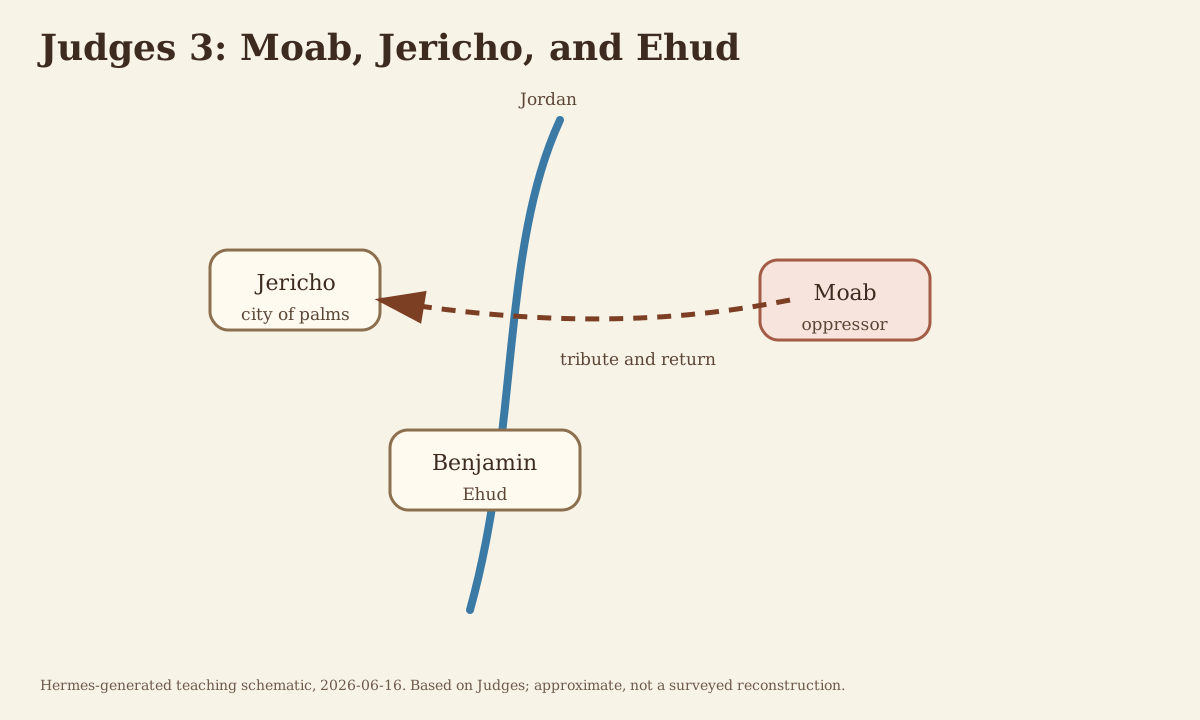 Source: Hermes-generated teaching schematic, 2026-06-16; approximate, not a surveyed reconstruction.
Light from the Word 🕯️
The Scripture is followed in its natural units below.
The nations remain as a test (Judges 3:1-6)
1 And these are the nations which the Lord left to prove Israel with them, all that had not known the wars of Chanaan. 2 Only for the sake of the generations of Israel, to teach them war, only the men before them knew them not. 3 The five lordships of the Phylistines, and every Chananite, and the Sidonian, and the Evite who dwelt in Libanus from the mount of Aermon to Laboemath. 4 And this was done in order to prove Israel by them, to know whether they would obey the commands of the Lord, which he charged their fathers by the hand of Moses.
5 And the children of Israel dwelt in the midst of the Chananite, and the Chettite, and the Amorite, and the Pherezite, and the Evite, and the Jebusite. 6 And they took their daughters for wives to themselves, and they gave their daughters to their sons, and served their gods.
The chapter completes the account of why the nations remain. Judges 2:20-23 speaks of covenant-breaking and testing; these verses also speak of teaching a generation warfare. Those reasons must be held together. The military setting is real, but verse 4 gives the decisive question: will Israel obey the Lord’s commandments?
The answer arrives before the first judge is raised. Israel dwells among the nations, marries into their households, and serves their gods. The account moves from proximity to shared allegiance. Its religious warning does not license contempt for an interethnic marriage or hostility toward another people. The New Covenant gathers people from every nation, and Ephesians 6:10-18 directs Christian warfare against spiritual evil rather than flesh and blood.
Gems from the Fathers 💎: Learning to depend on God’s aid
St. John Cassian’s Conferences 4.6 directly quotes Judges 3:1-4. In the teaching of Abbot Daniel, the continuing conflict keeps Israel conscious of its need to invoke God’s help. Cassian does not say that God envies their peace or wishes to injure them. The danger he identifies is forgetfulness during ease: “For again and again, men whom adversity could not overcome, have been cast down by freedom from care and by prosperity.”1
His point reaches into ordinary spiritual life. A difficult season may teach us to pray, but a quiet season tests whether prayer has become love or remains only a response to alarm. Cassian also appeals here to 1 Corinthians 10:13: endurance depends on God’s faithful aid. This reading neither makes suffering desirable nor tells someone to remain in a harmful situation. It calls the person to receive God’s help in the struggle that is actually present.
Othniel and the first full cycle of deliverance (Judges 3:7-11)
7 And the children of Israel did evil in the sight of the Lord, and forgot the Lord their God, and served Baalim and the groves. 8 And the Lord was very angry with Israel, and sold them into the hand of Chusarsathaim king of Syria of the rivers: and the children of Israel served Chusarsathaim eight years.
9 And the children of Israel cried to the Lord; and the Lord raised up a saviour to Israel, and he saved them, Gothoniel the son of Kenez, the brother of Chaleb younger than himself. 10 And the Spirit of the Lord came upon him, and he judged Israel; and he went out to war against Chusarsathaim: and the Lord delivered into his hand Chusarsathaim king of Syria of the rivers, and his hand prevailed against Chusarsathaim. 11 And the land was quiet forty years; and Gothoniel the son of Kenez died.
Othniel’s story gives the cycle in its clearest short form: evil, forgetting, idolatry, oppression, a cry to the Lord, deliverance, and rest. The order matters. Israel’s cry does not manufacture a savior; the Lord raises one. The Spirit comes upon Othniel before he goes out to war, and the Lord gives the oppressor into his hand. The judge acts, but the account keeps God’s action at the center.
“Forgot the Lord” names a change of loyalty, not simply a lapse of recollection. The people live as though the One who delivered them has no claim upon their present choices. Fr. Tadros Y. Malaty, commenting on Judges 3:10 under “Othniel Set a Judge,” directs attention to the Spirit rather than Othniel’s strength. The spiritual cure begins with receiving God’s aid instead of making competence a substitute for communion with Him.2
Language insight: “a saviour”
Verse 9 calls Othniel σωτήρ, sōtēr, a savior or deliverer; verse 15 uses the same word for Ehud. Their saving work is real within this history. The word does not identify either man with Christ. It allows the Christian to honor the gift while recognizing its limit: the judge dies, and the people remain capable of returning to their old worship. Christ saves through His Cross and Resurrection and gives the Spirit for the healing of the person, not only an interval without an oppressor.3
Gems from the Fathers 💎: The Spirit who empowered Othniel
St. Cyril of Jerusalem explicitly names Othniel while teaching about the Holy Spirit in Catechetical Lecture 16.28: “In the might of this Spirit, as we have it in the Book of Judges, Othniel judged”. He goes on to name other judges, placing their gifts within the work of the same Spirit.4
Cyril’s teaching prevents a split between the God of Israel and the God confessed by the Church. The Spirit who gives life to the baptized is no newly introduced power, and Othniel’s strength was never self-sufficient. This is doctrinal continuity, not evidence that this chapter is an appointed Coptic baptismal reading.
Eglon’s oppression and the raising up of Ehud (Judges 3:12-15)
12 And the children of Israel continued to do evil before the Lord: and the Lord strengthened Eglom king of Moab against Israel, because they had done evil before the Lord. 13 And he gathered to himself all the children of Ammon and Amalec, and went and smote Israel, and took possession of the city of Palm-trees. 14 And the children of Israel served Eglom the king of Moab eighteen years.
15 And the children of Israel cried to the Lord; and he raised up to them a saviour, Aod the son of Gera a son of Jemeni, a man who used both hands alike: and the children of Israel sent gifts by his hand to Eglom king of Moab.
After the rest associated with Othniel, Israel returns to evil. Moab, Ammon, and Amalek now occupy the city of Palm-trees, commonly identified with Jericho. The place near Israel’s entrance into the land becomes the seat of humiliation. The reversal makes clear that an earlier gift can be enjoyed without its meaning being faithfully retained.
Ehud is raised in answer to Israel’s cry, yet he first appears carrying tribute to the oppressor. God begins deliverance within the condition of servitude. The person through whom help will come is not yet publicly standing above it. That detail gives the episode its tension and keeps us from requiring a savior’s instrument to arrive already adorned with prestige.
Language insight: “used both hands alike”
The Greek calls Ehud ἀμφοτεροδέξιος, amphoterodexios, able to use both hands. Hebrew-based translations describe him as left-handed, and verse 21 explicitly says that he draws the weapon with his left hand. These are distinct textual descriptions, not grounds for diagnosing a disability or a moral quality. The same Greek adjective occurs for Benjamin’s seven hundred fighters in Judges 20:16. The tribe that supplies this deliverer will later be entangled in the horror at Gibeah and civil war. Skill can serve deliverance or deepen a people’s catastrophe; it cannot replace holiness.3
Gems from the Fathers 💎: Turning both hands toward righteousness
Cassian’s Conferences 6.10 directly interprets Ehud’s description: “as Ehud is described in the book of Judges who used either hand as the right hand.” In Abbot Theodore’s teaching, prosperity is the right hand and adversity the left. The mature person receives the former without pride and faces the latter without surrendering to despair, making both serve righteousness.5
This is a spiritual interpretation of Ehud’s bodily description, not its literal medical meaning. Its benefit is concrete: success need not make us careless, and difficulty need not make us faithless. Each condition becomes a place to practice gratitude, patience, and dependence on God.
Ehud’s hidden dagger and the judgment on Eglon (Judges 3:16-23)
16 And Aod made himself a dagger of two edges, of a span long, and he girded it under his cloak upon his right thigh. 17 And he went, and brought the presents to Eglom king of Moab, and Eglom was a very handsome man.
18 And it came to pass when Aod had made an end of offering his gifts, that he dismissed those that brought the gifts. 19 And he himself returned from the quarries that are by Galgal; and Aod said, I have a secret errand to thee, O king! and Eglom said to him, Be silent: and he sent away from his presence all who waited upon him. 20 And Aod went in to him; and he sat in his own upper summer chamber quite alone; and Aod said, I have a message from God to thee, O king: and Eglom rose up from his throne near him. 21 And it came to pass as he arose, that Aod stretched forth his left hand, and took the dagger off his right thigh, and plunged it into his belly; 22 and drove in also the haft after the blade, and the fat closed in upon the blade, for he drew not out the dagger from his belly.
23 And Aod went out to the porch, and passed out by the appointed guards, and shut the doors of the chamber upon him, and locked them.
Ehud makes a short concealed weapon, carries it on his right thigh, dismisses the tribute-bearers, and gains a private audience. Eglon rises at the announcement of a message from God. The ruler’s confidence leaves him exposed at the moment he believes himself secure. The narrative does not spare the reader the violence of his death.
Christians must not receive this as a prescription for assassination, deception, or religious revenge. It is an ancient act of deliverance narrated within Israel’s wartime history. Its spiritual application turns against the tyranny of sin, not against a person we decide has become an obstacle to God. The Cross forbids us to make another person’s destruction the fulfillment of our religious zeal.
Language insight: “two edges”, “message from God”, and “quarries”
The Greek of verse 16 is μάχαιραν δίστομον, machairan distomon, a double-edged sword or dagger. Hebrews 4:12 uses that same two-word expression when describing God’s word as sharper than every double-edged sword. Judges 3:20 also has λόγος θεοῦ, “a word/message of God,” while Hebrews has ὁ λόγος τοῦ θεοῦ, “the word of God.” The vocabulary gives a genuine resonance, but the complete expressions differ, and these words alone do not prove that Hebrews intentionally alludes to Ehud.6
The Christian comparison changes the object of the searching action. Hebrews brings our own thoughts and intentions before God. We are to let His word reach the hidden defense of sin, not appoint ourselves agents of violence against another person. The spiritual reading is strongest when it increases truthful repentance and mercy together.
Brenton’s “quarries” in verse 19 translates γλυπτά, glypta, carved objects, possibly images; the word recurs in verse 26. Judges 2:2 uses the same word for objects Israel was commanded to destroy. The possible presence of images at Gilgal is a searching contrast with its memorial stones and early acts of obedience. It must remain a possibility: the text does not identify these objects as Joshua’s stones or give an inventory of an idol sanctuary. In the B tradition followed here, Ehud turns back at them; the A text instead names Eglon in that sentence.7
Verse 17’s adjective ἀστεῖος, asteios, is rendered “handsome” here and is also used for the infant Moses in Exodus 2:2 and Hebrews 11:23. This shared adjective does not establish a Moses-Eglon typology. Nor does it remove the graphic bodily detail: verse 22 still describes fat closing over the blade. The translation difference is worth knowing without claiming that Greek Judges has made the scene genteel.3
Pastoral guardrail: Bloodshed and the life of the Church
St. Basil’s Letter 188, Canon 13, distinguishes wartime killing from ordinary homicide in the earlier Fathers’ reckoning, yet counsels three years of abstention from communion for those whose hands are not clean. His careful counsel does not make every war murder or present killing as spiritually harmless. It provides a sober canonical witness beside this narrative, not an explanation of Ehud’s verse or a penance for a reader to impose.8
Escape, trumpet, and the long rest (Judges 3:24-30)
24 And he went out: and Eglom’s servants came, and saw, and behold, the doors of the upper chamber were locked; and they said, Does he not uncover his feet in the summer-chamber? 25 And they waited till they were ashamed, and, behold, there was no one that opened the doors of the upper chamber; and they took the key, and opened them; and, behold, their lord was fallen down dead upon the earth.
26 And Aod escaped while they were in a tumult, and no one paid attention to him; and he passed the quarries, and escaped to Setirotha.
27 And it came to pass when Aod came into the land of Israel, that he blew the horn in mount Ephraim, and the children of Israel came down with him from the mountain, and he was before them. 28 And he said to them, Come down after me, for the Lord God has delivered our enemies, even Moab, into our hand; and they went down after him, and seized on the fords of Jordan before Moab, and he did not suffer a man to pass over. 29 And they smote Moab on that day about ten thousand men, every lusty person and every mighty man; and not a man escaped. 30 So Moab was humbled in that day under the hand of Israel, and the land had rest eighty years; and Aod judged them till he died.
The servants suppose that Eglon is relieving himself; “uncover his feet” is the bodily euphemism. Their delay permits Ehud’s escape. The narrative then widens from the private chamber to a gathered people: the horn sounds, Israel follows, and the Jordan fords are seized. Ehud names the Lord, rather than his own ingenuity, as the giver of the victory.
The rest of eighty years is a real mercy, not a passing detail to be dismissed because another relapse will come. Yet rest creates its own task. A people released from oppression must learn to live faithfully in the freedom received. Here the chapter’s opening question about obedience reaches beyond the immediate battle.
Ascetical application
The Jordan crossings suggest a practical comparison: after renunciation, guard the route by which the old habit returns. A confession of gossip needs a changed conversation; a confession of lust needs a changed practice of attention; a confession of anger needs patience at the point where the familiar provocation arrives. This is an application of the narrative, not a claim that its place-names secretly stand for a fixed map of the soul.
The gathering of Israel also resists an isolated picture of repentance. A person needs the Church’s prayer, sacramental forgiveness, counsel, and mutual help. A hidden decision can become a common life of obedience without becoming a public performance of spiritual success.
Shamgar and the ploughshare (Judges 3:31)
31 And after him rose up Samegar the son of Dinach, and smote the Philistines to the number of six hundred men with a ploughshare such as is drawn by oxen; and he too delivered Israel.
Shamgar’s notice is brief: he strikes the Philistines and also delivers Israel. The chapter does not supply his motives, a detailed social position, or a long account of his calling. His place in Scripture depends on the help given, not on the amount of biography preserved.
Language insight: “ploughshare” and “ox-goad”
The B Greek text followed by Brenton names a ploughshare associated with oxen, the cutting part of a plough. The Hebrew names an ox-goad, a tool for directing cattle. These are different implements, not interchangeable English labels for one object. The A Greek text has another difficult reading involving calves of cattle. This study therefore calls the implement a ploughshare while keeping the difference visible.9
Ascetical application
The notice turns our attention toward service that does not establish a person’s fame. It does not prove that every ordinary tool will become miraculous or that Shamgar’s violence is a pattern to imitate. It gives the quieter encouragement that a brief, obscure life can still be remembered for real help. A servant can do the good that is needed without demanding that the work first produce a story about the servant’s importance.
Spiritual Fruit 🍇
Continue prayer when the crisis ends. Cassian’s reading of the remaining nations exposes forgetfulness during ease. After relief, keep the fitting Agpeya Hour within your rule, with thanksgiving for the help received. The Agpeya is the Coptic book of the Hours. Its steady return to Psalms, Gospel, and petitions helps prayer become a life with God rather than an emergency instrument.
Turn both hands toward righteousness. In a success, thank God and relinquish the need to be praised; in disappointment, name one duty you can still perform without bitterness. Cassian’s reading of Ehud gives the same heart a task in both conditions. Neither prosperity nor adversity need become the master of our response.
Let the word search your own hidden chamber. The sword resonance with Hebrews 4:12 belongs first to our conscience. Before confession, identify the thought or excuse that has kept a recurring act defensible. Bring it to your father of confession, the priest who accompanies your repentance, and agree on one real change of practice. Do not make the scrutiny of another person’s faults a substitute for this return.
Guard the crossing and value the unnoticed servant. Ehud’s fords give an image for the point where a habit returns. Change that concrete point, such as the conversation, device use, or angry reply that keeps the route open. Shamgar’s brief notice also trains us to receive quiet help. Thank a person whose faithful work is usually overlooked, and do one needed task without seeking a place at the center.
The land’s rest is a gift for which to give thanks. In a quieter hour, we can learn to love the Giver without waiting for another alarm. The Spirit who empowered Othniel is not absent from the Church’s ordinary life. We can begin the next obedience with prayer rather than the demand to feel strong.
Teaching Notes
- Begin with Judges 3:1-6. Without that frame, Othniel and Ehud can sound like disconnected action stories.
- Say early and clearly that Ehud’s violent episode is descriptive, not prescriptive for Christian ethics.
- If the group fixates on the graphic detail, redirect to the larger theological themes: bondage, judgment, deliverance, and the inadequacy of merely temporary saviors.
- Use St Basil’s canonical sobriety about bloodshed as a pastoral guardrail. The Church does not romanticize violence, even when reading warfare texts.
- Contrast Othniel and Ehud. Othniel is brief, stable, and Spirit-marked. Ehud is more complex and narratively charged. That contrast helps students feel the moral texture of Judges.
- Spend time on the phrase “forgot the Lord.” It explains more than the military details do.
- Shamgar should not be skipped. His one verse is a needed lesson in God’s freedom to use obscure and ordinary servants.
- Helpful New Testament lenses include Ephesians 6:10-18 for spiritual warfare, Hebrews 4:12 for the two-edged word of God, and 1 Corinthians 10:1-12 for Israel as warning and instruction.
- If time is short, focus on Judges 3:4, 3:7-10, 3:15, 3:20, 3:28, and 3:31.
The nations remain as a test (Judges 3:1-6)
- Ask: The nations are left to test obedience, yet Israel serves their gods. At what point does living beside a temptation become consenting to it?
- Watch for: Distinguish the historical nations from the Christian struggle against sin. People of another ethnicity or religion are neighbors to love, not passions to destroy.
Othniel and the first full cycle of deliverance (Judges 3:7-11)
- Ask: What does the order of this story teach us when we feel that deliverance must begin with our own competence?
- Watch for: The Spirit’s action is God’s gift, not a technique. Othniel’s victory does not guarantee earthly success or immediate relief to everyone who prays.
Eglon’s oppression and the raising up of Ehud (Judges 3:12-15)
- Ask: Why is the return of oppression to the city of Palm-trees a particularly painful reversal of Israel’s earlier deliverance?
- Watch for: The Hebrew and Greek descriptions of Ehud’s hands differ. Do not build a theory about disability, moral character, or God’s preference from the translation difference.
Ehud’s hidden dagger and the judgment on Eglon (Judges 3:16-23)
- Ask: How can we receive God’s searching word against our own excuses without turning it into a weapon against another person?
- Watch for: Ehud’s killing is not a Christian prescription. The spiritual reading must direct the sword toward sin, while leaving the historical violence visible and soberly acknowledged.
Escape, trumpet, and the long rest (Judges 3:24-30)
- Ask: After an important renunciation, what practical changes keep the old habit from finding its way back?
- Watch for: Explain the bodily euphemism plainly and without ridicule. The long rest is a real mercy, not evidence that Israel has reached permanent holiness.
Shamgar and the ploughshare (Judges 3:31)
- Ask: What does Shamgar’s brief notice teach us about service that receives little attention?
- Watch for: The narrative gives almost no biography. Do not invent his social standing, motives, or a miraculous origin for the agricultural implement.
Glossary
- Othniel / Gothoniel: first major judge narrated in the book; related to Caleb’s family.
- Ehud / Aod: Benjaminite deliverer whose bodily skill and daring are central to his mission.
- Shamgar / Samegar: brief but memorable deliverer against the Philistines.
- Chusarsathaim: Brenton’s form for the king of “Syria of the rivers,” corresponding to the Mesopotamian oppressor in Othniel’s episode.
- City of Palm-trees: location commonly associated with Jericho and the Jordan oasis zone.
- Fords of the Jordan: crossing points whose control could determine the outcome of a campaign.
- Baalim and the groves: terms tied to idolatrous worship; the issue is covenant betrayal, not merely alternative ritual style.
- Passions: in Orthodox ascetical language, disordered movements and habits of the soul that enslave the heart.
- “Ploughshare”: the cutting part of a plough, named for Shamgar’s implement in Greek B; the Hebrew text instead has an ox-goad, used to direct cattle.
Translation and Source Notes
Embedded Scripture is from Brenton’s English Septuagint (LXX).
Othniel, Ehud, and Shamgar appear as Gothoniel, Aod, and Samegar in the Scripture blocks. Brenton generally follows the Vaticanus-based tradition represented by Greek Judges B. This guide preserves that wording and identifies material A/B and Hebrew differences beside their verses, including Ehud’s hands, the carved objects, Eglon’s description, and Shamgar’s implement.
The patristic witnesses on testing, Othniel, and Ehud refer directly to Judges. Basil’s Canon 13 is a related canonical guardrail, not direct exegesis of Ehud. Cyril’s catechesis establishes the continuity of the Spirit’s work, not an appointment of this chapter in the Coptic baptismal rite. No particular Coptic lectionary appointment is claimed for Judges 3.
Sources
Brenton, Judges 3. 🔗
Greek Judges A/B, CCAT/Rahlfs text conversion, chapter 3. 🔗 🔗
NETS, Judges A/B translation and introduction. 🔗
St. Cyril of Jerusalem, Catechetical Lecture 16.28. 🔗
St. Basil the Great, Letter 188, Canon 13. 🔗
Fr. Tadros Y. Malaty, A Patristic Commentary: The Book of Judges, translated by Dr. George Botros, chapter 3, “Othniel Set a Judge.” A modern Coptic Orthodox commentary. 🔗
Footnotes
-
St. John Cassian, Conferences 4.6, trans. C. S. Gibson, NPNF second series, vol. 11. 🔗 ↩
-
Fr. Tadros Y. Malaty, A Patristic Commentary: The Book of Judges, chapter 3, section 3, “Othniel Set a Judge.” 🔗 ↩
-
Greek Judges B 3:9,15-17,22 🔗; Judges 20:16, Greek B 🔗, with the Hebrew-based English comparison 🔗; Exodus 2:2 Greek 🔗; Hebrews 11:23 🔗. ↩ ↩2 ↩3
-
St. Cyril of Jerusalem, Catechetical Lecture 16.28, trans. Edwin Hamilton Gifford, NPNF second series, vol. 7. 🔗 ↩
-
St. John Cassian, Conferences 6.10, trans. C. S. Gibson, NPNF second series, vol. 11. 🔗 ↩
-
Greek Judges B 3:16,20 🔗; Hebrews 4:12 Greek 🔗. Shared vocabulary supports the comparison; an intentional allusion is not established here. ↩
-
Greek Judges B 3:19,26 🔗; A 3:19 🔗; NETS, “carved objects” and explanatory note 🔗. ↩
-
St. Basil the Great, Letter 188 to Amphilochius, Canon 13, trans. Blomfield Jackson, NPNF second series, vol. 8. 🔗 ↩
-
Judges 3:31, Greek A/B 🔗 🔗; Hebrew 🔗; NETS introduction on the difficult A wording 🔗. ↩