


This narration predates the current revision and may differ from the written study.
The Jubilee trumpet sounds on the Day of Atonement. The people who have received mercy must make room for return: a field restored, a family reunited, a poor brother allowed to live. Leviticus 25 brings the holiness of the sanctuary into the use of land, money, and labor. God’s claim reaches beyond the altar into the arrangements by which one person can prosper while another loses everything.
The chapter also contains a grave limit to its release: foreign slaves are treated as inheritable possessions. That difficulty belongs inside the reading, alongside its protections for Israelites. Christ’s proclamation of release will illuminate the chapter without making its hard words disappear.
Historical and Scriptural Context
The Lord speaks on mount Sina about the land Israel is to receive. Six years of cultivation lead to a seventh year of rest; seven such cycles lead to the fiftieth-year Jubilee. The instructions concern an agrarian people whose fields sustain households across generations. A sale can therefore threaten more than income: it can sever a family from its inheritance. Release and redemption prevent that loss from becoming permanent for the households protected by these laws.
Geographical Significance ⛰️
Fields, unwalled villages, walled cities, and Levitical towns receive different provisions. The differences matter because the chapter does not promise the same legal outcome for every piece of property. The land of Chanaan is received from the God who brought Israel out of Egypt.
The Characters 👥
The Lord gives the land and claims the people He redeemed. Moses delivers the commands; households cultivate and inherit; a near kinsman can redeem a poor relative’s land or person. The poor brother, the hired worker, the stranger, and the foreign slave stand within the chapter’s unequal legal protections. Each must remain visible as a human person.
A Sabbath for the land (Leviticus 25:1–7)
1 And the Lord spoke to Moses in the mount Sina, saying, 2 Speak to the children of Israel, and thou shalt say to them, Whensoever ye shall have entered into the land, which I give to you, then the land shall rest which I give to you, for its sabbaths to the Lord. 3 Six years thou shalt sow thy field, and six years thou shalt prune thy vine, and gather in its fruit. 4 But in the seventh year shall be a sabbath, it shall be a rest to the land, a sabbath to the Lord: thou shalt not sow thy field, and thou shalt not prune thy vine. 5 And thou shalt not gather the spontaneous produce of thy field, and thou shalt not gather fully the grapes of thy dedication: it shall be a year of rest to the land. 6 And the sabbaths of the land shall be food for thee, and for thy man-servant, and for thy maid-servant, and thy hireling, and the stranger that abides with thee. 7 And for thy cattle, and for the wild beasts that are in thy land, shall every fruit of it be for food.
The seventh year is called “a sabbath to the Lord”. Rest belongs to worship before it belongs to convenience. Israel may sow and prune for six years, but in the seventh it must surrender the ordinary claim to manage and gather the harvest. The spontaneous produce still feeds people and animals. Rest therefore does not mean that the hungry are forbidden to eat; it means that the land’s fruit is received without the usual cycle of cultivation and full harvesting.
Verses 6–7 widen the table. The household’s master is named alongside servants, a hireling, a stranger, cattle, and wild beasts. The owner cannot consume the gift as though everyone else exists only to increase his store. The field’s rest becomes a confession that creation is God’s gift, and that other lives have claims upon its abundance.
The law’s cost should remain real. 1 Maccabees 6:49 describes people leaving Bethsura during a siege because they lacked food in a year of rest; verse 53 also names the exhaustion of provisions. The Sabbath year was not an easy decorative ideal. Its memory exposes how deeply food, obedience, and vulnerability belong together.
Lesson Guide
- Key phrases: “the land shall rest”; “food for thee”; “the stranger”.
- Emphasize: Rest interrupts exclusive control of the land’s produce.
- Avoid: Do not present uncultivated fruit as forbidden food or the command as merely a farming technique.
The trumpet of release (Leviticus 25:8–13)
The study follows the NKJV verse frame. Where NKJV says “liberty” in verse 10, Brenton prints “release”; the complete Brenton wording is retained below.
8 And thou shalt reckon to thyself seven sabbaths of years, seven times seven years; and they shall be to thee seven weeks of years, nine and forty years. 9 In the seventh month, on the tenth day of the month, ye shall make a proclamation with the sound of a trumpet in all your land; on the day of atonement ye shall make a proclamation with a trumpet in all your land. 10 And ye shall sanctify the year, the fiftieth year, and ye shall proclaim a release upon the land to all that inhabit it; it shall be given a year of release, a jubilee for you; and each one shall depart to his possession, and ye shall go each to his family. 11 This is a jubilee of release, the year shall be to you the fiftieth year: ye shall not sow, nor reap the produce that comes of itself from the land, neither shall ye gather its dedicated fruits. 12 For it is a jubilee of release; it shall be holy to you, ye shall eat its fruits off the fields. 13 In the year of the release even the jubilee of it, shall each one return to his possession.
Seven cycles of seven years lead to the Jubilee. Verse 9 places its trumpet on the tenth day of the seventh month, the Day of Atonement. The people’s return to God and the household’s return to its possession belong within the same sacred calendar. Mercy received before God must reach the arrangements that bind people on earth. This is a theological connection within the law, not a claim that the trumpet itself forgives sins.
Brenton repeatedly says “release.” Each person returns to possession and family, while sowing and ordinary harvesting cease. The year is holy precisely as the people relinquish what they otherwise might keep. Jubilee gives the protected household a future beyond its present loss.
Language insight: “release”
The Septuagint of verse 10 uses ἄφεσις (aphesis), release. The same noun occurs in Luke 4:18-19, where Christ reads Isaiah 61:1–2 and announces freedom to captives and the acceptable year. Its range includes release from bondage and, in other contexts, forgiveness of sins. The shared word lets a Greek-speaking reader hear Jubilee’s promise of liberation behind the Gospel. Luke directly quotes Isaiah, however; land restoration, freedom from oppression, and forgiveness are related gifts, not one undifferentiated legal rule.1
Gems from the Fathers 💎: The acceptable year of the Crucified
St. Cyril of Alexandria, commenting on Luke 4:18–19, joins release from Satan’s tyranny to Christ’s advent, Cross, Resurrection, baptism, and communion in the Holy Spirit. He locates the acceptable year in the saving work that makes us acceptable to the Father: “For that was the acceptable year in which Christ was crucified in our behalf, because we then were made acceptable unto God the Father, as the fruit borne by Him.”2
Cyril’s reading gives Jubilee a center in Christ, not in optimism about human progress. The bondage that reaches into the heart is broken by the Redeemer who brings us into His family.
The Church’s Voice in Worship ⛪
At Nayrouz, the first day of Thoout, the Liturgy Gospel is Luke 4:14–30, including the Lord’s proclamation of the acceptable year and release to the captives.3 The Church begins her year by hearing Christ announce salvation. A new calendar becomes more than a changed date: it calls us to receive His word and live as people who have been set free.
The Litany of the Sick also remembers captives: “Those who are in prisons or dungeons, those who are in exile or captivity, or those who are held in bitter bondage, O Lord, set them all free and have mercy upon them.”4 The prayer keeps bodily bondage beside the need for spiritual healing.
Lesson Guide
- Key phrases: “on the day of atonement”; “a jubilee of release”; “each to his family”.
- Emphasize: Place the trumpet’s date beside the concrete return to household and inheritance.
- Avoid: Do not claim Luke directly quotes Leviticus or erase the material meaning of release.
Trade under the fear of God (Leviticus 25:14–17)
14 And if thou shouldest sell a possession to thy neighbour, or if thou shouldest buy of thy neighbour, let not a man oppress his neighbour. 15 According to the number of years after the jubilee shalt thou buy of thy neighbour, according to the number of years of the fruits shall he sell to thee. 16 According as there may be a greater number of years he shall increase the value of his possession, and according as there may be a less number of years he shall lessen the value of his possession; for according to the number of his crops, so shall he sell to thee. 17 Let not a man oppress his neighbour, and thou shalt fear the Lord thy God: I am the Lord thy God.
A sale is measured by the crops remaining before Jubilee. More years mean a higher value; fewer years mean a lower value. The purchaser cannot price the field as permanent ownership when the law has already fixed its return. The calculation makes the approaching release part of every bargain.
“Let not a man oppress his neighbour” frames the transaction twice. The fear of God must govern the price as surely as it governs worship. A legally clever bargain can still be oppressive if it takes advantage of another person’s distress. The Lord’s presence belongs at the negotiating table, where greed often prefers Him absent.
Lesson Guide
- Key phrases: “number of years of the fruits”; “let not a man oppress”.
- Emphasize: The price concerns a limited succession of crops, not permanent title.
- Avoid: Do not replace the actual calculation with a vague slogan about generosity.
The fear of having nothing to eat (Leviticus 25:18–22)
18 And ye shall keep all my ordinances, and all my judgments; and do ye observe them, and ye shall keep them, and dwell securely in the land. 19 And the land shall yield her increase, and ye shall eat to fulness, and shall dwell securely in it. 20 And if ye should say, What shall we eat in this seventh year, if we do not sow nor gather in our fruits? 21 Then will I send my blessing upon you in the sixth year, and the land shall produce its fruits for three years. 22 And ye shall sow in the eighth year, and eat old fruits till the ninth year: until its fruit come, ye shall eat old fruits of the old.
God hears the question that makes the Sabbath command difficult: “What shall we eat in this seventh year”? Israel is not asked to pretend food is unnecessary. The promise of a sixth-year harvest carries the household through the rest and into the next cultivation cycle. Verse 22 follows the delay between sowing and the arrival of fresh produce; trust must endure beyond the first day of obedience.
This is a covenant promise addressed to Israel’s life in the land. It does not authorize a Christian to promise that every faithful financial decision will yield a multiplied harvest. Its spiritual force is more exact: fear of scarcity must not become permission to disobey God or neglect a neighbor. Planning and stored provisions appear within the promised obedience; trust is not carelessness.
Lesson Guide
- Key phrases: “What shall we eat”; “my blessing”; “eat old fruits”.
- Emphasize: God answers the need for food across the whole sowing-and-harvest interval.
- Avoid: Do not offer a guaranteed financial return for Christian obedience.
The land is Mine (Leviticus 25:23–28)
The study follows NKJV numbering. In verse 28, Brenton prints “till the sixth year of the release”, while NKJV says “until the Year of Jubilee”. The source’s difficult phrase is retained; both readings conclude with release and return to possession.
23 And the land shall not be sold for a permanence; for the land is mine, because ye are strangers and sojourners before me. 24 And in every land of your possession, ye shall allow ransoms for the land. 25 And if thy brother who is with thee be poor, and should have sold part of his possession, and his kinsman who is nigh to him come, then he shall redeem the possession which his brother has sold. 26 And if one have no near kinsman, and he prosper with his hand, and he find sufficient money, even his ransom; 27 then shall he calculate the years of his sale, and he shall give what is due to the man to whom he sold it, and he shall return to his possession. 28 But if his hand have not prospered sufficiently, so as that he should restore the money to him, then he that bought the possessions shall have them till the sixth year of the release; and it shall go out in the release, and the owner shall return to his possession.
The reason for release is stated plainly: “the land is mine”. Israel’s possession is real, but it is held before the true Owner. The description “strangers and sojourners” names dependence, not rejection. Their home is a gift they cannot turn into absolute dominion. 1 Peter 2:11 takes up the language of pilgrims and sojourners to call Christians away from passions that war against the soul. Possession and appetite must remain answerable to God.
The poor brother who sells part of his land is not abandoned to the transaction. A near kinsman may redeem what was sold. If the man later has sufficient means, he can calculate the remaining value, repay it, and return. If neither remedy is possible, release still restores the possession. Money is therefore a means of restoration rather than the final judge of a family’s future.
Ruth 4 gives kinship-redemption a concrete narrative setting. Boaz enters a family’s need and acts within obligations concerning land and name. The Christian connection is strengthened by Hebrews 2:11-17: the Son shares our flesh and blood and is not ashamed to call us brethren. Christ’s redemption reaches us through His real solidarity with our humanity; it is deeper than an attractive financial metaphor.
Lesson Guide
- Key phrases: “the land is mine”; “strangers and sojourners”; “his kinsman who is nigh”.
- Emphasize: Redemption restores a threatened household rather than merely moving money.
- Avoid: Do not call human beings God’s property in a way that licenses one person to own another.
Homes and Levitical inheritance (Leviticus 25:29–34)
29 And if any one should sell an inhabited house in a walled city, then there shall be the ransom of it, until the time is fulfilled: its time of ransom shall be a full year. 30 And if it be not ransomed until there be completed of its time a full year, the house which is in the walled city shall be surely confirmed to him that bought it, throughout his generations; and it shall not go out in the release. 31 But the houses in the villages which have not a wall round about them, shall be reckoned as the fields of the country: they shall always be redeemable, and they shall go out in the release. 32 And the cities of the Levites, the houses of the cities in their possession, shall be always redeemable to the Levites. 33 And if any one shall redeem a house of the Levites, then shall their sale of the houses of their possession go out in the release; because the houses of the cities of the Levites are their possession in the midst of the children of Israel. 34 And the lands set apart for their cities shall not be sold, because this is their perpetual possession.
The walled-city house has a full year for ransom. If it is not redeemed within that period, its sale is confirmed and it does not return at Jubilee. An unwalled village house follows the rule for fields and remains redeemable. The law thus distinguishes a city dwelling from the household’s rural inheritance instead of imposing a single rule on every sale.
Levitical towns receive a further protection: their houses are always redeemable and return at release, because these homes are their possession among Israel. Their surrounding lands cannot be sold. Those entrusted with sacred service also need a place to live. Holiness does not make ordinary shelter irrelevant, and generosity to God must not become an excuse to disregard a household’s future.
Lesson Guide
- Key phrases: “a full year”; “always redeemable”; “perpetual possession”.
- Emphasize: Notice the exception for a city house and the protection of Levitical homes and land.
- Avoid: Do not promise that Jubilee reverses every property transaction.
Let your brother live with you (Leviticus 25:35–38)
35 And if thy brother who is with thee become poor, and he fail in resources with thee, thou shalt help him as a stranger and a sojourner, and thy brother shall live with thee. 36 Thou shalt not receive from him interest, nor increase: and thou shalt fear thy God: I am the Lord: and thy brother shall live with thee. 37 Thou shalt not lend thy money to him at interest, and thou shalt not lend thy meat to him to be returned with increase. 38 I am the Lord your God, who brought you out of the land of Egypt, to give you the land of Chanaan, so as to be your God.
The command arrives before the poor brother disappears into destitution. When he fails in resources, “thou shalt help him”. Twice the passage insists that he shall live with the person who has means. Poverty must not dissolve kinship or become an occasion for pushing someone out of sight.
Interest on money and increase on food are forbidden here. A person needing bread must not be made to return more bread as the price of surviving. The fear of God governs lending, and verse 38 returns to the Exodus: the God who brought Israel out of bondage forbids turning a brother’s need into profitable dependence. Luke 6:34-35 presses Christian lending beyond the expectation of return, while Sirach 29:1-13 joins lending, repayment, patience toward poverty, and mercy. Help must be truthful as well as generous.
Gems from the Fathers 💎: No profit from calamity
St. Basil the Great, preaching against usury on Psalm 15:5 (LXX Ps 14:5), describes the poor borrower who seeks an ally and finds a foe. His concern is the lender’s transformation of necessity into gain: “For in truth it is the last pitch of inhumanity that one man, in need of the bare necessities of life, should be compelled to borrow, and another, not satisfied with the principal, should seek to make gain and profit for himself out of the calamities of the poor.”5
Basil makes the neighbor visible again. Before asking what can be earned from a loan, the conscience must ask what the loan will do to the person who needs it. In Acts 4:32-35, the believers’ shared possessions answer actual need. Their unity makes another person’s lack a concern for the whole community, rather than a private misfortune left to its victim.
The parable of the Good Samaritan (Luke 10:25–37) gives this mercy a concrete shape: the wounded man receives immediate care and provision for continued care. Read beside “thy brother shall live with thee”, it calls us to remain answerable for a neighbor’s need after the first generous impulse has passed.
Lesson Guide
- Key phrases: “thou shalt help him”; “interest, nor increase”; “live with thee”.
- Emphasize: The command seeks the poor person’s life, not the lender’s advantage.
- Avoid: Do not praise compassion while defending profit made from another person’s desperation.
A redeemed people must not recreate Egypt (Leviticus 25:39–43)
39 And if thy brother by thee be lowered, and be sold to thee, he shall not serve thee with the servitude of a slave. 40 He shall be with thee as a hireling or a sojourner, he shall work for thee till the year of release: 41 and he shall go out in the release, and his children with him; and he shall go to his family, he shall hasten back to his patrimony. 42 Because these are my servants, whom I brought out of the land of Egypt; such an one shall not be sold as a common servant. 43 Thou shalt not oppress him with labour, and shalt fear the Lord thy God.
An Israelite sold through poverty is not to serve “with the servitude of a slave.” He is treated as a hireling or sojourner until release. His children go out with him, and he returns to family and patrimony. The law protects more than an individual labor contract: it protects the possibility of a household’s restoration.
That does not make the situation comfortable or ideal. Poverty is still painful, dependence is still real, and the text regulates a damaged social world. But the mitigation is explicit. These Israelites are the Lord’s servants whom He brought out of Egypt, and they must not be sold as common servants or oppressed with labor. The memory of the Exodus forbids their masters from rebuilding Egypt inside Israel.
1 Corinthians 7:22-23 joins freedom and service to Christ and reminds the Church that believers were bought at a price. Service to God cannot justify the domination of another person. It calls those with authority to answer for how they use it.
Lesson Guide
- Key phrases: “as a hireling or a sojourner”; “his children with him”; “my servants”.
- Emphasize: The Exodus grounds protection from harsh labor and the return of a household.
- Avoid: Do not romanticize poverty-driven sale as an ideal relationship.
The hard text of foreign slavery (Leviticus 25:44–46)
44 And whatever number of men-servants and maid-servants thou shalt have, thou shalt purchase male and female servants from the nations that are round about thee. 45 And of the sons of the sojourners that are among you, of these ye shall buy and of their relations, all that shall be in your lands; let them be to you for a possession. 46 And ye shall distribute them to your children after you, and they shall be to you permanent possessions for ever: but of your brethren the children of Israel, one shall not oppress his brother in labours.
Leviticus 25:44–46 is the hardest part of the chapter. Verse 46 speaks of foreign slaves as inheritable property, and that line must not be softened. Here the text does not apply the same release structure to foreigners that it applies to fellow Israelites. It permits acquiring male and female slaves from surrounding nations and certain sojourning populations, and passing them to one’s children as permanent possessions.
That is morally hard. Leviticus 25 mitigates Israelite debt-servitude; it does not abolish slavery as such. The distinction between Israelite brothers and foreign slaves remains in the printed text. The chapter’s language of release cannot honestly be made to say that every enslaved person receives it.
Christians read these words in the light of Christ without pretending they already express the whole Christian moral horizon. In Philemon 1:15–16, St. Paul asks that Onesimus be received beyond the status of a slave, as a beloved brother. That appeal does not amount to a complete legal abolition program, but it makes personal brotherhood incompatible with treating a human being as merely a possession. No person’s ethnic origin makes ownership of that person righteous. These verses authorize neither slavery today nor coercion, trafficking, or the reduction of the image of God to property.
Lesson Guide
- Key phrases: “let them be to you for a possession”; “permanent possessions for ever”.
- Emphasize: Keep the unequal treatment of Israelites and foreigners visible.
- Avoid: Do not defend ownership of persons or conceal it beneath the language of employment.
Redemption does not depend on the master’s identity (Leviticus 25:47–55)
The headings follow the NKJV frame. The closing declaration of NKJV 25:55 begins Brenton 26:1; its complete source verse is printed with the opening reading of the next study, without repetition here.
47 And if a stranger or sojourner with thee wax rich, and thy brother in distress be sold to the stranger or the sojourner that is with thee, or to a proselyte by extraction; 48 after he is sold to him there shall be redemption for him, one of his brethren shall redeem him. 49 A brother of his father, or son of his father’s brother shall redeem him; or let one of his near kin of his tribe redeem him, and if he should be rich and redeem himself, 50 then shall he calculate with his purchaser from the year that he sold himself to him until the year of release: and the money of his purchase shall be as that of a hireling, he shall be with him from year to year. 51 And if any have a greater number of years than enough, according to these he shall pay his ransom out of his purchase-money. 52 And if but a little time be left of the years to the year of release, then shall he reckon to him according to his years, and shall pay his ransom 53 as a hireling; he shall be with him from year to year; thou shalt not oppress him with labour before thee. 54 And if he do not pay his ransom accordingly, he shall go out in the year of his release, he and his children with him. 55 For the children of Israel are my servants: they are my attendants, whom I brought out of the land of Egypt.
If an Israelite is sold to a wealthy stranger or sojourner, his brethren still have a duty of redemption. The law names an uncle, a cousin, and near kin, and also permits self-redemption if means become available. A brother cannot be written off simply because he now belongs to a household outside Israel.
The ransom is calculated by the years remaining before release. The purchaser receives the equivalent of a hireling’s service, not a claim that can swallow the man’s whole future. Verse 53 makes the community responsible for seeing that he is not oppressed. Even when no ransom is paid, he and his children go out at release.
The chapter’s final reason is the Exodus: Israel are the Lord’s servants and attendants. The Christian promise of freedom reaches deeper in John 8:36, where the Son truly frees those enslaved by sin, and in Romans 6:22, where service to God bears fruit in holiness. Freedom is received for life with the Redeemer, not for indifference toward the person still in bondage.
Lesson Guide
- Key phrases: “there shall be redemption”; “as that of a hireling”; “he and his children”.
- Emphasize: The right of release remains when the purchaser is a stranger.
- Avoid: Do not let the buyer’s power erase the community’s duty to protect the poor brother.
Iconography and Visual Teaching 🖼️
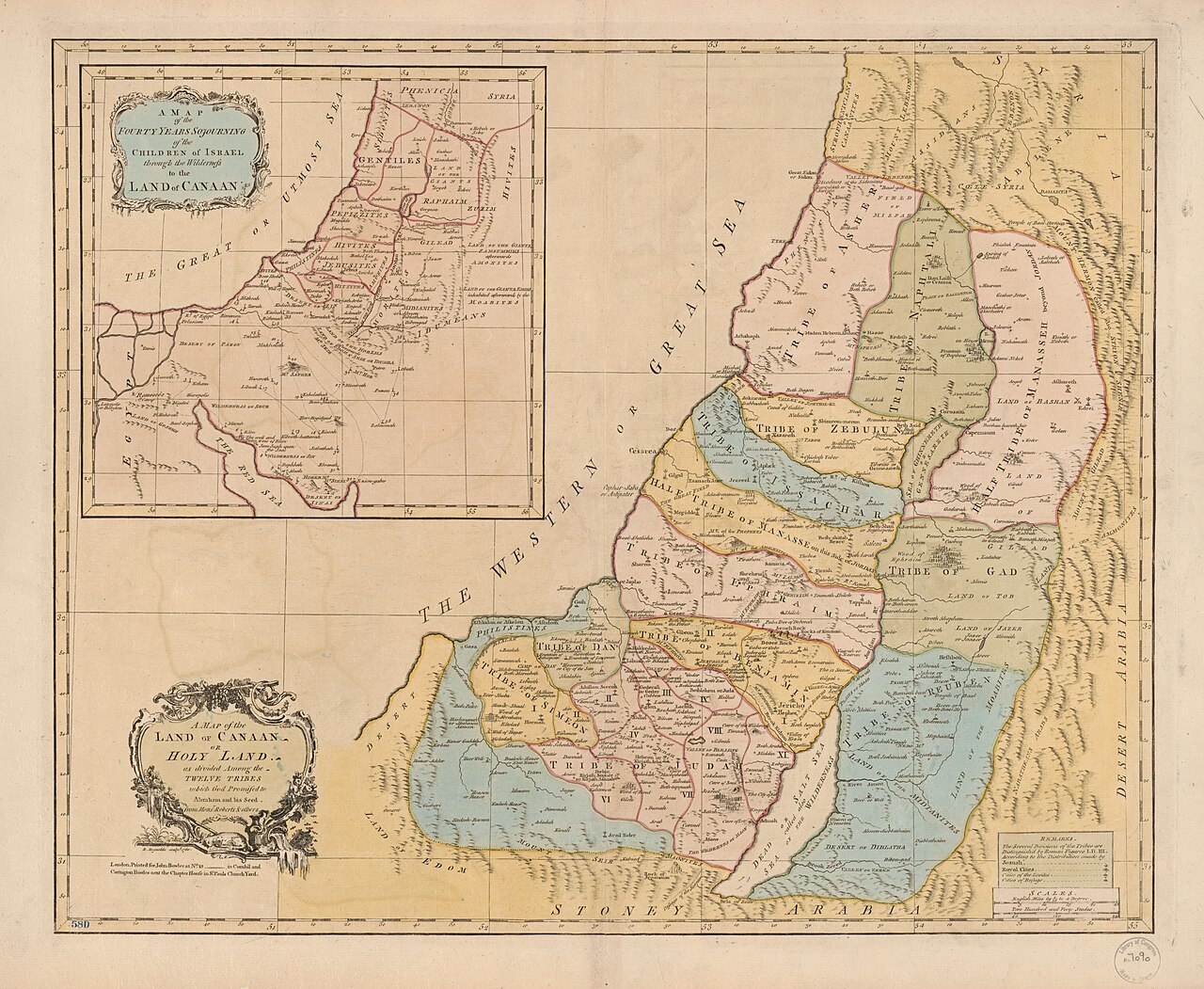 John Bowles, map of Canaan divided among the twelve tribes; Library of Congress scan via Wikimedia Commons, public domain. An early modern orientation aid, not a map from Moses’ period.
Glossary
- Sabbath year: The seventh year of rest from sowing, pruning, and full harvesting, with the spontaneous produce available for food.
- Jubilee: The fiftieth-year release after seven cycles of seven years, marked by a trumpet on the Day of Atonement and return to family and possession.
- Release: The ending of specified claims and restoration commanded in the Jubilee laws; the Greek “aphesis” also carries liberation and forgiveness according to context.
- Ransom / redemption: Payment or legal restoration that recovers a person or possession; release also provides return where a ransom cannot be paid.
- Near kinsman: A close relative who can act to redeem the threatened inheritance or person of a family member.
- Stranger and sojourner: One dwelling without absolute or permanent ownership; Israel themselves receive this description before God in verse 23.
- Interest / increase: Additional return demanded on money or food lent to a poor brother, prohibited in verses 35–38.
- Hireling: A hired worker whose service provides the standard for the protected Israelite’s labor and ransom calculation.
- Patrimony: A family inheritance to which the released Israelite returns.
- Foreign slavery: The acquisition and hereditary ownership of non-Israelite persons permitted in verses 44–46, distinct from the chapter’s protected Israelite servitude and never a model for Christian ownership of persons.
- Acceptable year: Isaiah’s proclamation received by Christ in Luke 4, interpreted by St. Cyril through the Lord’s saving advent and Pascha.
Spiritual Fruit 🍇
Receive what you possess as entrusted. The field can be cultivated, but it cannot become an absolute possession before God. Choose one place where fear makes you grasp: your time, a reserve of money, or control over another person’s work. Put a concrete act of rest or generosity there, with responsible provision for those who depend on you.
Strengthen someone before collapse. The poor brother is helped while resources are failing. A discreet conversation, needed food, help with an urgent payment, or assistance seeking work can prevent a person from becoming invisible. Give without turning the recipient’s vulnerability into authority over his conscience or future.
Practice release where resentment has become a ledger. Christ’s teaching in Matthew 6:12 and Matthew 18:21-35 binds forgiveness received to forgiveness given. Bring an actual grievance into prayer. Relinquish revenge and seek a truthful path toward peace; forgiveness does not require surrendering protection from abuse or pretending an injury never happened.
Lord Jesus Christ, let the trumpet of Your mercy reach what I keep closed. Teach me to receive my life from You and to make room for another person’s return. Where I have used someone’s need to strengthen my own position, lead me to repentance and repair. Make the new beginning I desire a beginning of mercy for someone else.
Teaching Notes
A Sabbath for the land (Leviticus 25:1–7)
- Ask: Who receives a share when the owner stops gathering fully?
- Watch for: Turning a difficult agricultural command into an effortless promise of abundance.
The trumpet of release (Leviticus 25:8–13)
- Ask: Why does the command join atonement, holiness, and return?
- Watch for: Making Nayrouz an appointment of Leviticus 25 rather than its related Gospel.
Trade under the fear of God (Leviticus 25:14–17)
- Ask: How does an approaching Jubilee change what the buyer is purchasing?
- Watch for: Assuming whatever is profitable or contractually permitted must be righteous.
The fear of having nothing to eat (Leviticus 25:18–22)
- Ask: What waiting does verse 22 require after sowing begins again?
- Watch for: Treating careful provision as unbelief or poverty as failed faith.
The land is Mine (Leviticus 25:23–28)
- Ask: What hope remains for a household without sufficient money or a redeeming relative?
- Watch for: Turning the kinsman into a mechanical code for every detail of the Incarnation.
Homes and Levitical inheritance (Leviticus 25:29–34)
- Ask: Why does the law name several kinds of homes rather than simply repeat the field rule?
- Watch for: Forcing an unsourced economic explanation onto the distinctions.
Let your brother live with you (Leviticus 25:35–38)
- Ask: What changes if lending begins with the borrower’s survival rather than the lender’s return?
- Watch for: Shaming a person who needs assistance or promising aid one cannot responsibly supply.
A redeemed people must not recreate Egypt (Leviticus 25:39–43)
- Ask: Why are the children’s release and the return to patrimony named?
- Watch for: Using the language of obedience to defend coercive treatment of workers.
The hard text of foreign slavery (Leviticus 25:44–46)
- Ask: How does the foreign-slave provision limit what can be claimed about Jubilee?
- Watch for: Presenting later Christian interpretation as though it changes the words of the ancient law.
Redemption does not depend on the master’s identity (Leviticus 25:47–55)
- Ask: What can the community do while the man waits for redemption?
- Watch for: Treating spiritual freedom as an excuse to ignore bodily exploitation.
Sources
Embedded Scripture is from Brenton’s English Septuagint (LXX). Passage headings follow the NKJV chapter-and-verse frame; the readings retain Brenton’s complete source verses and printed labels.
Leviticus 25, Lancelot C. L. Brenton, The Septuagint Version of the Old Testament (1851).
Patristic works quoted below, each identified by its containing passage and edition. Their application here is thematic unless direct commentary is expressly named.
Coptic Reader, Coptic Orthodox Metropolis of the Southern United States; appointment and prayer locations are given in the notes below. Related readings are distinguished from assignments of Leviticus itself.
Footnotes
-
Greek comparison: Septuagint Leviticus 25:10–11 and Nestle 1904 Luke 4:18; Thayer, “ἄφεσις,” release from bondage and forgiveness according to context. https://biblehub.com/sepd/leviticus/25.htm, https://biblehub.com/text/luke/4-18.htm, https://biblehub.com/greek/859.htm. ↩
-
St. Cyril of Alexandria, Commentary on Luke, on Luke 4:18–19, pp. 61–62, translated by R. Payne Smith (Oxford, 1859). https://www.tertullian.org/fathers/cyril_on_luke_02_sermons_12_25.htm. ↩
-
Coptic Reader, Nayrouz, Thoout 1, Readings / Liturgy / Psalm and Gospel, Luke 4:14–30; corroborated by @andraws/lectionary-data 1.3.1. https://copticreader.org/app/#/document. This is the related Gospel, not an assignment of Leviticus 25. ↩
-
Coptic Reader, Clergy / Litanies, Litany of the Sick. https://copticreader.org/app/#/document. ↩
-
St. Basil the Great, Second Homily on Psalm 14, against usury, §1 of the selected NPNF English transcription. The biblical text is Psalm 15:5 (LXX Ps 14:5). https://earlychurchtexts.com/public/basil_homily_psalm_14_against_usury.htm. ↩