


This narration is from a previous version of the study and may include a combined recording of multiple chapters.
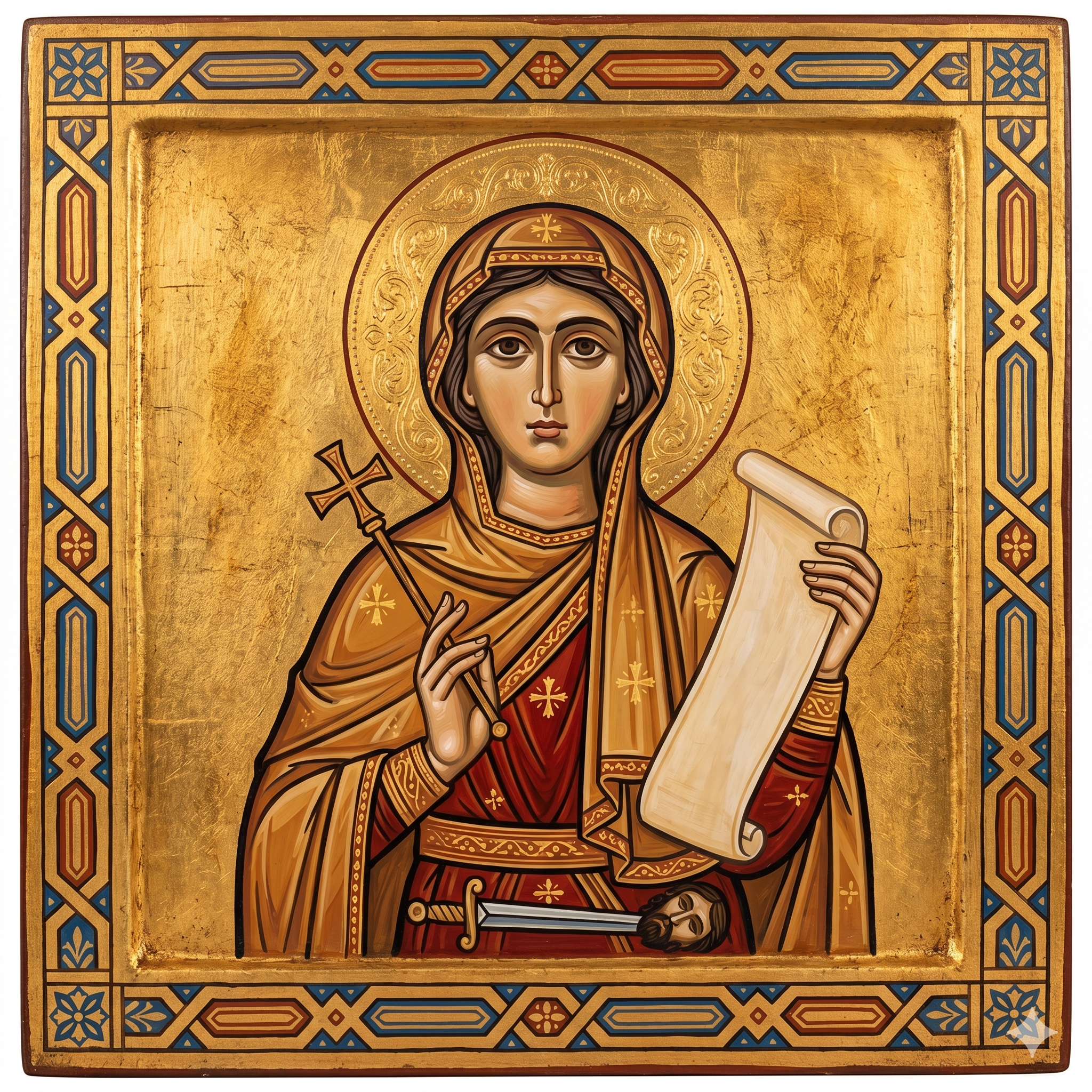
Judith 13 is the violent turning point of the book. The commander who planned to possess Judith lies drunk in his tent, unable to discern or resist her purpose. She stands beside his bed in prayer, then acts with all her strength. The city whose people were fainting with thirst will receive an unexpected sign of deliverance.
The text describes a beheading and blesses Judith for risking her life. Its severity must neither become entertainment nor disappear into a harmless metaphor. This is the rescue of a threatened community through a violent wartime act. Christian readers bring it before Christ, whose Cross and Resurrection reveal a greater and different victory, not permission for private revenge.
Context and chapter arc
Judith 10-12 placed Judith inside the camp. Holofernes admired her beauty and words, believed her promise of conquest, and planned sexual possession. Her prayer for the raising up of her people was directed toward an end he failed to recognize.
Chapter 13 moves from the private tent to the public gate. Judith prays, kills Holofernes with his own sword, and escapes with her maid along their accustomed route out to prayer. Then she calls Bethulia to praise God, shows the head and canopy as evidence, and receives the people’s blessing. Hidden action becomes communal thanksgiving.
Judith alone before the sleeping Holofernes (Judith 13:1-10)
1 Now when the evening was come, his servants made haste to depart, and Bagoas shut his tent without, and dismissed the waiters from the presence of his lord; and they went to their beds: for they were all weary, because the feast had been long. 2 And Judith was left alone in the tent, and Holofernes lying along on his bed: for he was filled with wine.
3 Now Judith had commanded her maid to stand without her bedchamber, and to wait for her coming forth, as she did daily: for she said she would go forth to her prayers, and she spake to Bagoas according to the same purpose.
4 So all went forth, and none was left in the bedchamber, neither little nor great. Then Judith, standing by his bed, said in her heart, O Lord God of all power, look at this present upon the work of mine hands for the exaltation of Jerusalem. 5 For now is the time to help thine inheritance, and to execute my enterprise to the destruction of the enemies which are risen against us.
6 Then she came to the pillar of the bed, which was at Holofernes’ head, and took down his fauchion from thence, 7 and approached to his bed, and took hold of the hair of his head, and said, Strengthen me, O Lord God of Israel, this day.
8 And she smote twice upon his neck with all her might, and she took away his head from him, 9 and tumbled his body down from the bed, and pulled down the canopy from the pillars; and anon after she went forth, and gave Holofernes his head to her maid; 10 and she put it in her bag of meat: so they twain went together according to their custom unto prayer: and when they passed the camp, they compassed the valley, and went up the mountain of Bethulia, and came to the gates thereof.
Bagoas shuts the tent, the servants withdraw, and the long feast has left them weary. Holofernes lies drunk on his bed. The arrangement meant to leave him alone with Judith also leaves him unable to defend himself. His desire has not given him mastery of this encounter.
His drunkenness has dulled his judgment. Chapter 12 described extraordinary excess, not merely the use of wine; Judith herself ate and drank. He has confused rule over armies with rule over himself. The man who could encircle a city cannot guard his own heart.
Judith’s maid waits outside as instructed. Their established practice of leaving for prayer will help them pass through the camp. The household entrusted to the maid in chapter 8, the provisions she carried in chapter 10, and the meal she prepared in chapter 12 now lead to the work of escape. Judith is alone in the bedchamber, not without help in the mission.
Standing beside the bed, Judith prays in her heart for Jerusalem and God’s inheritance. The long prayer cried aloud in chapter 9 has become an inward appeal. Its length has changed; its dependence has not. Then she asks for strength immediately before the blow. She does not offer God self-sufficiency disguised as courage.
The violence is stark. The “fauchion” is Holofernes’ sword. Judith takes it, grips his hair, and strikes twice “with all her might.” Prayer does not erase her bodily effort or the fact that she kills him. She pulls down the canopy and gives the head to her maid, who puts it in the food bag. Together they cross the valley and climb back to Bethulia. The luxurious bed and ordinary provisions of the previous chapters now belong to the evidence and means of escape.
Christian readers recognize a pattern of God breaking the certainty of oppressive power, but Judith’s blow is not the Cross. Christ freely gives His own life and rises to destroy death. His victory over sin, death, and the devil is not an instruction to identify living people with demons. In union with Him we resist pride, lust, and hatred in ourselves without excusing violence done to others. Repentance and active protection of the afflicted belong together; neither requires continued exposure to abuse.
The reversal also questions our confidence in power. Rank could not make Holofernes sober, nor could armed strength make him wise. Judith asks for what she lacks and acts for people other than herself. The chapter will honour that self-risking love rather than invite the reader to enjoy an enemy’s humiliation.
The city receives the sign of deliverance (Judith 13:11-20)
11 Then said Judith afar off to the watchmen at the gate, Open, open now the gate: God, even our God, is with us, to shew his power yet in Israel, and his strength against the enemy, as he hath even done this day.
12 Now when the men of her city heard her voice, they made haste to go down to the gate of their city, and they called the elders of the city. 13 And then they ran all together, both small and great, for it was strange unto them that she was come: so they opened the gate, and received them, and made a fire for a light, and stood round about them.
14 Then she said to them with a loud voice, Praise, praise God, praise God, I say, for he hath not taken away his mercy from the house of Israel, but hath destroyed our enemies by mine hands this night. 15 So she took the head out of the bag, and shewed it, and said unto them, Behold the head of Holofernes, the chief captain of the army of Assur, and behold the canopy, wherein he did lie in his drunkenness; and the Lord hath smitten him by the hand of a woman. 16 As the Lord liveth, who hath kept me in my way that I went, my countenance hath deceived him to his destruction, and yet hath he not committed sin with me, to defile and shame me.
17 Then all the people were wonderfully astonished, and bowed themselves, and worshipped God, and said with one accord, Blessed be thou, O our God, which hast this day brought to nought the enemies of thy people. 18 Then said Ozias unto her, O daughter, blessed art thou of the most high God above all the women upon the earth; and blessed be the Lord God, which hath created the heavens and the earth, which hath directed thee to the cutting off of the head of the chief of our enemies. 19 For this thy confidence shall not depart from the heart of men, which remember the power of God for ever. 20 And God turn these things to thee for a perpetual praise, to visit thee in good things, because thou hast not spared thy life for the affliction of our nation, but hast revenged our ruin, walking a straight way before our God. And all the people said, So be it, so be it.
Judith’s first announcement at the gate names God with His people. The enemy army still stands outside the walls; its rout has not yet occurred. But the commander has fallen, and she brings evidence that the city is not abandoned. Deliverance will need to become public knowledge and common action.
The whole city gathers, “both small and great.” The people who thirsted, wept, prayed, and nearly surrendered now stand together in the firelight. Judith calls for praise because God has not taken away His mercy. She also says plainly that He has acted by her hands. Gratitude to God does not require pretending that a human servant did nothing.
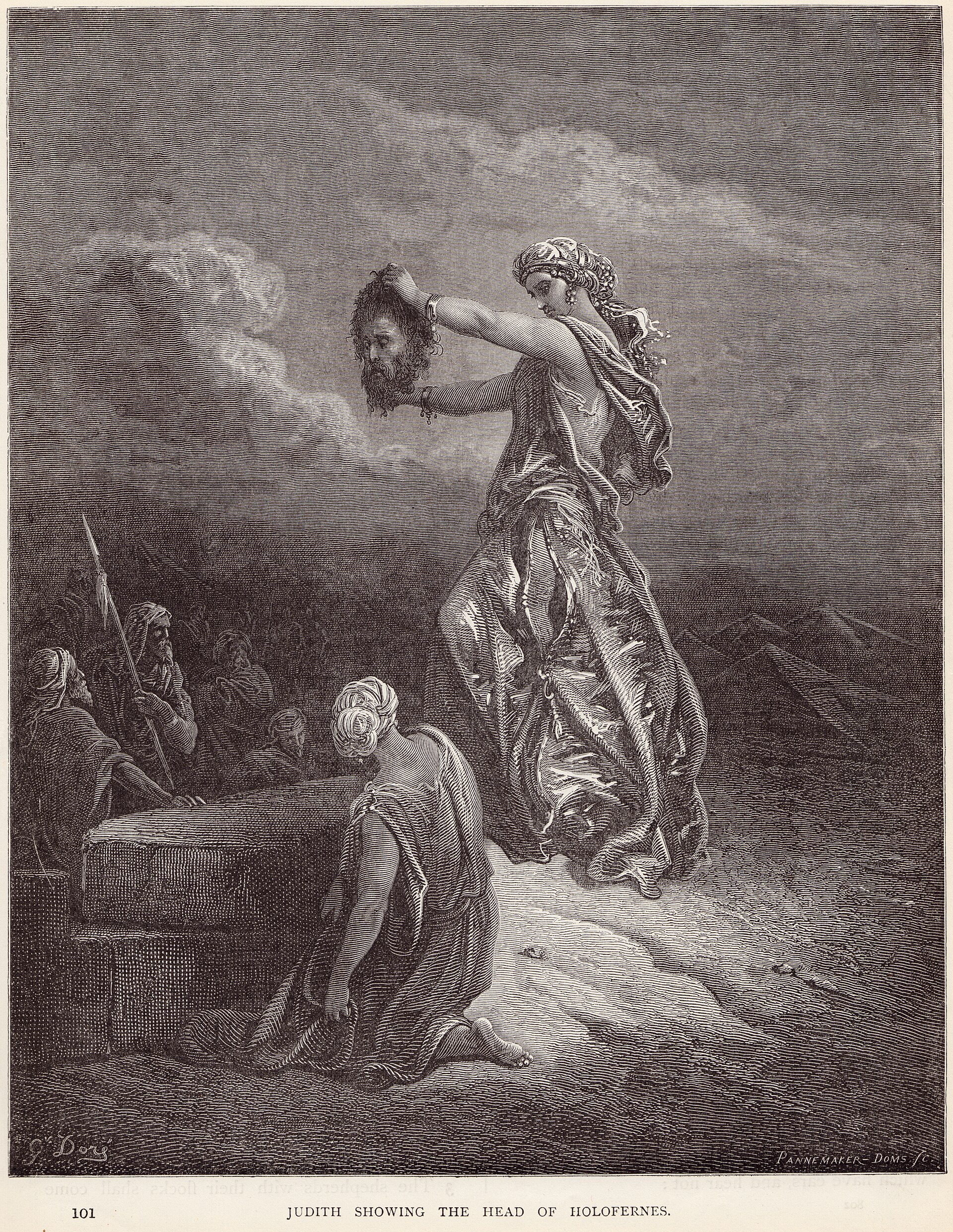 Source: Gustave Dore, The Holy Bible, Judith XIV, Wikimedia Commons, public domain.
This Western Bible illustration by Gustave Dore is not an Orthodox icon. It depicts the public display of the sign of deliverance. The head and canopy serve as evidence in the story, not objects for devotional fascination.
Verse 15 names the reversal of expected military strength: the general surrounded by armed men has fallen “by the hand of a woman.” Holofernes intended Judith to serve his desire; instead, through her God has broken his command. The reversal of military expectations does not make women inherently helpless.
In verse 16 Judith openly acknowledges that her appearance deceived Holofernes. She also testifies that he did not carry out his sexual purpose. The words about defilement describe the violation she escaped, not a moral stain that an assailant can impose on a victim. Sexual assault never makes its victim morally impure or less beloved by God. His violence would have been his sin, not hers. Her escape is a gift for which to give thanks, not a test of the faith or chastity of people who have suffered assault. Freezing, inability to resist, or an involuntary bodily response does not create consent.
The people bow and worship God; Ozias then blesses Judith and blesses the Creator who directed her way. The order holds together divine mercy and truthful human honour. He praises her confidence and her refusal to spare her life while the nation suffered. Their “So be it” receives that thanksgiving as the voice of the whole assembly. The book’s wider resonance with the Gospel’s blessing of Mary is considered in the overview; here the immediate emphasis is the community learning to bless God and honour courageous service.
Gems from the Fathers 💎
Saint Clement of Rome directly recalls Judith in an exhortation to love that accepts loss for others. He places her alongside people who endured danger or bondage for their neighbours. His point is self-risking love for the besieged, not a rule for Christian deceit or violence. He remembers that “she went out for the love which she bare to her country and people then besieged; and the Lord delivered Holofernes into the hands of a woman.”1
Brenton’s verse 20 says Judith “revenged our ruin.” The blessing concerns deliverance from the destroyer of a people, not a quarrel settled for private satisfaction. We may give thanks for rescue and honour those who protect others without nourishing hatred. The Christian application must leave room both for resisting the passions and for helping people who remain in actual danger.
Spiritual Fruit 🍇
When a difficult faithful act is before you, ask for strength before beginning. A few words spoken inwardly are still prayer. Do not wait until you can produce the long prayer you once could offer.
Give thanks for help received without judging people whose danger has not ended. If you have suffered assault, your dignity and your place before God are undiminished. You need care and protection, not a comparison with Judith’s escape. If another person confides in you, listen without blaming, and help them find safe, competent support.
Honour one person’s uncelebrated help. Judith’s maid carries, prepares, waits, and returns with her. Name the good someone has actually done, and thank God for that person without making them an idol. Truthful honour and worship of God can belong in the same thanksgiving.
Teaching Notes
Judith alone before the sleeping Holofernes (Judith 13:1-10)
- Ask: How do the inward prayer, the appeal for strength, and the words “with all her might” hold dependence and effort together?
- Watch for: Equating the beheading with Christ’s voluntary Cross, or reducing an external oppressor to the victim’s inward struggle.
The city receives the sign of deliverance (Judith 13:11-20)
- Ask: How does the city’s response honour Judith without diverting worship from God?
- Watch for: Hearing verse 16 as a claim that assault destroys holiness or that discipline guarantees escape.
- Show: If using the Dore illustration, identify it as Western Bible art and direct attention to the gathered people and public evidence, not gore.
Sources
Embedded Scripture is from Brenton’s English Septuagint (LXX).
Clement’s Judith example is direct early Christian reception within an exhortation to love, not continuous verse-by-verse commentary. The applications to Christ distinguish His freely given life and Resurrection from Judith’s wartime act.
Image: Gustave Dore, The Holy Bible, Judith XIV, Judith showing the head of Holofernes, Wikimedia Commons, public domain.
Footnotes
-
Saint Clement of Rome, First Epistle to the Corinthians 55, Judith example (55.5), https://www.newadvent.org/fathers/1010.htm. The ANF I translation was completed and revised in ANF IX. This is an excerpt from Clement’s sentence, read in the context of chapters 54-56. ↩