


This narration is from a previous version of the study and may include a combined recording of multiple chapters.
Judith begins not with Judith, but with empire. Before the widow appears, Scripture shows the proud king, the offended throne, the general who turns policy into terror, and the nations who seek peace by offering everything. The thesis of these opening chapters is severe: imperial pride turns insult into violence, but Scripture exposes the spiritual sickness beneath worldly power.
This first session therefore teaches the enemy before it teaches the deliverer. Nabuchodonosor cannot bear being disregarded. Holofernes does not merely fight armies; he reorganizes peoples, borders, crops, cities, and worship around fear. Judith 3 then shows a false peace: nations submit outwardly, receive him with celebration, and still lose freedom, boundaries, and gods. The book is already teaching that surrender of property is not the same as surrender of the soul, and that fear can make oppression look reasonable.
Session Orientation
The opening frame is historically difficult. Judith names Nabuchodonosor as king of the Assyrians ruling from Nineve, although the historical Nebuchadnezzar is associated with Babylon. The return from captivity mentioned in Judith 4:3 adds another chronological difficulty. Explanations differ; the text does not tell us why these settings are combined. We can nevertheless attend to the theological portrait before us: proud power claims an authority that belongs to God.1
The movement of Judith 1-3 is clear. Chapter 1 shows insult becoming vengeance. Chapter 2 shows vengeance becoming administration, logistics, military force, and terror. Chapter 3 shows fear producing outward submission, while the decree in Judith 3:8 exposes the aim: that all nations should worship Nabuchodonosor alone. The story is not only about politics. It is about worship.
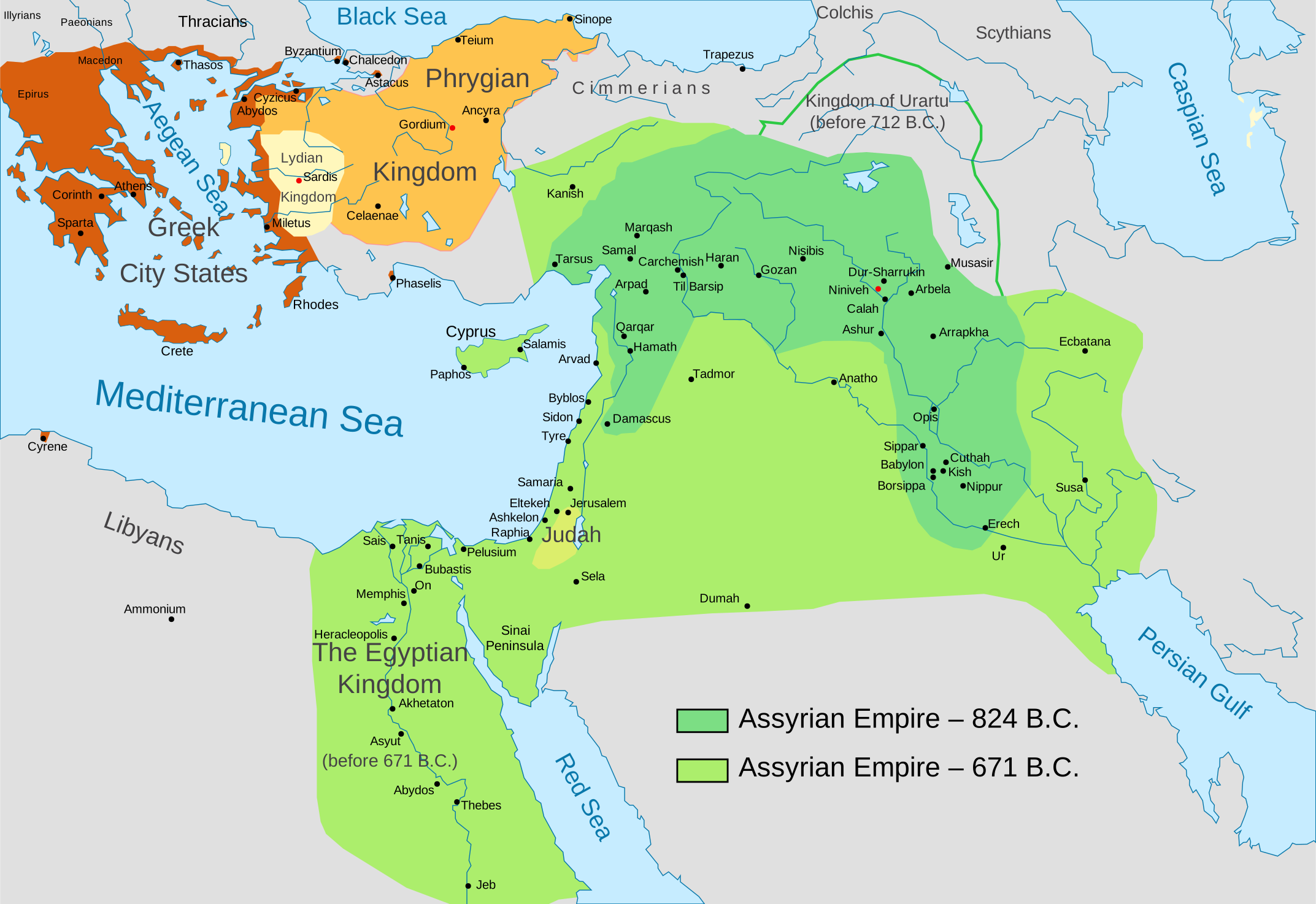 Source: Map of the Assyrian Empire, Wikimedia Commons, public domain.
The map orients the Assyrian world that stands behind the book’s imagery. It should be read with care: Judith’s geography is theological and historically complex. The map helps the reader feel the pressure of empire without pretending that every campaign movement can be reconstructed with certainty.
Judith in the Church’s Bible
Judith is received in the Coptic Orthodox Old Testament among the deuterocanonical books.2 Its absence from many Protestant Bible editions reflects different canonical boundaries. The Judith overview explains the book’s reception and textual history more fully. The aim here is not to win an argument over a table of contents, but to receive the spiritual warning the Church has preserved.
The proud king and the nations who made light of him (Judith 1:1-16)
1 In the twelfth year of the reign of Nabuchodonosor, who reigned in Nineve, the great city; in the days of Arphaxad, which reigned over the Medes in Ecbatane, 2 and built in Ecbatane walls round about of stones hewn three cubits broad and six cubits long, and made the height of the wall seventy cubits, and the breadth thereof fifty cubits: 3 and set the towers thereof upon the gates of it, an hundred cubits high, and the breadth thereof in the foundation threescore cubits: 4 and he made the gates thereof, even gates that were raised to the height of seventy cubits, and the breadth of them was forty cubits, for the going forth of his mighty armies, and for the setting in array of his footmen:
5 Even in those days king Nabuchodonosor made war with king Arphaxad in the great plain, which is the plain in the borders of Ragau. 6 And there came unto him all they that dwelt in the hill country, and all that dwelt by Euphrates, and Tigris, and Hydaspes, and the plain of Arioch the king of the Elymeans, and very many nations of the sons of Cheleul, assembled themselves to the battle.
7 Then Nabuchodonosor king of the Assyrians sent unto all that dwelt in Persia, and to all that dwelt westward, and to those that dwelt in Cilicia, and Damascus, and Libanus, and Antilibanus, and to all that dwelt upon the sea coast, 8 and to those among the nations that were of Carmel, and Galaad, and the higher Galilee, and the great plain of Esdrelom, 9 and to all that were in Samaria and the cities thereof, and beyond Jordan unto Jerusalem, and Betane, and Chellus, and Kades, and the river of Egypt, and Taphnes, and Ramesse, and all the land of Gesem, 10 until ye come beyond Tanis and Memphis, and to all the inhabitants of Egypt, until ye come to the borders of Ethiopia.
11 But all the inhabitants of the land made light of the commandment of Nabuchodonosor king of the Assyrians, neither went they with him to the battle; for they were not afraid of him: yea, he was before them as one man, and they sent away his ambassadors from them without effect, and with disgrace. 12 Therefore Nabuchodonosor was very angry with all this country, and sware by his throne and kingdom, that he would surely be avenged upon all those coasts of Cilicia, and Damascus, and Syria, and that he would slay with the sword all the inhabitants of the land of Moab, and the children of Ammon, and all Judea, and all that were in Egypt, till ye come to the borders of the two seas.
13 Then he marched in battle array with his power against king Arphaxad in the seventeenth year, and he prevailed in his battle: for he overthrew all the power of Arphaxad, and all his horsemen, and all his chariots, 14 and became lord of his cities, and came unto Ecbatane, and took the towers, and spoiled the streets thereof, and turned the beauty thereof into shame. 15 He took also Arphaxad in the mountains of Ragau, and smote him through with his darts, and destroyed him utterly that day.
16 So he returned afterward to Nineve, both he and all his company of sundry nations, being a very great multitude of men of war, and there he took his ease, and banqueted, both he and his army, an hundred and twenty days.
The first image is stone. Ecbatane is built with massive walls, towers, gates, and military scale. Scripture lets us feel the apparent security of fortified power before showing how fragile it can be. Arphaxad builds a city that looks secure, but its beauty is turned into shame. The point is not architectural trivia. These defenses cannot save the city from a stronger army. What looks immovable at the opening lies ruined by the chapter’s end.
Nabuchodonosor sends to a vast list of peoples, including regions that press toward the land of Israel. The list widens the reader’s imagination. This is not a small quarrel. It is the beginning of a world-ordering claim. Yet the nations make light of him. They are not afraid. They treat him as one man. That phrase cuts the proud king at the place where pride is most tender. He wants to be more than one man. He wants his will to weigh upon the whole earth.
Verse 12 exposes the spiritual sickness. Nabuchodonosor is not merely disappointed that allies did not come. He is very angry, swears by his throne and kingdom, and vows to be avenged. Pride interprets non-cooperation as humiliation. It cannot say, “They did not join me.” It says, “They dishonored me, and therefore they must be punished.” In the soul, this same passion appears whenever a person cannot bear being ignored, corrected, or resisted. At imperial scale it becomes massacre. At household scale it becomes control, coldness, rage, and punishment disguised as justice.
After Arphaxad falls, Nabuchodonosor returns to Nineve and banquets for one hundred and twenty days. The ruined streets of Ecbatane stand beside the conqueror’s prolonged ease. The text gives no account of his conscience at the feast. Its sequence is disturbing enough: one city’s devastation is followed by another court’s rest and abundance. For us, the contrast raises a searching question about comforts enjoyed without regard for those who bear their cost.
For Christian readers, this opening stands opposite the kingship of Christ. Christ is mocked, resisted, and rejected, yet He does not turn wounded pride into vengeance. He conquers by humility, the Cross, and voluntary suffering. Judith begins by showing the anti-king, the ruler whose throne cannot survive insult. The Gospel reveals the true King, whose throne is established by love that bears insult without becoming cruel.
Gems from the Fathers 💎
Saint John Chrysostom, commenting on John 10 rather than on Judith, notices Christ’s gentleness toward those who had repeatedly opposed Him. This Gospel witness sharpens the contrast with Nabuchodonosor: authority need not answer rejection with cruelty. Chrysostom writes, “Yet not even in this case did He reject them after so many and so great plots against Him, but answered them with great gentleness.”3
Vengeance becomes counsel for the whole earth (Judith 2:1-13)
1 And in the eighteenth year, the two and twentieth day of the first month, there was talk in the house of Nabuchodonosor king of the Assyrians, that he should, as he said, avenge himself on all the earth. 2 So he called unto him all his officers, and all his nobles, and communicated with them his secret counsel, and concluded the afflicting of the whole earth out of his own mouth. 3 Then they decreed to destroy all flesh, that did not obey the commandment of his mouth.
4 And when he had ended his counsel, Nabuchodonosor king of the Assyrians called Holofernes the chief captain of his army, which was next unto him, and said unto him, 5 Thus saith the great king, the lord of the whole earth, Behold, thou shalt go forth from my presence, and take with thee men that trust in their own strength, of footmen an hundred and twenty thousand; and the number of horses with their riders twelve thousand. 6 And thou shalt go against all the west country, because they disobeyed my commandment: 7 and thou shalt declare unto them, that they prepare for me earth and water: for I will go forth in my wrath against them, and will cover the whole face of the earth with the feet of mine army, and I will give them for a spoil unto them: 8 so that their slain shall fill their valleys and brooks, and the river shall be filled with their dead, till it overflow: 9 and I will lead them captives to the utmost parts of all the earth. 10 Thou therefore shalt go forth, and take beforehand for me all their coasts: and if they will yield themselves unto thee, thou shalt reserve them for me till the day of their punishment.
11 But concerning them that rebel, let not thine eye spare them; but put them to the slaughter, and spoil them wheresoever thou goest. 12 For as I live, and by the power of my kingdom, whatsoever I have spoken, that will I do by mine hand. 13 And take thou heed that thou transgress none of the commandments of thy lord, but accomplish them fully, as I have commanded thee, and defer not to do them.
The insult of chapter 1 becomes the state policy of chapter 2. There is talk in the king’s house, then secret counsel, then a plan to afflict the whole earth. This is the machinery of domination. Sin begins in a wounded heart, but it becomes meetings, titles, officers, numbers, supply lines, and orders. The book refuses to let the reader separate the inner passion from the outward system. Empire is built from hearts.
Nabuchodonosor calls himself “the great king, the lord of the whole earth.” This is blasphemous political language. He is not content to rule territory. He speaks as though the earth belongs to his breath, his mouth, his oath, and his hand. The repetition of his mouth matters. Those who do not obey the word of his mouth are marked for destruction. The proud ruler sets his speech in the place of truth.
In this speech, the demand for “earth and water” belongs to a demand for submission. The threats that follow make its scope plain: occupied land, bodies filling rivers, and people carried into captivity. Even those who yield are only preserved until the day of punishment. The tyrant’s mercy is temporary ownership. He may spare a people for a season, but only as property.
Holofernes receives the role of executor. He is next to the king, and he carries the king’s wrath westward. Spiritually, this matters because evil often hides behind delegated responsibility. One man imagines himself lord of the earth; another man implements the imagination. In Christian life, this warns us not to excuse ourselves by saying, “I only carried out what was expected.” Each soul must answer before God for the part it plays in another person’s cruelty.
The passage also exposes the false trust of worldly force. Holofernes is sent with men who “trust in their own strength.” The wording is important for the whole book. Judith will later pray that God’s power does not stand in multitude or strong men. Here, before Judith ever speaks, Scripture names the opposing religion: trust in strength. The battle is already spiritual. Will the earth belong to the mouth of Nabuchodonosor, or to the Lord who made heaven and earth?
Fear becomes an army with supplies and fire (Judith 2:14-28)
14 Then Holofernes went forth from the presence of his lord, and called all the governors and captains, and the officers of the army of Assur; 15 and he mustered the chosen men for the battle, as his lord had commanded him, unto an hundred and twenty thousand, and twelve thousand archers on horseback; 16 and he ranged them, as a great army is ordered for the war. 17 And he took camels and asses for their carriages, a very great number; and sheep and oxen and goats without number for their provision: 18 and plenty of victual for every man of the army, and very much gold and silver out of the king’s house.
19 Then he went forth and all his power to go before king Nabuchodonosor in the voyage, and to cover all the face of the earth westward with their chariots, and horsemen and their chosen footmen. 20 A great number also of sundry countries came with them like locusts, and like the sand of the earth: for the multitude was without number.
21 And they went forth of Nineve three days’ journey toward the plain of Bectileth, and pitched from Bectileth near the mountain which is at the left hand of the upper Cilicia. 22 Then he took all his army, his footmen, and horsemen, and chariots, and went from thence into the hill country; 23 and destroyed Phud and Lud, and spoiled all the children of Rasses, and the children of Ismael, which were toward the wilderness at the south of the land of the Chellians.
24 Then he went over Euphrates, and went through Mesopotamia, and destroyed all the high cities that were upon the river Arbonai, till ye come to the sea.
25 And he took the borders of Cilicia, and killed all that resisted him, and came to the borders of Japheth, which were toward the south, over against Arabia.
26 He compassed also all the children of Madian, and burned up their tabernacles, and spoiled their sheepcotes.
27 Then he went down into the plain of Damascus in the time of wheat harvest, and burnt up all their fields, and destroyed their flocks and herds, also he spoiled their cities, and utterly wasted their countries, and smote all their young men with the edge of the sword.
28 Therefore the fear and dread of him fell upon all the inhabitants of the sea coasts, which were in Sidon and Tyrus, and them that dwelt in Sur and Ocina, and all that dwelt in Jemnaan; and they that dwelt in Azotus and Ascalon feared him greatly.
The second half of chapter 2 turns the king’s wrath into a moving machine. The text slows down to list governors, captains, officers, chosen men, archers, camels, asses, sheep, oxen, goats, food, gold, and silver. This detail is spiritual. Domination does not remain an emotion. It becomes organized, funded, fed, transported, and repeated.
The army is described as covering the face of the earth and as a multitude like locusts and like sand. Locust imagery is important because locusts consume. Holofernes does not simply pass through regions. He devours them. He destroys cities, burns dwellings, spoils sheepcotes, burns fields at wheat harvest, destroys flocks and herds, and kills young men. The timing of wheat harvest makes the violence feel especially cruel. It strikes not only soldiers, but the hope of bread, household stability, and next season’s life.
Verse 28 shows the effect of the campaign. Fear and dread fall upon the sea coast, and the next chapter shows ambassadors seeking peace. Terror can win submission before another battle is fought. Not every fear is sinful; danger is real, and the vulnerable should not be shamed for trembling. Fear becomes spiritually dangerous when it persuades the soul that survival requires betrayal.
Judith 2 also helps us read later chapters correctly. Bethulia will face not a vague enemy, but a disciplined machinery of fear. The people are not wrong to recognize danger. Their danger is real. The question is whether real danger will make them forget the Lord. In Christian terms, this is where watchfulness begins. The enemy may threaten the body, reputation, finances, relationships, or comfort. But the decisive battle is whether the heart yields worship.
Christ does not teach His people to deny fear as if pain were imaginary. In Gethsemane He enters anguish without sin. The Christian answer to terror is not bravado, but prayer, obedience, and trust in the Father. Judith 2 shows the size of the threat so that Judith’s later courage will not look like human confidence. It will reveal courage that depends on God rather than on superior force.
Peace without freedom and surrender without worship (Judith 3:1-10)
1 So they sent ambassadors unto him to treat of peace, saying, 2 Behold, we the servants of Nabuchodonosor the great king lie before thee; use us as shall be good in thy sight. 3 Behold, our houses, and all our places, and all our fields of wheat, and flocks, and herds, and all the lodges of our tents, lie before thy face; use them as it pleaseth thee. 4 Behold, even our cities and the inhabitants thereof are thy servants; come and deal with them as seemeth good unto thee.
5 So the men came to Holofernes, and declared unto him after this manner. 6 Then came he down toward the sea coast, both he and his army, and set garrisons in the high cities, and took out of them chosen men for aid. 7 So they and all the country round about received him with garlands, with dances, and with timbrels. 8 Yet he did cast down their frontiers, and cut down their groves: for he had decreed to destroy all the gods of the land, that all nations should worship Nabuchodonosor only, and that all tongues and tribes should call upon him as a god.
9 Also he came over against Esdraelon near unto Judea, over against the great strait of Judea. 10 And he pitched between Geba and Scythopolis, and there he tarried a whole month, that he might gather together all the carriages of his army.
Chapter 3 is one of Scripture’s clearest pictures of false peace. The nations send ambassadors to treat of peace, but their words are the language of total self-surrender. Houses, fields, flocks, herds, tents, cities, and inhabitants are placed before Holofernes. They ask him to use them as seems good to him. They hope that if they give enough, they will be spared.
The result proves the lie. Holofernes accepts their submission, but he still sets garrisons, takes chosen men, casts down frontiers, and cuts down groves. He receives garlands, dances, and timbrels, yet his stated decree is to destroy the gods of the land so that all nations worship Nabuchodonosor only. The celebration cannot hide the slavery. A procession with music may still be a funeral for freedom.
This passage is not telling Christians to despise all political compromise or ordinary prudence. Scripture is more sober than that. Sometimes peace-making is blessed. Sometimes yielding property can prevent bloodshed. But Judith 3 draws a sharp boundary: no peace is holy if it requires worshiping a man as god. No outward arrangement can justify inward apostasy. The nations may lie before Holofernes, but the people of God must not give the Lord’s place to another.
The contrast between outward surrender and inward fidelity is crucial for the rest of Judith. Bethulia will later be pressured to surrender because thirst and fear are breaking the people. Judith’s story will not teach careless defiance. It will teach that the soul cannot be handed over to fear. The body may be besieged, resources may fail, leaders may grow weak, but worship belongs to God alone.
Verse 9 brings the army near Judea, against Esdraelon and the great strait of Judea. The machinery of domination has moved from insult, to policy, to terror, to false peace, and now to the threshold of God’s people. Then the army pauses for a whole month to assemble its transport. The pressure has not vanished because the advance has stopped. Israel must now answer a threat that is both near and patiently organized.
Spiritual Fruit 🍇
The offended throne has a smaller likeness in the heart that cannot bear correction. When someone contradicts us, we can ask Christ for the freedom to hear what is true before planning our reply. A quiet apology, a question asked without sarcasm, or the decision not to punish someone with silence can interrupt the movement from wounded pride to organized cruelty.
Holofernes also warns us against borrowing another person’s authority to excuse harm. Before passing on a humiliating message or joining a campaign against someone, pause to consider the part you are being asked to play. Obedience to a powerful person does not remove responsibility before God. Christ’s gentleness gives us another way to exercise whatever authority we have, especially over someone unable to answer back.
Lord Jesus Christ, keep my fear from becoming betrayal and my wounded pride from becoming another person’s burden.
Teaching Notes
The proud king and the nations who made light of him (Judith 1:1-16)
- Ask: What turns Nabuchodonosor’s military disappointment into a vow of vengeance?
- Watch for: Assigning Arphaxad a motive the text does not give, or pretending the historical difficulties have a settled explanation.
- Show: Use the Assyrian Empire map for orientation, not as proof of a precise campaign route.
Vengeance becomes counsel for the whole earth (Judith 2:1-13)
- Ask: How does the king’s anger become a public system of violence, and where does Holofernes take responsibility within it?
- Watch for: Treating delegated orders as an excuse for participating in cruelty.
Fear becomes an army with supplies and fire (Judith 2:14-28)
- Ask: What do the supplies and the destruction at wheat harvest reveal about the reach of this violence?
- Watch for: Shaming people who tremble under real danger. Christ in Gethsemane shows obedience under anguish, not bravado.
Peace without freedom and surrender without worship (Judith 3:1-10)
- Ask: What do the garrisons and the exclusive-worship decree reveal beneath the public celebration?
- Watch for: Teaching reckless defiance as if all compromise were sin. Prudent peacemaking is not the same as giving God’s place to a ruler.
Sources
Embedded Scripture is from Brenton’s English Septuagint (LXX).
Map: Map of the Assyrian Empire, Wikimedia Commons, public domain.
Further reading: David A. deSilva, Introducing the Apocrypha; Carey A. Moore, Judith (Anchor Bible 40); Lawrence M. Wills, Judith (Hermeneia).
Footnotes
-
For differing historical explanations, see Hugh Pope, “Book of Judith,” Catholic Encyclopedia (1913), “Historicity,” article, and Encyclopaedia Britannica, “Book of Judith”. These are secondary orientations, not a single agreed solution. ↩
-
Fr. Moses Samaan, “The Deuterocanonical Books,” Coptic Orthodox Diocese of Los Angeles, July 19, 2012, archived July 14, 2026. ↩
-
Saint John Chrysostom, Homilies on John 61.1, on John 10:22-24, text. This is a thematic Gospel comparison, not commentary on Judith 1-3. ↩