


Jeremiah’s consolation is not shallow optimism. It comes after wound, exile, false peace, and the collapse of every refuge Judah trusted. In Brenton’s Septuagint order, this consolation and new-covenant unit appears in Jeremiah 37-38. In many English Bibles following the Masoretic order, the same familiar theological center is cited as Jeremiah 30-31. This guide follows the embedded Brenton/LXX source while naming the familiar reference so teachers do not confuse the passage.
Source Shape Note
Brenton/LXX Jeremiah 37-38 contains the material commonly known in English Bibles as Jeremiah 30-31: restoration after judgment, Rachel’s tears, the Lord gathering His scattered people, and the promise of the new covenant. This study follows the Septuagint chapter order while naming the familiar Masoretic references so that readers can find the same prophetic unit in either textual tradition.
The movement is from exile back toward Zion. The north, the islands, Samaria, Ephraim, Rama, Zion, Judah, and Jerusalem are not decorative place names. They show a people scattered by judgment being gathered by mercy. The promised return is not only political relocation. It is the Lord re-forming His people around worship, forgiveness, and a healed heart.
Jacob, Israel, Ephraim, and Judah name the divided and wounded people whom God gathers again. Rachel gives voice to maternal grief over children lost to judgment and exile. Priests and shepherds share the restored joy when the Lord feeds and gathers His people, and Jeremiah must proclaim this hope without pretending that judgment was unreal.
Jeremiah 37 LXX: Wound, healing, and return
1 The Word that came to Jeremias from the Lord, saying, 2 Thus speaks the Lord God of Israel, saying, Write all the words which I have spoken to thee in a book.
3 For, behold, the days come, saith the Lord, when I will bring back the captivity of my people Israel and Juda, said the Lord: and I will bring them back to the land which I gave to their fathers, and they shall be lords of it.
4 And these are the Words which the Lord spoke concerning Israel and Juda:
5 Thus said the Lord: Ye shall hear a sound of fear, there is fear, and there is not peace. 6 Enquire, and see if a male has born a child? and ask concerning the fear, wherein they shall hold their loins, and look for safety: for I have seen every man, and his hands are on his loins; their faces are turned to paleness. 7 For that day is great, and there is not such another; and it is a time of straitness to Jacob; but he shall be saved out of it. 8 In that day, said the Lord, I will break the yoke off their neck, and will burst their bonds, and they shall no longer serve strangers: 9 but they shall serve the Lord their God; and I will raise up to them David their king.
12 Thus saith the Lord; I have brought on thee destruction; thy stroke is painful. 13 There is none to judge thy cause: thou hast been painfully treated for healing, there is no help for thee. 14 All thy friends have forgotten thee; they shall not ask about thee at all, for I have smitten thee with the stroke of an enemy, even severe correction: thy sins have abounded above all thine iniquity.
16 Therefore all that devour thee shall be eaten, and all thine enemies shall eat all their own flesh. Thy sins have abounded beyond the multitude of thine iniquities, therefore they have done these things to thee. And they that spoil thee shall become a spoil, and I will give up to be plundered all that have plundered thee. 17 For I will bring about thy healing, I will heal thee of thy grievous wound, saith the Lord; for thou art called Dispersed: she is your prey, for no one seeks after her.
18 Thus said the Lord; Behold, I will turn the captivity of Jacob, and will have pity upon his prisoners; and the city shall be built upon her hill, and the people shall settle after their manner. 19 And there shall go forth from them singers, even the sound of men making merry: and I will multiply them, and they shall not at all be diminished. 20 And their sons shall go in as before, and their testimonies shall be established before me, and I will visit them that afflict them. 21 And their mighty ones shall be over them, and their prince shall proceed of themselves; and I will gather them, and they shall return to me: for who is this that has set his heart to return to me? saith the Lord.
23 For the wrathful anger of the Lord has gone forth, even a whirlwind of anger has gone forth: it shall come upon the ungodly. 24 The fierce anger of the Lord shall not return, until he shall execute it, and until he shall establish the purpose of his heart: in the latter days ye shall know these things.
Jeremiah 37 opens with the command to write the words in a book. The hope here is not a mood. It is a word preserved for a people who will need it after the visible disaster arrives. The Lord promises to bring back the captivity of Israel and Judah, but He does not erase the wound by denying it. The text names fear, straitness, painful stroke, abandonment by friends, and severe correction. Then it says, “I will bring about thy healing, I will heal thee of thy grievous wound.”
That order matters spiritually. Jeremiah does not teach cheap healing. He teaches true healing, where God first exposes the wound, then restores what sin and judgment have broken. The return from exile is therefore a school of repentance. The people are not restored because their sin was minor. They are restored because God’s covenant mercy is deeper than their ruin.
The promise to raise up David their king opens the passage toward Christ. The people need more than a return to land. They need righteous rule, a Shepherd-King who can gather, heal, and govern the heart. Orthodox readers hear this as a preparation for Christ, the Son of David, who heals not only exile’s outward consequences but the inward captivity of sin.
Jeremiah 38 LXX: Rachel’s tears and the new covenant
1 At that time, saith the Lord, I will be a God to the family of Israel, and they shall be to me a people. 2 Thus saith the Lord, I found him warm in the wilderness with them that were slain with the sword: go ye and destroy not Israel. 3 The Lord appeared to him from afar, saying, I have loved thee with an everlasting love: therefore have I drawn thee in compassion. 4 For I will build thee, and thou shalt be built, O virgin of Israel: thou shalt yet take thy timbrel, and go forth with the party of them that make merry. 5 For ye have planted vineyards on the mountains of Samaria: plant ye, and praise. 6 For it is a day when those that plead on the mountains of Ephraim shall call, saying, Arise ye, and go up to Sion to the Lord your God.
7 For thus saith the Lord to Jacob; Rejoice ye, and exult over the head of the nations: make proclamation, and praise ye: say, The Lord has delivered his people, the remnant of Israel. 8 Behold, I bring them from the north, and will gather them from the end of the earth to the feast of the passover: and the people shall beget a great multitude, and they shall return hither. 9 They went forth with weeping, and I will bring them back with consolation, causing them to lodge by the channels of waters in a straight way, and they shall not err in it: for I am become a father to Israel, and Ephraim is my first-born.
10 Hear the words of the Lord, ye nations, and proclaim them to the islands afar off; say, He that scattered Israel will also gather him, and keep him as one that feeds his flock. 11 For the Lord has ransomed Jacob, he has rescued him out of the hand of them that were stronger than he. 12 And they shall come, and shall rejoice in the mount of Sion, and shall come to the good things of the Lord, even to a land of corn, and wine, and fruits, and cattle, and sheep: and their soul shall be as a fruitful tree; and they shall hunger no more. 13 Then shall the virgins rejoice in the assembly of youth, and the old men shall rejoice; and I will turn their mourning into joy, and will make them merry. 14 I will expand and cheer with wine the soul of the priests the sons of Levi, and my people shall be satisfied with my good things: thus saith the Lord.
15 A voice was heard in Rama, of lamentation, and of weeping, and wailing; Rachel would not cease weeping for her children, because they are not.
16 Thus saith the Lord; Let thy voice cease from weeping, and thine eyes from thy tears: for there is a reward for thy works; and they shall return from the land of thine enemies. 17 There shall be an abiding home for thy children.
18 I have heard the sound of Ephraim lamenting, and saying, Thou hast chastened me, and I was chastened; I as a calf was not willingly taught: turn thou me, and I shall turn; for thou art the Lord my God. 19 For after my captivity I repented; and after I knew, I groaned for the day of shame, and shewed thee that I bore reproach from my youth. 20 Ephraim is a beloved son, a pleasing child to me: for because my words are in him, I will surely remember him: therefore I made haste to help him; I will surely have mercy upon him, saith the Lord.
21 Prepare thyself, O Sion; execute vengeance; look to thy ways: return, O virgin of Israel, by the way by which thou wentest, return mourning to thy cities. 22 How long, O disgraced daughter, wilt thou turn away? for the Lord has created safety for a new plantation: men shall go about in safety.
23 For thus saith the Lord; They shall yet speak this word in the land of Juda, and in the cities thereof, when I shall turn his captivity; blessed be the Lord on his righteous holy mountain! 24 And there shall be dwellers in the cities of Juda, and in all his land, together with the husbandman, and the shepherd shall go forth with the flock. 25 For I have saturated every thirsting soul, and filled every hungry soul. 26 Therefore I awaked, and beheld; and my sleep was sweet to me.
27 Therefore, behold, the days come, saith the Lord, when I will sow the house of Israel and the house of Juda with the seed of man, and the seed of beast. 28 And it shall come to pass, that as I watched over them, to pull down, and to afflict, so will I watch over them, to build, and to plant, saith the Lord. 29 In those days they shall certainly not say, The fathers ate a sour grape, and the children’s teeth were set on edge. 30 But every one shall die in his own sin; and the teeth of him that eats the sour grape shall be set on edge.
31 Behold, the days come, saith the Lord, when I will make a new covenant with the house of Israel, and with the house of Juda: 32 not according to the covenant which I made with their fathers in the day when I took hold of their hand to bring them out of the land of Egypt; for they abode not in my covenant, and I disregarded them, saith the Lord. 33 For this is my covenant which I will make with the house of Israel; after those days, saith the Lord, I will surely put my laws into their mind, and write them on their hearts; and I will be to them a God, and they shall be to me a people. 34 And they shall not at all teach every one his fellow citizen, and every one his brother, saying, Know the Lord: for all shall know me, from the least of them to the greatest of them: for I will be merciful to their iniquities, and their sins I will remember no more.
35 Though the sky should be raised to a greater height, saith the Lord, and though the ground of the earth should be sunk lower beneath, yet I will not cast off the family of Israel, saith the Lord, for all that they have done.
36 Thus saith the Lord, who gives the sun for a light by day, the moon and the stars for a light by night, and makes a roaring in the sea, so that the waves thereof roar; the Lord Almighty is his name: 37 if these ordinances cease from before me, saith the Lord, then shall the family of Israel cease to be a nation before me for ever.
38 Behold, the days come, saith the Lord, when the city shall be built to the Lord from the tower of Anameel to the gate of the corner. 39 And the measurement of it shall proceed in front of them as far as the hills of Gareb, and it shall be compassed with a circular wall of choice stones. 40 And all the Asaremoth even to Nachal Kedron, as far as the corner of the horse-gate eastward, shall be holiness to the Lord; and it shall not fail any more, and shall not be destroyed for ever.
Jeremiah 38 moves from gathering to inward renewal. The Lord appears from afar and says, “I have loved thee with an everlasting love.” This is not sentimentality. It is covenant love that survives judgment and calls the wounded people back to life.
Rachel’s tears give the passage its emotional center. She weeps for children who are not. The Lord does not scold her grief. He answers it with hope: “Let thy voice cease from weeping, and thine eyes from thy tears.” The Church should learn from this. Holy grief is not unbelief. But grief must be held before the Lord long enough to receive His promise.
The new covenant promise is the theological summit. God does not merely command from outside. He writes His law within. The problem exposed throughout Jeremiah is the heart: false worship, false prophecy, false confidence, and refusal to listen. The answer is not a more impressive religious performance. The answer is God’s own inward work: law in the mind, law on the heart, knowledge of the Lord, mercy for iniquity, and sins remembered no more.
For Christians, this opens naturally toward Christ’s words at the Mystical Supper: the cup is the new covenant in His Blood. Jeremiah’s promise is fulfilled not by ignoring sin, but by the forgiveness and communion given through Christ.
LXX / Brenton insight
The LXX placement is not a technical curiosity. In Brenton’s Septuagint the consolation and new-covenant text is Jeremiah 37-38, while the familiar English citation is usually Jeremiah 30-31. Naming both forms protects the unity of the passage and lets the reader attend to the same promise across the Greek and Hebrew chapter arrangements.
Gems from the Fathers 💎
Eusebius of Caesarea reads Jeremiah’s new covenant as the gift by which Christ raises people into the life of God’s kingdom. Its promise reaches beyond return from exile to a communion offered to all peoples: “But the new covenant leads those who, through our Saviour by the grace and gift of God are raised up, to a rapid march into the kingdom promised by God. It summons all men equally to share together the same good things.”1 The initiative remains God’s: He forgives, writes His law within, and gathers a people who know Him through His saving work.
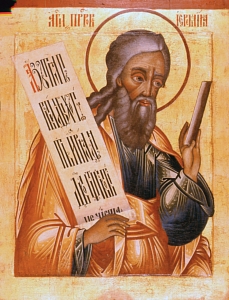 Source: Prophet Jeremiah, Russian icon, first quarter 18th century, Wikimedia Commons, public domain.
The icon presents Jeremiah as the holy prophet who bears the word of God with grief and intercession. It is not a literal illustration of Jeremiah 37-38: consolation in these chapters is spoken by a suffering servant, not by a detached commentator.
Western artworks such as Rembrandt’s grieving Jeremiah and Dore’s Baruch writing Jeremiah’s prophecies are useful elsewhere in the series, especially for lament, the burned scroll, and the fall of Jerusalem. They should be labeled as Western biblical artwork, not icons.
The Church’s Voice in Worship ⛪
Jeremiah 38:31-34 is especially important for Orthodox worship because the new covenant is not an abstraction. It is heard in relation to Christ’s Passion, burial, and the forgiveness sealed by His Blood. The Church reads this passage at the Ninth Hour of Bright Saturday, hearing the new covenant promise as Christ rests in the tomb, having opened forgiveness and inward renewal through His saving death.
Spiritual Fruit 🍇
God’s consolation begins by telling the truth about the wound. The people are not healed by pretending exile never happened or by calling the injury light. The Lord names terror, grief, captivity, and the apparent incurability of the wound, then promises to restore health. Christian hope can therefore look directly at sin and loss without surrendering to despair; the Physician’s mercy is strong enough to meet the wound as it is.
Rachel’s tears are not silenced by a command to move on. The Lord hears them and gives them a horizon: children will return, roads will be marked, and mourning will be turned into joy. In family grief, displacement, unanswered prayer, and parish wounds, faithful lament remains before God until promise and sorrow can be held together. Hope does not erase the tears; it keeps them from becoming the final word.
The new covenant reaches deeper than restored circumstances. God places His laws in the mind, writes them on the heart, forgives iniquity, and becomes the God of a people who know Him. In Christ this is lived through baptism, repentance, the gift of the Spirit, Scripture received inwardly, and the Eucharistic cup of the new covenant. Lord Jesus, heal what I cannot heal, receive the tears I cannot explain, and write Your law within me. Give me not only relief, but the transformed heart that knows You. Amen.
Teaching Notes
Jeremiah 37 LXX - Wound, healing, and return
- Ask: Why does Jeremiah name the wound before announcing healing?
- Emphasize: Biblical hope does not require pretending judgment or grief were unreal.
- Watch for: Treating exile as only punishment. In Jeremiah, discipline becomes the setting where mercy is revealed.
- Connect: Christ heals the wound of sin by entering it, not by minimizing it.
- Show: Use the Jeremiah icon to show the prophet as grieving witness, then move from his sorrow to God’s promise.
Jeremiah 38 LXX - Rachel’s tears and the new covenant
Ask: What does the Lord do with Rachel’s grief, and what changes when the law is written on the heart?
Emphasize: Holy grief can become prayer, and the new covenant is inward renewal and forgiveness.
Watch for: Shaming grief as unbelief or reducing the new covenant to moral self-improvement.
Connect: Christ gives the cup as the new covenant in His Blood.
Show: Use the late-Judah royal chart and geography schematic from the Resources note to show why failed kingship and exile prepare the reader for covenant renewal.
Sources
Embedded Scripture is from Brenton’s English Septuagint (LXX).
Familiar English Bible references normally cite this unit as Jeremiah 30-31, while the embedded text here follows Brenton/LXX Jeremiah 37-38. The new-covenant interpretation above follows Eusebius of Caesarea, Proof of the Gospel I.4.