


This narration is from a previous version of the study and may include a combined recording of multiple chapters.
Baruch 4:36-37 does not pause at the chapter line. Jerusalem has just been told to look toward the east and behold the joy that comes from God, and to see her sons coming, gathered by the word of the Holy One. Chapter 5 takes up that command and clothes it. Put off mourning. Put on the beauty of glory. The book does not deny the grief of exile. It refuses to let grief have the final word.
Put Off Mourning and Put On Glory (Baruch 5:1-4)
1 Put off, O Jerusalem, the garment of thy mourning and affliction, and put on the comeliness of the glory that cometh from God for ever.
2 Cast about thee a double garment of the righteousness which cometh from God; and set a diadem on thine head of the glory of the Everlasting. 3 For God will shew thy brightness unto every country under heaven. 4 For thy name shall be called of God for ever The peace of righteousness, and The glory of God’s worship.
Jerusalem is not told to pretend she never mourned. She is told to put mourning off because God is giving another garment. The glory does not come from her strength, her beauty, or a political recovery. It “cometh from God for ever.”
Sin and grief clothe a person with shame, heaviness, and affliction. God clothes His people with righteousness. The Church can hear a baptismal resonance here, the old garment put off and a garment given, provided the first meaning is kept: God restores Jerusalem by giving what she could not weave for herself. The double garment is not her self-respect, repaired. It is “the righteousness which cometh from God.”
The new names in verse 4 are not a slogan the city chooses for herself. God names her “The peace of righteousness” and “The glory of God’s worship.” Restoration means a people becomes again what worship was meant to make them: a place where righteousness and glory can be seen.
The Children Gathered by the Word (Baruch 5:5-6)
5 Arise, O Jerusalem, and stand on high, and look about toward the east, and behold thy children gathered from the west unto the east by the word of the Holy One, rejoicing in the remembrance of God. 6 For they departed from thee on foot, and were led away of their enemies: but God bringeth them unto thee exalted with glory, as children of the kingdom.
Jerusalem must stand and look. Hope here is not a mood. It is obedience to a promise. The children who left on foot, under enemy power, are brought back by God “as children of the kingdom.”
The eastward gaze can resonate with the Church’s prayer toward the east. The text’s first meaning is the hope of return. What exile scattered, the word of the Holy One calls home. That is why the passage opens toward the Church gathered from every direction into Christ’s kingdom, without the verse being turned into a proof-text for the liturgical custom.
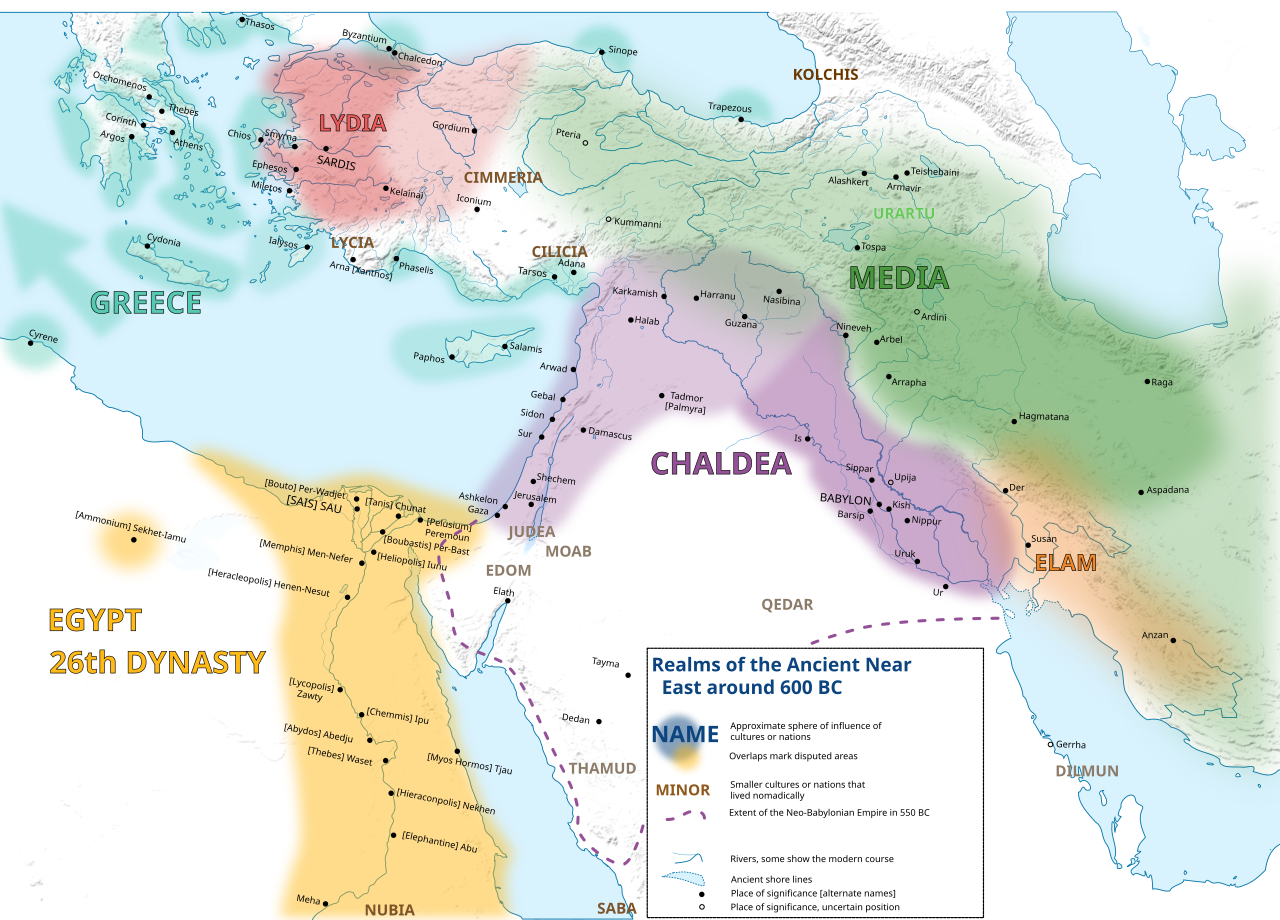 Source: Enyavar (German original) and Redx360 (English translation), Near East around 600 BC, Wikimedia Commons, CC BY-SA 4.0. Regional orientation for Judah, Babylon, Egypt, and neighboring powers, not a return route.
Gems from the Fathers 💎: A Real Restoration
St. Irenaeus, in Against Heresies V.35.1, quotes Baruch 4:36-5:9 at length and attributes the words to Jeremiah. He begins from the eastward look: “Look around Jerusalem towards the east, and behold the joy which comes to you from God Himself.” He continues through the robe of mourning put off, the beauty of eternal splendour put on, the double garment of righteousness, the name “the peace of righteousness,” the children brought in with glory, the mountains brought low, the valleys filled, and God going before His people with joy.1
At the start of V.35.2 he insists that these things “cannot be understood in reference to super-celestial matters,” because God will show Jerusalem’s glory “to the whole earth that is under heaven.” His witness, for this study, is that God’s restoration is real. It is not a metaphor for a private religious feeling, and it is not a way of saying that nothing on earth will be healed. The children really return. The garment is really given. The glory is really shown.
Be candid about the frame in which he reads the passage. St. Irenaeus expects an earthly kingdom after the resurrection of the just, before the final new heaven and new earth. The Church did not adopt that framework. Cite him for what he witnesses, the reality of God’s restoring work, not for the timetable he builds around it. A real restoration in Christ, in the Church, and on the last day does not require his sequence in order to be real.
The Leveled Road and the Light of Glory (Baruch 5:7-9)
7 For God hath appointed that every high hill, and banks of long continuance, should be cast down, and vallies filled up, to make even the ground, that Israel may go safely in the glory of God. 8 Moreover even the woods and every sweetsmelling tree shall overshadow Israel by the commandment of God. 9 For God shall lead Israel with joy in the light of his glory with the mercy and righteousness that cometh from him.
God appoints the road home. Hills are cast down, valleys are filled, and the way is made safe. This is the language of Isaiah 40:4, the voice that cries, “Prepare ye the way of the Lord.” The Gospel applies that cry to John the Baptist, who prepares the Lord’s way (Luke 3:4-6). What Baruch sees at the end of the exile, the Gospel sees at the edge of the Jordan: a road leveled because the Lord Himself is coming.
Baruch 5 is not read in the Theophany Laqqan. Isaiah 40:1-5 is. The Church reads that prophecy in the same Liturgy of the Waters in which she reads Baruch 3:36-4:4. The book’s ending and its liturgical heart speak the same language without being the same appointment. The God who showed Himself upon earth, in the reading over the water, is the God whose way John prepares, and the God who, at the end of Baruch, leads Israel with joy in the light of His glory. A servant can say that. A servant should not say that Baruch 5 itself is chanted at the font.
The book closes with four gifts: joy, light, mercy, and righteousness. All of them come from God. The final word over the penitent is not shame. It is God leading His people.
Spiritual Fruit 🍇
Put off mourning when God gives the garment, and do not pretend the sorrow never happened. The command rests on God’s act, not on your ability to recover your mood. If you are still in the sackcloth of Baruch 4:20, do not force this chapter early. When the gift is given, do not cling to the old garment because it has become familiar.
Receive righteousness as clothing from God. The double garment is not a reputation you assemble after failure. People who have sinned often try to sew a respectable self and call it repentance. Baruch will not let Jerusalem do that. The glory comes from God for ever.
Stand and look for the gathering. The children left on foot and return as children of the kingdom. If you are waiting for someone the Church has not stopped loving, this chapter tells you to look, not to stare only at the loss. The gathering is by the word of the Holy One. Pray that word over the one who is gone.
Trust that God can level a road you cannot build. High hills of pride, old banks of bitterness, valleys of despair: the image is a highway, not a self-improvement plan. Ask, in prayer, where the road home is still blocked, and ask the Lord who prepared John’s way to prepare yours.
Let the hope be larger than private recovery. God gathers children into a kingdom. Your healing matters. It is not the whole of the glory. The name God gives is “The peace of righteousness” and “The glory of God’s worship.” A restored life that never becomes worship has not yet put on the garment.
Walk, then, in the mercy and righteousness with which God leads His people. The last sentence of Baruch is not a feeling. It is a procession. He leads. The light is His. The mercy is His. The righteousness comes from Him.
Jerusalem, the garment is given. Stand on high. The children are not gone forever. Look toward the joy that comes from God, and walk in the light in which He leads His people home.
Teaching Notes
Put Off Mourning and Put On Glory (Baruch 5:1-4)
- Ask: What garments do grief, shame, or sin put on us, and what does God give instead?
- Emphasize: The glory comes from God, not from self-repair. The command follows the eastward look in Baruch 4:36-37.
- Watch for: Do not tell a suffering person to move on. The command to put off mourning rests on God’s act.
- Connect: Baptismal garment, Isaiah 61, the Church clothed in Christ.
- Show: No painting is necessary. A spoken contrast is enough: mourning, righteousness, glory.
The Children Gathered by the Word (Baruch 5:5-6)
- Ask: What does it mean to be gathered by God’s word rather than by nostalgia or force?
- Emphasize: They return as children of the kingdom. St. Irenaeus witnesses that the restoration is real. Say plainly that the Church did not adopt his earthly-kingdom timetable.
- Watch for: Eastward language may resonate with Orthodox prayer. Do not claim the verse as the source of the custom.
- Connect: Christ gathers the scattered children of God into one.
- Show: Use the 600 BC map only to orient exile and return. Name Enyavar and Redx360, and the CC BY-SA 4.0 license. Say it is not a route map.
The Leveled Road and the Light of Glory (Baruch 5:7-9)
- Ask: Where does the road home still need to be leveled?
- Emphasize: God leads with joy, light, mercy, and righteousness. Isaiah 40:4 and Luke 3:4-6 let the ending speak to the Theophany service without making Baruch 5 a reading.
- Watch for: Do not claim that Baruch 5 is read at the Laqqan. Do not make restoration automatic. This chapter follows confession and wisdom.
- Connect: Isaiah 40:1-5 is the prophecy read with Baruch 3:36-4:4 at the Theophany Laqqan.
- Show: No additional visual. Let the last image be God leading His people in light.
Sources
Embedded Scripture is from Brenton’s English Septuagint (LXX). These studies use Brenton’s verse numbers.
Cross-references: Isaiah 40:1-5, Isaiah 61, Luke 3:4-6, and the command that begins in Baruch 4:36-37. The Theophany reading of Baruch is Baruch 3:36-4:4, not this chapter.
Visual source: Enyavar (German original) and Redx360 (English translation), Near East around 600 BC, Wikimedia Commons, CC BY-SA 4.0, file page.
Footnotes
-
St. Irenaeus of Lyons, Against Heresies V.35.1-2, quoting Baruch 4:36-5:9 and attributing it to Jeremiah. He argues that the prophecy cannot be read as merely about heavenly realities, inside a framework of an earthly kingdom after the resurrection of the just that the Church did not adopt. https://www.newadvent.org/fathers/0103535.htm ↩