


This narration is from a previous version of the study and may include a combined recording of multiple chapters.
 Generated decorative cover art for orientation only. It is not a manuscript witness and not an Orthodox icon.
The Letter of Jeremiah is a letter for people who must keep worship alive while the gods of the winning empire are carried past them in the street. Its working prayer comes early, and the whole study keeps returning to it: “O Lord, we must worship thee.” The letter does not ask the exiles to win Babylon. It asks them not to fear what cannot speak, see, heal, or show mercy, and to save their worship for the living God.
The verse-by-verse reading is the study of the letter. This overview does a different work. It asks why the book sits where it does, how it belongs with Jeremiah, and who in the early Church received it.
Why the letter sits with Jeremiah
The superscription calls it a copy of an epistle Jeremiah sent to those about to be led captive to Babylon. That claim is not a modern invention. The Greek Church kept the letter inside Jeremiah’s prophetic book, after Baruch and Lamentations, as its own piece rather than as a chapter of Baruch. In the Greek manuscripts it stands at the end of that group, separated from Baruch, with its own voice.
The Latin tradition attached the letter to Baruch. Catholic Bibles, and the Apocrypha of the King James Version, therefore print it as Baruch 6. That title comes from the Latin attachment, not from the Greek manuscripts, where the letter remains its own piece. St. Jerome would not put it in his new translation of Jeremiah. His preface says, “The book of Baruch, his scribe, however, which the Hebrews neither have nor read, we have omitted.” He had no Hebrew text for Baruch, and he would not treat what the Hebrew Bible did not carry as part of that translation. Later Latin Bibles included Baruch anyway, with this letter as its last chapter. Jerome’s omission explains the hesitation. The Latin attachment explains the title Baruch 6.
Orthodox readers inherit the wider stream. Common NKJV editions usually omit the letter because they follow the Protestant sixty-six-book canon and do not print the deuterocanonical books. That is a fact about printed Bibles, not a reason to sneer. The Church received a broader Old Testament through the Greek Scriptures and the worshiping community. The calm question is reception, not scorekeeping.
Two early witnesses show how the Greek Church named the book. In 367, St. Athanasius of Alexandria, in his thirty-ninth Festal Letter, section 4, counts the Old Testament and says, “Jeremiah with Baruch, Lamentations, and the epistle, one book.” St. Cyril of Jerusalem, teaching catechumens in Catechetical Lecture 4.35, gives the same grouping: “of Jeremiah one, including Baruch and Lamentations and the Epistle.” They are not commenting on a verse. They are telling the Church which books belong together.
A small physical witness answers the fear that the letter is a modern add-on. Among the Dead Sea Scrolls, a tiny Greek papyrus from Qumran Cave 7, called 7Q2, has been identified with verses 43 and 44. The piece holds only about twenty-two letters, so the identification is not beyond question. If it is this letter, it was already being copied about a century before Christ. The Church did not invent the text in order to fill a gap in Jeremiah.
Brenton, which this study prints, and the King James Apocrypha number seventy-three verses. The standard Greek editions of Rahlfs-Hanhart and Ziegler present the letter as seventy-two verses, so the closing beatitude printed here as verse 73 may appear as verse 72 in those editions. The words are the same. The count is not.
Authorship should be said calmly. The superscription presents the letter as Jeremiah’s. Many scholars think it was composed later, in Greek or from a Semitic original, for Jews living under the pressure of foreign gods. The Church received it inside Jeremiah’s prophetic book either way. We do not have to settle the author’s desk before we can pray the letter’s prayer.
Jeremiah’s own letter, and a longer wait
Jeremiah did write a letter to the exiles. In the Hebrew Bible, and in most English Bibles, it is Jeremiah 29. In the Septuagint the same letter stands in Jeremiah 36. There the prophet says, “When seventy years shall be on the point of being accomplished at Babylon, I will visit you, and will confirm my words to you, to bring back your people to this place.” This letter says something different in verse 3: the people will remain in Babylon “many years, and for a long season, namely, seven generations,” and then God will bring them away peaceably.
Those are not the same sentence, and honesty requires the difference to be named. Seventy years is a measured promise of return. Seven generations is a figure for a wait long enough that children will be born, and their children, under the same pressure. It does not cancel the seventy years, and it does not invite a hidden chronology. One fair reading is pastoral: the exile will outlast a mood. Another, held by many who think the letter was written later, is that a community which had already lived through a long delay spoke of generations rather than of a single lifetime. Either way, the spiritual burden is stable. God has not abandoned the souls of the exiles, and the gods of the empire are not the reason they must wait.
Jeremiah 10:1-16 is the closest cousin inside the prophet’s own book. There a man cuts a tree, decks it with silver and gold, and then has to fasten it so it will not totter. Verse 11 of that chapter is the one verse written in Aramaic, the language the exiles would hear in Babylon. It is a sentence meant to be said to the nations about their gods: “Let the gods which have not made heaven and earth perish from off the earth, and from under this sky.” This letter takes that sentence into the street, where the gods are being carried on shoulders.
A later biblical memory keeps the same charge. In 2 Maccabees 2:1-3, the records say that Jeremiah commanded those who were carried away not to forget the commandments of the Lord, “and that they should not err in their minds, when they see images of silver and gold, with their ornaments.” That is this letter’s message, remembered inside another book the Church reads as Scripture. The warning was not a private anxiety. It was part of how Israel told the story of exile.
The shape of the letter
The letter is one chapter, seventy-three verses in Brenton, and one study is the right shape. Splitting it would break the refrain. Six parts carry the argument. The chapter study opens each of them.
- Verses 1 to 7. Captivity is judgment, not abandonment. Before the crowd can train the heart, the exile says, “O Lord, we must worship thee.”
- Verses 8 to 23. Gold, purple, sceptres, and candles cannot give a god a voice, sight, or a life of its own.
- Verses 24 to 44. The test of a god is mercy. These cannot save from death, open blind eyes, or help the widow and the fatherless. Christ does.
- Verses 45 to 58. What carpenters and goldsmiths make cannot become lord. It cannot save itself from war, plague, thieves, or fire.
- Verses 59 to 69. Sun, moon, wind, cloud, and fire obey the Creator. The idol cannot bless, curse, judge, or shine.
- Verses 70 to 73. Purple rots on a lifeless thing. Better is the just man who has no idols.
Who received the letter, and how
Direct early witness does exist, and it should be named as what it is.
Tertullian, in Scorpiace 8, quotes verses 4 to 6 by name as “the words of Jeremias writing to those over whom that captivity was impending,” and he ends the quotation with “Our duty is to worship You, O Lord.” He is an early Christian writer of the Latin West, not a saint. Scorpiace comes from his later period, after his separation from the Church, and it is an argument that martyrdom is commanded by God. He reads the letter through the three young men who refused the golden image. When the king demanded worship, they already knew, from this letter, that the gods borne on shoulders were not to be feared, and that their duty was to worship the Lord. The quotation is precious because it joins the exile’s prayer to the martyrs. It does not make Tertullian a Father of the Church in the same sense as Athanasius or Cyril.
St. Athanasius and St. Cyril, already cited, are the canonical witnesses. They do not explain a verse. They tell the baptized, and those preparing for baptism, that Jeremiah’s book includes this epistle.
The icon question belongs here, because the letter can be misused. It condemns rival gods, lifeless powers falsely feared and trusted. It does not condemn matter, and it does not condemn the holy images of the Church. St. Basil the Great, in On the Holy Spirit 18.45, is the source of the rule the Church later used for icons. He is speaking of the Son and the Father, and he uses the image of a king: “We speak of a king, and of the king’s image, and not of two kings. … the honour paid to the image passes on to the prototype.” St. John of Damascus, in Part I of his apology for the holy images, introduces that rule with the words, “St Basil says, ‘Honouring the image leads to the prototype.’” He also says, “I adore Him alone with the worship of latreia.” Honor shown to an icon passes to the person represented. Divine worship belongs to the Holy Trinity alone.
That distinction is not a permission for superstition. A person can kiss an icon, light a candle, and still refuse repentance. The letter purifies worship. It does not teach suspicion of water, oil, bread, wood, or paint when they serve the living God.
The Church’s voice in worship
No exact Coptic lectionary placement for the Letter of Jeremiah, or for Baruch 6, appears in the readings checked. The Church does not appoint this letter. She reads other passages that carry the same message, and the chapter study names them beside the verses they illuminate.
Two are enough to name here. On Nayrouz, Tut 1, the feast of the martyrs, the Church reads Acts 17:16-34, Paul in a city full of idols. On Bright Saturday, in the Midnight Praises, she reads Daniel 3:1-23, the three young men and the golden image, the very scene through which Tertullian heard this letter. And at the Theophany Laqqan the Church reads Baruch 3:36-4:4. That is a sister book being read, not a reading of this letter. The Baruch study follows that book on its own terms.
Iconography and Visual Teaching 🖼️
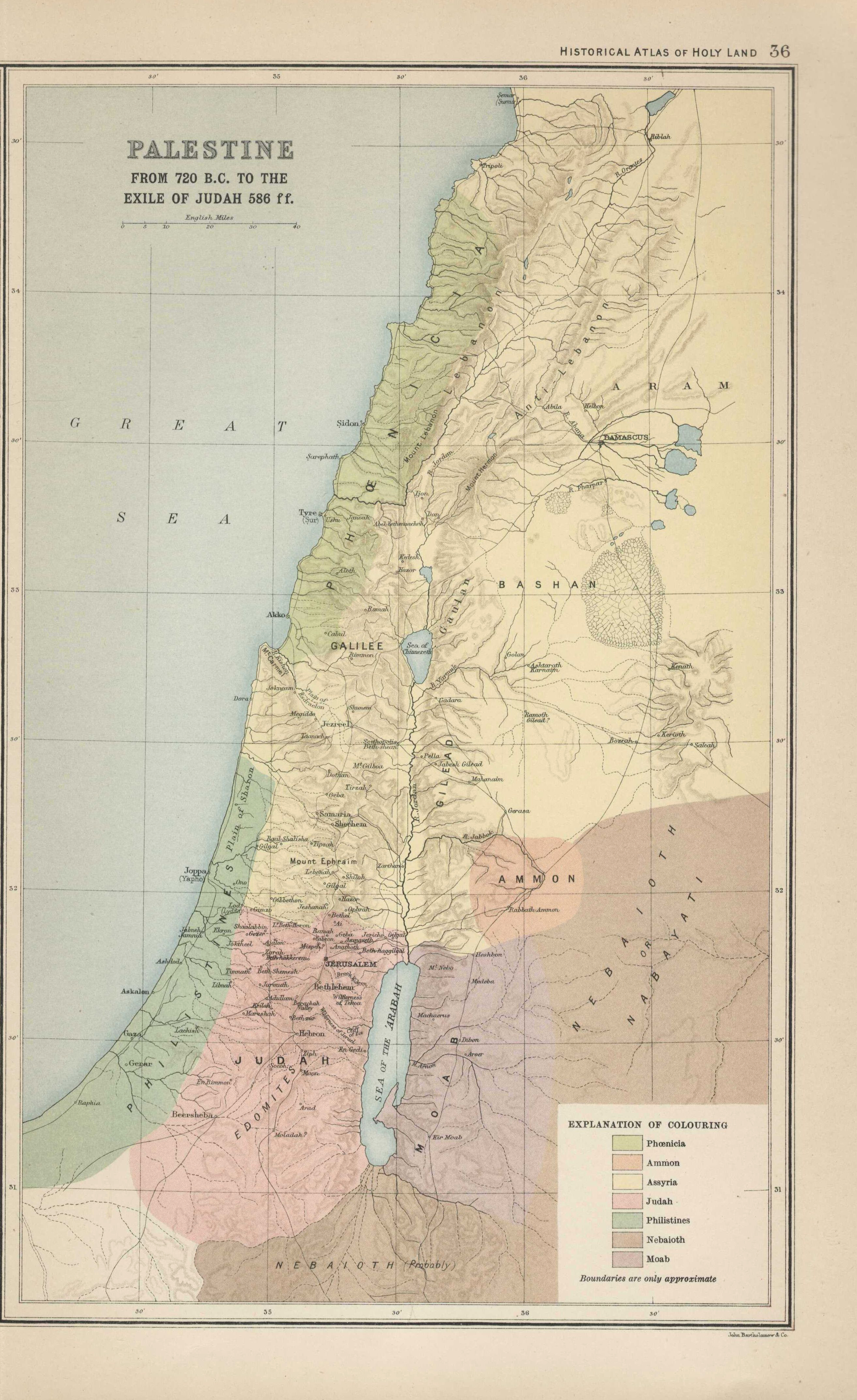 Historical map for broad location context: John Bartholomew & Co., Palestine from 720 B.C. to the exile of Judah 586, public domain, National Library of Israel / Wikimedia Commons. Use as a teaching locator, not as an exact reconstruction of the Letter’s route.
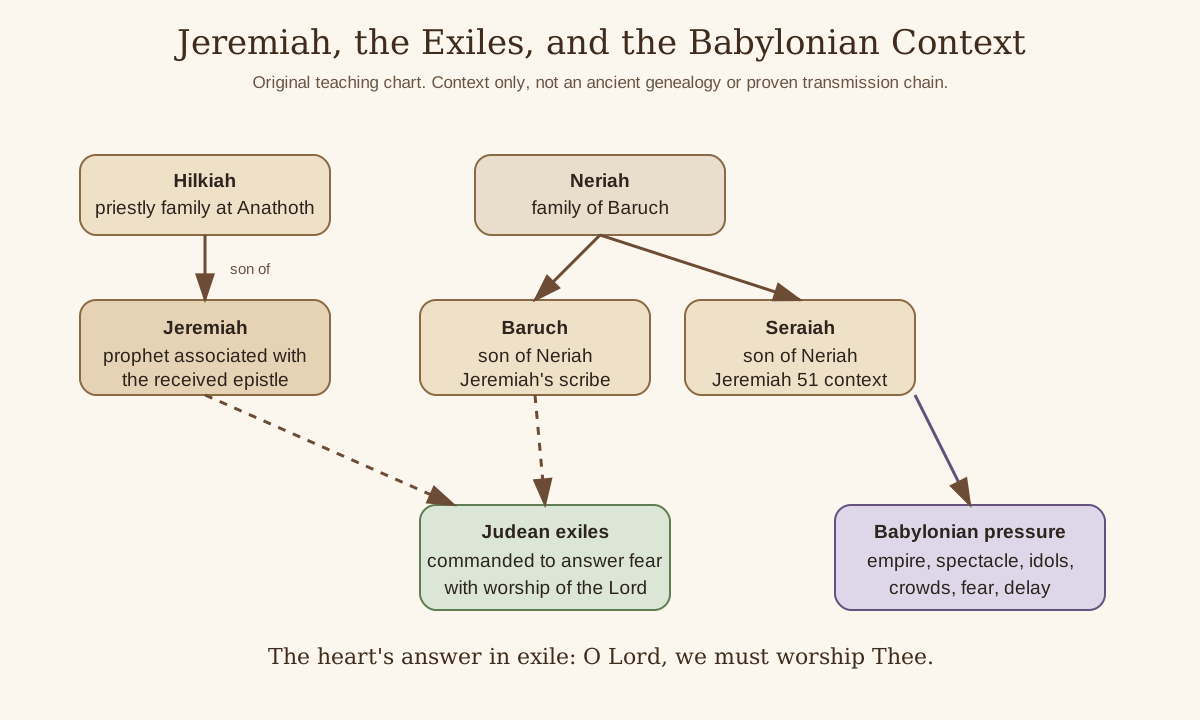 Original teaching chart created for this guide. It is context only, not an ancient genealogy, manuscript witness, or proven transmission chain. The Letter does not provide a meaningful genealogy tree, so a cautious context chart is better than inventing one.
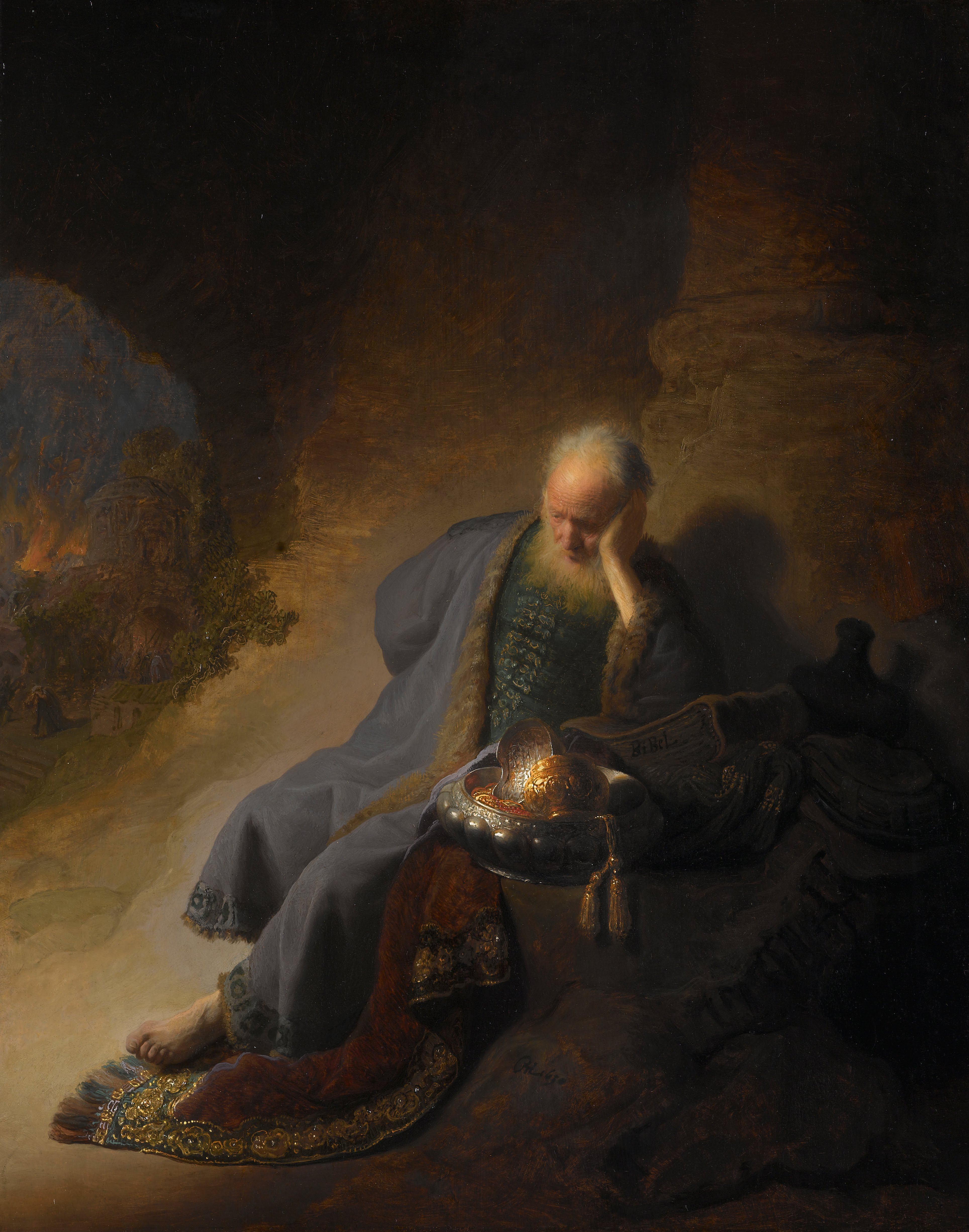 Rembrandt, Jeremiah Lamenting the Destruction of Jerusalem, public domain, Wikimedia Commons / Google Art Project. This is Western biblical artwork for Jeremiah and exile context, not an Orthodox icon and not a direct illustration of the Letter of Jeremiah.
 Source: Franz Heinrich Weissbach, Babylonische Miscellen (1903), public domain, Wikimedia Commons: https://commons.wikimedia.org/wiki/File:Marduk_and_pet.jpg. Ancient Near Eastern divine-image context only; this is not the exact idol targeted by the Letter, not a biblical illustration, and not an Orthodox icon.
The map places the exile. The chart keeps Jeremiah, the captives, and Babylonian pressure in view without pretending to be a genealogy. Rembrandt’s Jeremiah is Western biblical art for the grief of the fall, not an icon and not a picture of this letter. The Marduk drawing is a Babylonian religious image from a cylinder seal. It helps the eye feel the world the exiles entered. It is not the idol the letter names, and it is not an Orthodox icon.
Spiritual Fruit 🍇
The prayer is the fruit. Before the argument, before the list of powerless gods, the exile is told to speak in the heart: “O Lord, we must worship thee.” A heart that has not learned that sentence in quiet will borrow its worship from whatever the crowd fears.
The mercy test belongs beside the prayer. Verses 36 to 38 ask whether a god can save from death, deliver the weak, open blind eyes, help the distressed, show mercy to the widow, or do good to the fatherless. Christ does those works. The widow of Nain, the blind, and the tomb are not decorations on an anti-idol essay. They are how the living God is recognized.
Name the respectable idol once, and then watch it in a particular verse rather than in a repeated list. Safety, belonging, success, reputation, money, comfort, control, technology, tribe, ministry success, family image, and religious appearance can all ask for the fear that belongs to God. The letter’s question is simpler than the list: can the thing you fear save you, and does it show mercy?
Better is the just man who has no idols. He may look small beside gold, processions, and official confidence. He is alive before God. That is the freedom the letter wants to leave in the hands of people who feel outnumbered.
Teaching Notes
Canon, placement, and authorship
- Ask: Why do Greek Bibles keep this letter as its own piece in Jeremiah’s book, while Catholic Bibles and the KJV Apocrypha print Baruch 6?
- Emphasize: St. Jerome omitted Baruch because the Hebrews neither read nor possessed it. The Latin attachment followed that decision. St. Athanasius and St. Cyril count the epistle inside Jeremiah.
- Watch for: Scorekeeping over Bible editions, and overclaiming either that Jeremiah certainly wrote every line or that the Church’s reception does not matter.
- Connect: 7Q2, if the identification holds, shows the letter was copied before Christ. Say that the fragment is tiny.
The two letters
- Ask: What is the difference between seventy years in Jeremiah 36 (Hebrew Jeremiah 29) and seven generations here?
- Emphasize: Name the difference. Do not invent a chronology that makes them say the same thing.
- Watch for: Treating 2 Maccabees 2:1-3 as a quotation of this letter. It is a canonical memory of the same charge.
- Connect: Jeremiah 10:11, the Aramaic sentence spoken to the nations about their gods.
Witnesses and icons
- Ask: How does Tertullian hear verses 4 to 6, and why must he be distinguished from St. Athanasius and St. Cyril?
- Emphasize: He is an early Christian writer, not a saint, and Scorpiace is from his later period. His link to the three young men is still a true and powerful reading.
- Watch for: Using the letter against Orthodox icons. St. Basil’s image-and-prototype rule, quoted by St. John of Damascus in Part I, is the guardrail. Superstition is the other guardrail.
- Show: Keep the Marduk image, the map, and the chart in their present captions. Rembrandt stays on this overview only.
Worship without a false placement
- Ask: Which appointed readings carry this letter’s message, and how do we say that without claiming the Church reads the letter?
- Emphasize: No exact placement for the Letter of Jeremiah or Baruch 6. Say, “The Church reads a passage that carries the same message.”
- Watch for: Calling the first Sunday of Tout the same day as Nayrouz. Acts 17:16-34 is the Nayrouz reading. James 1:22-27 is the first Sunday of Tout.
- Connect: Baruch 3:36-4:4 at the Theophany Laqqan is a sister book, not this letter.
Sources
Embedded Scripture in the chapter study is from Brenton’s English Septuagint. Brenton and the King James Apocrypha number seventy-three verses. Rahlfs-Hanhart and Ziegler present the Greek letter as seventy-two.
- St. Athanasius, Festal Letter 39, section 4 (367), “Jeremiah with Baruch, Lamentations, and the epistle, one book”: https://www.newadvent.org/fathers/2806039.htm
- St. Cyril of Jerusalem, Catechetical Lecture 4.35: https://www.newadvent.org/fathers/310104.htm
- St. Jerome, Preface to Jeremiah: “The book of Baruch, his scribe, however, which the Hebrews neither have nor read, we have omitted.” Latin and English: https://epistolae.ctl.columbia.edu/letter/266.html
- Tertullian, Scorpiace 8, quoting the letter and reading it through Daniel 3. An early Christian writer, not a saint; the work belongs to his later period: https://www.newadvent.org/fathers/0318.htm
- St. Basil the Great, On the Holy Spirit 18.45: https://www.ccel.org/ccel/schaff/npnf208.vii.xix.html
- St. John of Damascus, Apologia Against Those Who Decry Holy Images, Part I, quoting St. Basil: https://sourcebooks.web.fordham.edu/basis/johndamascus-images.asp
- Sean A. Adams, “2.4.2 Greek,” in Textual History of the Bible, on the Greek placement after Lamentations, the seventy-two-verse count, and 7Q2 as a twenty-two-letter fragment thought to contain verses 43-44, with the identification not assured: https://eprints.gla.ac.uk/186389/7/186389.pdf
- 2 Maccabees 2:1-3; Jeremiah 36:10 in Brenton (Hebrew Jeremiah 29:10); Jeremiah 10:11.
- Baruch overview, for the sister book read at the Theophany Laqqan.
- Wikimedia Commons, Marduk and pet.jpg: https://commons.wikimedia.org/wiki/File:Marduk_and_pet.jpg
- Wikimedia Commons / National Library of Israel, John Bartholomew & Co., Palestine from 720 B.C. to the exile of Judah 586: https://commons.wikimedia.org/wiki/File:John_Bartholomew_%26_Co.,_Palesine_from_720_B.C._To_the_exile_of_Judah_586_ff_(FL36567167_3907302).jpg
- Wikimedia Commons / Google Art Project, Rembrandt, Jeremiah Lamenting the Destruction of Jerusalem: https://commons.wikimedia.org/wiki/File:Rembrandt_Harmensz._van_Rijn_-_Jeremia_treurend_over_de_verwoesting_van_Jeruzalem_-_Google_Art_Project.jpg