
The Magi have departed, but the danger has not. Joseph must rise by night and carry the Child and His mother away from Herod, while Bethlehem’s mothers are left to weep. Matthew’s account brings the Savior into flight, lament, and the hidden home of Nazareth: God is with us on roads we would never have chosen.
Egypt and Rachel (Matthew 2:13-18)
13 Now when they had departed, behold, an angel of the Lord appeared to Joseph in a dream, saying, “Arise, take the young Child and His mother, flee to Egypt, and stay there until I bring you word; for Herod will seek the young Child to destroy Him.” 14 When he arose, he took the young Child and His mother by night and departed for Egypt, 15 and was there until the death of Herod, that it might be fulfilled which was spoken by the Lord through the prophet, saying, “Out of Egypt I called My Son.” 16 Then Herod, when he saw that he was deceived by the wise men, was exceedingly angry; and he sent forth and put to death all the male children who were in Bethlehem and in all its districts, from two years old and under, according to the time which he had determined from the wise men. 17 Then was fulfilled what was spoken by Jeremiah the prophet, saying: 18 “A voice was heard in Ramah, Lamentation, weeping, and great mourning, Rachel weeping for her children, Refusing to be comforted, Because they are no more.”
The child who is “God with us” becomes a refugee. Joseph receives another command in a dream, and again he obeys immediately. Matthew gives no heroic speech and no dramatic resistance. Joseph rises in the night, takes the child and His mother, and flees.
Matthew reads the flight into Egypt through Hosea 11: “Out of Egypt I called My Son.” In Hosea, the line looks back to Israel’s exodus. Brenton’s Septuagint has “out of Egypt have I called his children”; Matthew’s singular “My Son” agrees with the Hebrew form reflected in the NKJV. The wording differs, but the fulfillment gathers the history rather than discarding it: Israel was called out of Egypt as God’s son; now the true Son goes into Egypt and returns. He takes Israel’s story into Himself in order to fulfill and heal it.1
The direction is spiritually startling. Egypt was once the house of bondage. Now Egypt becomes a place of shelter for the Savior. The Lord is free to turn old places of pain into places of preservation. The old wound remains in memory, and God’s sovereignty over history remains. The Theotokos carries into Egypt the Lord whom Egypt will come to worship.
He enters displacement, danger, and hidden survival. He is carried by His mother, guarded by Joseph, hunted by a king, and preserved by God. The Gospel begins by telling suffering families that God has walked the road of flight.
Gems from the Fathers 💎: Egypt Receives the Persecuted Child
Chrysostom hears a reversal: the land remembered for bondage receives the Child whom fearful power seeks to kill. Egypt’s welcome also opens, in his preaching, toward her later life in Christ. Looking at her monks and virgins, he tells his hearers, “you will see this desert become better than any paradise”.2 The land that sheltered the Lord becomes a land where lives are offered to Him. The praise is not of national prestige but of the transforming fruit of His presence.
Matthew lets the lament stand. Rachel weeps and refuses to be comforted because the children are no more. The Holy Innocents must not be explained away, blamed, or used to promise that obedience prevents catastrophe; Herod’s evil is real, and Rachel’s grief remains grief.
Jeremiah 31:15 (LXX Jer 38:15) originally speaks into the grief of exile. Brenton’s wording, “Rachel would not cease weeping for her children, because they are not,” keeps the same grief with a slightly different expression.3 Yet the chapter also contains hope: God promises restoration, return, and a new covenant. Matthew quotes the lament first. The grief is real, and the promise is real. Both must be allowed to stand.
Herod’s rage shows what fearful power does when it cannot possess the future. He vents his fury on the innocent. This is the anti-kingdom. Christ comes as Shepherd. Herod devours. Joseph obeys the warning and shelters the Child. Herod orders the killing.
The Christian can believe God is faithful while still calling the death of children terrible. Prayer can stay near the mothers’ lament without trying to explain away their loss. Matthew places lament inside the infancy of Christ. The Savior’s birth is surrounded by angels, worship, and tears.
Gems from the Fathers 💎: Rachel’s Lament and Herod’s Cruelty
Chrysostom locates the guilt in “the king’s cruelty”, not in Christ.4 God’s saving work exposes evil; it does not make evil innocent.
Nazareth and Hidden Obedience (Matthew 2:19-23)
19 Now when Herod was dead, behold, an angel of the Lord appeared in a dream to Joseph in Egypt, 20 saying, “Arise, take the young Child and His mother, and go to the land of Israel, for those who sought the young Child’s life are dead.” 21 Then he arose, took the young Child and His mother, and came into the land of Israel. 22 But when he heard that Archelaus was reigning over Judea instead of his father Herod, he was afraid to go there. And being warned by God in a dream, he turned aside into the region of Galilee. 23 And he came and dwelt in a city called Nazareth, that it might be fulfilled which was spoken by the prophets, “He shall be called a Nazarene.”
Herod dies, and the world remains dangerous. Archelaus reigns in Judea, and Joseph must still discern danger. Obedience includes seeing harm clearly. Joseph is warned by God and turns aside to Galilee.
Nazareth introduces another form of humility. Bethlehem has prophetic honor. Egypt has biblical memory. Nazareth is obscure and later despised. In John, Nathanael will ask, “Can anything good come out of Nazareth?” Matthew says the child dwells there so that He may be called a Nazarene.
Matthew says “prophets” in the plural, not one prophet. Chrysostom asks about the missing prophetic wording and answers that not all the prophetic writings had been preserved.5 His answer reminds us that the citation cannot simply be matched to one surviving sentence. Nazareth also gathers a recognizable prophetic lowliness: the King receives a name people can dismiss. The proposed connection with Isaiah 11:1 rests on the Hebrew nēṣer, a shoot or branch from Jesse’s stock; Brenton’s Septuagint says “a blossom shall come up from his root.” This suggests a possible wordplay with Nazareth, not an exact quotation of Matthew’s sentence.6 It is suggestive rather than certain; the clearer claim is the humility of the home Christ actually inhabits.
This is spiritually necessary. The Son of God inhabits humble conditions. He accepts a name that sounds unimpressive to the proud. He grows in hidden obedience. Before public preaching, there are years of quietness. Before the Sermon on the Mount, there is Nazareth.
The passage ends with a hidden home. This is revelation. God’s Kingdom can be present in what the world overlooks. The Savior truly shares our hidden human life.
| Promise in Israel | Septuagint wording or reference | Fulfillment in Christ |
|---|---|---|
| Isaiah 7:14 | The virgin conceives; explained with Joseph and Emmanuel | God is with us in the flesh to save from sins |
| Micah 5:2; 2 Samuel 5:2 | Brenton Micah 5:1; 2 Kings 5:2; explained with the Magi | The Ruler comes from Bethlehem and shepherds His people |
| Hosea 11:1 | “his children” where Matthew has “My Son” | The true Son gathers Israel’s exodus into Himself |
| Jeremiah 31:15 | LXX Jer 38:15: Rachel will not cease weeping | The King enters real grief; hope does not deny tears |
The Church’s Voice in Worship ⛪
Egypt remembers her Guest. On Bashans 24, the Coptic Church keeps the Entrance of the Lord into Egypt. The Synaxarium reads the flight as both a witness to Christ’s real humanity and a blessing bestowed on Egypt by His presence. It names stations cherished in the Church’s memory: Wadi El-Natroun, later filled with monasteries; Mount Qosqam, home of al-Muharraq; the cave remembered at Abu Serga in Old Cairo; and El-Mahamma at Musturud. These places belong to the Church’s remembrance of the journey; Matthew himself names no Egyptian towns.7
The Synaxarium explicitly hears Isaiah 19:1 in His coming: “the Lord sits on a swift cloud, and shall come to Egypt” (Brenton). The idols are shaken before Him. Isaiah 19:19 promises “an altar to the Lord in the land of the Egyptians” (Brenton). Egypt’s Christian altars give visible, grateful expression to that promise: the land receives the Lord, and its people learn to offer themselves to Him.8
On Paona 8, the Church commemorates the consecration of the church of the Virgin known as El-Mahamma. Its Synaxarium entry identifies the place as Musturud and remembers the spring and the Holy Family’s return journey. At both the Entrance into Egypt and Paona 8, Vespers sings Psalm 105:23, 27 (LXX Ps 104:23, 27), recalling Israel’s entrance into Egypt, then hears Matthew 4:12-17 and the light dawning in darkness. At Matins, Psalm 106:4, 21-22 (LXX Ps 105:4, 21-22) remembers the Savior’s wonders in Egypt, and Matthew 12:15-23 proclaims the gentle Servant in whose name the nations hope. At the Liturgy, Ephesians 2:1-22 announces the bringing near of those once far off; 1 John 4:7-19 roots our welcome in God’s prior love; Acts 7:20-34 remembers Moses in Egypt. Psalm 105:36, 38 (LXX Ps 104:36, 38) recalls the old exodus, before Matthew 2:13-23 reveals the Son who gathers that history into Himself.9
The children are remembered, not explained away. On Toba 3, the Church keeps the Martyrdom of the Children of Bethlehem. Vespers hears Matthew 18:1-7 and Christ’s call to become little children; Matins hears Matthew 18:10-20 and His care for the little ones. At the Liturgy, 1 Corinthians 13:11-14:4 moves from childhood toward love, 1 Peter 1:25-2:10 speaks of newborn children nourished by God’s word, and Acts 9:22-30 remembers Paul escaping a murderous plot by night. Psalm 113:1-2 (LXX Ps 112:1-2) calls the Lord’s servants to praise; then this Gospel is read. The Church crowns the children while the Gospel gives their mothers’ grief its full voice.10
On the first Sunday of Toba, the same Gospel follows Psalm 98:2-3 (LXX Ps 97:2-3): salvation is revealed in the sight of the nations. Romans 15:4-19 teaches hope through the Scriptures and welcome among the nations; 1 John 3:1-11 names the love that makes us God’s children; Acts 14:24-15:3 recalls the door of faith opened to the Gentiles. Egypt’s shelter and the nations’ welcome belong within that widening joy.11
Iconography Connection 🖼️
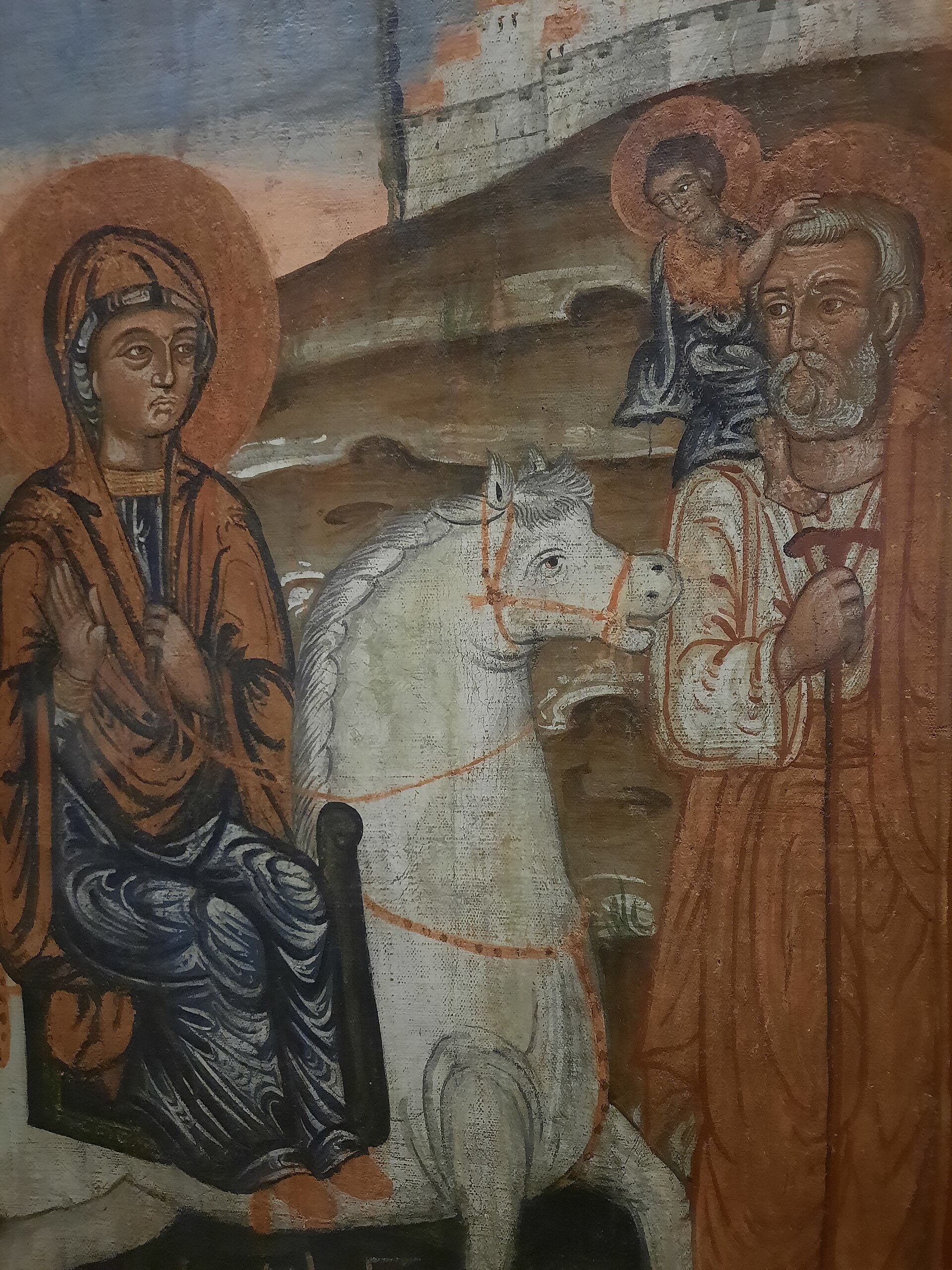 Source: Flight into Egypt, Coptic Museum; photograph © أحمد ناجي (Ahmad Nagy), CC BY-SA 4.0, 1920px rendition. Image source and credits.
The Theotokos rides while Joseph leads the flight, carrying the Child close to his shoulder. The Lord enters Egypt not as a distant visitor but within a family keeping Him safe through obedient love; the land that once held Israel in bondage becomes a refuge for Israel’s Savior.
Spiritual Fruit 🍇
-
Pray honestly with grief and protect the small. Rachel refuses shallow comfort. Stay near a bereaved family without supplying a reason for their loss. Pray for children by name, and do the next concrete act of protection that belongs to your household or parish: listen carefully, report danger appropriately, support a parent, or make a child safer.
-
Welcome Christ in a displaced neighbor. The Lord accepted shelter away from home. Offer practical mercy to a displaced family through a meal, transport, help with forms, or patient friendship. A neighbor needs welcome, not to become an illustration for our opinions.
-
Keep faith in the hidden years. Nazareth follows the night road. Choose one quiet obedience at home and keep it all week: prayer without display, work done honestly, attention to an elderly relative, or a gentler answer when tired. The Son who lived in obscurity does not overlook that life.
Joseph rises in the night and takes the young Child and His mother toward Egypt. The Magi go home another way. Rachel weeps, and the Church stays near her lament. Egypt becomes shelter for the hunted Son; Nazareth receives Him under an unimpressive name. Worship Him there, and ask Him to save you from the sins that still hunt the heart.
Teaching Notes
Egypt and Rachel (Matthew 2:13-18)
- Ask: How does Egypt’s role change when the land of bondage becomes shelter?
- Emphasize: Hosea’s exodus history is gathered into the true Son, not treated as an unrelated prediction.
- Explain: Matthew’s singular agrees with the Hebrew; Brenton’s Greek-based translation has “his children.”
- Connect: Hold Jeremiah’s lament beside its hope of restoration, without rushing from one to the other.
- Watch for: Teaching the later Egyptian itinerary as though Matthew narrated its stations.
- Show: Contrast the movements already named in the text: flight by night, refuge in Egypt, return after Herod’s death.
- Practice: Pray the names of children you know who are in danger, and do one thing to protect a child.
Nazareth and Hidden Obedience (Matthew 2:19-23)
- Ask: Why does the infancy narrative end with a hidden home rather than public acclaim?
- Emphasize: The Son shares ordinary human life without needing worldly prestige.
- Explain: Matthew says “prophets”; no single surviving Old Testament sentence exactly matches the Nazarene citation.
- Connect: Joseph’s attention to danger belongs with his obedience, not against it.
- Watch for: Treating a proposed wordplay as a proven source of the quotation.
- Show: Put “Herod’s palace” beside “Nazareth’s home” to compare control with humble guardianship.
- Practice: Choose one hidden faithfulness at home and keep it all week.
Glossary
- Recapitulation: The Son gathers a history into Himself to fulfill and heal it. Here He retraces Israel’s passage into and out of Egypt.
- Rachel weeping: Jeremiah’s image of Israel’s grief, applied by Matthew to the murdered children.
- Nazarene: A name identifying Jesus with Nazareth, the home where His hidden years unfold.
- Synaxarium: The Church’s collection of saints’ lives and commemorations, read in worship.
Sources
Scripture is from NKJV.
Coptic Synaxarium, Bashans 24, Paona 8 and Toba 3; Coptic Orthodox Katameros, Entrance into Egypt, Paona 8, Toba 3 and the first Sunday of Toba.
St John Chrysostom, Homilies on Matthew 8-9.
Brenton: Hosea 11:1, Jeremiah 38:15, Isaiah 19:1, 19 and Psalms 97, 104 and 112: ebible.org; ebible.org; ebible.org; ebible.org; ebible.org; ebible.org.
Footnotes
-
Hosea 11:1, NKJV and Brenton; ebible.org. ↩
-
St John Chrysostom, Homilies on Matthew 8.5-6, newadvent.org. ↩
-
Jeremiah 38:15, Brenton, ebible.org. ↩
-
St John Chrysostom, Homilies on Matthew 9, opening section on Matthew 2:16, newadvent.org. ↩
-
St John Chrysostom, Homilies on Matthew 9.6, newadvent.org. ↩
-
Isaiah 11:1, Hebrew and Brenton; biblehub.com; ebible.org. ↩
-
Coptic Synaxarium, Bashans 24, st-takla.org. ↩
-
Isaiah 19:1, 19, Brenton; Coptic Synaxarium, Bashans 24. ↩
-
Coptic Synaxarium, Paona 8, st-takla.org; Coptic Orthodox Katameros, Paona 8. ↩
-
Coptic Synaxarium and Katameros, Toba 3. ↩
-
Coptic Orthodox Katameros, first Sunday of Toba, Liturgy. ↩