
Matthew 9 ends with a command to pray. Jesus has seen the crowds harassed and helpless, sheep without a shepherd, and He has told His disciples to ask the Lord of the harvest to send laborers. Matthew 10 is the answer to that prayer, and it is sterner than volunteer enthusiasm. He calls twelve men to Himself, names them one by one, gives them His own authority over unclean spirits and disease, and sends them with empty money belts. The same Lord who has been healing, forgiving, raising, and shepherding now makes His compassion apostolic. Those who were told to pray for laborers become the laborers. They will carry His power without owning it and His peace without forcing it.
Authority given to the Twelve (Matthew 10:1-4)
1 And when He had called His twelve disciples to Him, He gave them power over unclean spirits, to cast them out, and to heal all kinds of sickness and all kinds of disease. 2 Now the names of the twelve apostles are these: first, Simon, who is called Peter, and Andrew his brother; James the son of Zebedee, and John his brother; 3 Philip and Bartholomew; Thomas and Matthew the tax collector; James the son of Alphaeus, and Lebbaeus, whose surname was Thaddaeus; 4 Simon the Cananite, and Judas Iscariot, who also betrayed Him.
Jesus first calls the Twelve to Himself before He sends them away from Himself. Mission begins with nearness to Christ. The disciples do not invent authority, borrow it from the crowds, or create it by strategy. He gives them power over unclean spirits and over every kind of sickness and disease. The works that filled Matthew 8 and 9 now become the works entrusted to His apostles.
Matthew names the Twelve slowly. Peter is first, but not alone. Andrew is his brother. James and John are sons of Zebedee. Matthew names himself plainly as “the tax collector,” without hiding the mercy that called him from the table. Judas is also named as the one who betrayed Him. The apostolic list is therefore both gift and warning. Christ truly gives authority, but authority does not remove the need for faithfulness. Judas’s place in the list does not prove that authority is empty. It proves that a real gift can still be refused.
The number Twelve is not accidental. Jesus is gathering and renewing Israel around Himself. The mission begins within Israel, but it already points beyond Israel, because the renewed people of God will become the witness through whom the nations are blessed.
Language insight
The disciples are called mathētai, learners, and then named as apostoloi, those sent with commission. Jesus gives them exousia, authority, over unclean spirits, pneumatōn akathartōn. Matthew does not present the apostles as independent miracle-workers. They are sent ones carrying authority that belongs first to Christ.1
Gems from the Fathers 💎: Christ’s Authority in the Twelve
St John Chrysostom links this sending to the previous harvest saying. Christ calls the ministry a harvest not because it belongs to someone else; the One who commands prayer for laborers is Himself both husbandman and Lord of the harvest.2
Chrysostom also notes that the apostles cast out spirits by Christ’s own command and authority.3 Their mission is therefore a manifestation of Christ’s own lordship, not a separate power possessed by the disciples.
St Cyril of Alexandria makes the Giver’s identity decisive. Other servants may receive divine power; Christ can bestow it from His own fullness. In Luke’s sending of the Twelve, “He gives them, as I said, His own glory.”4 What is shared is not an independent possession. The power remains Christ’s gift and must retain the generosity and holiness of its source.
Freely received, freely given (Matthew 10:5-15)
5 These twelve Jesus sent out and commanded them, saying: “Do not go into the way of the Gentiles, and do not enter a city of the Samaritans. 6 But go rather to the lost sheep of the house of Israel. 7 And as you go, preach, saying, ‘The kingdom of heaven is at hand.’ 8 Heal the sick, cleanse the lepers, raise the dead, cast out demons. Freely you have received, freely give. 9 Provide neither gold nor silver nor copper in your money belts, 10 nor bag for your journey, nor two tunics, nor sandals, nor staffs; for a worker is worthy of his food.
11 “Now whatever city or town you enter, inquire who in it is worthy, and stay there till you go out. 12 And when you go into a household, greet it. 13 If the household is worthy, let your peace come upon it. But if it is not worthy, let your peace return to you. 14 And whoever will not receive you nor hear your words, when you depart from that house or city, shake off the dust from your feet. 15 Assuredly, I say to you, it will be more tolerable for the land of Sodom and Gomorrah in the day of judgment than for that city!
Jesus first sends the Twelve to “the lost sheep of the house of Israel.” This Israel-first sending is an order in Matthew’s salvation history, not contempt for Gentiles, Samaritans, or Jews. The same Gospel has already shown Gentile Magi worshiping Christ and a Roman centurion praised for faith, and it will end with the risen Lord’s commission to all nations. The promise comes to Israel first, and through Israel the blessing will reach the nations.
Their message is simple: “The kingdom of heaven is at hand.” Their works make the message visible. They heal the sick, cleanse lepers, raise the dead, and cast out demons. These signs are not a performance to attract attention. They show that the kingdom is not merely an idea. In Christ, God’s reign touches bodies, households, sickness, uncleanness, death, and demonic bondage.
“Freely you have received, freely give” is the heart of apostolic poverty. The apostles cannot turn grace into a market. They must not make the power of Christ serve greed, status, or control. Their simplicity of travel is also a spiritual school. They go without money belts, extra bag, or layers of security. The same Lord who forbids a money belt also says that a worker is worthy of his food. Dependence on God does not become a weapon against clergy, missionaries, or ordinary workers who need legitimate provision.
The peace they bring is real, but it is not forced. A worthy household receives peace. A rejecting household loses it. Shaking the dust from the feet is departure and sober witness, not revenge, harassment, or a license for disciples to pronounce final judgment. The missionaries are poor and vulnerable, but the word they carry is not light. Sodom and Gomorrah stand as a scriptural comparison that intensifies the gravity of refusing Christ’s word. The verse does not hand the apostles a verdict to deliver against particular people.
Language insight
Jesus “sent” the Twelve with apostellō, the verb behind apostle. He “commanded” them, parangellō, showing that mission is obedient commission, not personal initiative. The kingdom is “at hand,” ēngiken, near and pressing upon the hearer. The apostles are told to give freely, dōrean, because they have received freely. Grace keeps its character when it is passed on without possession.
Gems from the Fathers 💎: Freely Given Mission
Chrysostom says Christ did not send them at the beginning, but only after they had followed Him and seen His works: the dead raised, the sea rebuked, demons expelled, sins remitted, and a leper cleansed.5 They are sent after being formed by the sight of Christ’s power.
On the poverty of the apostles, Chrysostom explains that Christ casts out their anxiety by the promise that a worker is worthy of support, and by opening the houses of those who would receive them.6
The Church’s Voice in Worship ⛪
The Common of the Apostles proclaims Matthew 10:1-15 at the Liturgy on Abib 5, Sts Peter and Paul; Abib 18, St James the brother of the Lord; Hatour 18, St Philip; Kiahk 4, St Andrew; and Kiahk 21, St Barnabas. These are the commemoration’s appointed readings when Sunday or seasonal precedence does not replace them. Vespers reads Mark 3:7-21 and Matins Luke 6:12-23, placing the choosing of the Twelve before their sending. At the Liturgy, Romans 10:4-18 unfolds the need for preachers who are sent; 2 Peter 1:12-21 gives the apostles’ witness to Christ; Acts 3:1-16 shows Peter healing in Jesus’ name; and Psalm 19:1, 4 (LXX 18:2, 5) gives the proclamation its worldwide horizon. Paul quotes that same Psalm in Romans 10:18. Brenton’s “Their voice is gone out into all the earth” answers the Twelve’s first steps toward Israel with the promise’s widening fulfillment.7
The apostle’s name does not replace the Sender’s name. In Acts, Peter refuses to make the healed man evidence of his own power or holiness; faith in Jesus’ name has made him strong. The poverty, proclamation, healing, and peace of Matthew 10:1-15 are received as Christ’s freely given mercy rather than private religious enterprise. The Church honors apostles most truthfully when she receives what they themselves received from Christ.
| Promise in Israel | The sign or event here | Fulfillment in Christ |
|---|---|---|
| The Lord of the harvest and the lost sheep of Israel | Jesus calls twelve named men and sends them with His own authority, poverty, and peace | Christ remains the husbandman; apostolic mission is His compassion taking form in the Church |
Iconography Connection 🖼️
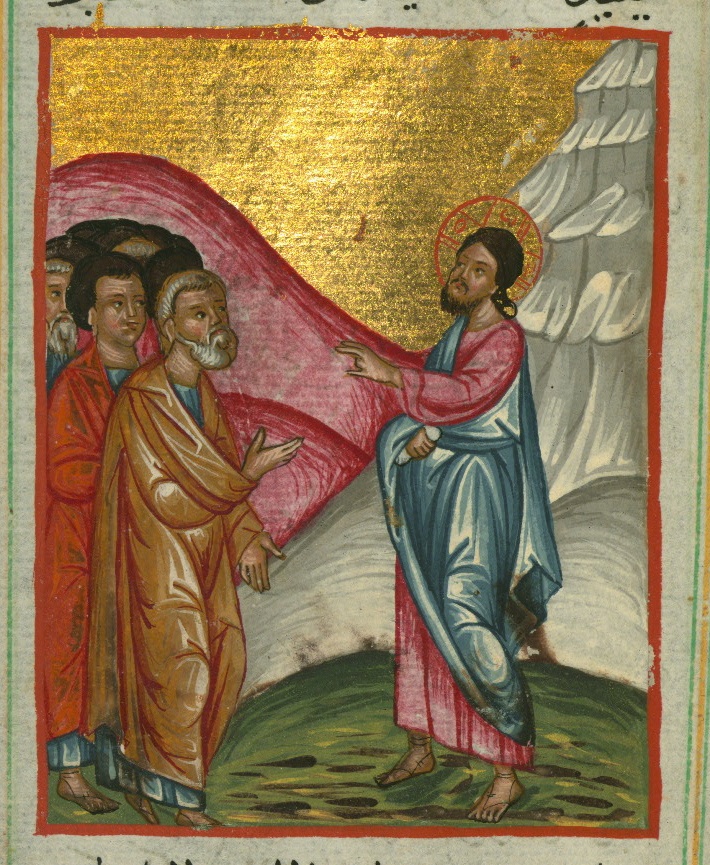 Source: Walters MS W.592, fol. 25a, The Walters Art Museum, CC BY-NC-SA 3.0, cropped detail.
Christ faces the apostles and sends them from His own authority. Their crowded gathering and His extended hand place the source of their mission before its journeys: they can give freely because they have first received from Him.
This is a historical Egyptian Arabic Gospel miniature from 1684; the painter is unidentified.
Spiritual Fruit 🍇
Matthew 10 searches the servant who has begun to possess grace. The Twelve heal, preach, and cast out demons only because they have received. A parish gift treated as a personal brand, a labor that withholds mercy until it pays, a need to be noticed in every service: these already convert what Christ gave freely into property. “Freely give” answers that heart. Give without collecting status, and receive ordinary provision as a worker worthy of food, not as a right to control others.
Offer Christ one gift you have begun to treat as your own. Ask whom it could serve if no credit returned to you. Then give it freely, receiving the ordinary help you need with gratitude.
Teaching Notes
Authority given to the Twelve (Matthew 10:1-4)
- Ask: Why does Jesus call the disciples to Himself before sending them out?
- Emphasize: Apostolic authority is received from Christ. It is not personality, charisma, or institutional self-importance.
- Watch for: Treating Judas’s presence as proof that authority is meaningless. The passage shows both real authority and the need for faithfulness.
- Connect: Link the Twelve to the renewal of Israel and to the Church’s apostolic foundation.
- Show: Read the Twelve’s names aloud, including Matthew’s occupation and Judas’s betrayal. The list holds gift and responsibility together.
- Explain: Authority is given after Christ calls the disciples to Himself.
- Practice: Pray the names of the Twelve this week and ask Christ for one gift to use freely.
Freely received, freely given (Matthew 10:5-15)
- Ask: What does “freely you have received, freely give” protect the apostles from?
- Emphasize: Grace cannot be sold, owned, or used for status. Simplicity of life protects the mission from greed, while the worker remains worthy of food.
- Watch for: Detaching the signs from their message that the kingdom is near.
- Connect: Link the kingdom proclamation to the signs of restoration and the apostolic witness in Acts 3.
- Show: Contrast receiving peace with refusing peace. The apostles are vulnerable, but the word they carry is serious.
- Explain: The peace is offered freely, and the refusal is left to God’s judgment.
- Practice: Do one service this week for which you will not be thanked or paid.
Glossary
- Apostle: A person sent with commission, carrying the Sender’s authority.
- The Twelve: The named disciples through whom Christ’s renewal of Israel becomes apostolic mission.
Sources
Scripture is from NKJV.
Coptic Katameros readings and Synaxarium commemorations are cited by their day and service. Septuagint comparisons use Brenton’s English translation.
Footnotes
-
Greek text, Matthew 10:1-2, 5-8: biblehub.com and biblehub.com. ↩
-
St John Chrysostom, Homilies on Matthew, Homily 32, §4, NPNF1 10: newadvent.org. ↩
-
St Cyril of Alexandria, Commentary on Luke, Sermon XLVII, on Luke 9:1-5, pp. 199-207, especially 200, trans. R. Payne Smith (1859): tertullian.org. ↩
-
St John Chrysostom, Homilies on Matthew, Homily 32, §4, NPNF1 10: newadvent.org. ↩
-
St John Chrysostom, Homilies on Matthew, Homily 32, §7, NPNF1 10: newadvent.org. ↩
-
Psalm 19:4 (LXX 18:5), Brenton Septuagint: ebible.org; Romans 10:18. ↩