


Genesis 42-45 shows that reconciliation in Scripture is not sentimental forgetting. Joseph does not expose himself to his brothers cheaply, and he does not use power for revenge. He tests them until the truth comes into the open, until Benjamin is no longer treated as Joseph once was, and until Judah is willing to stand in another brother’s place. Only then does Joseph reveal himself and interpret the whole history through providence: evil was real, but God sent him ahead for life.
Why this passage matters
These chapters are among the deepest biblical texts on repentance, conscience, substitution, hidden providence, and family restoration. Joseph is a suffering and exalted savior for the very men who betrayed him. Judah, who once participated in Joseph’s sale, becomes the brother who offers himself instead of Benjamin. The whole scene prepares the reader to understand both Christ and the Church: sin must be faced truthfully, mercy must be received humbly, and a fractured family can be gathered around life-giving bread.
Route schematic: repeated descent, testing, and mercy revealed
This visual is a teaching schematic rather than an atlas map. It follows the order and spiritual movement of Genesis 42-45 in the embedded Brenton Septuagint text. Use it to help readers keep the narrative’s geography and theology together: the brothers’ journeys to Egypt, Judah’s intercession, and Joseph’s merciful revelation.
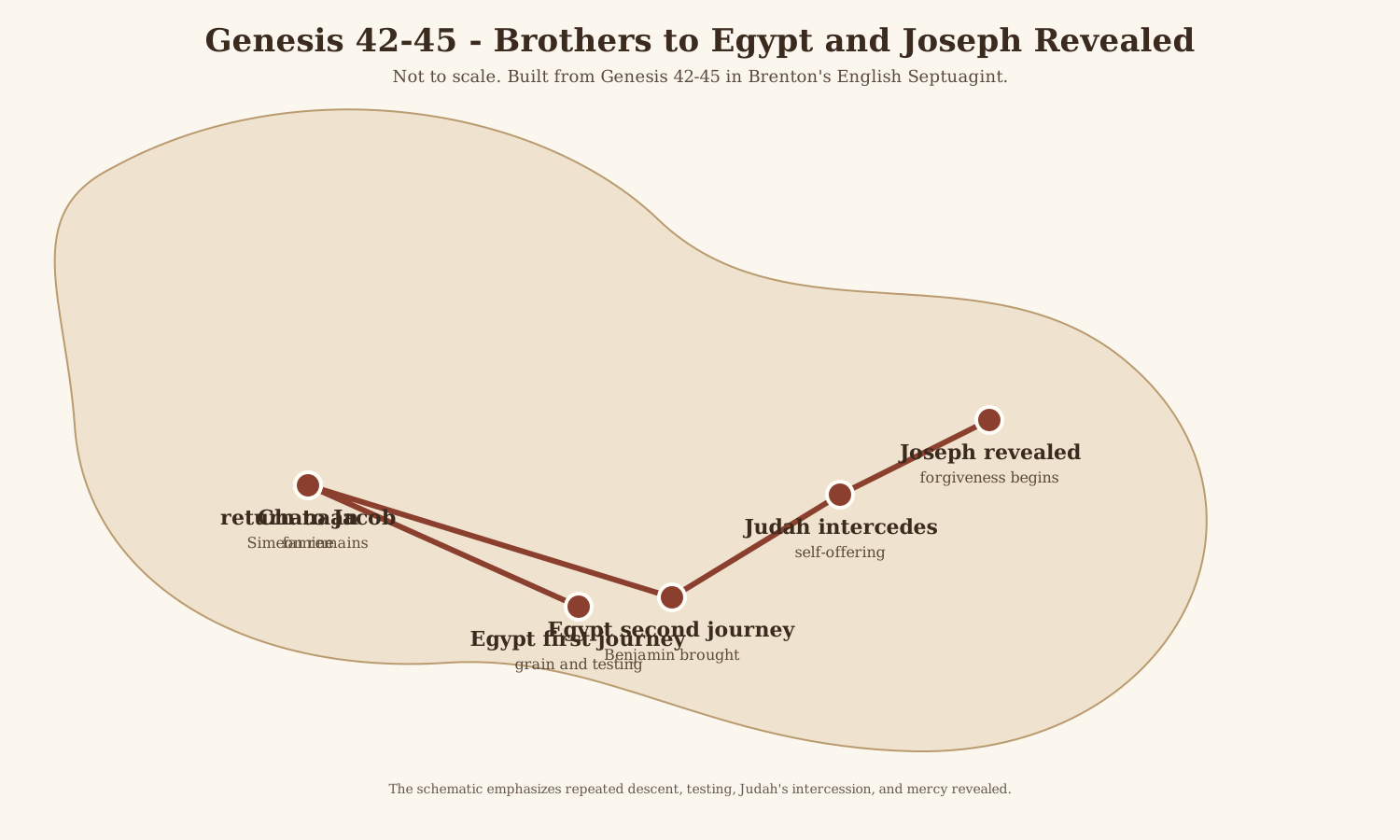 Source: created for this guide from Genesis 42-45 in Brenton’s English Septuagint, 2026-06-06. Not to scale.
Historical and Scriptural Context
Joseph has already been sold, humiliated, imprisoned, and exalted. The dreams of Genesis 37 are now ripening under famine. Jacob’s house, which once tore itself apart through jealousy and favoritism, is forced to descend into Egypt for bread. This descent is historically important because it begins the movement that will eventually lead into Exodus.
Theologically, these chapters also complete Judah’s moral turn. In Genesis 37 he helped sell Joseph; in Genesis 38 his own sin was exposed; here in Genesis 44 he speaks and acts as a changed man. The narrative therefore does not only ask whether Joseph can forgive. It asks whether the brothers have actually become different men.
Famine brings buried sin back to speech (Genesis 42:1-38)
1 And Jacob having seen that there was a sale of corn in Egypt, said to his sons, Why are ye indolent? 2 Behold, I have heard that there is corn in Egypt; go down thither, and buy for us a little food, that we may live, and not die.
3 And the ten brethren of Joseph went down to buy corn out of Egypt. 4 But Jacob sent not Benjamin, the brother of Joseph, with his brethren; for he said, Lest, haply, disease befal him. 5 And the sons of Israel came to buy with those that came, for the famine was in the land of Chanaan. 6 And Joseph was ruler of the land; he sold to all the people of the land. And the brethren of Joseph, having come, did reverence to him, bowing with the face to the ground. 7 And when Joseph saw his brethren, he knew them, and estranged himself from them, and spoke hard words to them; and said to them, Whence are ye come? And they said, Out of the land of Chanaan, to buy food. 8 And Joseph knew his brethren, but they knew not him. 9 And Joseph remembered his dream, which he saw; and he said to them, Ye are spies; to observe the marks of the land are ye come. 10 But they said, Nay, Sir, we thy servants are come to buy food; 11 we are all sons of one man; we are peaceable, thy servants are not spies. 12 And he said to them, Nay, but ye are come to observe the marks of the land. 13 And they said, We thy servants are twelve brethren, in the land of Chanaan; and, behold, the youngest is with our father to-day, but the other one is not. 14 And Joseph said to them, This is it that I spoke to you, saying, ye are spies; 15 herein shall ye be manifested; by the health of Pharao, ye shall not depart hence, unless your younger brother come hither. 16 Send one of you, and take your brother; and go ye to prison, till your words be clear, whether ye speak the truth or not; but, if not, by the health of Pharao, verily ye are spies. 17 And he put them in prison three days. 18 And he said to them on the third day, This do, and ye shall live, for I fear God. 19 If ye be peaceable, let one of your brethren be detained in prison; but go ye, and carry back the corn ye have purchased. 20 And bring your younger brother to me, and your words shall be believed; but, if not, ye shall die. And they did so. 21 And each said to his brother, Yes, indeed, for we are in fault concerning our brother, when we disregarded the anguish of his soul, when he besought us, and we hearkened not to him; and therefore has this affliction come upon us. 22 And Ruben answered them, saying, Did I not speak to you, saying, Hurt not the boy, and ye heard me not? and, behold, his blood is required. 23 But they knew not that Joseph understood them; for there was an interpreter between them. 24 And Joseph turned away from them, and wept; and again he came to them, and spoke to them; and he took Symeon from them, and bound him before their eyes.
25 And Joseph gave orders to fill their vessels with corn, and to return their money to each into his sack, and to give them provision for the way; and it was so done to them. 26 And having put the corn on the asses, they departed thence. 27 And one having opened his sack to give his asses fodder, at the place where they rested, saw also his bundle of money, for it was on the mouth of his sack. 28 And he said to his brethren, My money has been restored to me, and behold this is in my sack. And their heart was wonder-struck, and they were troubled, saying one to another, What is this that God has done to us? 29 And they came to their father, Jacob, into the land of Chanaan, and reported to him all that had happened to them, saying, 30 The man, the lord of the land, spoke harsh words to us, and put us in prison as spies of the land. 31 And we said to him, We are men of peace, we are not spies. 32 We are twelve brethren, sons of our father; one is not, and the youngest is with his father to-day in the land of Chanaan. 33 And the man, the lord of the land, said to us, Herein shall I know that ye are peaceable; leave one brother here with me, and having taken the corn ye have purchased for your family, depart. 34 And bring to me your younger brother; then I shall know that ye are not spies, but that ye are men of peace: and I will restore you your brother, and ye shall trade in the land. 35 And it came to pass as they were emptying their sacks, there was each man’s bundle of money in his sack; and they and their father saw their bundles of money, and they were afraid. 36 And their father Jacob said to them, Ye have bereaved me. Joseph is not, Symeon is not, and will ye take Benjamin? all these things have come upon me. 37 And Ruben spoke to his father, saying, Slay my two sons, if I bring him not to thee; give him into my hand, and I will bring him back to thee. 38 But he said, My son shall not go down with you, because his brother is dead, and he only has been left; and suppose it shall come to pass that he is afflicted by the way by which ye go, then ye shall bring down my old age with sorrow to Hades.
The famine drives Joseph’s brothers to Egypt, but the deeper movement is inward. The men who once silenced Joseph now speak openly of their guilt: “we are in fault concerning our brother.” Joseph’s harshness is not petty vengeance. He is pressing their conscience until the past can no longer remain buried.
Simeon is held, Benjamin is demanded, and the returned money disturbs them. Fear enters because grace enters strangely. They cannot yet distinguish mercy from judgment. This is spiritually accurate: a guilty heart often trembles not only before punishment, but also before unexpected kindness.
Benjamin becomes the test of whether the brothers have changed (Genesis 43:1-34)
1 But the famine prevailed in the land. 2 And it came to pass, when they had finished eating the corn which they had brought out of Egypt, that their father said to them, Go again; buy us a little food. 3 And Judas spoke to him, saying, The man, the lord of the country, positively testified to us, saying, Ye shall not see my face, unless your younger brother be with you. 4 If, then, thou send our brother with us, we will go down, and buy thee food; 5 but if thou send not our brother with us, we will not go: for the man spoke to us, saying, Ye shall not see my face, unless your younger brother be with you. 6 And Israel said, Why did ye harm me, inasmuch as ye told the man that ye had a brother? 7 And they said, The man closely questioned us about our family also, saying, Does your father yet live, and have ye a brother? and we answered him according to this question: did we know that he would say to us, Bring your brother? 8 And Judas said to his father Israel, Send the boy with me, and we will arise and go, that we may live and not die, both we and thou, and our store. 9 And I engage for him; at my hand do thou require him; if I bring him not to thee, and place him before thee, I shall be guilty toward thee for ever. 10 For if we had not tarried, we should now have returned twice. 11 And Israel, their father, said to them, If it be so, do this; take of the fruits of the earth in your vessels, and carry down to the man presents of gum and honey, and frankincense, and stacte, and turpentine, and walnuts. 12 And take double money in your hands, and the money that was returned in your sacks, carry back with you, lest peradventure it is a mistake. 13 And take your brother; and arise, go down to the man. 14 And my God give you favour in the sight of the man, and send away your other brother, and Benjamin, for I accordingly as I have been bereaved, am bereaved.
15 And the men having taken these presents, and the double money, took in their hands also Benjamin; and they rose up and went down to Egypt, and stood before Joseph. 16 And Joseph saw them and his brother Benjamin, born of the same mother; and he said to the steward of his household, Bring the men into the house, and slay beasts and make ready, for the men are to eat bread with me at noon. 17 And the man did as Joseph said; and he brought the men into the house of Joseph. 18 And the men, when they perceived that they were brought into the house of Joseph, said, We are brought in because of the money that was returned in our sacks at the first; even in order to inform against us, and lay it to our charge; to take us for servants, and our asses. 19 And having approached the man who was over the house of Joseph, they spoke to him in the porch of the house, 20 saying, We pray thee, Sir; we came down at first to buy food. 21 And it came to pass, when we came to unlade, and opened our sacks, there was also this money of each in his sack; we have now brought back our money by weight in our hands. 22 And we have brought other money with us to buy food; we know not who put the money into our sacks. 23 And he said to them, God deal mercifully with you; be not afraid; your God, and the God of your fathers, has given you treasures in your sacks, and I have enough of your good money. And he brought Symeon out to them. 24 And he brought water to wash their feet; and gave provender to their asses. 25 And they prepared their gifts, until Joseph came at noon, for they heard that he was going to dine there. 26 And Joseph entered into the house, and they brought him the gifts which they had in their hands, into the house; and they did him reverence with their face to the ground. 27 And he asked them, How are ye? and he said to them, Is your father, the old man of whom ye spoke, well? Does he yet live? 28 And they said, Thy servant our father is well; he is yet alive. And he said, Blessed be that man by God;—and they bowed, and did him reverence. 29 And Joseph lifted up his eyes, and saw his brother Benjamin, born of the same mother; and he said, Is this your younger brother, whom ye spoke of bringing to me? and he said, God have mercy on thee, my son. 30 And Joseph was troubled, for his bowels yearned over his brother, and he sought to weep; and he went into his chamber, and wept there.
31 And he washed his face and came out, and refrained himself, and said, Set on bread. 32 And they set on bread for him alone, and for them by themselves, and for the Egyptians feasting with him by themselves, for the Egyptians could not eat bread with the Hebrews, for it is an abomination to the Egyptians. 33 And they sat before him, the first-born according to his seniority, and the younger according to his youth; and the men looked with amazement every one at his brother. 34 And they took their portions from him to themselves; but Benjamin’s portion was five times as much as the portions of the others. And they drank and were filled with drink with him.
Jacob cannot easily release Benjamin because Benjamin now bears the emotional weight that Joseph once carried. Judah, however, takes responsibility: “I engage for him.” This is new. The brother who once failed in fraternal truth now speaks as a guarantor.
Joseph’s banquet intensifies the test. Benjamin receives favor, yet the brothers do not react with the old envy. Joseph sees Benjamin, weeps in private, and restrains himself. The chapter is full of hidden tenderness under outward severity. Joseph’s heart is already moving toward reconciliation, but he will not reveal himself before the brothers are exposed as capable of protecting the beloved son rather than sacrificing him.
Judah’s self-offering is the turning point (Genesis 44:1-34)
1 And Joseph charged the steward of his house, saying, Fill the men’s sacks with food, as much as they can carry, and put the money of each in the mouth of his sack. 2 And put my silver cup into the sack of the youngest, and the price of his corn. And it was done according to the word of Joseph, as he said.
3 The morning dawned, and the men were sent away, they and their asses. 4 And when they had gone out of the city, and were not far off, then Joseph said to his steward, Arise, and pursue after the men; and thou shalt overtake them, and say to them, Why have ye returned evil for good? 5 Why have ye stolen my silver cup? is it not this out of which my lord drinks? and he divines augury with it; ye have accomplished evil in that which ye have done. 6 And he found them, and spoke to them according to these words. 7 And they said to him, Why does our lord speak according to these words? far be it from thy servants to do according to this word. 8 If we brought back to thee out of the land of Chanaan the money which we found in our sacks, how should we steal silver or gold out of the house of thy lord? 9 With whomsoever of thy servants thou shalt find the cup, let him die; and, moreover, we will be servants to our lord. 10 And he said, Now then it shall be as ye say; with whomsoever the cup shall be found, he shall be my servant, and ye shall be clear. 11 And they hasted, and took down every man his sack on the ground, and they opened every man his sack. 12 And he searched, beginning from the eldest, until he came to the youngest; and he found the cup in Benjamin’s sack. 13 And they rent their garments, and laid each man his sack on his ass, and returned to the city.
14 And Judas and his brethren came in to Joseph, while he was yet there, and fell on the ground before him. 15 And Joseph said to them, What is this thing that ye have done? know ye not that a man such as I can surely divine? 16 And Judas said, What shall we answer to our lord, or what shall we say, or wherein should we be justified? whereas God has discovered the unrighteousness of thy servants; behold, we are slaves to our lord, both we and he with whom the cup has been found. 17 And Joseph said, Far be it from me to do this thing; the man with whom the cup has been found, he shall be my servant; but do ye go up with safety to your father. 18 And Judas drew near him, and said, I pray, Sir, let thy servant speak a word before thee, and be not angry with thy servant, for thou art next to Pharao. 19 Sir, thou askedst thy servants, saying, Have ye a father or a brother? 20 And we said to my lord, We have a father, an old man, and he has a son of his old age, a young one, and his brother is dead, and he alone has been left behind to his mother, and his father loves him. 21 And thou saidst to thy servants, Bring him down to me, and I will take care of him. 22 And we said to my lord, The child will not be able to leave his father; but if he should leave his father, he will die. 23 But thou saidst to thy servants, Except your younger brother come down with you, ye shall not see my face again. 24 And it came to pass, when we went up to thy servant our father, we reported to him the words of our lord. 25 And our father said, Go again, and buy us a little food. 26 And we said, We shall not be able to go down; but if our younger brother go down with us, we will go down; for we shall not be able to see the man’s face, our younger brother not being with us. 27 And thy servant our father said to us, Ye know that my wife bore me two sons; 28 and one is departed from me; and ye said that he was devoured of wild beasts, and I have not seen him until now. 29 If then ye take this one also from my presence, and an affliction happen to him by the way, then shall ye bring down my old age with sorrow to the grave. 30 Now then, if I should go in to thy servant, and our father, and the boy should not be with us, (and his life depends on this lad’s life)— 31 it shall even come to pass, when he sees the boy is not with us, that he will die, and thy servants will bring down the old age of thy servant, and our father, with sorrow to the grave. 32 For thy servant has received the boy in charge from his father, saying, If I bring him not to thee, and place him before thee, I shall be guilty towards my father for ever. 33 Now then I will remain a servant with thee instead of the lad, a domestic of my lord; but let the lad go up with his brethren. 34 For how shall I go up to my father, the lad not being with us? lest I behold the evils which will befal my father.
The silver cup episode is not about Joseph playing games for amusement. It recreates the moral crisis of Genesis 37. Will the brothers abandon another son of Rachel in order to save themselves? The answer is no. They return together, rend their garments, and stand with Benjamin.
Judah’s speech is one of the great speeches in Genesis. He recounts the father’s grief, the boy’s beloved status, and the cost of losing him. Then he offers himself: “I will remain a servant with thee instead of the lad.” This is the great reversal. Judah once participated in selling a brother; now he offers himself for a brother. Repentance has become visible.
Joseph reveals himself and names providence truthfully (Genesis 45:1-28)
1 And Joseph could not refrain himself when all were standing by him, but said, Dismiss all from me; and no one stood near Joseph, when he made himself known to his brethren. 2 And he uttered his voice with weeping; and all the Egyptians heard, and it was reported to the house of Pharao. 3 And Joseph said to his brethren, I am Joseph; doth my father yet live? And his brethren could not answer him, for they were troubled. 4 And Joseph said to his brethren, Draw nigh to me; and they drew nigh; and he said, I am your brother Joseph, whom ye sold into Egypt. 5 Now then be not grieved, and let it not seem hard to you that ye sold me hither, for God sent me before you for life. 6 For this second year there is famine on the earth, and there are yet five years remaining, in which there is to be neither ploughing, nor mowing. 7 For God sent me before you, that there might be left to you a remnant upon the earth, even to nourish a great remnant of you. 8 Now then ye did not send me hither, but God; and he hath made me as a father of Pharao, and lord of all his house, and ruler of all the land of Egypt. 9 Hasten, therefore, and go up to my father, and say to him, These things saith thy son Joseph; God has made me lord of all the land of Egypt; come down therefore to me, and tarry not. 10 And thou shalt dwell in the land of Gesem of Arabia; and thou shalt be near me, thou and thy sons, and thy sons’ sons, thy sheep and thine oxen, and whatsoever things are thine. 11 And I will nourish thee there: for the famine is yet for five years; lest thou be consumed, and thy sons, and all thy possessions. 12 Behold, your eyes see, and the eyes of my brother Benjamin, that it is my mouth that speaks to you. 13 Report, therefore, to my father all my glory in Egypt, and all things that ye have seen, and make haste and bring down my father hither. 14 And he fell on his brother Benjamin’s neck, and wept on him; and Benjamin wept on his neck. 15 And he kissed all his brethren, and wept on them; and after these things his brethren spoke to him.
16 And the report was carried into the house of Pharao, saying, Joseph’s brethren are come; and Pharao was glad, and his household. 17 And Pharao said to Joseph, Say to thy brethren, Do this; fill your waggons, and depart into the land of Chanaan. 18 And take up your father, and your possessions, and come to me; and I will give you of all the goods of Egypt, and ye shall eat the marrow of the land. 19 And do thou charge them thus; that they should take for them waggons out of the land of Egypt, for your little ones, and for your wives; and take up your father, and come. 20 And be not sparing in regard to your property, for all the good of Egypt shall be yours. 21 And the children of Israel did so; and Joseph gave to them waggons, according to the words spoken by king Pharao; and he gave them provision for the journey. 22 And he gave to them all two sets of raiment apiece; but to Benjamin he gave three hundred pieces of gold, and five changes of raiment. 23 And to his father he sent presents at the same rate, and ten asses, bearing some of all the good things of Egypt, and ten mules, bearing bread for his father for the journey. 24 And he sent away his brethren, and they went; and he said to them, Be not angry by the way. 25 And they went up out of Egypt, and came into the land of Chanaan, to Jacob their father. 26 And they reported to him, saying, Thy son Joseph is living, and he is ruler over all the land of Egypt; and Jacob was amazed, for he did not believe them. 27 But they spoke to him all the words uttered by Joseph, whatsoever he said to them; and having seen the chariots which Joseph sent to take him up, the spirit of Jacob their father revived. 28 And Israel said, It is a great thing for me if Joseph my son is yet alive, I will go and see him before I die.
Joseph’s revelation is powerful because it comes after moral truth has emerged. He does not say that evil never happened. He says, “whom ye sold into Egypt,” and in the same breath he says, “God sent me before you for life.” This is one of the clearest biblical statements about providence. Human malice remains evil. Divine wisdom is greater still.
Joseph’s forgiveness is not abstract. He feeds, gathers, comforts, and makes room for the family. Reconciliation becomes concrete provision. The house that once produced death now becomes a remnant preserved alive.
💎 Gems from the Fathers
St. Ambrose’s Joseph tradition helps this unit because it reads Joseph as both type and moral exemplar. Joseph’s merciful strength is seen here not in retaliation but in disciplined discernment. He does not surrender truth for the sake of emotional relief; he labors until truth and mercy can meet.
St. John Chrysostom’s Homily XLIX on Acts gives a providential lens for Joseph’s whole story, but not in a way that minimizes pain. It helps the teacher say exactly what Joseph says in Genesis 45: the brothers sold him, and God sent him before them for life. Chrysostom says Joseph’s brothers “freed him from having enemies dwelling in the same house with him, from envy and much ill will, and from daily machinations for his ruin: they placed him far aloof from them that hated him.” He then gives the theological reading: “while they and she were severally seeking to compass their own ends, far other were the mighty consequences working out by the Providence of God for that just man.”1
Judah’s transformation is also central. The tribe from which Christ comes is marked here by self-offering. Judah is not chosen because his past is spotless, but because grace has begun to reorder him toward responsibility, confession, and sacrificial love.
Christological and ecclesial fulfillment
Joseph remains one of the richest types of Christ in Genesis. He is the beloved son rejected by his own, stripped, sold, brought low, then exalted among the Gentiles, and finally revealed as the one through whom life is given. He does not merely survive the brothers’ violence; he becomes their bread-giver and rescuer.
Judah’s plea deepens the Christological reading. The future royal line is marked by substitution: “let me remain instead of the lad.” This does not equal the Cross, but it clearly prepares the imagination for it. The Messiah will come from Judah, and already Judah’s best moment is to stand between death and another’s loss.
Ecclesially, the Church appears here as a reconciled household gathered around bread, confession, tears, and peace. The family is not restored by denial. It is restored when hidden sin is uncovered, repentance becomes concrete, and mercy is received from the one who was wounded.
Coptic Orthodox liturgical and worship connection
This passage has no established place in the Coptic Orthodox lectionary.
Even so, the passage is deeply at home in Orthodox teaching and worship. Its themes belong naturally to confessional life: conscience awakened, tears that heal, providence stronger than malice, and brotherly reconciliation after truthful repentance. Joseph’s gift of bread also keeps this unit close to the Church’s Eucharistic imagination, where the rejected one becomes the giver of life.
Deeper spiritual insight and teaching emphasis
Joseph’s testing is medicinal. He is not punishing his brothers because he enjoys their fear. He is asking whether the old pattern still rules them. Will they again sacrifice a favored son to preserve themselves? Until that question is answered, a quick emotional reunion would be shallow.
Judah is therefore the key human figure in the unit. He has been morally compromised before, but grace has not left him unchanged. When he speaks for Benjamin and offers himself in the lad’s place, the chapter shows what repentance looks like in adult life: not mere regret, but a new willingness to bear cost for someone else.
Joseph’s providential reading must also be taught carefully. He does not say, “What you did was fine because it worked out.” He says they meant evil, and God meant good. That distinction matters pastorally. Orthodox teaching never blesses sin simply because God can bring good from it. Providence is not the denial of evil; it is the triumph of divine wisdom over evil.
Finally, Joseph’s tears matter. He weeps before the revelation, during the revelation, and after it. Strength in Scripture is not emotional numbness. Holy authority can be truthful, restrained, and tender at once.
Glossary
- Providence: God’s wise and sovereign governance, by which He can bring life out of human evil without approving the evil itself.
- Judah’s pledge: Judah’s promise to answer for Benjamin, culminating in his offer to remain as a servant in Benjamin’s place.
- Remnant: Joseph’s language for the preserved family line that God keeps alive through famine.
- Joseph typology: the Orthodox reading of Joseph as a pattern that anticipates Christ’s rejection, humiliation, exaltation, and merciful salvation.
- Gesem / Goshen: the region of Egypt where Joseph settles the family in safety and provision.
Spiritual Fruit 🍇
- Let conscience speak before you defend yourself. The brothers begin to heal when they finally name what they did.
- Measure repentance by changed behavior. Judah’s transformation is seen when he protects Benjamin instead of sacrificing him.
- Do not confuse hidden mercy with indifference. Joseph’s silence and tests are not absence of love.
- Refuse fatalism. What others mean for evil, God can still bend toward life without calling the evil good.
- Make reconciliation concrete. Joseph forgives, but he also feeds, gathers, and comforts.
Teaching Notes
Famine brings buried sin back to speech (Genesis 42:1-38)
- Ask: Why does Joseph delay his self-revelation instead of embracing his brothers immediately?
- Emphasize: Joseph tests in order to heal, not to humiliate.
- Watch for: Do not present Joseph as manipulative for manipulation’s sake. The test is narrative medicine.
- Connect: Confession begins when buried sin finally comes back to speech.
- Show: Use the Genesis 42-45 schematic to track the brothers’ repeated descent into Egypt and their repeated confrontation with truth.
Judah’s self-offering is the turning point (Genesis 44:1-34)
- Ask: What shows that Judah has actually changed since earlier Genesis narratives?
- Emphasize: Real repentance becomes costly protection of another person.
- Watch for: Do not tell wounded people that betrayal becomes pleasant if they simply trust God. Joseph names evil truthfully.
- Connect: Judah’s offer to remain instead of Benjamin prepares the imagination for substitution, while Joseph’s mercy prepares the imagination for Christ the life-giver.
- Show: Use the schematic to connect Judah’s intercession with Joseph’s merciful revelation and the family gathered around bread.
Sources
Primary sources
- Scripture: Genesis 42-45 in Brenton’s English Septuagint. Public-domain Brenton edition: https://archive.org/details/septuagintversio00bren
- Acts 7:9-14 for apostolic recollection of Joseph’s rejection and exaltation.
- St. Ambrose, On Joseph.: https://archive.org/details/deabrahamabramo0000ambr
- St. Ambrose, On the Christian Faith III.17, on Joseph as type of Christ and the sale for twenty pieces: https://www.ccel.org/ccel/schaff/npnf210.iv.ii.iv.xvii.html
- St. John Chrysostom, Homily XLIX on Acts, on Joseph and providence through intended harm: https://www.ccel.org/ccel/schaff/npnf111.vi.xlix.html
- St. Ephrem the Syrian, Commentary on Genesis.: https://archive.org/details/selectedprosewor0000ephr
Patristic direct quote anchors
St. John Chrysostom, Homily XLIX on Acts, on Joseph’s brothers and providence: https://www.ccel.org/ccel/schaff/npnf111.vi.xlix.html#vi.xlix-p16
Secondary academic sources
- Victor P. Hamilton, The Book of Genesis: Chapters 18-50.
- Kenneth A. Mathews, Genesis 11:27-50:26.
- Gordon J. Wenham, Genesis 16-50.
- Claus Westermann, Genesis 37-50.
Coptic Orthodox / pastoral sources
- The Orthodox Study Bible, notes on Joseph and providence.
- Fr. Tadros Yacoub Malaty, Genesis commentary.
- Pope Shenouda III on repentance, forgiveness, and God’s guidance through suffering.
- Fr. Bishoy Kamel on sacrifice, humility, and family healing in the life of grace.
Public web sources cited
- CCEL and New Advent for public-domain patristic access.
Visual sources
assets/genesis-42-45-brothers-to-egypt-schematic-lxx.svg: schematic or image used in this guide from the cited Genesis passage or public-domain source; see the inline caption where applicable.
Footnotes
-
St. John Chrysostom, Homily XLIX on Acts, https://www.ccel.org/ccel/schaff/npnf111.vi.xlix.html#vi.xlix-p16. ↩