


Genesis 39-41 shows the righteous servant passing through purity, slander, confinement, hidden service, wisdom, and exaltation. Joseph descends into Egypt, refuses uncleanness, is falsely accused, ministers faithfully in prison, is forgotten by the man he helped, and is finally raised up to preserve life. The passage teaches that God’s providence is not defeated by injustice, delay, or human ingratitude. In Orthodox reading, Joseph is one of Genesis’s clearest types of Christ: the innocent sufferer brought low and later manifested as life-giving.
Why this passage matters
These chapters matter because they unite moral struggle and salvation history. Joseph’s chastity is not a detached ethics lesson. His refusal of sin belongs to the same divine path that leads through humiliation into service for many. The narrative therefore teaches how the saint stands firm when no one seems to notice and how God prepares deliverance long before anyone can see it.
The Church loves Joseph because his story speaks of purity without sentimentality, suffering without despair, and power without vanity. Joseph prospers in Potiphar’s house, in prison, and before Pharaoh, yet the source is the same throughout: “the Lord was with Joseph.” Circumstances change; divine presence does not.
Spiritual geography schematic: house, prison, wisdom, and exaltation
This visual is a teaching schematic rather than an atlas map. It follows the order and spiritual movement of Genesis 39-41 in the embedded Brenton Septuagint text. Use it to help readers keep the narrative’s geography and theology together: Joseph’s movement inside Egypt from service to prison to interpreted dreams and exaltation.
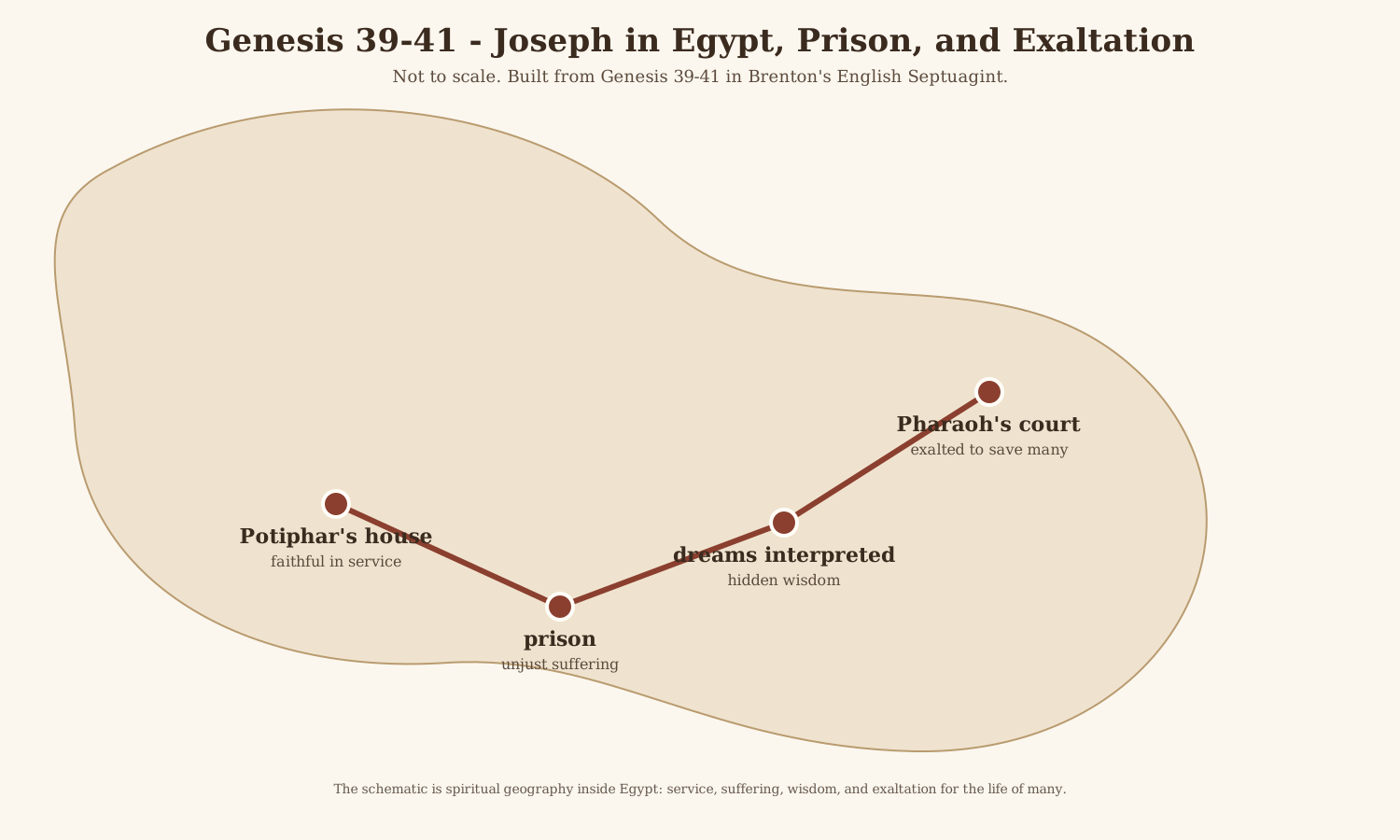 Source: created for this guide from Genesis 39-41 in Brenton’s English Septuagint, 2026-06-06. Not to scale.
Historical and Scriptural Context
Genesis 39-41 stands in the Joseph cycle after betrayal and sale into Egypt, but before reconciliation and the migration of Jacob’s family. Joseph has not yet been vindicated before his brothers, and the covenant family is still exposed to hunger and fracture. At this stage the text asks whether God’s purposes can survive slavery, temptation, false testimony, delay, and imperial politics. The answer is yes, not because evil is unreal, but because providence is deeper than it.
The setting also matters for Orthodox reading of exile. Joseph serves in a foreign land that does not worship the God of the fathers, yet he remains undefiled inwardly and fruitful outwardly. He is not preserved by withdrawal from the world but by fidelity within it. His trials become the means by which bread will later reach both Egypt and the house of Israel.
Prosperity in Potiphar’s house is the fruit of God’s presence (Genesis 39:1-6)
1 And Joseph was brought down to Egypt; and Petephres the eunuch of Pharao, the captain of the guard, an Egyptian, bought him of the hands of the Ismaelites, who brought him down thither. 2 And the Lord was with Joseph, and he was a prosperous man; and he was in the house with his lord the Egyptian. 3 And his master knew that the Lord was with him, and the Lord prospers in his hands whatsoever he happens to do. 4 And Joseph found grace in the presence of his lord, and was well-pleasing to him; and he set him over his house, and all that he had he gave into the hand of Joseph. 5 And it came to pass after that he was set over his house, and over all that he had, that the Lord blessed the house of the Egyptian for Joseph’s sake; and the blessing of the Lord was on all his possessions in the house, and in his field. 6 And he committed all that he had into the hands of Joseph; and he knew not of anything that belonged to him, save the bread which he himself ate. And Joseph was handsome in form, and exceedingly beautiful in countenance.
Joseph arrives in Egypt as a slave, yet the text immediately says that the Lord was with him. Biblical prosperity here is not luxury, but grace at work inside affliction. Joseph becomes trustworthy and a source of blessing even for the Egyptian household.
This first movement guards against a shallow reading of suffering. Joseph is not abandoned because he has been sold. The righteous may be externally constrained while internally free, and the holy life can bless even those who do not yet know the true God.
Joseph’s chastity is theological before it is practical (Genesis 39:7-12)
7 And it came to pass after these things, that his master’s wife cast her eyes upon Joseph, and said, Lie with me. 8 But he would not; but said to his master’s wife, If because of me my master knows nothing in his house, and has given into my hands all things that belong to him: 9 and in this house there is nothing above me, nor has anything been kept back from me, but thou, because thou art his wife—how then shall I do this wicked thing, and sin against God? 10 And when she talked with Joseph day by day, and he hearkened not to her to sleep with her, so as to be with her, 11 it came to pass on a certain day, that Joseph went into the house to do his business, and there was no one of the household within. 12 And she caught hold of him by his clothes, and said, Lie with me; and having left his clothes in her hands, he fled, and went forth.
Potiphar’s wife presses Joseph repeatedly. The temptation is not momentary but daily. Joseph’s response is rooted in gratitude, loyalty, and above all fear of God: “how then shall I do this wicked thing, and sin against God?” He does not define adultery merely as a private mistake or a social risk. He names it as wickedness before the Lord.
Just as important, Joseph does not stay to prove his strength. When the crisis sharpens, he flees. Orthodox moral teaching has always honored this realism. One does not negotiate with inflamed passion. One escapes it. Joseph loses his garment, but he keeps his soul. In Scripture, that is not cowardice. It is victory.
False accusation sends the innocent man into prison (Genesis 39:13-23)
13 And it came to pass, when she saw that he had left his clothes in her hands, and fled, and gone forth, 14 that she called those that were in the house, and spoke to them, saying, See, he has brought in to us a Hebrew servant to mock us—he came in to me, saying, Lie with me, and I cried with a loud voice. 15 And when he heard that I lifted up my voice and cried, having left his clothes with me, he fled, and went forth out. 16 So she leaves the clothes by her, until the master came to his house. 17 And she spoke to him according to these words, saying, The Hebrew servant, whom thou broughtest in to us, came in to me to mock me, and said to me, I will lie with thee. 18 And when he heard that I lifted up my voice and cried, having left his clothes with me, he fled and departed forth. 19 And it came to pass, when his master heard all the words of his wife, that she spoke to him, saying, Thus did thy servant to me, that he was very angry.
20 And his master took Joseph, and cast him into the prison, into the place where the king’s prisoners are kept, there in the prison. 21 And the Lord was with Joseph, and poured down mercy upon him; and he gave him favour in the sight of the chief keeper of the prison. 22 And the chief keeper of the prison gave the prison into the hand of Joseph, and all the prisoners as many as were in the prison; and all things whatsoever they do there, he did them. 23 Because of him the chief keeper of the prison knew nothing, for all things were in the hand of Joseph, because the Lord was with him; and whatever things he did, the Lord made them to prosper in his hands.
The garment Joseph leaves becomes the instrument of slander, just as his earlier tunic had been used by his brothers in deception. The righteous man who refused sin is treated as though he committed it. There is a painful irony here: purity brings punishment. Joseph enters prison not because he failed morally, but because he succeeded.
Yet the chapter repeats its central refrain. The Lord was with Joseph in prison exactly as He had been with Joseph in Potiphar’s house. Joseph again finds favor, receives responsibility, and becomes a servant within suffering. He does not allow unjust treatment to poison his character. That is one of the passage’s greatest ascetical lessons.
In prison Joseph serves, listens, and speaks truth (Genesis 40:1-23)
1 And it came to pass after these things, that the chief cupbearer of the king of Egypt and the chief baker trespassed against their lord the king of Egypt. 2 And Pharao was wroth with his two eunuchs, with his chief cupbearer, and with his chief baker. 3 And he put them in ward, into the prison, into the place whereinto Joseph had been led. 4 And the chief keeper of the prison committed them to Joseph, and he stood by them; and they were some days in the prison. 5 And they both had a dream in one night; and the vision of the dream of the chief cupbearer and chief baker, who belonged to the king of Egypt, who were in the prison, was this. 6 Joseph went in to them in the morning, and saw them, and they had been troubled. 7 And he asked the eunuchs of Pharao who were with him in the prison with his master, saying, Why is it that your countenances are sad to-day? 8 And they said to him, We have seen a dream, and there is no interpreter of it. And Joseph said to them, Is not the interpretation of them through God? tell them then to me. 9 And the chief cupbearer related his dream to Joseph, and said, In my dream a vine was before me. 10 And in the vine were three stems; and it budding shot forth blossoms; the clusters of grapes were ripe. 11 And the cup of Pharao was in my hand; and I took the bunch of grapes, and squeezed it into the cup, and gave the cup into Pharao’s hand. 12 And Joseph said to him, This is the interpretation of it. The three stems are three days. 13 Yet three days and Pharao shall remember thy office, and he shall restore thee to thy place of chief cupbearer, and thou shalt give the cup of Pharao into his hand, according to thy former high place, as thou wast wont to be cupbearer. 14 But remember me of thyself, when it shall be well with thee, and thou shalt deal mercifully with me, and thou shalt make mention of me to Pharao, and thou shalt bring me forth out of this dungeon. 15 For surely I was stolen away out of the land of the Hebrews, and here I have done nothing, but they have cast me into this pit. 16 And the chief baker saw that he interpreted aright; and he said to Joseph, I also saw a dream, and methought I took up on my head three baskets of mealy food. 17 And in the upper basket there was the work of the baker of every kind which Pharao eats; and the fowls of the air ate them out of the basket that was on my head. 18 And Joseph answered and said to him, This is the interpretation of it; The three baskets are three days. 19 Yet three days, and Pharao shall take away thy head from off thee, and shall hang thee on a tree, and the birds of the sky shall eat thy flesh from off thee. 20 And it came to pass on the third day that it was Pharao’s birth-day, and he made a banquet for all his servants, and he remembered the office of the cupbearer and the office of the baker in the midst of his servants. 21 And he restored the chief cupbearer to his office, and he gave the cup into Pharao’s hand. 22 And he hanged the chief baker, as Joseph interpreted to them. 23 Yet did not the chief cupbearer remember Joseph, but forgot him.
The imprisoned cupbearer and baker each dream, and Joseph notices their troubled faces. He is suffering, yet he is still attentive to the sorrow of others. This is a profound mark of sanctity. Self-pity narrows the world to the self; grace widens the heart even in confinement.
Joseph also states a foundational principle: interpretations belong to God. His gift is real, but it is not self-generated magic. He receives and announces what God grants. The results are mixed. One man is restored, the other condemned. Joseph’s fidelity does not guarantee that every word he speaks will please the hearer.
At the end of the chapter the cupbearer forgets Joseph. This is one of the loneliest lines in the story. Joseph asked for remembrance and was met with silence. The delay is not incidental. It reveals how often God’s servants must pass through the wound of being useful to others and then neglected by them.
Pharaoh’s dreams open the appointed hour (Genesis 41:1-36)
1 And it came to pass after two full years that Pharao had a dream. He thought he stood upon the bank of the river. 2 And lo, there came up as it were out of the river seven cows, fair in appearance, and choice of flesh, and they fed on the sedge. 3 And other seven cows came up after these out of the river, ill-favoured and lean-fleshed, and fed by the other cows on the bank of the river. 4 And the seven ill-favoured and lean cows devoured the seven well-favoured and choice-fleshed cows; and Pharao awoke. 5 And he dreamed again. And, behold, seven ears came up on one stalk, choice and good. 6 And, behold, seven ears thin and blasted with the wind, grew up after them. 7 And the seven thin ears and blasted with the wind devoured the seven choice and full ears; and Pharao awoke, and it was a dream. 8 And it was morning, and his soul was troubled; and he sent and called all the interpreters of Egypt, and all her wise men; and Pharao related to them his dream, and there was no one to interpret it to Pharao. 9 And the chief cupbearer spoke to Pharao, saying, I this day remember my fault: 10 Pharao was angry with his servants, and put us in prison in the house of the captain of the guard, both me and the chief baker. 11 And we had a dream both in one night, I and he; we saw, each according to his dream. 12 And there was there with us a young man, a Hebrew servant of the captain of the guard; and we related to him our dreams, and he interpreted them to us. 13 And it came to pass, as he interpreted them to us, so also it happened, both that I was restored to my office, and that he was hanged. 14 And Pharao having sent, called Joseph; and they brought him out from the prison, and shaved him, and changed his dress, and he came to Pharao. 15 And Pharao said to Joseph, I have seen a vision, and there is no one to interpret it; but I have heard say concerning thee that thou didst hear dreams and interpret them. 16 And Joseph answered Pharao and said, Without God an answer of safety shall not be given to Pharao. 17 And Pharao spoke to Joseph, saying, In my dream methought I stood by the bank of the river; 18 and there came up as it were out of the river, seven cows well-favoured and choice-fleshed, and they fed on the sedge. 19 And behold seven other cows came up after them out of the river, evil and ill-favoured and lean-fleshed, such that I never saw worse in all the land of Egypt. 20 And the seven ill-favoured and thin cows ate up the seven first good and choice cows. 21 And they went into their bellies; and it was not perceptible that they had gone into their bellies, and their appearance was ill-favoured, as also at the beginning; and after I awoke I slept, 22 and saw again in my sleep, and as it were seven ears came up on one stem, full and good. 23 And other seven ears, thin and blasted with the wind, sprang up close to them. 24 And the seven thin and blasted ears devoured the seven fine and full ears: so I spoke to the interpreters, and there was no one to explain it to me.
25 And Joseph said to Pharao, The dream of Pharao is one; whatever God does, he has shewn to Pharao. 26 The seven good cows are seven years, and the seven good ears are seven years; the dream of Pharao is one. 27 And the seven thin kine that came up after them are seven years; and the seven thin and blasted ears are seven years; there shall be seven years of famine. 28 And as for the word which I have told Pharao, whatsoever God intends to do, he has shewn to Pharao: 29 behold, for seven years there is coming great plenty in all the land of Egypt. 30 But there shall come seven years of famine after these, and they shall forget the plenty that shall be in all Egypt, and the famine shall consume the land. 31 And the plenty shall not be known in the land by reason of the famine that shall be after this, for it shall be very grievous. 32 And concerning the repetition of the dream to Pharao twice, it is because the saying which is from God shall be true, and God will hasten to accomplish it. 33 Now then, look out a wise and prudent man, and set him over the land of Egypt. 34 And let Pharao make and appoint local governors over the land; and let them take up a fifth part of all the produce of the land of Egypt for the seven years of the plenty. 35 And let them gather all the food of these seven good years that are coming, and let the corn be gathered under the hand of Pharao; let food be kept in the cities. 36 And the stored food shall be for the land against the seven years of famine, which shall be in the land of Egypt; and the land shall not be utterly destroyed by the famine.
After two full years the crisis shifts from prison to palace. Egypt’s wisdom cannot interpret Pharaoh’s dreams. Then the forgotten prisoner is remembered. Joseph is summoned, washed, changed, and brought before power. Even here he refuses self-exaltation: “Without God an answer of safety shall not be given to Pharao.” Joseph does not seize the moment to build a cult of personality. He directs attention upward.
Joseph interprets abundance and famine as one divine message. Then he does something more. He offers wise counsel about how to respond. This is important. Spiritual insight is not divorced from practical stewardship. Joseph is not only a reader of mysteries. He is a discerner of administration, storage, planning, and public survival. Wisdom in Scripture often includes concrete judgment about material life.
Exaltation becomes service, not revenge (Genesis 41:37-57)
37 And the word was pleasing in the sight of Pharao, and in the sight of all his servants.
38 And Pharao said to all his servants, Shall we find such a man as this, who has the Spirit of God in him? 39 And Pharao said to Joseph, Since God has shewed thee all these things, there is not a wiser or more prudent man than thou. 40 Thou shalt be over my house, and all my people shall be obedient to thy word; only in the throne will I excel thee. 41 And Pharao said to Joseph, Behold, I set thee this day over all the land of Egypt. 42 And Pharao took his ring off his hand, and put it on the hand of Joseph, and put on him a robe of fine linen, and put a necklace of gold about his neck. 43 And he mounted him on the second of his chariots, and a herald made proclamation before him; and he set him over all the land of Egypt. 44 And Pharao said to Joseph, I am Pharao; without thee no one shall lift up his hand on all the land of Egypt. 45 And Pharao called the name of Joseph, Psonthomphanech; and he gave him Aseneth, the daughter of Petephres, priest of Heliopolis, to wife. 46 And Joseph was thirty years old when he stood before Pharao, king of Egypt. And Joseph went out from the presence of Pharao, and went through all the land of Egypt. 47 And the land produced, in the seven years of plenty, whole handfuls of corn. 48 And he gathered all the food of the seven years, in which was the plenty in the land of Egypt; and he laid up the food in the cities; the food of the fields of a city round about it he laid up in it. 49 And Joseph gathered very much corn as the sand of the sea, until it could not be numbered, for there was no number of it.
50 And to Joseph were born two sons, before the seven years of famine came, which Aseneth, the daughter of Petephres, priest of Heliopolis, bore to him. 51 And Joseph called the name of the first-born, Manasse; for God, said he, has made me forget all my toils, and all my father’s house. 52 And he called the name of the second, Ephraim; for God, said he, has increased me in the land of my humiliation. 53 And the seven years of plenty passed away, which were in the land of Egypt. 54 And the seven years of famine began to come, as Joseph said; and there was a famine in all the land; but in all the land of Egypt there was bread. 55 And all the land of Egypt was hungry; and the people cried to Pharao for bread. And Pharao said to all the Egyptians, Go to Joseph, and do whatsoever he shall tell you. 56 And the famine was on the face of all the earth; and Joseph opened all the granaries, and sold to all the Egyptians. 57 And all countries came to Egypt to buy of Joseph, for the famine prevailed in all the earth.
Pharaoh raises Joseph over the land, places the ring on his hand, clothes him in royal garments, and entrusts him with authority. The prisoner becomes governor; the forgotten Hebrew becomes the channel of bread for nations. Yet the purpose of this elevation is not Joseph’s ego. It is preservation of life.
The names of Joseph’s sons also interpret the journey. Manasseh speaks of forgetfulness of toil; Ephraim speaks of fruitfulness in humiliation. Then the famine comes, and the line the Church has often cherished appears: “Go to Joseph.” In the literal narrative, Egypt must go to the steward appointed by Pharaoh. In typological reading, humanity must go to the One whom God has exalted and through whom life is given.
💎 Gems from the Fathers
Joseph is one of the clearest Genesis figures through whom the Fathers teach providence, chastity, and Christlike humiliation. The strongest anchors for this passage keep Joseph’s hidden purity, unjust suffering, and public wisdom together.
St. John Chrysostom, in Homily XLIX on Acts, explicitly uses Joseph as an example of God’s providence. He says Joseph’s mistress sought to ruin him, yet by that very harm God placed Joseph in safety; the broader biblical narrative also shows the sale by his brothers and the forgotten years in prison becoming stations on God’s road to life. Chrysostom sharpens the paradox: “She made his master his foe, but she made God his friend: brought him into closer relation to Him Who is indeed the true Master; she cast him out of his stewardship in the family, but made him a familiar friend to that Master.”1
St. Ambrose’s treatise On Joseph is a direct ancient Christian work on Genesis 37:2-46:27, with Joseph’s purity, faithfulness, and Christ-foreshadowing at its center. Ambrose also uses Joseph’s sale typologically elsewhere, contrasting Joseph sold for twenty pieces with Christ sold for thirty. The guide should therefore keep Joseph’s chastity and governance together: the man who refuses sin in secret is later entrusted with public care for the hungry.
Orthodox reading sees Joseph not merely as a moral hero but as a type whose life reveals righteous humiliation and life-giving exaltation. He is betrayed by his own, falsely accused, numbered with prisoners, forgotten by men, and then manifested as wise and saving. The likeness points forward to Christ without collapsing Joseph into Christ.
Christological and ecclesial fulfillment
Joseph’s story opens naturally toward Christ. Joseph descends into Egypt; Christ descends into the condition of fallen humanity. Joseph is beloved by his father and hated by his brothers; Christ comes to His own and is rejected. Joseph resists temptation, suffers unjust accusation, is placed with prisoners, and is later exalted to the right hand of earthly power. Christ is sinless, falsely accused, crucified between transgressors, descends into death, and is exalted in glory by the Father.
The parallels intensify in the movement from humiliation to bread. Joseph does not save the world by force of arms but by wisdom, obedience, and stored provision. He becomes the distributor of bread in a time of famine. Christ surpasses the type completely. He is not only the steward of bread; He is Himself the Bread of Life. Joseph preserves temporal life from starvation; Christ grants eternal life to a starving world.
There is also an ecclesial dimension. The Church receives from Christ what Egypt received through Joseph: ordered provision, saving abundance, and life for those who come in need. Yet the Church must imitate Joseph’s mode of stewardship. She is not called to vanity or domination, but to wise, chaste, patient service. Her ministries, sacraments, preaching, and almsgiving are not self-display. They are granaries opened for the hungry.
Joseph’s age at exaltation, thirty years, has often invited Christians to notice a pattern with the public manifestation of Christ. One should not force every detail, but the typological current is real. The righteous one emerges from obscurity at the appointed hour and becomes publicly manifest for the sake of many.
Coptic Orthodox liturgical and worship connection
This passage has no established place in the Coptic Orthodox lectionary.
Even with that caution preserved, the passage fits deeply within Coptic Orthodox spiritual memory. The Church repeatedly prays and sings through themes of righteous suffering, chastity, patient endurance, divine remembrance, and life given to the hungry. Joseph’s path from humiliation to exaltation belongs naturally beside the Church’s meditation on the suffering and glorified Christ. His refusal of sin also makes the passage especially useful in pastoral teaching on purity, repentance, and vigilance.
In homiletic and catechetical use, these chapters also resonate with fasting seasons, not because one should invent a precise lectionary assignment, but because they school the believer in restraint, endurance, and trust when comfort is absent. Joseph becomes a model for the faithful servant who waits, works, and remains undefiled until God’s hour is revealed.
Deeper spiritual insight and teaching emphasis
Genesis 39-41 exposes several deep spiritual truths. First, the main battle is often won before the public crisis arrives. Joseph’s clear conscience in Potiphar’s house prepares him for clarity in prison and boldness before Pharaoh. Purity is not a narrow private matter. It shapes vocation and the ability to bear responsibility.
Second, the chapters teach that hidden service is never wasted. Joseph interprets dreams in a prison cell before he interprets dreams in a palace. He learns administration over prisoners before he oversees a nation. God trains His servants in small and unseen obediences.
Third, the wound of being forgotten is part of the saint’s purification. The cupbearer forgets Joseph, but God does not. The servant of God must be rooted more deeply than human gratitude.
Fourth, Joseph shows that wisdom is both contemplative and practical. He recognizes God’s message and also knows how to gather grain, plan ahead, and save lives. Holy wisdom is concrete.
Glossary
- Petephres / Potiphar: the Egyptian official who buys Joseph and places him over his house.
- Chastity: purity of heart and body expressed here in refusal of adultery and flight from temptation.
- Cupbearer: the royal servant responsible for Pharaoh’s cup, later restored and eventually used in Joseph’s remembrance.
- Chief baker: the royal official whose dream ends in judgment, showing that Joseph speaks truth and not flattery.
- Psonthomphanech: the Egyptian name given to Joseph by Pharaoh in Brenton’s rendering.
- Manasseh and Ephraim: Joseph’s sons, whose names interpret forgetfulness of toil and fruitfulness in humiliation.
- Land of humiliation: Joseph’s own phrase for Egypt, revealing that fruitfulness can arise even in affliction.
- Granaries / storehouses: the practical means through which providence becomes bread for the nations.
Spiritual Fruit 🍇
- Guard chastity as reverence before God. Sin is never merely personal indulgence. It wounds communion with the Lord and with neighbor.
- Flee occasions of sin. Joseph’s flight is part of his holiness, not a sign of weakness.
- Serve faithfully in unjust conditions. Prison did not suspend Joseph’s calling to love, organize, and help others.
- Do not measure your life by who remembers you. God may be preparing a wider usefulness during the very season when people overlook you.
- Offer your gifts back to God. Joseph never claims independent power. He keeps saying that interpretation and safety belong to God.
- Use authority as stewardship for life. Joseph is raised up to feed the hungry. Christian leadership must be judged by the same standard.
Teaching Notes
Joseph’s chastity is theological before it is practical (Genesis 39:7-12)
- Ask: Why does Joseph say sin against Potiphar’s wife would be sin against God?
- Emphasize: Joseph’s purity is theological before it is strategic. He lives before God even in exile.
- Watch for: Do not imply that righteousness prevents suffering. Joseph’s obedience leads to prison.
- Connect: The Church can teach chastity here as faithfulness under pressure, not as image management.
- Show: Use the Egypt schematic to show descent through house and prison before exaltation.
Exaltation becomes service, not revenge (Genesis 41:37-57)
- Ask: What distinguishes Joseph’s wisdom from personal ambition?
- Emphasize: Joseph interprets dreams as God’s gift and receives authority as service for life.
- Watch for: Do not turn the chapter into a success story detached from suffering and patience.
- Connect: Joseph’s descent and exaltation prepare the imagination for Christ, but Joseph remains a servant-type, not the fulfillment.
- Show: Let the schematic connect prison, dreams, Pharaoh, bread, and preservation.
Sources
Primary sources
- Scripture: Genesis 39-41 in Brenton’s English Septuagint. Public-domain Brenton edition: https://archive.org/details/septuagintversio00bren
- Psalm 104:16-22, especially the biblical remembrance of Joseph’s humiliation and exaltation.
- St. John Chrysostom, Homily XLIX on Acts, on Joseph’s suffering and God’s providential reversal of harm: https://www.ccel.org/ccel/schaff/npnf111.vi.xlix.html#vi.xlix-p16
- St. Ambrose of Milan, On Joseph, bibliographically verified as commentary on Genesis 37:2-46:27 centered on Joseph’s purity, faithfulness, and role as a foreshadowing of Christ: https://www.fourthcentury.com/ambrose-on-joseph/
- St. Ambrose, On the Christian Faith III.17, on Joseph’s sale as type and Christ’s sale as truth: https://www.ccel.org/ccel/schaff/npnf210.iv.ii.iv.xvii.html
Patristic direct quote anchors
St. John Chrysostom, Homily XLIX on Acts, on Joseph, chastity, prison, and providence: https://www.ccel.org/ccel/schaff/npnf111.vi.xlix.html#vi.xlix-p16
Secondary academic sources
- Gordon J. Wenham, Genesis 16-50.
- Victor P. Hamilton, The Book of Genesis: Chapters 18-50.
- Kenneth A. Mathews, Genesis 11:27-50:26.
- Claus Westermann, Genesis 37-50.
Coptic Orthodox / pastoral sources
- The Orthodox Study Bible, notes on Genesis 39-41 and John 6.
- Fr. Tadros Yacoub Malaty, commentary on Genesis and Joseph as type of Christ.
- Pope Shenouda III on purity, patience in suffering, and trusting divine providence.
- Fr. Bishoy Kamel on endurance, service in hidden places, and sanctity in ordinary life.
Public web sources cited
- CCEL, Fourth Century Christianity, New Advent, and similar public-domain or bibliographic access points for patristic texts.
Visual sources
assets/genesis-39-41-joseph-egypt-schematic-lxx.svg: schematic or image used in this guide from the cited Genesis passage or public-domain source; see the inline caption where applicable.
Footnotes
-
St. John Chrysostom, Homily XLIX on Acts, https://www.ccel.org/ccel/schaff/npnf111.vi.xlix.html#vi.xlix-p16. ↩