


Joshua 15-17 moves deeper into the allotment of the land, yet it never allows the reader to treat inheritance as a mere land registry. Judah receives its boundaries, Caleb secures Hebron, Achsah asks for springs, Ephraim and Manasseh take their portions, the daughters of Zelophehad are remembered in justice, and the sons of Joseph complain that their lot is too small. Along the way, one theme keeps returning: God truly gives an inheritance, but His people do not always fully possess what He gives.
These chapters therefore balance gift, order, courage, and rebuke. Boundaries are named in detail because inheritance is concrete. Cities are listed because God’s promise takes visible form in real places. Yet the text also records failure. Judah does not drive out the Jebusites from Jerusalem. Ephraim does not expel the Canaanite from Gezer. Manasseh cannot fully possess key cities, and later subjects rather than destroys the Canaanites. The children of Joseph speak as if their problem were insufficient gift, when Joshua shows that the deeper issue is insufficient labor.
For Orthodox reading, these chapters are especially fruitful. Origen’s great insight is decisive: the land is both historical inheritance and a figure of the soul’s struggle to possess what God grants. The Christian has truly received grace, adoption, baptism, and a place in Christ, yet the passions are not expelled automatically. Holiness still requires warfare, boundaries, memory, and obedience.
Historical and Scriptural Context
Joshua 15 begins the western allotments in earnest with Judah, the leading southern tribe. Chapter 16 then turns to Joseph through Ephraim, while chapter 17 includes the western portion of Manasseh, together preserving the weight of Joseph’s house in Israel. These allotment texts stand downstream from Joshua 13-14, where the Lord already told Joshua that much land still remained to be possessed. The point is now demonstrated tribe by tribe.
The chapters also deliberately echo earlier Scripture. Caleb’s appearance returns the reader to Numbers 13-14, where he and Joshua stood faithful against the fear of the spies. The daughters of Zelophehad recall Numbers 27 and 36, where their claim was established by divine command through Moses. The sons of Joseph, by contrast, expose a different inheritance problem. They have received a real portion, but they want ease more than conquest.
Patristically, Origen remains the main guide. In the Homilies on Joshua he refuses to dismiss the allotment chapters as dead geography. The soul too has territories to clear, measures of grace to receive, and hostile occupants to cast out. Gregory of Nyssa helps by reminding the Church that entrance into promise does not cancel further ascent. John Cassian and the ascetical Fathers are also useful here, because these chapters describe precisely the spiritual danger of tolerated passions, partial victories, and complaint in the presence of divine generosity.
Geographical Significance ⛰️
- Judah’s border stretches from the Salt Sea and the wilderness toward the Great Sea, marking a large and varied southern inheritance.
- Jerusalem / Jebus appears within Judah’s border description, yet remains incompletely possessed.
- Hebron / Chebron anchors Caleb’s inheritance and links the allotments to patriarchal memory and conquest of the Anakim.
- Dabir, the city of Letters enters the Caleb narrative and becomes associated with covenant courage and family faithfulness.
- Gezer / Gazer becomes a test case in Ephraim, where coexistence replaces full obedience.
- Beth-shean, Dor, Megiddo, and related Manassite towns show how strategic cities could remain difficult to possess.
- The forested hill country of Ephraim becomes Joshua’s answer to Joseph’s complaint: clear, labor, ascend, and possess.
The Characters 👥
- The Lord: giver of the inheritance, keeper of earlier promises, and the one who exposes sloth beneath complaint.
- Joshua: distributor of the land and wise leader who refuses self-pitying excuses.
- Caleb / Chaleb: elder saint of perseverance, still forceful in faith.
- Achsah / Ascha: daughter who asks boldly and fittingly for blessing and springs.
- Othniel / Gothoniel: kinsman who wins the city and receives the marriage.
- Ephraim: strong tribe whose inheritance is real, but whose possession remains incomplete.
- Manasseh: large house with both eastern and western presence, marked by privilege and unfinished obedience.
- The daughters of Zelophehad / Salpaad: lawful heirs whose remembrance witnesses to God’s justice and covenant fidelity.
- The sons of Joseph: tribe-cluster that speaks from strength, yet must be told to work harder, not complain louder.
- The Jebusites and Canaanites: lingering occupants who become signs of tolerated resistance within the promised inheritance.
Light from the Word 🕯️
The following Scripture units are read passage by passage, with the literal sense, LXX/source-shape observations, patristic or thematic witness where useful, and Christological reading kept close to the text.
Joshua 15:1-12 - Judah’s border and the holiness of given limits
1 And the borders of the tribe of Juda according to their families were from the borders of Idumea from the wilderness of Sin, as far as Cades southward.
2 And their borders were from the south as far as a part of the salt sea from the high country that extends southward. 3 And they proceed before the ascent of Acrabin, and go out round Sena, and go up from the south to Cades Barne; and go out to Asoron, and proceed up to Sarada, and go out by the way that is west of Cades. 4 And they go out to Selmona, and issue at the valley of Egypt; and the termination of its boundaries shall be at the sea: these are their boundaries southward.
5 And their boundaries eastward are all the salt sea as far as Jordan; and their borders from the north, and from the border of the sea, and from part of Jordan— 6 the borders go up to Bæthaglaam, and they go along from the north to Bætharaba, and the borders go on up to the stone of Bæon the son of Ruben. 7 And the borders continue on to the fourth part of the valley of Achor, and go down to Galgal, which is before the approach of Adammin, which is southward in the valley, and terminate at the water of the fountain of the sun; and their going forth shall be the fountain of Rogel. 8 And the borders go up to the valley of Ennom, behind Jebus southward; this is Jerusalem: and the borders terminate at the top of the mountain, which is before the valley of Ennom toward the sea, which is by the side of the land of Raphain northward. 9 And the border going forth from the top of the mountain terminates at the fountain of the water of Naphtho, and terminates at mount Ephron; and the border will lead to Baal; this is the city of Jarim. 10 And the border will go round from Baal to the sea, and will go on to the mount of Assar behind the city of Jarin northwards; this is Chaslon: and it will come down to the city of the Sun, and will go on to the south. 11 And the border terminates behind Accaron northward, and the borders will terminate at Socchoth, and the borders will go on to the south, and will terminate at Lebna, and the issue of the borders will be at the sea; and their borders shall be toward the sea, the great sea shall be the boundary. 12 These are the borders of the children of Juda round about according to their families. Literal sense. Judah’s inheritance is described by edges, landmarks, valleys, ascent routes, water sources, and cities. This is not abstract promise. It is bounded gift. The tribe receives a portion large enough to sustain life and identity, and the text honors that concreteness by naming it carefully.
LXX insight. The repeated language of “borders” and “termination” gives the passage its texture. The inheritance is real precisely because it is delimited. In Scripture, a boundary is not merely a restriction. It is the shape of a received good.
Patristic voice. Origen’s treatment of the allotments depends on exactly this point: divine gifts come with order, measure, and responsibility. Basil’s ascetical mind helps as well. In the ascetic life, measure and rule do not suffocate freedom. They protect it. The Church therefore need not fear holy limits. She learns to receive them as conditions of peace.
Christological and typological reading. In Christ the inheritance is no longer tribal acreage, but the Kingdom, communion, virtue, and life in the Church. Even so, the principle remains. Christian freedom is not boundary-less wandering. It is life within the good order of God, within doctrine, sacrament, chastity, repentance, and obedience.
Joshua 15:13-19 - Caleb, Othniel, and Achsah ask for blessing
13 And to Chaleb the son of Jephone he gave a portion in the midst of the children of Juda by the command of God; and Joshua gave him the city of Arboc the metropolis of Enac; this is Chebron. 14 And Chaleb the son of Jephone destroyed thence the three sons of Enac, Susi, and Tholami, and Achima. 15 And Chaleb went up thence to the inhabitants of Dabir; and the name of Dabir before was the city of Letters.
16 And Chaleb said, Whosoever shall take and destroy the city of Letters, and master it, to him will I give my daughter Ascha to wife. 17 And Gothoniel the son of Chenez the brother of Chaleb took it; and he gave him Ascha his daughter to wife. 18 And it came to pass as she went out that she counselled him, saying, I will ask of my father a field; and she cried from off her ass; and Chaleb said to her, What is it? 19 And she said to him, Give me a blessing, for thou hast set me in the land of Nageb; give me Botthanis: and he gave her Gonæthla the upper, and Gonæthla the lower. Literal sense. Caleb receives Hebron by divine command, destroys the Anakim there, and presses on to Dabir. Othniel proves courageous and gains Achsah as wife. Achsah then asks her father for blessing and springs, and Caleb gives both the upper and lower waters. The scene joins conquest, household life, inheritance, and practical wisdom.
LXX insight. Dabir is remembered as “the city of Letters,” a detail that gives the scene unusual color. Achsah’s request is framed as a request for blessing, not grasping. The springs are not luxury. They are the life of the inheritance.
Patristic voice. Origen regularly reads wells, springs, and scriptural waters as figures of the grace of God and the depths of divine teaching. In that broader patristic line, Achsah’s bold request has spiritual beauty. She does not despise the inheritance, but asks that it be made fruitful. The Fathers also honor household faithfulness. Othniel’s courage and Achsah’s discernment show that holiness is not only public heroism, but wise ordering of a house under God.
Christological and typological reading. Caleb is again the elder who still believes the promise, Othniel is the man who enters the hard place rather than evading it, and Achsah is the soul that knows inherited land must be watered. In Christ, it is not enough to receive a calling. The heart must also ask for the living springs of the Spirit if that calling is to become fruitful.
Joshua 15:20-47 - Judah’s southern and lowland cities are named before God
20 This is the inheritance of the tribe of the children of Juda. 21 And their cities were cities belonging to the tribe of the children of Juda on the borders of Edom by the wilderness, and Bæseleel, and Ara, and Asor, 22 and Icam, and Regma, and Aruel, 23 and Cades, and Asorionain, and Mænam, 24 and Balmænan, and their villages, 25 and the cities of Aseron, this is Asor, 26 and Sen, and Salmaa, and Molada, 27 and Seri, and Bæphalath, 28 and Cholaseola, and Beersabee; and their villages, and their hamlets, 29 Bala and Bacoc, and Asom, 30 and Elboüdad, and Bæthel, and Herma, 31 and Sekelac, and Macharim, and Sethennac, 32 and Labos, and Sale, and Eromoth; twenty-nine cities, and their villages.
33 In the plain country Astaol, and Raa, and Assa, 34 and Ramen, and Tano, and Iluthoth, and Mæani, 35 and Jermuth, and Odollam, and Membra, and Saocho, and Jazeca. 36 And Sacarim and Gadera, and its villages; fourteen cities, and their villages; 37 Senna, and Adasan, and Magadalgad, 38 and Dalad, and Maspha, and Jachareel, 39 and Basedoth, and Ideadalea; 40 and Chabra, and Maches, and Maachos, 41 and Geddor, and Bagadiel, and Noman, and Machedan: sixteen cities, and their villages; 42 Lebna, and Ithac, and Anoch, 43 and Jana, and Nasib, 44 and Keilam, and Akiezi, and Kezib, and Bathesar, and Ælom: ten cities, and their villages; 45 Accaron and her villages, and their hamlets: 46 from Accaron, Gemna, and all the cities that are near Asedoth; and their villages. 47 Asiedoth, and her villages, and her hamlets; Gaza, and its villages and its hamlets as far as the river of Egypt, and the great sea is the boundary. Literal sense. The narrator now moves through Judah’s southern and lowland cities. The long list may seem repetitive, but its function is clear. God is not giving Judah a mood or a slogan. He is giving towns, fields, villages, and a pattern of life spread across real terrain.
LXX insight. The passage keeps saying “their villages” and “their hamlets.” The effect is theological. Inheritance includes the ordinary. The promise reaches not only famous strongholds, but local places where daily life unfolds.
Patristic voice. Origen insists that catalogues like this still nourish the Church when read spiritually. The many named places suggest many graces, many virtues, many stations of progress. Not every holy labor is spectacular. Some are villages, not capitals. The Church’s ascetical wisdom agrees. God sees hidden obediences as surely as public victories.
Christological and typological reading. Under Christ, no Christian should imagine that only grand acts matter. The inheritance includes unnoticed fidelity, obscure service, prayer in small places, and sanctification in ordinary households. The many villages of Judah are a rebuke to spiritual vanity.
Joshua 15:48-63 - Hill country cities and Jerusalem not yet fully possessed
48 And in the hill country Samir, and Jether, and Socha, 49 and Renna and the city of Letters, this is Dabir; 50 and Anon, and Es, and Man, and Æsam, 51 and Gosom, and Chalu, and Channa, and Gelom: eleven cities, and their villages; 52 Ærem, and Remna, and Soma, 53 and Jemain, and Bæthachu, and Phacua, 54 and Euma, and the city Arboc, this is Chebron, and Soraith: nine cities, and their villages: 55 Maor, and Chermel, and Ozib, and Itan, 56 and Jariel, and Aricam, and Zacanaim, 57 and Gabaa, and Thamnatha; nine cities, and their villages; 58 Ælua, and Bethsur, and Geddon, 59 and Magaroth, and Bæthanam, and Thecum; six cities, and their villages; Theco, and Ephratha, this is Bæthleem, and Phagor, and Ætan, and Culon, and Tatam, and Thobes, and Carem, and Galem, and Thether, and Manocho: eleven cities, and their villages, 60 Cariathbaal, this is the city of Jarim, and Sotheba: two cities, and their villages: 61 and Baddargeis, and Tharabaam, and Ænon; 62 and Æochioza, and Naphlazon, and the cities of Sadon, and Ancades; seven cities, and their villages.
63 And the Jebusite dwelt in Jerusalem, and the children of Juda could not destroy them; and the Jebusites dwelt in Jerusalem to this day. Literal sense. More cities are listed, including Hebron and Bethlehem, but the unit ends with a wound. Jerusalem lies within Judah’s border world, yet the Jebusite remains there. The chapter therefore closes not with simple completion, but with acknowledged inability.
LXX insight. The final sentence is stark: “the children of Juda could not destroy them.” This is not a minor footnote. It is the interpretive key to much that follows in Joshua and Judges. Assignment does not equal full possession.
Patristic voice. Origen repeatedly warns that enemies left alive become future trouble. John Cassian’s ascetical teaching presses the same point from the interior side. Passions that are tolerated do not stay quiet. They remain in the city and wait. The significance of Jerusalem deepens the warning: even the place destined for later holiness can remain compromised when obedience is incomplete.
Christological and typological reading. The soul may know its proper inheritance and yet still harbor Jebusites in Jerusalem, that is, tolerated patterns within the very center of prayer and identity. Christ assigns His people a holy city, but He also summons them to purification. Sacred belonging cannot be used as a substitute for real repentance.
Joshua 16:1-4 - Joseph receives a shared inheritance
1 And the borders of the children of Joseph were from Jordan by Jericho eastward; and they will go up from Jericho to the hill country, to the wilderness, to Bæthel Luza. 2 And they will go out to Bæthel, and will proceed to the borders of Achatarothi. 3 And they will go across to the sea to the borders of Aptalim, as far as the borders of Bæthoron the lower, and the going forth of them shall be to the sea. 4 And the sons of Joseph, Ephraim and Manasse, took their inheritance. Literal sense. The house of Joseph is introduced as a major inheritance block, stretching from Jordan westward. Ephraim and Manasseh are distinguished, yet treated together in this opening notice. The chapter honors both their unity and their later internal differentiation.
LXX insight. The brief conclusion, “the sons of Joseph, Ephraim and Manasse, took their inheritance,” is programmatic. Before disputes, failures, or complaints are narrated, the text insists that they really did receive.
Patristic voice. Gregory of Nyssa’s broader reading of succession is useful here. One generation hands on what another must inhabit. Origen likewise reads inheritance not as self-produced achievement, but as received gift. That order matters spiritually. Gratitude must come before grievance.
Christological and typological reading. In the Church as in Israel, there are common gifts and distinct callings. One body receives from one Lord, though portions vary. The first task is not envy, but thankful recognition that the inheritance has already been given in Christ.
Joshua 16:5-10 - Ephraim’s border and the Canaanite left in Gezer
5 And the borders of the children of Ephraim were according to their families, and the borders of their inheritance were eastward to Ataroth, and Eroc as far as Bæthoron the upper, and Gazara. 6 And the borders will proceed to the sea to Icasmon north of Therma; they will go round eastward to Thenasa, and Selles, and will pass on eastward to Janoca, 7 and to Macho, and Ataroth, and these are their villages; and they will come to Jericho, and will issue at Jordan. 8 And the borders will proceed from Tapho to the sea to Chelcana; and their termination will be at the sea; this is the inheritance of the tribe of Ephraim according to their families.
9 And the cities separated to the sons of Ephraim were in the midst of the inheritance of the sons of Manasse, all the cities and their villages. 10 And Ephraim did not destroy the Chananite who dwelt in Gazer; and the Chananite dwelt in Ephraim until this day, until Pharao the king of Egypt went up and took it, and burnt it with fire; and the Chananites, and Pherezites, and the dwellers in Gaza they destroyed, and Pharao gave them for a dowry to his daughter. Literal sense. Ephraim’s inheritance is carefully delimited, with certain cities embedded in the midst of Manasseh’s territory. Yet the unit ends with failure. The Canaanite in Gezer remains. Israel’s inheritance is real, but coexistence with the old occupant continues.
LXX insight. The contrast is sharp: “this is the inheritance” is followed by “Ephraim did not destroy.” The text places divine gift and human failure side by side, not because the gift was defective, but because possession was incomplete.
Patristic voice. Origen reads lingering Canaanites as figures of sins the believer has not fully cast out. Cassian’s ascetical realism sharpens the point. A passion that is subdued for convenience but not uprooted will continue to inhabit the soul. It may even become useful in worldly terms, but it still remains alien to holiness.
Christological and typological reading. Gezer represents the old life spared for the sake of accommodation. In Christ, such compromise is always unstable. One cannot inherit the Kingdom while preserving favorite Canaanites in the heart. Grace makes peace possible with persons, but not with sin.
Joshua 17:1-6 - Manasseh and the daughters of Zelophehad remembered in justice
1 And the borders of the tribe of the children of Manasse, (for he was the first-born of Joseph,) assigned to Machir the first-born of Manasse the father of Galaad, for he was a warrior, were in the land of Galaad and of Basan. 2 And there was land assigned to the other sons of Manasse according to their families; to the sons of Jezi, and to the sons of Kelez, and to the sons of Jeziel, and to the sons of Sychem, and to the sons of Symarim, and to the sons of Opher: these are the males according to their families.
3 And Salpaad the son of Opher had no sons but daughters: and these are the names of the daughters of Salpaad; Maala, and Nua, and Egla, and Melcha, and Thersa. 4 And they stood before Eleazar the priest, and before Joshua, and before the rulers, saying, God gave a charge by the hand of Moses, to give us an inheritance in the midst of our brethren: so there was given to them by the command of the Lord an inheritance among the brethren of their father. 5 And their lot fell to them from Anassa, and to the plain of Labec of the land of Galaad, which is beyond Jordan. 6 For the daughters of the sons of Manasse inherited a portion in the midst of their brethren, and the land of Galaad was assigned to the remainder of the sons of Manasse. Literal sense. The narrative pauses the boundary material in order to remember a prior command of God. The daughters of Zelophehad stand before priest, leader, and rulers, appeal to Moses’s earlier judgment, and receive their inheritance lawfully. The allotment therefore includes not only territory, but covenant justice.
LXX insight. The center of the passage is their appeal: God had already given a charge through Moses. Joshua’s administration is faithful precisely because it remembers. Good order in Israel is not innovation for its own sake, but obedience to what the Lord has already spoken.
Patristic voice. Augustine’s concern for the coherence of the Pentateuch and Joshua is helpful here. Earlier divine judgments are not forgotten when the land is distributed. Origen also treats remembered commands as spiritually instructive. The Church must not only seek fresh zeal. She must remember what God has already established. The daughters of Zelophehad embody faithful, lawful insistence on God’s justice.
Christological and typological reading. Spiritually, the Church learns to appear before God not with entitlement, but with covenant remembrance. In Christ, many prayers are exactly this: not inventing rights, but appealing to promises. The daughters stand as examples of holy boldness joined to reverence and order.
Joshua 17:7-13 - Manasseh’s cities and the tolerated Canaanite
7 And the borders of the sons of Manasse were Delanath, which is before the sons of Anath, and it proceeds to the borders even to Jamin and Jassib to the fountain of Thaphthoth. 8 It shall belong to Manasse, and Thapheth on the borders of Manasse shall belong to the sons of Ephraim. 9 And the borders shall go down to the valley of Carana southward by the valley of Jariel, (there is a turpentine tree belonging to Ephraim between that and the city of Manasse:) and the borders of Manasse are northward to the brook; and the sea shall be its termination. 10 Southward the land belongs to Ephraim, and northward to Manasse; and the sea shall be their coast; and northward they shall border upon Aseb, and eastward upon Issachar. 11 And Manasses shall have in the portion of Issachar and Aser Bæthsan and their villages, and the inhabitants of Dor, and its villages, and the inhabitants of Mageddo, and its villages, and the third part of Mapheta, and its villages.
12 And the sons of Manasse were not able to destroy these cities; and the Chananite began to dwell in that land. 13 And it came to pass that when the children of Israel were strong, they made the Chananites subject, but they did not utterly destroy them. Literal sense. Manasseh receives a complex inheritance stretching across shared borders and strategically important cities. Yet the tribe cannot fully possess what is assigned. Later, when stronger, Israel subjects the Canaanites to forced service rather than driving them out.
LXX insight. The movement from “were not able” to later subjecting the Canaanites without destroying them is revealing. The problem is not only weakness. It becomes compromise. What began as inability hardens into a manageable arrangement.
Patristic voice. Origen is especially sharp on this kind of passage. He teaches that hostile powers may be made tributary in appearance while still remaining alive within the soul. The ascetical tradition confirms the warning. A passion one learns to use is not the same thing as a passion one has slain. It remains a future tyrant.
Christological and typological reading. The Christian life cannot be satisfied with reduced symptoms. Christ comes not merely to make sin serve our purposes more quietly, but to crucify the old man. Manasseh’s partial possession therefore becomes a mirror for the believer who reorganizes vice rather than repenting of it.
Joshua 17:14-18 - Joseph complains, Joshua commands labor
14 And the sons of Joseph answered Joshua, saying, Wherefore hast thou caused us to inherit one inheritance, and one line? whereas I am a great people, and God has blessed me. 15 And Joshua said to them, If thou be a great people, go up to the forest, and clear the land for thyself, if mount Ephraim be too little for thee. 16 And they said, The mount of Ephraim does not please us, and the Chananite dwelling in it in Bæthsan, and in its villages, and in the valley of Jezrael, has choice cavalry and iron. 17 And Joshua said to the sons of Joseph, If thou art a great people, and hast great strength, thou shalt not have only one inheritance. 18 For thou shalt have the wood, for there is a wood, and thou shalt clear it, and the land shall be thine; even when thou shalt have utterly destroyed the Chananite, for he has chosen cavalry; yet thou art stronger than he. Literal sense. The sons of Joseph say they are numerous and blessed, yet speak as if their allotment is too small. Joshua does not flatter them. He answers by directing them to the forest and to the difficult labor of clearing and conquering. Their problem is not divine stinginess, but reluctance toward costly possession.
LXX insight. The exchange turns on the claim, “I am a great people,” and Joshua’s repeated reply, “If thou be a great people.” He tests their self-estimate by action. Greatness must be proved by clearing forest and facing iron chariots.
Patristic voice. Chrysostom often exposes the spiritual ugliness of self-praise combined with unwillingness to labor. This scene fits that pastoral logic exactly. Origen too would hear in the forest a place of hidden struggle. The unworked interior life is dense and resistant. It must be cut through with effort, courage, and divine help.
Christological and typological reading. In Christ, many believers want a wide inheritance without the axe, the ascent, or the battle. Joshua’s answer remains medicinal. If grace has made you strong, then clear the forest. If Christ has blessed you, then rise against the iron chariots of fear, habit, and discouragement. The gift is real, but so is the labor of appropriation.
The Church’s Voice in Worship 📖
Joshua 15-17 speaks deeply to Orthodox liturgical and ascetical life. The Church constantly teaches her children that the Lord Himself is our portion, yet she also disciplines them to possess that portion through prayer, fasting, almsgiving, sacramental fidelity, and repentance. This is why the language of inheritance can never be reduced to passive entitlement. What is received in Christ must be inhabited in Christ.
These chapters also resonate with the Church’s reverence for concrete holiness. Water, place, remembrance, family faithfulness, justice for the overlooked, and the purifying of what remains unconquered all belong naturally to Orthodox teaching. Caleb’s courage, Achsah’s request for springs, and Joshua’s rebuke of complaint all fit the Church’s pastoral labor: receive, ask rightly, work hard, do not excuse remaining idols.
Iconography and Visual Teaching 🖼️
These chapters need visual support because lists and borders can overwhelm readers. The reconstructed tribal map gives orientation, while the inheritance tree highlights Caleb, Achsah, Joseph’s house, Manasseh, and the daughters of Zelophehad. Together they show that inheritance is concrete, ordered, and morally demanding.
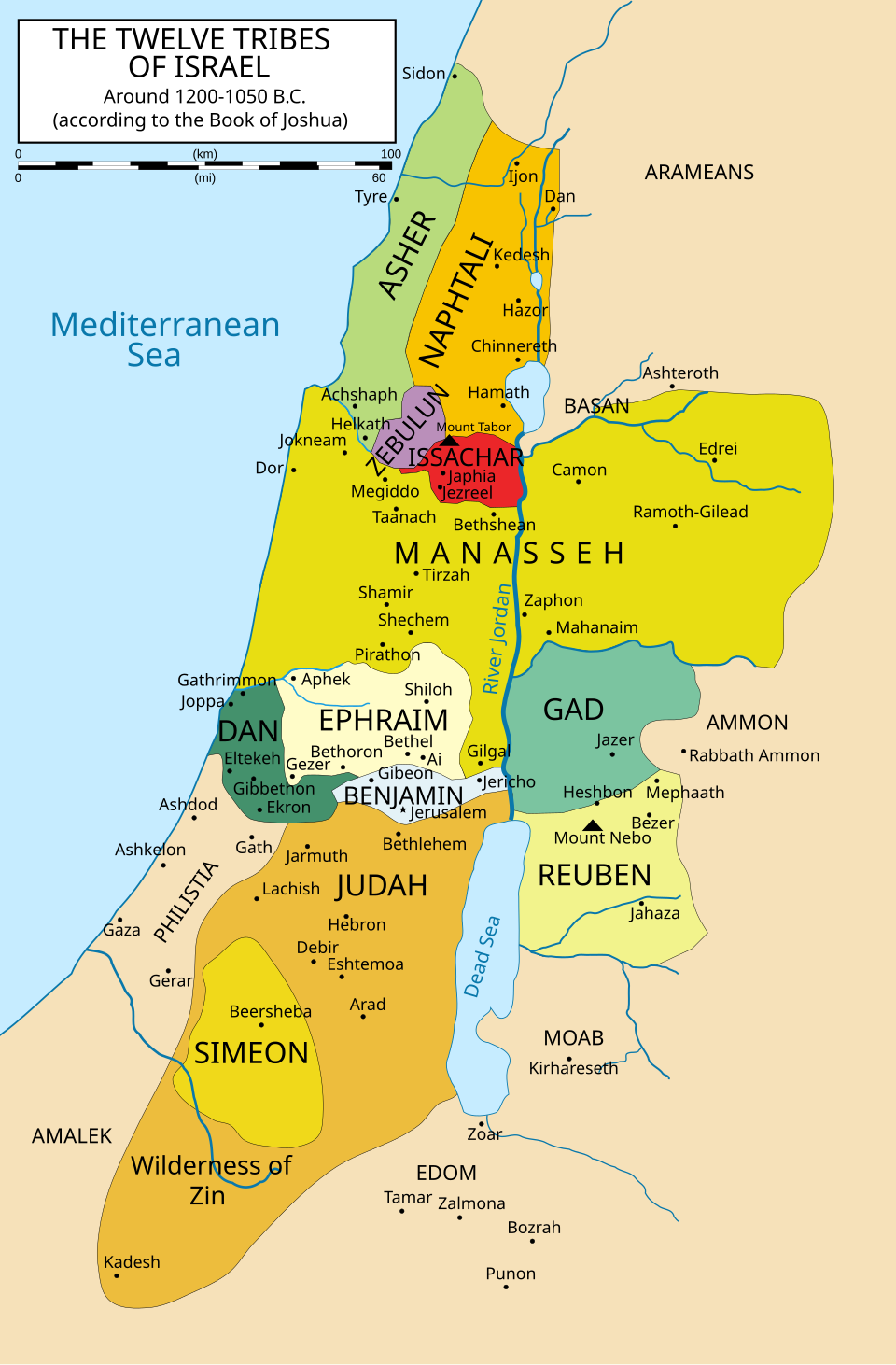 Source: 🔗 Wikimedia Commons, 12 tribus de Israel.svg translated by Kordas; 12 staemme israels heb.svg by user:יוסי; 12 staemme israels.png by user:Janz; derivative work Richardprins, CC BY-SA 3.0. Converted from SVG to PNG thumbnail with no substantive changes. Reconstructed tribal-allotment teaching map, not an ancient-period map and not to scale.
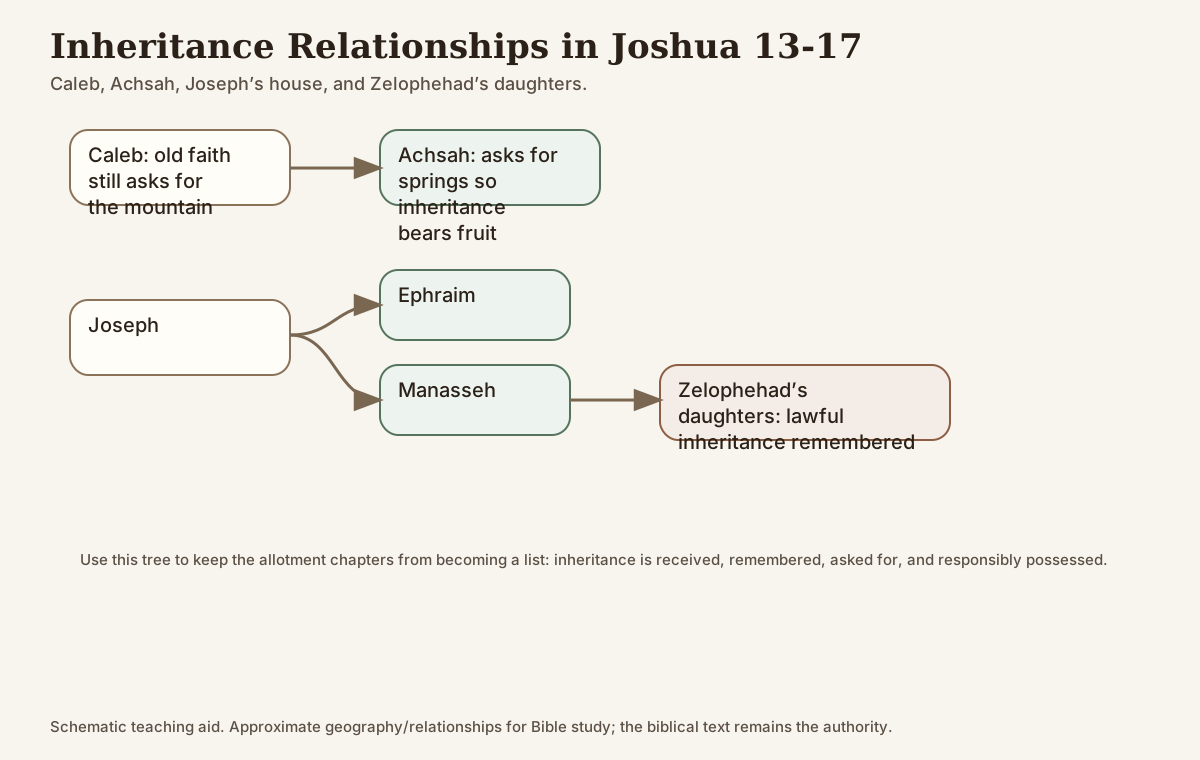 Source: Hermes-generated schematic teaching aid, 2026-06-19. Relationship and inheritance chart from Joshua 13-17 and Numbers 27/36; schematic, not to scale.
Spiritual Fruit 🍇
-
Boundaries can be mercy. These chapters are full of borders, towns, and allotments. Spiritually, boundaries are not always limitations; they can be the shape of obedience. A family needs boundaries around time, speech, screens, money, and worship. A servant needs boundaries against burnout and vanity. A soul needs boundaries around what it allows to enter the imagination. Inheritance without boundaries becomes confusion.
-
Achsah teaches holy boldness in asking for springs. She receives land and asks for water. This is not greed; it is wisdom. Many Christians accept a dry inheritance because they are afraid to ask God for the water needed to live faithfully. Ask for the springs: compunction in prayer, grace to forgive, strength for parenting, tears in confession, wisdom in ministry, love where duty has become dry.
-
Partial obedience leaves future trouble inside the gates. Judah, Ephraim, and Manasseh all have unresolved possession. The text is honest about enemies remaining. The heart is similar. A tolerated passion may seem manageable while we are strong, but later it teaches our children, shapes our reactions, and taxes our peace. Do not make permanent arrangements with sins Christ is asking you to drive out.
-
Complaint is not the same as courage. Joseph’s descendants say they are numerous and need more, but Joshua calls them to clear the forest and face the chariots. This is a sharp pastoral word. Sometimes we call ourselves trapped when we are really being summoned to work. Before blaming circumstances, ask: what obedience is already available but costly?
-
The daughters of Zelophehad show that justice must be remembered in administration. Their inheritance appears here because covenant faithfulness includes concrete fairness. Spiritual life is not only private prayer. It includes whether families, churches, and communities remember the vulnerable when decisions are made. The promised land must not be distributed in a way that forgets those God has already defended.
Summary Table
| Text | Literal focus | Spiritual and Christological reading |
|---|---|---|
| Joshua 15:1-12 | Judah’s borders are carefully defined | Holy inheritance has shape, measure, and order in God |
| Joshua 15:13-19 | Caleb secures Hebron; Othniel wins Dabir; Achsah asks for springs | The soul needs both courage and the living waters of grace |
| Joshua 15:20-47 | Judah’s southern and lowland cities are listed | Ordinary places and hidden obediences belong to the inheritance |
| Joshua 15:48-63 | Hill country cities listed; Jebusites remain in Jerusalem | Sacred belonging without purification leaves enemies near the center |
| Joshua 16:1-4 | Ephraim and Manasseh receive Joseph’s inheritance | Gratitude for gift must come before complaint |
| Joshua 16:5-10 | Ephraim’s border set; Gezer not fully possessed | Compromise with the old enemy corrupts the gift already received |
| Joshua 17:1-6 | Daughters of Zelophehad inherit by remembered command | Holy boldness appeals to God’s promise within rightful order |
| Joshua 17:7-13 | Manasseh receives cities but tolerates Canaanites | Managed passions are not the same as mortified passions |
| Joshua 17:14-18 | Joseph complains; Joshua commands forest-clearing and courage | Grace calls the believer to labor, not entitled grievance |
Closing Meditation
These chapters are full of names, boundaries, and villages, and for that very reason they are spiritually honest. God does not save in abstractions. He gives a portion. He names it. He places His people in it. Then He reveals what still remains unconquered. Jerusalem may still shelter Jebusites. Gezer may still host Canaanites. Manasseh may still choose tribute over obedience. Joseph may still complain instead of clearing the wood. Yet none of this cancels the reality of the inheritance. It reveals the seriousness of possessing it. The Church therefore reads Joshua 15-17 as a summons to grateful reception, ordered life, bold asking, remembered justice, and hard warfare against everything that still resists Christ within us.
Teaching Notes
Whole-study teaching helps:
- These chapters are ideal for teaching the difference between received gift and actual possession.
- Do not apologize for the city lists. Teach why Scripture names ordinary places.
- Caleb and Achsah should be taught together. The inheritance needs both courage and water.
- Joshua 15:63, 16:10, and 17:12-13 form a clear pattern of tolerated enemies.
- Joshua 17:14-18 is a major pastoral text for entitlement, complaint, and the dignity of labor.
- If time is short, linger on Joshua 15:19, 15:63, 16:10, and 17:18.
Joshua 15:1-12 - Judah’s border and the holiness of given limits
Ask: Where does this passage show the difference between receiving God’s promise and presuming on it?
Emphasize: God’s gifts often come to us as measured responsibilities, not limitless self-definition.
Watch for: speaking about boundaries as though they are automatically oppressive or spiritually inferior to spontaneity.
Connect: Use the guide’s Christological and spiritual reading to show how this passage is fulfilled in Christ without flattening the historical sense.
Show: Show the tribal map for orientation, then the inheritance tree when discussing Achsah, Joseph’s house, and the daughters of Zelophehad.
Joshua 15:13-19 - Caleb, Othniel, and Achsah ask for blessing
- Ask: Where does this passage show the difference between receiving God’s promise and presuming on it?
- Emphasize: bold asking is holy when it seeks fruitfulness, not self-indulgence.
- Watch for: reducing Achsah to a side character or treating her request as mere domestic detail.
- Connect: Use the guide’s Christological and spiritual reading to show how this passage is fulfilled in Christ without flattening the historical sense.
Joshua 15:20-47 - Judah’s southern and lowland cities are named before God
- Ask: Where does this passage show the difference between receiving God’s promise and presuming on it?
- Emphasize: God names what men often overlook.
- Watch for: skipping city lists as spiritually useless filler.
- Connect: Use the guide’s Christological and spiritual reading to show how this passage is fulfilled in Christ without flattening the historical sense.
Joshua 15:48-63 - Hill country cities and Jerusalem not yet fully possessed
- Ask: Where does this passage show the difference between receiving God’s promise and presuming on it?
- Emphasize: the most dangerous incompleteness is often nearest the center.
- Watch for: treating this verse as a trivial historical delay rather than a theological warning.
- Connect: Use the guide’s Christological and spiritual reading to show how this passage is fulfilled in Christ without flattening the historical sense.
Joshua 16:1-4 - Joseph receives a shared inheritance
- Ask: Where does this passage show the difference between receiving God’s promise and presuming on it?
- Emphasize: gratitude is the right first response to divine allotment.
- Watch for: beginning with later tribal dissatisfaction and forgetting the reality of the gift already received.
- Connect: Use the guide’s Christological and spiritual reading to show how this passage is fulfilled in Christ without flattening the historical sense.
Joshua 16:5-10 - Ephraim’s border and the Canaanite left in Gezer
- Ask: Where does this passage show the difference between receiving God’s promise and presuming on it?
- Emphasize: compromise can look manageable for a time and still be spiritually dangerous.
- Watch for: excusing partial obedience because the result appears outwardly stable.
- Connect: Use the guide’s Christological and spiritual reading to show how this passage is fulfilled in Christ without flattening the historical sense.
Joshua 17:1-6 - Manasseh and the daughters of Zelophehad remembered in justice
- Ask: Where does this passage show the difference between receiving God’s promise and presuming on it?
- Emphasize: divine justice includes those whom ordinary custom might overlook.
- Watch for: turning the passage into a modern ideological slogan detached from covenant obedience and scriptural continuity.
- Connect: Use the guide’s Christological and spiritual reading to show how this passage is fulfilled in Christ without flattening the historical sense.
Joshua 17:7-13 - Manasseh’s cities and the tolerated Canaanite
- Ask: Where does this passage show the difference between receiving God’s promise and presuming on it?
- Emphasize: not every improvement is victory. Some are only better-managed disobedience.
- Watch for: reading tribute as success when the text treats it as failure to complete the command.
- Connect: Use the guide’s Christological and spiritual reading to show how this passage is fulfilled in Christ without flattening the historical sense.
Joshua 17:14-18 - Joseph complains, Joshua commands labor
- Ask: Where does this passage show the difference between receiving God’s promise and presuming on it?
- Emphasize: complaint is often cured by obedient labor.
- Watch for: praising wounded self-importance as though it were spiritual sensitivity.
- Connect: Use the guide’s Christological and spiritual reading to show how this passage is fulfilled in Christ without flattening the historical sense.
Glossary
- Inheritance: the portion given by God, historically as land and spiritually as participation in divine life.
- Boundary: the marked edge of a received portion, showing order rather than arbitrary limitation.
- Hebron / Chebron: Caleb’s inheritance, linked to the Anakim and patriarchal memory.
- Dabir, city of Letters: city won in Caleb’s campaign and remembered in the Achsah narrative.
- Gezer / Gazer: Ephraimite site where incomplete possession becomes explicit.
- Zelophehad / Salpaad: father whose daughters lawfully inherited by divine command.
- Jebusite: pre-Israelite inhabitant of Jerusalem, emblem here of unfinished conquest.
Sources
Primary sources
- The Holy Bible, Brenton Septuagint, Joshua 15-17.
- The Holy Bible, NKJV, Numbers 13-14; Numbers 27:1-11; Numbers 36:1-12; Psalm 15(16):5-6.
- Origen, Homilies on Joshua.
- St Augustine, Questions on the Heptateuch.
- St Gregory of Nyssa, The Life of Moses.
- St John Chrysostom, pastoral and ascetical teaching on labor, pride, and complaint.
- St John Cassian, ascetical teaching on persistent passions and gradual purification.
Secondary academic sources
- Richard S. Hess, Joshua (Tyndale Old Testament Commentaries).
- David M. Howard Jr., Joshua (New American Commentary).
- Marten H. Woudstra, The Book of Joshua (NICOT).
- Trent C. Butler, Joshua (Word Biblical Commentary).
Coptic Orthodox / pastoral sources
- Orthodox Study Bible notes on Joshua.
- Coptic Orthodox pastoral teaching on family responsibility, fairness, and partial obedience, used thematically.
- Coptic Orthodox pastoral teaching on inheritance, ascetic struggle, holy boldness in prayer, and the mortification of the passions.
Web pages and non-academic sources cited
- CCEL, New Advent, and similar access sites for public-domain patristic texts.
- Bible atlas resources used only for orientation to Judah, Jerusalem, Hebron, Gezer, and the hill country of Ephraim.