


Genesis 35-36 shows how God restores His people after defilement without pretending their wounds are gone. Jacob is called back to Bethel after Shechem, the household buries its foreign gods, and worship is renewed. Yet the same stretch of narrative records Deborah’s death, Rachel’s death, Reuben’s sin, Isaac’s death, and the long genealogy of Esau. The chapters teach that repentance is a real return to God, that covenant life passes through grief as well as blessing, and that even genealogies are preserved as sacred memory inside God’s providence.
Why this passage matters
This is one of Genesis’ clearest pictures of repentance as return. Jacob does not invent a new spirituality. He goes back to Bethel, the place of earlier encounter, vow, and promise. He cannot go there casually. Idols must be buried, garments changed, and the altar rebuilt.
The passage also matters because it refuses to separate promise from pain. Rachel dies on the road, Reuben sins inside the household, and Isaac is buried by both sons. The people of God are not idealized into a clean legend.
Finally, chapter 36 matters because Esau’s line is remembered in detail. Orthodox reading does not dismiss genealogy as filler. The chapter closes the Esau cycle, prepares for later biblical history, and shows that visible power and covenant centrality are not the same thing.
Route schematic: Bethel return, grief, and Esau’s line
This visual is a teaching schematic rather than an atlas map. It follows the order and spiritual movement of Genesis 35-36 in the embedded Brenton Septuagint text. Use it to help readers keep the narrative’s geography and theology together: purification, renewed worship at Bethel, Rachel’s death, Jacob’s return, and Esau’s line.
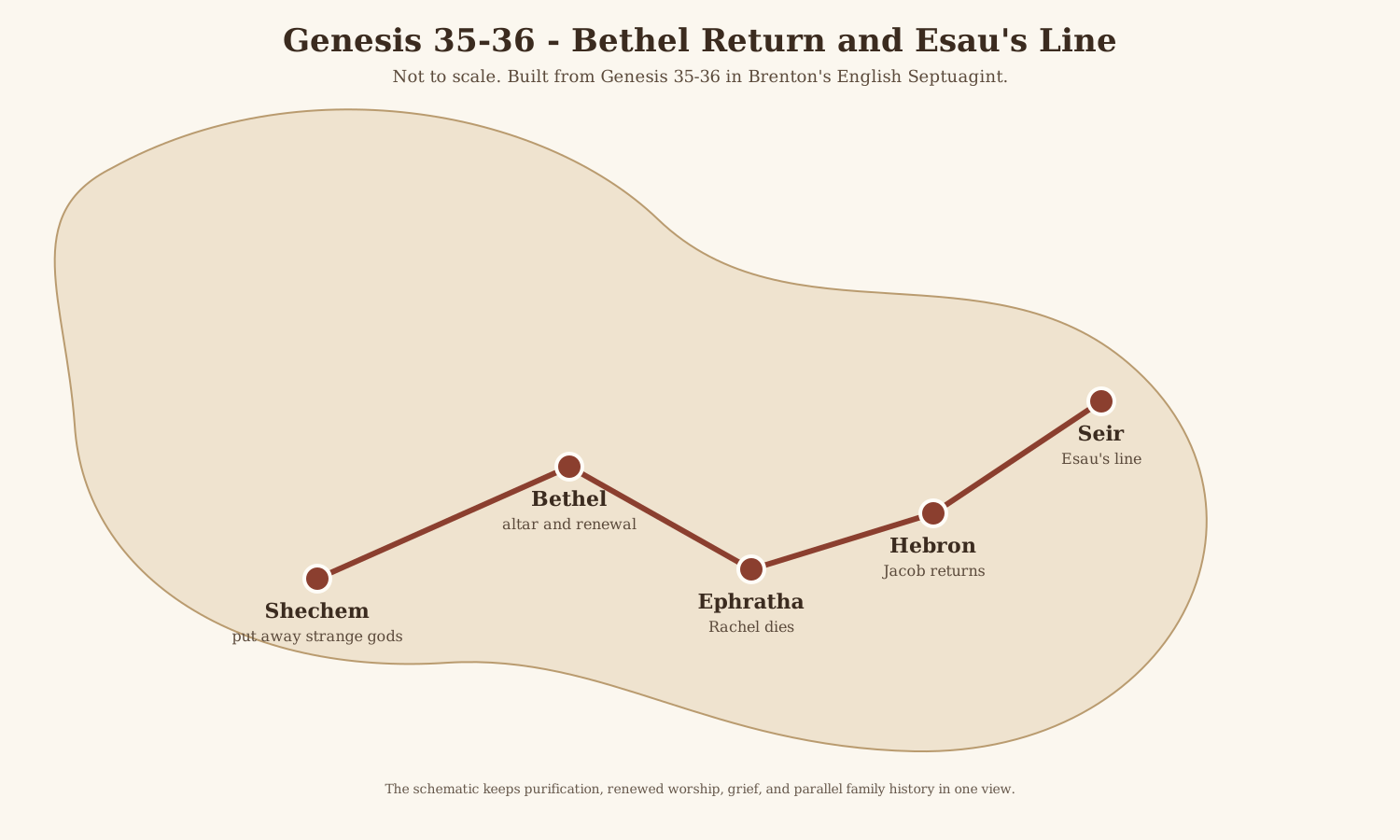 Source: created for this guide from Genesis 35-36 in Brenton’s English Septuagint, 2026-06-06. Not to scale.
Historical and Scriptural Context
Genesis 35 answers the crisis of Genesis 34. After the outrage and bloodshed at Shechem, God tells Jacob to arise and go up to Bethel. Bethel is the place of Jacob’s earlier vision in Genesis 28, where heaven opened, promise was spoken, and the place was named the house of God. The return is therefore both geographic and spiritual.
The purification scene is central. Foreign gods and earrings are surrendered and buried under the tree at Shechem. Jacob does not lead his house to the altar while tolerating rival worship. The fear of God then falls on the surrounding cities, so the family is preserved on the road of obedience.
Genesis 35 also gathers transitions. Deborah links the story back to Rebekah’s generation. Rachel’s death and Isaac’s death mark the passing of key figures. Reuben’s sin reveals that the next generation is already fractured. Even so, the twelve sons are named together, showing that the covenant people move forward through wounded history.
Genesis 36 gives Esau’s descendants their land, chiefs, and kings. The note that kings ruled in Edom before a king ruled in Israel is theological, not random. Earthly structure may appear quickly outside the covenant line, while the chosen line still lives by promise and delay. The genealogy prepares the rest of the Bible and teaches the reader to remember Edom as part of the sacred landscape.
Return after Shechem (Genesis 35:1-5)
1 And God said to Jacob, Arise, go up to the place, Bæthel, and dwell there; and make there an altar to the God that appeared to thee, when thou fleddest from the face of Esau thy brother. 2 And Jacob said to his house, and to all that were with him, Remove the strange gods that are with you from the midst of you, and purify yourselves, and change your clothes. 3 And let us rise and go up to Bæthel, and let us there make an altar to God who hearkened to me in the day of calamity, who was with me, and preserved me throughout in the journey, by which I went. 4 And they gave to Jacob the strange gods, which were in their hands, and the ear-rings which were in their ears, and Jacob hid them under the turpentine tree which is in Secima, and destroyed them to this day. 5 So Israel departed from Secima, and the fear of God was upon the cities round about them, and they did not pursue after the children of Israel.
God’s answer to the Shechem disaster is a call back to Bethel. Jacob responds by commanding the house to remove foreign gods, purify itself, and change garments. The buried idols under the tree show that repentance is concrete. Something must actually be put away before the ascent to worship. Then the fear of God falls on the surrounding cities, showing that the Lord guards the path He commands.
Bethel, altar, and the renewed name Israel (Genesis 35:6-15)
6 And Jacob came to Luza, which is in the land of Chanaan, which is Bæthel, he and all the people that were with him. 7 And he built there an altar, and called the name of the place Bæthel; for there God appeared to him, when he fled from the face of his brother Esau.
8 And Deborrha, Rebecca’s nurse, died, and was buried below Bæthel under the oak; and Jacob called its name, The Oak of Mourning. 9 And God appeared to Jacob once more in Luza, when he came out of Mesopotamia of Syria, and God blessed him. 10 And God said to him, Thy name shall not be called Jacob, but Israel shall be thy name; and he called his name Israel. 11 And God said to him, I am thy God; increase and multiply; for nations and gatherings of nations shall be of thee, and kings shall come out of thy loins. 12 And the land which I gave to Abraam and Isaac, I have given it to thee; and it shall come to pass that I will give this land also to thy seed after thee. 13 And God went up from him from the place where he spoke with him. 14 And Jacob set up a pillar in the place where God spoke with him, even a pillar of stone; and offered a libation upon it, and poured oil upon it. 15 And Jacob called the name of the place in which God spoke with him, Bæthel.
At Bethel the altar is built and the promise is renewed. Jacob’s name, already given new meaning at Peniel, is reaffirmed before God and tied again to the covenant future. Nations, assemblies, and kings are promised. Bethel is therefore not only a place of private comfort. It is a place where worship, identity, and mission are joined.
Rachel dies on the way (Genesis 35:16-20)
16 [And Jacob removed from Bæthel, and pitched his tent beyond the tower of Gader,] and it came to pass when he drew nigh to Chabratha, to enter into Ephratha, Rachel travailed; and in her travail she was in hard labour. 17 And it came to pass in her hard labour, that the midwife said to her, Be of good courage, for thou shalt also have this son. 18 And it came to pass in her giving up the ghost (for she was dying), that she called his name, The son of my pain; but his father called his name Benjamin. 19 So Rachel died, and was buried in the way of the course of Ephratha, this is Bethleem. 20 And Jacob set up a pillar on her tomb; this is the pillar on the tomb of Rachel, until this day.
Deborah’s death quietly brings the older household memory of Rebekah’s world into view. Rachel’s death is more open and piercing. She names the child from her pain; Jacob renames him Benjamin. Scripture does not deny sorrow, but it refuses to let sorrow speak the last word. Rachel’s tomb near Bethlehem makes grief part of Israel’s enduring memory.
Reuben’s sin (Genesis 35:22)
22 And it came to pass when Israel dwelt in that land, that Ruben went and lay with Balla, the concubine of his father Jacob; and Israel heard, and the thing appeared grievous before him. And the sons of Jacob were twelve.
The notice about Reuben is brief and severe. The firstborn violates the household, and Israel hears of it. The text does not dramatize the event, but neither does it soften it. The covenant family remains morally wounded, and privilege does not protect a son from grave sin.
The twelve sons and Isaac’s burial (Genesis 35:23-29)
23 The sons of Lea, the first-born of Jacob; Ruben, Symeon, Levi, Judas, Issachar, Zabulon. 24 And the sons of Rachel; Joseph and Benjamin. 25 And the sons of Balla, the hand-maid of Rachel; Dan and Nephthalim. 26 And the sons of Zelpha, the hand-maid of Lea; Gad and Aser. These are the sons of Jacob, which were born to him in Mesopotamia of Syria. 27 And Jacob came to Isaac his father to Mambre, to a city of the plain; this is Chebron in the land of Chanaan, where Abraam and Isaac sojourned. 28 And the days of Isaac which he lived were an hundred and eighty years. 29 And Isaac gave up the ghost and died, and was laid to his family, old and full of days; and Esau and Jacob his sons buried him.
The naming of the twelve sons after Reuben’s failure is important. Israel’s future will move through sons who need judgment and mercy, not through an ideal family. Isaac’s death then closes another generation, and Esau with Jacob buries their father. The reconciliation of the brothers is not absolute sameness, but it is real enough to share the final act of filial honor.
Esau’s generations (Genesis 36:1-43)
1 And these are the generations of Esau; this is Edom. 2 And Esau took to himself wives of the daughters of the Chananites; Ada, the daughter of Ælom the Chettite; and Olibema, daughter of Ana the son of Sebegon, the Evite; 3 and Basemath, daughter of Ismael, sister of Nabaioth. 4 And Ada bore to him Eliphas; and Basemath bore Raguel. 5 And Olibema bore Jeus, and Jeglom, and Core; these are the sons of Esau, which were born to him in the land of Chanaan. 6 And Esau took his wives, and his sons, and his daughters, and all the persons of his house, and all his possessions, and all his cattle, and all that he had got, and all things whatsoever he had acquired in the land of Chanaan; and Esau went forth from the land of Chanaan, from the face of his brother Jacob. 7 For their substance was too great for them to dwell together; and the land of their sojourning could not bear them, because of the abundance of their possessions. 8 And Esau dwelt in mount Seir; Esau, he is Edom. 9 And these are the generations of Esau, the father of Edom in the mount Seir. 10 And these are the names of the sons of Esau. Eliphas, the son of Ada, the wife of Esau; and Raguel, the son of Basemath, wife of Esau. 11 And the sons of Eliphas were Thæman, Omar, Sophar, Gothom, and Kenez. 12 And Thamna was a concubine of Eliphaz, the son of Esau; and she bore Amalec to Eliphas. These are the sons of Ada, the wife of Esau. 13 And these are the sons of Raguel; Nachoth, Zare, Some, and Moze. These were the sons of Basemath, wife of Esau. 14 And these are the sons of Olibema, the daughter of Ana, the son of Sebegon, the wife of Esau; and she bore to Esau, Jeus, and Jeglom, and Core. 15 These are the chiefs of the son of Esau, even the sons of Eliphas, the first-born of Esau; chief Thæman, chief Omar, chief Sophar, chief Kenez, 16 chief Core, chief Gothom, chief Amalec. These are the chiefs of Eliphas, in the land of Edom; these are the sons of Ada. 17 And these are the sons of Raguel, the son of Esau; chief Nachoth, chief Zare, chief Some, chief Moze. These are the chiefs of Raguel, in the land of Edom; these are the sons of Basemath, wife of Esau. 18 And these are the sons of Olibema, wife of Esau; chief Jeus, chief Jeglom, chief Core. These are the chiefs of Olibema, daughter of Ana, wife of Esau. 19 These are the sons of Esau, and these are the chiefs; these are the sons of Edom. 20 And these are the sons of Seir, the Chorrhite, who inhabited the land; Lotan, Sobal, Sebegon, Ana, 21 and Deson, and Asar, and Rison. These are the chiefs of the Chorrhite, the son of Seir, in the land of Edom. 22 And the sons of Lotan were Chorrhi and Hæman; and the sister of Lotan, Thamna. 23 And these are the sons of Sobal; Golam, and Manachath, and Gæbel, and Sophar, and Omar. 24 And these are the sons of Sebegon; Aïe, and Ana; this is the Ana who found Jamin in the wilderness, when he tended the beasts of his father Sebegon. 25 And these are the sons of Ana; Deson—and Olibema was daughter of Ana. 26 And these are the sons of Deson; Amada, and Asban, and Ithran, and Charrhan. 27 And these are the sons of Asar; Balaam, and Zucam, and Jucam. 28 And these are the sons of Rison; Hos, and Aran. 29 And these are the chiefs of Chorri; chief Lotan, chief Sobal, chief Sebegon, chief Ana, 30 chief Deson, chief Asar, chief Rison. These are the chiefs of Chorri, in their principalities in the land of Edom.
31 And these are the kings which reigned in Edom, before a king reigned in Israel. 32 And Balac, son of Beor, reigned in Edom; and the name of his city was Dennaba. 33 And Balac died; and Jobab, son of Zara, from Bosorrha reigned in his stead. 34 And Jobab died; and Asom, from the land of the Thæmanites, reigned in his stead. 35 And Asom died; and Adad son of Barad, who cut off Madiam in the plain of Moab, ruled in his stead; and the name of his city was Getthaim. 36 And Adad died; and Samada of Massecca reigned in his stead. 37 And Samada died; and Saul of Rhoöboth by the river reigned in his stead. 38 And Saul died; and Ballenon the son of Achobor reigned in his stead. 39 And Ballenon the son of Achobor died; and Arad the son of Barad reigned in his stead; and the name of his city was Phogor; and the name of his wife was Metebeel, daughter of Matraith, son of Maizoöb. 40 These are the names of the chiefs of Esau, in their tribes, according to their place, in their countries, and in their nations; chief Thamna, chief Gola, chief Jether, 41 chief Olibema, chief Helas, chief Phinon, 42 chief Kenez, chief Thæman, chief Mazar, 43 chief Magediel, chief Zaphoin. These are the chiefs of Edom in their dwelling-places, in the land of their possession; this is Esau, the father of Edom.
Chapter 36 establishes Esau in Seir and preserves his descendants in detail. Chiefs, Horites, kings, and tribal names all matter because later Scripture will return to Edom repeatedly. The genealogy also teaches a theological contrast: a line can possess land, rulers, and public stability without carrying the messianic promise. That is why the chapter is preserved and why it should be taught carefully.
💎 Gems from the Fathers
St. Eusebius of Caesarea gives a direct and valuable anchor for Genesis 35. In Proof of the Gospel V.12, he quotes Jacob’s command to remove the strange gods, arise, go to Bethel, and make an altar to the Lord who heard him in affliction. Eusebius uses this to show that the patriarchs were not trapped in idolatry and that their piety existed before the Mosaic law. Genesis 35 is therefore not merely a family move. It is a return to the ancient worship of the true God. Eusebius hears God direct Jacob: “Make an altar to the God that appeared to thee,” and then explains, “I have already shewn Who this was that was described before as appearing to him, and proved that it was the Word of God.”1
That reading clarifies the order of the chapter. The household does not ascend to Bethel while keeping rival gods in its pockets. Repentance becomes visible: foreign gods are surrendered, garments are changed, and the altar is rebuilt.
St. Augustine, in The City of God XVI.37, reads Jacob and Esau through the mystery of grace and the elder serving the younger. That helps chapter 36 be read without contempt. Esau’s line is real history, real human flourishing, and real memory, but it is not the saving center of the covenant. The visible strength of Edom cannot replace the promise carried through weakness.
The chapter therefore joins purification, grief, genealogy, and hope. Bethel is restored, Rachel dies, Isaac is buried, Reuben’s sin is named, and Esau’s chiefs are remembered. The promised line continues, but never as a sanitized family story.
Christological and ecclesial fulfillment
Bethel, the house of God, finds its fullness not in a single patriarchal site but in God’s dwelling with humanity in Christ. The Son comes in the flesh, and the Church becomes the temple of His presence. Jacob’s return to Bethel therefore opens toward the mystery of restored communion in the incarnate Lord.
The burying of idols and changing of garments also carry a clear ecclesial resonance. The Church hears in them the logic of repentance, baptismal renunciation, and putting on Christ. One does not come to the altar unchanged in heart. False gods must be buried if worship is to be true.
The renewed name Israel and the promise of gatherings of nations widen toward the Church drawn from Jews and Gentiles in Christ. Rachel’s tomb near Bethlehem adds another line of memory, later joined to biblical scenes of weeping in that region. Even Esau’s genealogy belongs here, because the Messiah who comes from Israel is not Lord of Israel alone but of the nations remembered by God. The Church therefore reads these chapters not as clan history only, but as a map of renunciation, communion, grief, and hope.
Coptic Orthodox liturgical and worship connection
This passage has no established place in the Coptic Orthodox lectionary.
Even without an exact preserved row, the chapter is deeply liturgical in movement. The household puts away foreign gods, purifies itself, changes garments, and ascends to build an altar. Orthodox worship likewise insists that repentance and offering belong together. Stone, oil, libation, tomb, and memorial place also fit the Church’s sacramental instinct that God is remembered through material signs and embodied prayer.
Deeper spiritual insight and teaching emphasis
Genesis 35 teaches that repentance is often a return before it is a discovery. Jacob had already known Bethel. After fear, compromise, and scandal, the way forward is to go back to the place of first obedience. Many believers want progress without return, but Scripture often heals by restoration.
The chapter also teaches that blessing and grief can stand together. Jacob obeys and worships, yet he still buries Deborah, Rachel, and Isaac. The faithful do not measure God’s presence only by the absence of tears.
Reuben’s fall and Esau’s genealogy complete the lesson. Sin can rise inside the covenant house, and visible historical strength can rise outside it. The people of God must therefore seek holiness rather than appearances. Edom may look settled first, but Jacob must still learn purity, worship, and patience under the word of God.
Glossary
- Bethel: the house of God, linked to Jacob’s earlier vision and his return in chapter 35.
- Foreign gods: rival cult objects buried before the ascent to Bethel.
- Israel: Jacob’s covenant name, reaffirmed here before God.
- Benjamin: Rachel’s last son, born in sorrow and given a lasting covenant identity.
- Edom: Esau’s national line and land identity.
- Genealogy: a sacred record of descent and relation preserved for later salvation history.
Spiritual Fruit 🍇
- Return to Bethel quickly. Go back to the place of prayer, vow, and worship when life has become spiritually compromised.
- Bury idols in practice. Repentance requires concrete renunciation, not religious language alone.
- Accept grief without unbelief. Tears do not cancel promise.
- Guard household holiness. Jacob’s return involves the whole camp.
- Read genealogy reverently. God’s memory of names teaches patience with history.
Teaching Notes
Return after Shechem (Genesis 35:1-5)
- Ask: Why must Jacob’s household put away foreign gods before returning to Bethel?
- Emphasize: Return to worship requires concrete purification, not only nostalgia for a holy place.
- Watch for: Do not make Bethel a sentimental reset that ignores Shechem’s aftermath.
- Connect: Repentance in the Church is personal and household-shaped, involving memory, renunciation, and renewed worship.
- Show: Use the Bethel-Seir schematic to show purification, altar, renewed name, grief, and family lines.
Rachel dies on the way (Genesis 35:16-20)
- Ask: Why does the passage place grief, scandal, burial, and genealogy so close together?
- Emphasize: Covenant history includes mourning and disorder, yet God continues to remember names and promises.
- Watch for: Do not skip Esau’s line as filler. Genealogy teaches that Scripture remembers peoples beyond the main covenant line.
- Connect: The faithful learn patience from Genesis’ refusal to make history tidy.
- Show: Let the schematic help students see that return to promise does not remove sorrow from the road.
Sources
Primary sources
- Scripture: Genesis 35-36 in Brenton’s English Septuagint. Public-domain Brenton edition: https://archive.org/details/septuagintversio00bren
- Genesis 28; Genesis 34; Genesis 49:3-4; 1 Chronicles 5:1-2; Matthew 2:16-18.
- Eusebius of Caesarea, Proof of the Gospel I.2, quoting Genesis 35:2-4 on Jacob putting away strange gods before Bethel: https://www.tertullian.org/fathers/eusebius_de_03_book1.htm#C2
- St. Augustine, The City of God XVI.37, on Jacob and Esau, grace, and the elder serving the younger: https://www.newadvent.org/fathers/120116.htm
Patristic direct quote anchors
Eusebius of Caesarea, Proof of the Gospel V.12, on Genesis 35:1-3 and the Word appearing to Jacob: https://www.tertullian.org/fathers/eusebius_de_07_book5.htm#C12
Secondary academic sources
- Gordon J. Wenham, Genesis 16-50.
- Victor P. Hamilton, The Book of Genesis: Chapters 18-50.
- Kenneth A. Mathews, Genesis 11:27-50:26.
- Claus Westermann, Genesis 12-36.
Coptic Orthodox / pastoral sources
- The Orthodox Study Bible, notes on Genesis 35-36.
- Fr. Tadros Yacoub Malaty, commentary on Genesis.
- Pope Shenouda III on repentance, purity, and spiritual watchfulness.
- Fr. Bishoy Kamel on worship, repentance, and holiness in the household of faith.
Public web sources cited
- Tertullian.org, New Advent, and CCEL as public-domain access points for patristic material.
- Coptic Orthodox lectionary sources were consulted only to support the constrained wording above.
Visual sources
assets/genesis-35-36-bethel-seir-schematic-lxx.svg: schematic or image used in this guide from the cited Genesis passage or public-domain source; see the inline caption where applicable.
Footnotes
-
Eusebius of Caesarea, Proof of the Gospel V.12, https://www.tertullian.org/fathers/eusebius_de_07_book5.htm. ↩