


Genesis 33-34 places two radically different scenes side by side: a reconciliation full of tears and humility, and then a grievous violation followed by deceit and bloodshed. Scripture does this on purpose. The same family that receives peace with Esau still carries wounds, passions, and moral disorder within itself. The chapter pair teaches that reconciliation is real, but it is not magic. One healed relationship does not mean the whole heart is already healed.
These chapters also demand moral seriousness. Dinah’s humiliation must not be softened, and Simeon and Levi’s revenge must not be romanticized. Covenant signs cannot be turned into weapons, and zeal is not the same thing as holiness.
Why this passage matters
Many Bible readers love Genesis 33 because Esau embraces Jacob and both men weep. But Genesis 34 follows immediately to remind us that human history after the Fall is never tidy. Grace and danger, mercy and violence, humility and rage may sit side by side in the same household.
This passage matters for pastoral reasons as much as theological ones. It teaches us how to speak about reconciliation without naïveté, how to name sexual wrongdoing without blame-shifting, and how to reject vengeance even when real evil has occurred. It also teaches the Church to guard holy things. Circumcision, a covenant sign, is abused in Genesis 34 for deceit and massacre. The lesson is sobering: sacred realities can be handled carnally by hearts that are still unhealed.
Route schematic: Jacob’s return, boundary, wrestling, and settlement
Jacob’s return from Laban is not one simple trip home. It includes flight, pursuit, a covenant boundary at Galaad/Mizpah, the meeting of angels, fear before Esau, the night struggle at Peniel, and the return into the land. The schematic below spans Genesis 31-33 so this chapter can be read as part of the whole return movement.
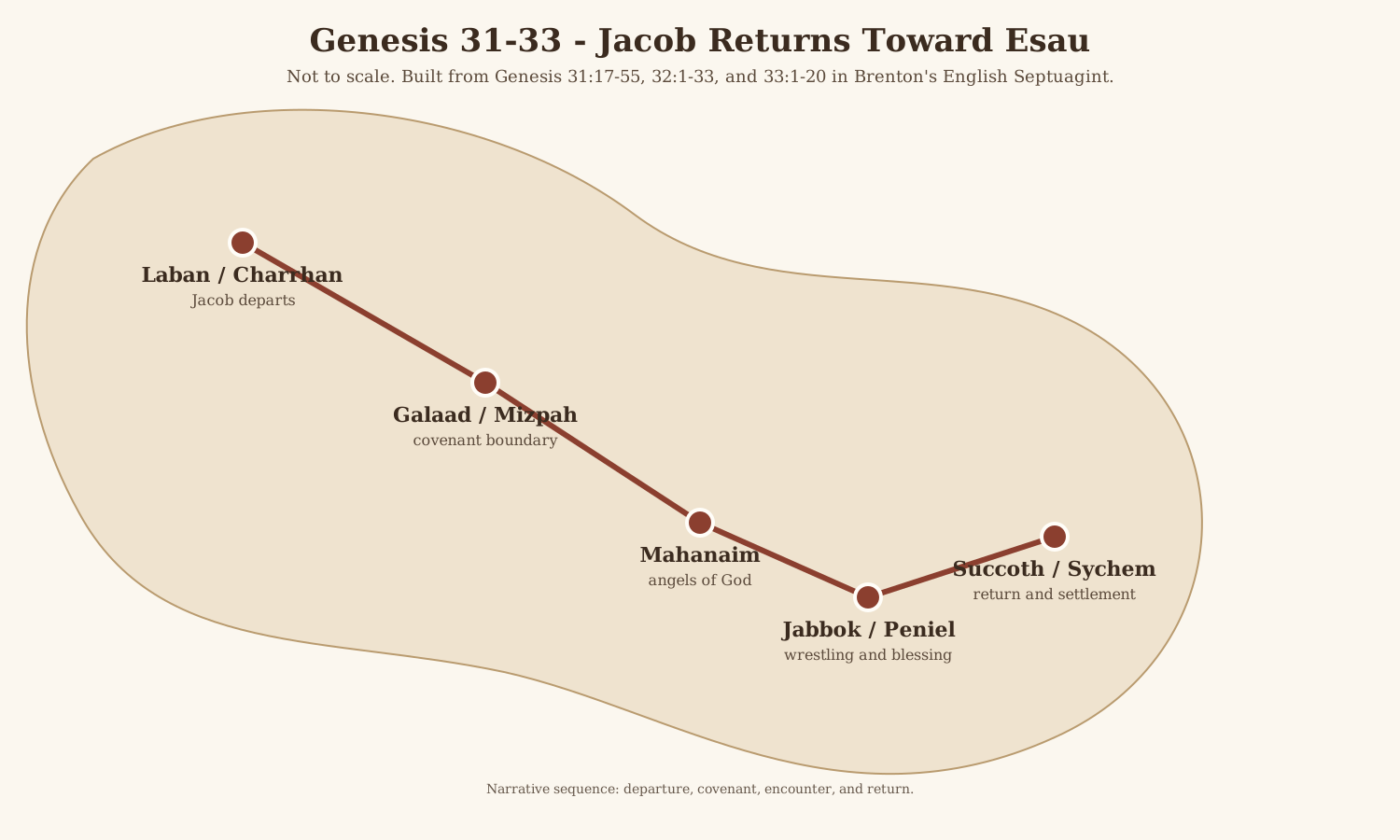 Source: created for this guide from Genesis 31:17-55, 32:1-32, and 33:1-20 in Brenton’s English Septuagint, 2026-06-06. Not to scale.
Historical and Scriptural Context
Genesis 33 comes immediately after Jacob’s night at Peniel. He has seen the Face of God and now must face Esau. The reconciliation scene is therefore not random; it is the first fruit of the night’s transformation. Jacob no longer approaches Esau as a rival to outmaneuver, but as a brother before whom he bows low.
Genesis 34 then relocates the family in the region of Shechem and exposes how fragile outward settlement can be when the inner life of the family remains disordered. These chapters are also part of the wider patriarchal story in which God’s people live among the peoples of Canaan without being absorbed into their ways. The danger is not only military. It is moral, social, and spiritual.
The text also prepares later biblical developments. Jacob’s criticism of Simeon and Levi here is sharpened in Genesis 49, where their violence is explicitly cursed. Scripture itself interprets their deed as unholy wrath, not heroic zeal.
Jacob’s sevenfold bow and Esau’s embrace (Genesis 33:1-11)
1 And Jacob lifted up his eyes, and beheld, and lo! Esau his brother coming, and four hundred men with him; and Jacob divided the children to Lea and to Rachel, and the two handmaidens. 2 And he put the two handmaidens and their children with the first, and Lea and her children behind, and Rachel and Joseph last. 3 But he advanced himself before them, and did reverence to the ground seven times, until he drew near to his brother. 4 And Esau ran on to meet him, and embraced him, and fell on his neck, and kissed him; and they both wept. 5 And Esau looked up and saw the women and the children, and said, What are these to thee? And he said, The children with which God has mercifully blessed thy servant. 6 And the maid-servants and their children drew near and did reverence. 7 And Lea and her children drew near and did reverence; and after this drew near Rachel and Joseph, and did reverence. 8 And he said, What are these things to thee, all these companies that I have met? And he said, That thy servant might find grace in thy sight, my lord. 9 And Esau said, I have much, my brother; keep thine own. 10 And Jacob said, If I have found grace in thy sight, receive the gifts through my hands; therefore have I seen thy face, as if any one should see the face of God, and thou shalt be well-pleased with me. 11 Receive my blessings, which I have brought thee, because God has had mercy on me, and I have all things; and he constrained him, and he took them.
Jacob advances before his family and bows to the ground seven times. This is humility in motion. He does not send others forward while he hangs back. The man who once stole blessing now comes low before the brother he wronged.
Esau runs, embraces, kisses, and weeps. The scene is one of the most tender reconciliations in Genesis. Jacob even says that seeing Esau’s face is “as if any one should see the face of God.” That language echoes Peniel. Having been met by God, Jacob can now receive mercy from his brother without defensiveness.
This does not mean everything in Esau’s life has become spiritually ideal. It means a real grace has happened. Adult learners often need that distinction. Reconciliation does not require pretending the past never mattered. It means mercy interrupts the cycle of retaliation.
A peaceful parting and altar-building (Genesis 33:12-20)
12 And he said, Let us depart, and proceed right onward. 13 And he said to him, My lord knows, that the children are very tender, and the flocks and the herds with me are with young; if then I shall drive them hard one day, all the cattle will die. 14 Let my lord go on before his servant, and I shall have strength on the road according to the ease of the journey before me, and according to the strength of the children, until I come to my lord to Seir. 15 And Esau said, I will leave with thee some of the people who are with me. And he said, Why so? it is enough that I have found favour before thee, my lord. 16 And Esau returned on that day on his journey to Seir. 17 And Jacob departs to his tents; and he made for himself there habitations, and for his cattle he made booths; therefore he called the name of that place, Booths.
18 And Jacob came to Salem, a city of Secima, which is in the land of Chanaan, when he departed out of Mesopotamia of Syria, and took up a position in front of the city. 19 And he bought the portion of the field, where he pitched his tent, of Emmor the father of Sychem, for a hundred lambs. 20 And he set up there an altar, and called on the God of Israel.
Jacob does not simply merge his household into Esau’s company. He moves at the pace of the vulnerable: children, nursing animals, and a fragile household. This is a quiet spiritual detail. Peace is not maintained by force or display, but by truthful pacing.
He then settles, buys land, and raises an altar, calling on the God of Israel. The altar matters because reconciliation must become worship or it will remain a pleasant moment without lasting center. Jacob’s household needs more than relief from danger. It needs a life ordered toward God.
Dinah’s violation and the text’s moral clarity (Genesis 34:1-7)
1 And Dina, the daughter of Lea, whom she bore to Jacob, went forth to observe the daughters of the inhabitants. 2 And Sychem the son of Emmor the Evite, the ruler of the land, saw her, and took her and lay with her, and humbled her. 3 And he was attached to the soul of Dina the daughter of Jacob, and he loved the damsel, and he spoke kindly to the damsel. 4 Sychem spoke to Emmor his father, saying, Take for me this damsel to wife. 5 And Jacob heard that the son of Emmor had defiled Dina his daughter (now his sons were with his cattle in the plain). And Jacob was silent until they came. 6 And Emmor the father of Sychem went forth to Jacob, to speak to him. 7 And the sons of Jacob came from the plain; and when they heard, the men were deeply pained, and it was very grievous to them, because the man wrought folly in Israel, having lain with the daughter of Jacob, and so it must not be.
Genesis 34 begins in a way that must be taught soberly. Dinah is taken, violated, and humbled. The text does not present this as romance. Shechem’s later desire to marry her does not erase the wrong. His feelings after the act do not sanctify the act.
Pastoral care matters here. The chapter should not be taught as gossip, shock material, or family drama entertainment. Dinah is not a plot device. A grievous wrong has been done. The brothers are right to be deeply pained. Scripture itself says, “so it must not be.”
The false peace offered by Hamor and Shechem (Genesis 34:8-24)
8 And Emmor spoke to them, saying, Sychem my son has chosen in his heart your daughter; give her therefore to him for a wife, 9 and intermarry with us. Give us your daughters, and take our daughters for your sons. 10 And dwell in the midst of us; and, behold, the land is spacious before you, dwell in it, and trade, and get possessions in it. 11 And Sychem said to her father and to her brothers, I would find grace before you, and we will give whatever ye shall name. 12 Multiply your demand of dowry very much, and I will give accordingly as ye shall say to me, only ye shall give me this damsel for a wife.
13 And the sons of Jacob answered to Sychem and Emmor his father craftily, and spoke to them, because they had defiled Dina their sister. 14 And Symeon and Levi, the brothers of Dina, said to them, We shall not be able to do this thing, to give our sister to a man who is uncircumcised, for it is a reproach to us. 15 Only on these terms will we conform to you, and dwell among you, if ye also will be as we are, in that every male of you be circumcised. 16 And we will give our daughters to you, and we will take of your daughters for wives to us, and we will dwell with you, and we will be as one race. 17 But if ye will not hearken to us to be circumcised, we will take our daughter and depart. 18 And the words pleased Emmor, and Sychem the son of Emmor. 19 And the young man delayed not to do this thing, for he was much attached to Jacob’s daughter, and he was the most honourable of all in his father’s house. 20 And Emmor and Sychem his son came to the gate of their city, and spoke to the men of their city, saying, 21 These men are peaceable, let them dwell with us upon the land, and let them trade in it, and behold the land is extensive before them; we will take their daughters to us for wives, and we will give them our daughters. 22 Only on these terms will the men conform to us to dwell with us so as to be one people, if every male of us be circumcised, as they also are circumcised. 23 And shall not their cattle and their herds, and their possessions, be ours? only in this let us conform to them, and they will dwell with us. 24 And all that went in at the gate of their city hearkened to Emmor and Sychem his son, and they were circumcised in the flesh of their foreskin every male.
Hamor’s speech offers intermarriage, trade, and land. On the surface it sounds conciliatory. But the city gate speech reveals another layer: “shall not their cattle and their herds, and their possessions, be ours?” What is being proposed is not simply family repair, but absorption and profit.
This matters spiritually. Sin often tries to repair itself only at the level of arrangement. Instead of repentance, it offers transaction. Instead of truth, it offers terms.
Circumcision weaponized (Genesis 34:25-29)
25 And it came to pass on the third day, when they were in pain, the two sons of Jacob, Symeon and Levi, Dina’s brethren, took each man his sword, and came upon the city securely, and slew every male. 26 And they slew Emmor and Sychem his son with the edge of the sword, and took Dina out of the house of Sychem, and went forth. 27 But the sons of Jacob came upon the wounded, and ravaged the city wherein they had defiled Dina their sister. 28 And their sheep, and their oxen, and their asses they took, and all things whatsoever were in the city, and whatsoever were in the plain. 29 And they took captive all the persons of them, and all their store, and their wives, and plundered both whatever things there were in the city, and whatever things there were in the houses.
Simeon and Levi answer “craftily” and use circumcision as the trap. The covenant sign given by God is turned into the instrument of massacre. This is one of the darkest acts in Genesis, not because the original wrong was small, but because holy things are pressed into service of wrath.
St. John Chrysostom repeatedly warns in his moral teaching that anger can dress itself in the language of righteousness while still remaining passion. That insight fits Genesis 34 with painful exactness. Simeon and Levi are not indifferent to evil, but their response is not governed by holiness. It becomes deceit, slaughter, and plunder.
Jacob’s protest and the chapter’s unresolved ending (Genesis 34:30-31)
30 And Jacob said to Symeon and Levi, Ye have made me hateful so that I should be evil to all the inhabitants of the land, both among the Chananites and the Pherezites, and I am few in number; they will gather themselves against me and cut me in pieces, and I shall be utterly destroyed, and my house. 31 And they said, Nay, but shall they treat our sister as an harlot?
Jacob protests that his sons have made him hateful to the surrounding peoples. His first stated concern is the danger to the household. That can sound too narrow to modern ears, yet the wider canonical reading helps. Genesis 49 makes clearer what is morally wrong in Simeon and Levi’s wrath. The chapter ends unresolved because Scripture wants us to feel the disfigurement.
There is no neat closure because trauma, revenge, and misuse of the holy never produce neat closure.
💎 Gems from the Fathers
Orthodox reading of these chapters must hold together mercy and discernment. The reconciliation with Esau can be received with gratitude without pretending that every wound in the family has been healed. Dinah’s violation must be named without blessing the vengeance of Simeon and Levi.
St. Augustine, in The City of God XVI.37, reads the Jacob and Esau history as a mystery of grace, not as a simple celebration of human strength. That helps Genesis 33 stay sober. Jacob’s bowing and Esau’s embrace are real mercy, yet they do not erase the need for watchfulness, humility, and continued conversion.
St. John Chrysostom gives a direct guardrail in Homily 31 on John. When explaining Sychar and Jacob’s well, he identifies the place as connected with Levi and Simeon. Chrysostom’s wording matters because he does not romanticize the massacre as holy zeal. He asks why the Evangelist is exact about the place and answers, “It is, that when you hear the woman say, Jacob our father gave us this well, you may not think it strange. For this was the place where Levi and Simeon, being angry because of Dinah, wrought that cruel slaughter.”1 He names its cruelty, which gives the guide a necessary pastoral guardrail.
The misuse of circumcision in Genesis 34 therefore becomes a warning for the Church. Holy signs can be handled carnally when the heart is ruled by passion. Sacraments, symbols, offices, and righteous language must never become tools of revenge or domination.
Christological and ecclesial fulfillment
Christ brings reconciliation that is deeper than Genesis 33 because He does not merely soften a brother’s anger; He destroys the wall of enmity through His Cross. In Him, peace is not sentiment. It is costly, truthful, and holy.
At the same time, Genesis 34 warns the Church never to confuse Christ’s peace with passivity toward harm. The Church must tell the truth about violation, protect the vulnerable, and reject exploitative false peaces. But she must also reject blood vengeance, deceit, and the weaponization of holy things.
Circumcision in Genesis belonged to the covenant household. In the New Testament, the Church receives baptism and chrismation as holy mysteries. The lesson remains: what is given for union with God must never be used for tribal fury, manipulation, or power.
Coptic Orthodox liturgical and worship connection
This passage has no established place in the Coptic Orthodox lectionary.
Even without an exact row, these chapters speak deeply to Orthodox worship and pastoral life. Genesis 33 resonates with repentance, prostration, and the kiss of peace: humility makes room for mercy. Genesis 34 reminds the Church that worship divorced from purity of heart becomes dangerous. The outward holy sign is not enough if anger, deception, and violence rule the inner man.
Deeper spiritual insight and teaching emphasis
One major teaching emphasis is that real reconciliation does not erase the need for vigilance. Jacob and Esau are reconciled, but Jacob’s household is still spiritually fragile. This is true in parish life and family life. A major peace may occur, yet other wounds remain unhealed.
Another emphasis is the difference between zeal and passion. Many people instinctively admire Simeon and Levi because they were not passive. But Scripture does not invite admiration here. They tell a lie, misuse circumcision, murder men in weakness, and plunder a city. Their anger is connected to a real outrage, but it becomes something corrupt and destructive.
A third emphasis is pastoral honesty about the vulnerable. Dinah should not disappear beneath the arguments of men. The chapter is not fundamentally about male honor. It is about wrongdoing, exploitation, and the way unhealed men can answer evil with another form of evil.
Glossary
- Peniel / Face of God: the prior chapter’s place of divine encounter, echoed when Jacob sees Esau’s face in peace.
- Shechem / Secima: the city where Jacob settles and where Dinah is violated.
- Dinah: Jacob and Leah’s daughter, whose defilement is the center of Genesis 34’s moral crisis.
- Circumcision: the covenant sign shamefully abused in chapter 34 as a trap for violence.
- Simeon and Levi: Dinah’s brothers, whose revenge becomes a warning against wrath without holiness.
Spiritual Fruit 🍇
- Practice humility in reconciliation. Jacob bows low before he is embraced. Peace often begins when pride falls first.
- Do not confuse strong feeling with holy zeal. Anger can speak the language of righteousness while still serving passion.
- Refuse transactional repentance. Hamor’s speeches are full of arrangement and advantage, but not true brokenness.
- Guard holy things from misuse. Covenant signs are for communion with God, not for revenge or leverage.
- Keep the vulnerable in view. Moral clarity includes telling the truth about harm and not letting powerful voices control the story.
Teaching Notes
Jacob’s sevenfold bow and Esau’s embrace (Genesis 33:1-11)
- Ask: Why does the reconciliation scene feel real but still unfinished?
- Emphasize: Esau’s embrace is mercy, yet Jacob remains cautious and the family still carries unresolved wounds.
- Watch for: Do not force reconciliation into a neat emotional ending.
- Connect: Orthodox pastoral care should honor genuine steps toward peace while avoiding pressure for false intimacy.
- Show: Use the Jacob return schematic to mark the movement from fear toward meeting, altar, and settlement.
Dinah’s violation and the text’s moral clarity (Genesis 34:1-7)
- Ask: How does Genesis 34 protect moral clarity about Dinah without baptizing Simeon and Levi’s violence?
- Emphasize: The chapter condemns violation and also condemns vengeance disguised as covenant zeal.
- Watch for: Do not let Dinah disappear behind male strategy, family honor, or tribal politics.
- Connect: The passage teaches the Church to reject both predatory power and religiously branded cruelty.
- Show: Keep the visual use minimal here. The text’s moral clarity matters more than dramatic enhancement.
Sources
Primary sources
- Scripture: Genesis 33-34 in Brenton’s English Septuagint. Public-domain Brenton edition: https://archive.org/details/septuagintversio00bren
- Genesis 49:5-7, for Jacob’s later judgment on Simeon and Levi’s anger.
- St. Augustine, The City of God XVI.37, on the mystery of Jacob and Esau: https://www.newadvent.org/fathers/120116.htm
- St. John Chrysostom, Homily 31 on John, on Sychar, Jacob’s well, Dinah, and the cruel slaughter by Levi and Simeon: https://www.newadvent.org/fathers/240131.htm
Patristic direct quote anchors
St. John Chrysostom, Homilies on John, Homily XXXIII on John 3:35-36, recalling Dinah and the slaughter at Shechem: https://www.ccel.org/ccel/schaff/npnf114.iv.xxxiii.html#iv.xxxiii-p31
Secondary academic sources
- Gordon J. Wenham, Genesis 16-50.
- Victor P. Hamilton, The Book of Genesis: Chapters 18-50.
- Kenneth A. Mathews, Genesis 11:27-50:26.
- Claus Westermann, Genesis 12-36 and Genesis 37-50 where relevant to transitional themes.
Coptic Orthodox / pastoral sources
- The Orthodox Study Bible, notes on Jacob, Dinah, and the moral complexity of the patriarchal narratives.
- Fr. Tadros Yacoub Malaty, commentary on Genesis with pastoral and patristic synthesis.
- Pope Shenouda III on repentance, peace-making, guarding the heart, and the danger of anger.
- Fr. Bishoy Kamel on holiness, gentleness, and the purification of zeal.
Public web sources cited
- New Advent and CCEL as public-domain access points for patristic texts.
- Coptic Orthodox lectionary sources were consulted only to support the constrained wording above.
Visual sources
assets/genesis-31-33-jacob-return-route-schematic-lxx.svg: schematic or image used in this guide from the cited Genesis passage or public-domain source; see the inline caption where applicable.
Footnotes
-
St. John Chrysostom, Homilies on John, Homily XXXI on John 4:5, https://www.newadvent.org/fathers/240131.htm. ↩