


Deuteronomy 27 and 28 bring Israel to a solemn covenant threshold. Great stones are to be raised and plastered with the law. An altar of whole stones is to stand beside them. Blessings are proclaimed for obedience, and curses for rebellion. The people answer, “So be it.” The covenant is not vague. It is written, heard, confessed, and embodied in worship. These chapters reveal the seriousness of life before God. They also prepare the reader to feel the need for deeper healing, since the law is holy, but the human heart is unstable.
Deuteronomy 27-28 - Covenant Stones, Blessings, and Curses
Historical and Scriptural Context
Moses is still speaking on the plains of Moab, but the ritual itself is appointed for life within the land after the crossing of the Jordan. Mount Garizin and Mount Gæbal become covenant witnesses. Chapter 27 lists specific covenant curses, while chapter 28 expands the full consequences of obedience and disobedience.
These chapters belong to the theology of covenant sanctions. Israel is not entering anonymous history. She enters a pledged relationship with the Lord. The blessings and curses are not arbitrary threats. They disclose that communion with God is life, while revolt against Him bears death and disorder.
Saint Paul cites Deuteronomy 27:26 in Galatians 3:10: “Cursed is everyone who does not continue in all things which are written in the book of the law, to do them.” He uses this to show that fallen man cannot boast before God by law-keeping, but needs the redemption of Christ. Saint John Chrysostom’s reading of Galatians is especially useful here, because he preserves the law’s goodness while exposing man’s inability to justify himself by it.
Geographical Significance ⛰️
- The Jordan: the boundary between wilderness wandering and inheritance.
- Mount Gæbal and Mount Garizin: mountains near Shechem, forming a natural covenant theatre for blessing and curse.
- The stones and altar: fixed witnesses within the land, indicating that Israel’s national life is to be built around written revelation and sacrificial worship.
The geography is theological. Israel’s land is not merely territory. It is a place where covenant truth is to be inscribed and publicly heard.
Visual orientation: stones, altar, and the mountains
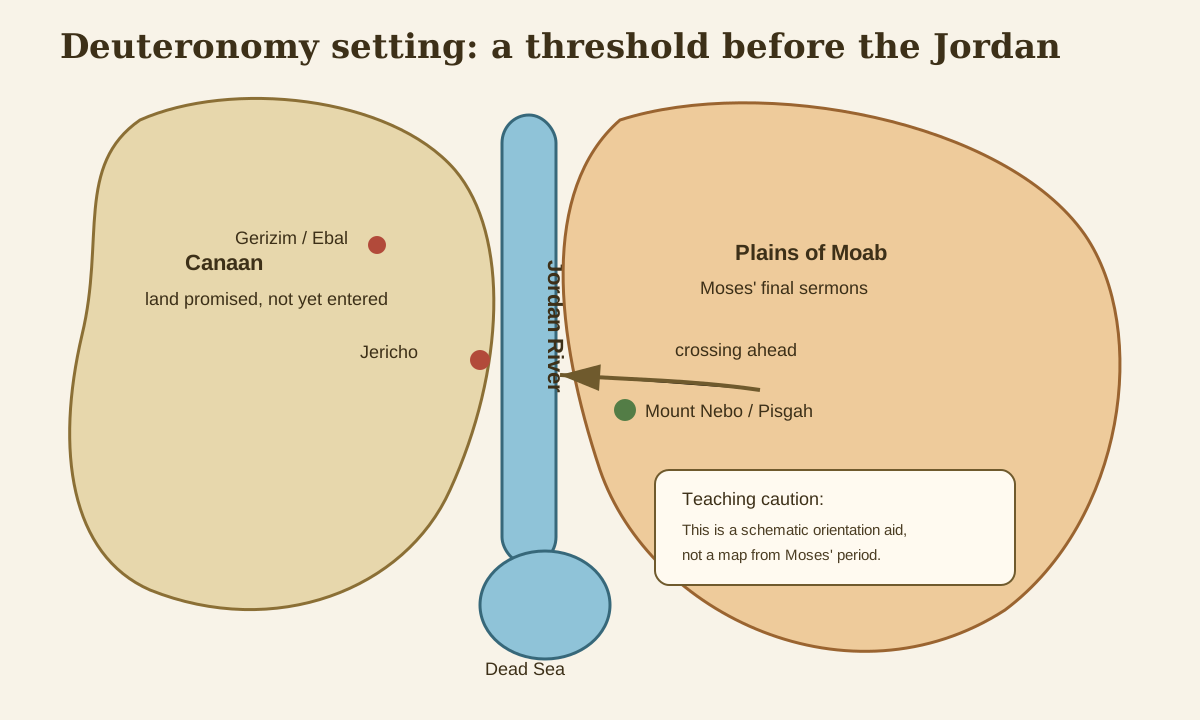 Source: Original project schematic, 2026-06-19. Schematic orientation only, not a period map or archaeological reconstruction.
The map matters because Deuteronomy 27 is public and embodied. The law is written, the altar is built, the people answer Amen, and the mountains teach that covenant is not an idea floating above ordinary life. The visual aid should serve this point: Israel is about to enter a real land with real communal accountability before God.
Characters
- Moses and the elders: covenant commanders at the threshold.
- The priests and Levites: public proclaimers of the law.
- The tribes: divided between the mounts for blessing and curse.
- The whole people: hearers and respondents, responsible before God.
Text Broken Open
1. Stones, plaster, and clear writing
“And thou shalt write upon the stones all this law very plainly.” (Deuteronomy 27:8, Brenton)
The law is not hidden in mystery cults or reserved for elites. It is made public, visible, and plain. This teaches accountability. One reason sin flourishes is that man prefers vagueness. He wants a God who can be honoured sentimentally but never obeyed concretely.
The altar of uncut stones beside the inscribed law is also important. Worship and obedience belong together. Sacrifice without truth is hypocrisy. Law without worship becomes barren moralism.
2. The people’s Amen
“And all the people shall answer and say, So be it.” (Deuteronomy 27:15 and throughout, Brenton)
The repeated response is not decorative. Israel binds herself by hearing and agreement. The Amen of the people shows that covenant life is participatory. Silence would be evasion.
The Church too says Amen. In Orthodox worship, Amen seals prayer, confession, and praise. It is a word of consent. This chapter reminds us that to say Amen lightly is dangerous. One’s life should not contradict one’s liturgical answer.
3. Hidden sins named aloud
The curses in chapter 27 especially target acts often done in secrecy or through exploitation: idolatry in secret, dishonouring parents, moving landmarks, perverting justice, sexual corruption, secret violence, bribery. This is notable. God exposes what society may ignore.
“Cursed is every one that shall pervert the judgment of the stranger, and orphan, and widow.” (Deuteronomy 27:19, Brenton)
The covenant tests not only religious identity, but treatment of the defenceless. Basil’s concern for the poor and Chrysostom’s warnings against exploiting the weak both stand squarely within this moral world.
4. Blessing for hearing the voice of the Lord
“And it shall come to pass, if thou wilt indeed hear the voice of the Lord thy God… blessed shalt thou be in the city, and blessed shalt thou be in the field.” (Deuteronomy 28:1, 3, Brenton)
Blessing spreads through ordinary life: city and field, womb and flock, storehouse and journey. This is not prosperity preaching in a modern shallow sense. It is covenant wholeness. Life aligned with God becomes ordered, fruitful, and protected.
5. The terrible unraveling of rebellion
Chapter 28 then unfolds the curse in great detail. Disorder enters body, field, family, memory, war, and exile. What is striking is the reversal. Blessings become curses turned inside out.
“And these things shall be signs in thee, and wonders among thy seed for ever; because thou didst not serve the Lord thy God with gladness and a good heart, because of the abundance of all things.” (Deuteronomy 28:46-47, Brenton)
This is a severe diagnosis. It is not only that Israel disobeyed. She failed to serve with gladness even while surrounded by gift. Ingratitude is at the root of apostasy.
6. Why the Christian reads this chapter with trembling and hope
If one reads chapter 28 honestly, one begins to understand why mere possession of law cannot save. The commandments are righteous, but the sinner is unstable. The result is not that the law is evil, but that man needs redemption deeper than external instruction.
Here the New Testament opens the way. Christ enters the place of curse in order to bring blessing to the nations. Galatians 3 must be read alongside these chapters. The Cross does not trivialize the curses of Deuteronomy; it reveals how serious they truly are. The obedient Son bears what rebellious humanity cannot escape and breaks the curse by His own holy obedience. Athanasius and Cyril are both useful guides to this movement from condemnation toward life in Christ.
7. The curse and the Cross
The deepest Christological reading of Deuteronomy 27-28 is not that the law was mistaken, but that Christ alone fulfils and carries what the law exposes. Saint Paul says plainly: “Christ redeemed us from the curse of the law, having become a curse for us” (Galatians 3:13). The Church therefore reads these chapters in the shadow of Golgotha. The warnings are real. The disobedience is real. The exile-making power of sin is real. But the Cross is more than another example of curse. It is the place where the curse is exhausted in the crucified and risen Lord.
Church’s Voice in Worship
These chapters harmonize strongly with Orthodox themes of covenant seriousness, public confession, Amen, repentance, and the consequences of sin. The movement from inscription, altar, proclamation, and response is especially fruitful for catechesis.
Their Christological completion is also central. When the Church proclaims the Cross, she does not deny the old covenant’s seriousness; she confesses that Christ has entered the place of curse in order to open blessing to Jew and Gentile alike. This gives the chapter both gravity and hope.
Spiritual Fruit 🍇
- Clarity: God’s will must be written plainly in the heart.
- Reverent Amen: agreement with God must be real.
- Fear of hidden sins: secrecy does not hide from heaven.
- Grateful obedience: blessing is meant to produce thanksgiving.
- Compassion: mistreatment of the weak belongs among the covenant curses.
- Need for Christ: the chapter exposes the poverty of self-righteousness.
Questions for reflection:
- Where do I prefer spiritual vagueness because clarity would require change?
- Do I say Amen with my mouth while resisting God in practice?
- Which sins do I assume are safe because they are hidden?
- Have I failed to serve God with gladness despite abundance?
- Do I let the Cross interpret the severity of the law, or do I try to escape both?
Teacher's Notes
- Show: Use the covenant geography schematic to locate Gerizim and Ebal before explaining the public Amen and the covenant curses.
- Do not flatten blessing and curse into simplistic formulas for every individual circumstance. The chapters speak covenantally and nationally, though their principles remain spiritually instructive.
- Explain that chapter 28 is intentionally overwhelming. It teaches the gravity of rebellion.
- Bring in Galatians 3 carefully. Paul does not reject the law’s goodness. He reveals man’s need for the saving work of Christ.
- The altar of whole stones in chapter 27 should be highlighted. Human craftsmanship is not the source of atonement.
- Keep the treatment pastoral. The Christian answer to curse is not denial, but the Cross.
Glossary
- Covenant sanctions: blessings and curses attached to covenant faithfulness or rebellion.
- Amen: “So be it,” a word of assent and agreement.
- Gæbal / Ebal: the mountain associated with the proclamation of curse.
- Garizin / Gerizim: the mountain associated with blessing.
- Landmark: a boundary marker; moving it was both theft and injustice.
Translation and Source Notes
- Old Testament citations are from the Brenton Septuagint.
- The chief New Testament point of contact is Galatians 3:10-14.
- Chapter 28 contains severe imagery. Teachers should prepare hearers pastorally while not softening the text.
- Patristic observations are summarized thematically unless tied to clearly identifiable primary works.
Sources
Primary sources
- Deuteronomy 27-28 (Brenton Septuagint)
- Galatians 3:10-14
- Saint John Chrysostom, Homilies on Galatians
- Saint Athanasius, On the Incarnation
- Saint Cyril of Alexandria, Glaphyra on the Pentateuch
Secondary academic sources
- Peter C. Craigie, The Book of Deuteronomy
- J. G. McConville, Deuteronomy
- Christopher J. H. Wright, Deuteronomy
Coptic Orthodox / pastoral sources
- Orthodox Study Bible, notes on Deuteronomy and Galatians
- Fr. Tadros Y. Malaty, commentary on Deuteronomy
Web pages and non-academic sources cited
- None cited directly in this guide