


Leviticus 8-10 moves from priestly consecration to divine glory and then to judgment on strange fire. Priesthood is gift and danger, because those who draw near must receive worship from God rather than invent it.
Leviticus 8-10 is the first major narrative movement of the book. Aaron and his sons are washed, vested, anointed, marked with blood, and consecrated. Sacrifices are offered. The glory of the Lord appears. Fire comes out from before the Lord. Then, suddenly, Nadab and Abihu offer strange fire and die before the Lord.
This unit must be studied as one arc. Leviticus 8 shows consecration. Leviticus 9 shows priestly ministry accepted by divine fire. Leviticus 10 shows the danger of self-willed worship. The same holy fire that confirms true worship also judges false worship. For Orthodox readers, this is one of the strongest Old Testament passages on priesthood, ordination, vestments, anointing, liturgical reverence, sobriety, and holy fear.
Historical and Scriptural Context
Leviticus 8-10 belongs to the approved Leviticus literary-unit plan. It should be read in light of the whole book’s movement from holy approach, priesthood, purity, atonement, holiness, covenant warning, and truthful dedication.
Geographical Significance ⛰️
The doorway of the tabernacle of witness, the altar, and the sanctuary boundary matter. The priests remain at the threshold where God’s holiness meets Israel’s worship.
The Characters 👥
Moses consecrates, Aaron and his sons receive priesthood, Nadab and Abihu show the danger of self-willed worship, and the congregation sees fire from the Lord.
🕯️ Light from the Word
Leviticus 8
1 And the Lord spoke to Moses, saying, 2 Take Aaron and his sons, and his robes and the anointing oil, and the calf for the sin-offering, and the two rams, and the basket of unleavened bread, 3 and assemble the whole congregation at the door of the tabernacle of witness. 4 And Moses did as the Lord appointed him, and he assembled the congregation at the door of the tabernacle of witness. 5 And Moses said to the congregation, This is the thing which the Lord has commanded you to do. 6 And Moses brought nigh Aaron and his sons, and washed them with water, 7 and put on him the coat, and girded him with the girdle, and clothed him with the tunic, and put on him the ephod; 8 and girded him with a girdle according to the make of the ephod, and clasped him closely with it: and put upon it the oracle, and put upon the oracle the Manifestation and the Truth. 9 And he put the mitre on his head, and put upon the mitre in front the golden plate, the most holy thing, as the Lord commanded Moses.
10 And Moses took of the anointing oil, 11 and sprinkled of it seven times on the altar; and anointed the altar, and hallowed it, and all things on it, and the laver, and its foot, and sanctified them; and anointed the tabernacle and all its furniture, and hallowed it. 12 And Moses poured of the anointing oil on the head of Aaron; and he anointed him and sanctified him. 13 And Moses brought the sons of Aaron near, and put on them coats and girded them with girdles, and put on them bonnets, as the Lord commanded Moses.
14 And Moses brought near the calf for the sin-offering, and Aaron and his sons laid their hands on the head of the calf of the sin-offering. 15 And he slew it; and Moses took of the blood, and put it on the horns of the altar round about with his finger; and he purified the altar, and poured out the blood at the bottom of the altar, and sanctified it, to make atonement upon it. 16 And Moses took all the fat that was upon the inwards, and the lobe on the liver, and both the kidneys, and the fat that was upon them, and Moses offered them on the altar. 17 But the calf, and his hide, and his flesh, and his dung, he burnt with fire without the camp, as the Lord commanded Moses.
18 And Moses brought near the ram for a whole-burnt-offering, and Aaron and his sons laid their hands on the head of the ram. And Moses slew the ram: and Moses poured the blood on the altar round about. 19 And he divided the ram by its limbs, and Moses offered the head, and the limbs, and the fat; and he washed the belly and the feet with water. 20 And Moses offered up the whole ram on the altar: it is a whole-burnt-offering for a sweet-smelling savour; it is a burnt-offering to the Lord, as the Lord commanded Moses.
21 And Moses brought the second ram, the ram of consecration, and Aaron and his sons laid their hands on the head of the ram, and he slew him; 22 and Moses took of his blood, and put it upon the tip of Aaron’s right ear, and on the thumb of his right hand, and on the great toe of his right foot. 23 And Moses brought near the sons of Aaron; and Moses put of the blood on the tips of their right ears, and on the thumbs of their right hands, and on the great toes of their right feet, and Moses poured out the blood on the altar round about. 24 And he took the fat, and the rump, and the fat on the belly, and the lobe of the liver, and the two kidneys, and the fat that is upon them, and the right shoulder. 25 And from the basket of consecration, which was before the Lord, he also took one unleavened loaf, and one loaf made with oil, and one cake; and put them upon the fat, and the right shoulder: 26 and put them all on the hands of Aaron, and upon the hands of his sons, and offered them up for a wave-offering before the Lord. 27 And Moses took them at their hands, and Moses offered them on the altar, on the whole-burnt-offering of consecration, which is a smell of sweet savour: it is a burnt-offering to the Lord. 28 And Moses took the breast, and separated it for a heave-offering before the Lord, from the ram of consecration; and it became Moses’ portion, as the Lord commanded Moses.
29 And Moses took of the anointing oil, and of the blood that was on the altar, and sprinkled it on Aaron, and on his garments, and his sons, and the garments of his sons with him. 30 And he sanctified Aaron and his garments, and his sons, and the garments of his sons with him. 31 And Moses said to Aaron and to his sons, Boil the flesh in the tent of the tabernacle of witness in the holy place; and there ye shall eat it and the loaves in the basket of consecration, as it has been appointed me, the Lord saying, Aaron and his sons shall eat them. 32 And that which is left of the flesh and of the loaves burn ye with fire. 33 And ye shall not go out from the door of the tabernacle of witness for seven days, until the day be fulfilled, the day of your consecration; for in seven days shall he consecrate you, 34 as he did in this day on which the Lord commanded me to do so, to make an atonement for you. 35 And ye shall remain seven days at the door of the tabernacle of witness, day and night; ye shall observe the ordinances of the Lord, that ye die not; for so has the Lord God commanded me. 36 And Aaron and his sons performed all these commands which the Lord commanded Moses.
Lesson Guide
- Key phrases: Leviticus 8.
- Emphasize: Keep the literal sense clear before drawing typology. Show how the command forms worship, holiness, and mercy.
- Avoid: Do not turn the passage into either obsolete ritual detail or free-floating moralism.
Leviticus 9
1 And it came to pass on the eighth day, that Moses called Aaron and his sons, and the elders of Israel, 2 and Moses said to Aaron, Take to thyself a young calf of the herd for a sin-offering, and a ram for a whole-burnt-offering, unblemished, and offer them before the Lord. 3 And speak to the elders of Israel, saying, Take one kid of the goats for a sin-offering, and a young calf, and a lamb of a year old for a whole-burnt-offering, spotless, 4 and a calf and a ram for a peace offering before the Lord, and fine flour mingled with oil, for to-day the Lord will appear among you. 5 And they took as Moses commanded them before the tabernacle of witness, and all the congregation drew nigh, and they stood before the Lord. 6 And Moses said, This is the thing which the Lord has spoken; do it, and the glory of the Lord shall appear among you. 7 And Moses said to Aaron, Draw nigh to the altar, and offer thy sin-offering, and thy whole-burnt-offering, and make atonement for thyself, and for thy house; and offer the gifts of the people, and make atonement for them, as the Lord commanded Moses. 8 And Aaron drew nigh to the altar, and slew the calf of his sin-offering. 9 And the sons of Aaron brought the blood to him, and he dipped his finger into the blood, and put it on the horns of the altar, and he poured out the blood at the bottom of the altar. 10 And he offered up on the altar the fat and the kidneys and the lobe of the liver of the sin-offering, according as the Lord commanded Moses. 11 And the flesh and the hide he burnt with fire outside of the camp. 12 And he slew the whole-burnt-offering; and the sons of Aaron brought the blood to him, and he poured it on the altar round about. 13 And they brought the whole-burnt-offering, according to its pieces; them and the head he put upon the altar. 14 And he washed the belly and the feet with water, and he put them on the whole-burnt-offering on the altar.
15 And he brought the gift of the people, and took the goat of the sin-offering of the people, and slew it, and purified it as also the first. 16 And he brought the whole-burnt-offering, and offered it in due form. 17 And he brought the sacrifice and filled his hands with it, and laid it on the altar, besides the morning whole-burnt-offering. 18 And he slew the calf, and the ram of the sacrifice of peace-offering of the people; and the sons of Aaron brought the blood to him, and he poured it out on the altar round about. 19 And he took the fat of the calf, and the hind quarters of the ram, and the fat covering the belly, and the two kidneys, and the fat upon them, and the caul on the liver. 20 And he put the fat on the breasts, and offered the fat on the altar. 21 And Aaron separated the breast and the right shoulder as a choice-offering before the Lord, as the Lord commanded Moses. 22 And Aaron lifted up his hands on the people and blessed them; and after he had offered the sin-offering, and the whole-burnt-offerings, and the peace-offerings, he came down. 23 And Moses and Aaron entered into the tabernacle of witness. And they came out and blessed all the people, and the glory of the Lord appeared to all the people. 24 And fire came forth from the Lord, and devoured the offerings on the altar, both the whole-burnt-offerings and the fat; and all the people saw, and were amazed, and fell upon their faces.
Lesson Guide
- Key phrases: Leviticus 9.
- Emphasize: Keep the literal sense clear before drawing typology. Show how the command forms worship, holiness, and mercy.
- Avoid: Do not turn the passage into either obsolete ritual detail or free-floating moralism.
Leviticus 10
1 And the two sons of Aaron, Nadab and Abiud, took each his censer, and put fire therein, and threw incense thereon, and offered strange fire before the Lord, which the Lord did not command them, 2 and fire came forth from the Lord, and devoured them, and they died before the Lord. 3 And Moses said to Aaron, This is the thing which the Lord spoke, saying, I will be sanctified among them that draw nigh to me, and I will be glorified in the whole congregation; and Aaron was pricked in his heart. 4 And Moses called Misadaë, and Elisaphan, sons of Oziel, sons of the brother of Aaron’s father, and said to them, Draw near and take your brethren from before the sanctuary out of the camp. 5 And they came near and took them in their coats out of the camp, as Moses said. 6 And Moses said to Aaron, and Eleazar and Ithamar his sons that were left, Ye shall not make bare your heads, and ye shall not tear your garments; that ye die not, and so there should be wrath on all the congregation: but your brethren, even all the house of Israel, shall lament for the burning, with which they were burnt by the Lord. 7 And ye shall not go forth from the door of the tabernacle of witness, that ye die not; for the Lord’s anointing oil is upon you: and they did according to the word of Moses.
8 And the Lord spoke to Aaron, saying, 9 Ye shall not drink wine nor strong drink, thou and thy sons with thee, whensoever ye enter into the tabernacle of witness, or when ye approach the altar, so shall ye not die; it is a perpetual statute for your generations, 10 to distinguish between sacred and profane, and between clean and unclean, 11 and to teach the children of Israel all the statutes, which the Lord spoke to them by Moses. 12 And Moses said to Aaron, and to Eleazar and Ithamar, the sons of Aaron who survived, Take the sacrifice that is left of the burnt-offerings of the Lord, and ye shall eat unleavened bread by the altar: it is most holy. 13 And ye shall eat it in the holy place; for this is a statute for thee and a statute for thy sons, of the burnt-offerings to the Lord; for so it has been commanded me. 14 And ye shall eat the breast of separation, and the shoulder of the choice-offering in the holy place, thou and thy sons and thy house with thee; for it has been given as an ordinance for thee and an ordinance for thy sons, of the sacrifices of peace-offering of the children of Israel. 15 They shall bring the shoulder of the choice-offering, and the breast of the separation upon the burnt-offerings of the fat, to separate for a separation before the Lord; and it shall be a perpetual ordinance for thee and thy sons and thy daughters with thee, as the Lord commanded Moses.
16 And Moses diligently sought the goat of the sin-offering, but it had been consumed by fire; and Moses was angry with Eleazar and Ithamar the sons of Aaron that were left, saying, 17 Why did ye not eat the sin-offering in the holy place? for because it is most holy he has given you this to eat, that ye might take away the sin of the congregation, and make atonement for them before the Lord. 18 For the blood of it was not brought into the holy place: ye shall eat it within, before the Lord, as the Lord commanded me. 19 And Aaron spoke to Moses, saying, If they have brought nigh to-day their sin-offerings, and their whole-burnt-offerings before the Lord, and these events have happened to me, and yet I should eat to-day of the sin-offerings, would it be pleasing to the Lord? 20 And Moses heard it, and it pleased him.
Lesson Guide
- Key phrases: Leviticus 10.
- Emphasize: Keep the literal sense clear before drawing typology. Show how the command forms worship, holiness, and mercy.
- Avoid: Do not turn the passage into either obsolete ritual detail or free-floating moralism.
From instruction to enacted priesthood
Until this point, Leviticus has largely given sacrificial instructions. In chapter 8, the instructions become embodied in persons. Aaron and his sons are not simply told to perform rites. They themselves are ritually prepared. Priesthood is not a job assignment; it is consecrated life.
The congregation is gathered. Moses washes Aaron and his sons. He clothes Aaron with priestly garments. He anoints the tabernacle, altar, vessels, and Aaron. He offers sacrifices. He applies blood to Aaron and his sons: ear, thumb, and toe. He places portions in their hands. They remain at the door of the tabernacle for seven days.
The whole scene teaches that priestly ministry is received, not self-invented. Aaron does not ordain himself. His sons do not seize ministry. The priest is washed, clothed, anointed, blood-marked, and commanded.
The repeated LXX phrase tabernacle of witness is also worth hearing. Israel is assembled at the place where God’s dwelling bears witness before the whole congregation. Priesthood is therefore not esoteric technique for a spiritual elite. It is public, covenantal service before the God who has chosen to dwell among His people and testify to His holiness in their midst.
Lesson Guide
- Key phrases: From instruction to enacted priesthood.
- Emphasize: Keep the literal sense clear before drawing typology. Show how the command forms worship, holiness, and mercy.
- Avoid: Do not turn the passage into either obsolete ritual detail or free-floating moralism.
Washing, vesting, anointing, and blood
The washing of the priests points to purification before service. The vesting teaches that priesthood is not private personality. The priest is clothed in an office. The anointing teaches that holy service requires divine consecration. The blood on ear, hand, and foot teaches that hearing, action, and walk must be marked by sacrifice.
The LXX wording in 8:8 is especially illuminating: Aaron bears the Manifestation and the Truth. Whatever questions remain about the exact historical use of the priestly lots, Brenton’s wording helps Christian readers hear a genuine theological point. Priestly judgment must belong to revelation and truth, not charisma, mood, or experiment. The one who serves near the altar must not govern holy things by private impulse.
In Orthodox life, these images remain deeply resonant. Baptism, chrismation, ordination, vestments, altar service, and Eucharistic priesthood all belong to a fulfilled sacramental world. The Church does not copy Leviticus woodenly, but she recognizes that God teaches through bodies, garments, oil, blood, place, and time.
The blood on the ear is especially powerful. The priest must hear differently. He does not serve by his own opinion. The blood on the hand teaches that his actions are not his own. The blood on the foot teaches that even his path must be consecrated.
Lesson Guide
- Key phrases: Washing, vesting, anointing, and blood.
- Emphasize: Keep the literal sense clear before drawing typology. Show how the command forms worship, holiness, and mercy.
- Avoid: Do not turn the passage into either obsolete ritual detail or free-floating moralism.
Seven days at the door
The seven-day consecration period teaches patience and completion. Priesthood is not rushed. The priests remain at the door of the tabernacle, under command, before public ministry begins. This waiting is part of the ordination.
For modern servants, this is a needed correction. The desire to serve publicly must be purified by hidden obedience. A person who cannot wait at the door is not ready to stand at the altar. A Church that rushes people into visible ministry without formation should tremble before Leviticus 8.
Lesson Guide
- Key phrases: Seven days at the door.
- Emphasize: Keep the literal sense clear before drawing typology. Show how the command forms worship, holiness, and mercy.
- Avoid: Do not turn the passage into either obsolete ritual detail or free-floating moralism.
Leviticus 9: glory and divine fire
In chapter 9, Aaron begins priestly ministry. Offerings are made for himself and for the people. Moses and Aaron bless the people. The glory of the Lord appears. Fire comes out from before the Lord and consumes the offering. The people shout and fall on their faces.
This is the proper climax of priestly service: not performance, but glory. The goal of liturgy is not that people admire the priest, the music, or the order. The goal is that God receives worship and the people encounter His presence. The fire comes from the Lord, not from human creativity.
This is one of the great liturgical lessons of Leviticus. True worship is both ordered and alive. It follows divine command, and God answers with glory. Order without glory becomes dead formalism. Claimed spiritual fire without obedience becomes strange fire. At the tabernacle of witness, the congregation does not applaud technique; it falls on its face before manifested holiness.
Lesson Guide
- Key phrases: Leviticus 9: glory and divine fire.
- Emphasize: Keep the literal sense clear before drawing typology. Show how the command forms worship, holiness, and mercy.
- Avoid: Do not turn the passage into either obsolete ritual detail or free-floating moralism.
Leviticus 10: strange fire
The death of Nadab and Abihu is shocking, and it should remain shocking. They offer strange or unauthorized fire before the Lord, which He had not commanded. Fire comes out from before the Lord and consumes them. Moses says, “This is what the Lord spoke, saying, I will be sanctified in them that draw nigh to me.”
The text does not answer every question modern readers ask. Was the issue drunkenness, because wine is mentioned afterward? Was it unauthorized incense? Was it the wrong fire source? Was it the wrong time, place, or attitude? The safest answer is the one the text gives: they offered what God had not commanded. The ambiguity may be intentional. The point is not curiosity about the mechanics of their sin. The point is holy fear before God.
This chapter must not be used to terrify people away from God. It must be used to teach that nearness to God is real. The holy is not a toy. Liturgical service is not self-expression. Those who draw near must sanctify Him. Early Christian writers repeatedly returned to Nadab and Abihu as a warning against self-chosen worship: zeal can be sincere and still be disobedient when it ignores the form God has given.
Lesson Guide
- Key phrases: Leviticus 10: strange fire.
- Emphasize: Keep the literal sense clear before drawing typology. Show how the command forms worship, holiness, and mercy.
- Avoid: Do not turn the passage into either obsolete ritual detail or free-floating moralism.
Aaron pricked in heart, and priestly grief
Brenton’s wording in Leviticus 10:3 deserves attention. Many English Bibles, following the Hebrew/Masoretic tradition, say that Aaron “held his peace” or was silent. Brenton’s Septuagint says instead that “Aaron was pricked in his heart.” The two readings should not be collapsed carelessly. The Hebrew-shaped reading emphasizes Aaron’s restrained silence before the terrifying holiness of God. Brenton’s wording emphasizes the inward wound: Aaron is pierced, stricken, and cut to the heart.
For this guide, the Brenton wording should lead. Aaron is not presented as cold or indifferent. He is a father whose heart has been pierced, yet he remains within the discipline of priestly service. Moses commands that the service not collapse into disorder, while relatives carry the bodies away and the congregation mourns.
Leviticus does not deny grief. It orders grief in relation to holy service. Priests are not less human, but their public service places them under particular discipline. Orthodox clergy and deacons should read this with humility, not harshness. Aaron is neither rebellious nor numb. His heart is wounded, and yet he remains under command.
Lesson Guide
- Key phrases: Aaron pricked in heart, and priestly grief.
- Emphasize: Keep the literal sense clear before drawing typology. Show how the command forms worship, holiness, and mercy.
- Avoid: Do not turn the passage into either obsolete ritual detail or free-floating moralism.
Sobriety and discernment
The command not to drink wine or strong drink when entering the tabernacle of witness follows the death of Nadab and Abihu. The priests must distinguish between holy and profane, clean and unclean, and teach Israel all the statutes of the Lord. Sobriety here is more than avoiding alcohol. It is spiritual clarity.
The priest must be able to discern. If his senses are clouded, the people suffer. If he cannot distinguish holy from common, his ministry becomes dangerous. This has direct relevance for all forms of spiritual leadership. A servant who lacks discernment may still be energetic, charismatic, and sincere, but he is unsafe near holy things.
Lesson Guide
- Key phrases: Sobriety and discernment.
- Emphasize: Keep the literal sense clear before drawing typology. Show how the command forms worship, holiness, and mercy.
- Avoid: Do not turn the passage into either obsolete ritual detail or free-floating moralism.
Leviticus 10:16-20 and Aaron’s refusal to eat the sin offering
These closing verses are essential, because they prevent a shallow reading of the chapter. Moses searches for the goat of the people’s sin offering and discovers that it has been burned rather than eaten. His anger is understandable. According to the earlier legislation, when the blood of a sin offering was not taken into the sanctuary, the priests were to eat it in the holy place. This was not a casual meal. By eating it, they bore the iniquity of the congregation in their priestly service.
So Moses is not defending empty formalism. A real command appears to have been neglected at exactly the moment when the integrity of the priesthood is under scrutiny. Yet Aaron’s answer is one of the most searching and humane moments in Leviticus. He does not deny the law. He does not excuse the deaths of Nadab and Abihu. He simply says that after the day’s offerings had been brought, “these events have happened to me.” In that condition, would eating the sin offering have been pleasing to the Lord?
This is why Leviticus 10 is not merely a chapter of “ritual precision or death.” Nadab and Abihu approached God in a self-authorizing way. Aaron does the opposite. He restrains himself, discerns the spiritual state of the day, and refuses to perform priestly eating as though nothing has happened. Moses listens, and Leviticus 10:20 says plainly that the answer pleased him. The law is not discarded; it is rightly applied with fear of God, grief, and discernment.
Pastorally, this matters a great deal. Aaron is forbidden from outward gestures that would break the order of consecration, but he is not commanded to become emotionally false. The chapter ends with Moses pleased, not because rules no longer matter, but because truthful obedience is deeper than mechanical completion. The priest must not invent worship like Nadab and Abihu, yet neither must he pretend before God that grief does not exist. Holiness includes obedience, sorrow, sobriety, and discernment together.
Lesson Guide
- Key phrases: Leviticus 10:16-20 and Aaron’s refusal to eat the sin offering.
- Emphasize: Keep the literal sense clear before drawing typology. Show how the command forms worship, holiness, and mercy.
- Avoid: Do not turn the passage into either obsolete ritual detail or free-floating moralism.
Christological reading
Likewise, Christ is anointed by the Spirit in His humanity not because He lacked the Spirit, but because the incarnate Son manifests in our flesh the messianic anointing that is eternally His. Hebrews can even speak of His being perfected through sufferings, not as if He moved from moral defect to holiness, but as the sinless Son bringing His priestly mission to completion in our condition. He is both Priest and Offering, and He consecrates the new covenant by His own Blood.
The fire that consumes the acceptable offering in Leviticus 9 points toward divine acceptance. The fire that judges Nadab and Abihu warns that nearness without obedience is perilous. At the Cross, Christ enters the full fire of judgment and love. In Him, worship becomes possible, not casual.
Hebrews presents Christ as the true High Priest who does not need to offer first for His own sins. That is a major contrast with Aaron, and St. John Chrysostom presses that contrast strongly in his preaching on Hebrews. Aaron must be consecrated and must offer for himself. Christ is sinless, yet He enters fully into priestly mediation for us and opens our access to the Father.
Lesson Guide
- Key phrases: Christological reading.
- Emphasize: Keep the literal sense clear before drawing typology. Show how the command forms worship, holiness, and mercy.
- Avoid: Do not turn the passage into either obsolete ritual detail or free-floating moralism.
The Church’s Voice in Worship
No exact Coptic placement is claimed for this Leviticus unit. The local Coptic Orthodox lectionary reference data has not yielded an exact occurrence for this passage, so this section gives thematic worship resonance rather than a fixed reading claim.
This passage has no established place in the Coptic Orthodox lectionary.
The thematic connection is extremely strong. Coptic worship retains a deep sense of priesthood, vestment, altar, incense, washing, anointing, prostration, and holy fear. The deacon does not serve casually. The priest does not stand at the altar as a performer. The congregation does not approach communion as entitlement. Leviticus 8-10 helps explain why Orthodox liturgy is careful.
This unit is especially useful for deacon formation. It teaches that beautiful ritual without obedience is not enough, and zeal without command can become strange fire. It also teaches that priesthood is for blessing the people and revealing the glory of God, not for clerical self-importance.
Iconography and Visual Teaching 🖼️
This unit needs a genealogy visual because many readers lose track of Aaron’s sons. The priestly family tree keeps Nadab, Abihu, Eleazar, and Ithamar visible and helps the class feel the tragedy of strange fire without turning it into an abstract warning. The Tissot tabernacle image can support the setting, but it must be labeled as Western biblical artwork, not Orthodox iconography.
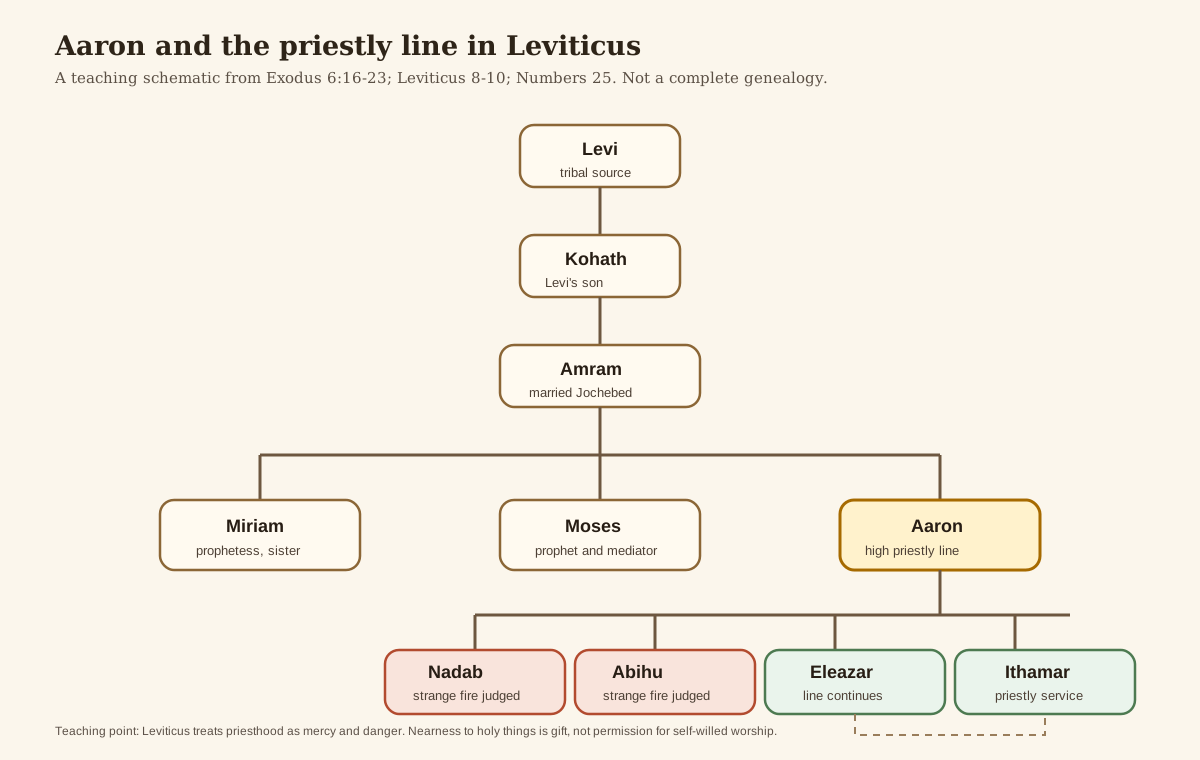 Source: Hermes-generated teaching schematic from Exodus 6:16-23, Leviticus 8-10, and Numbers 25. Partial teaching genealogy, not a complete Levitical genealogy.
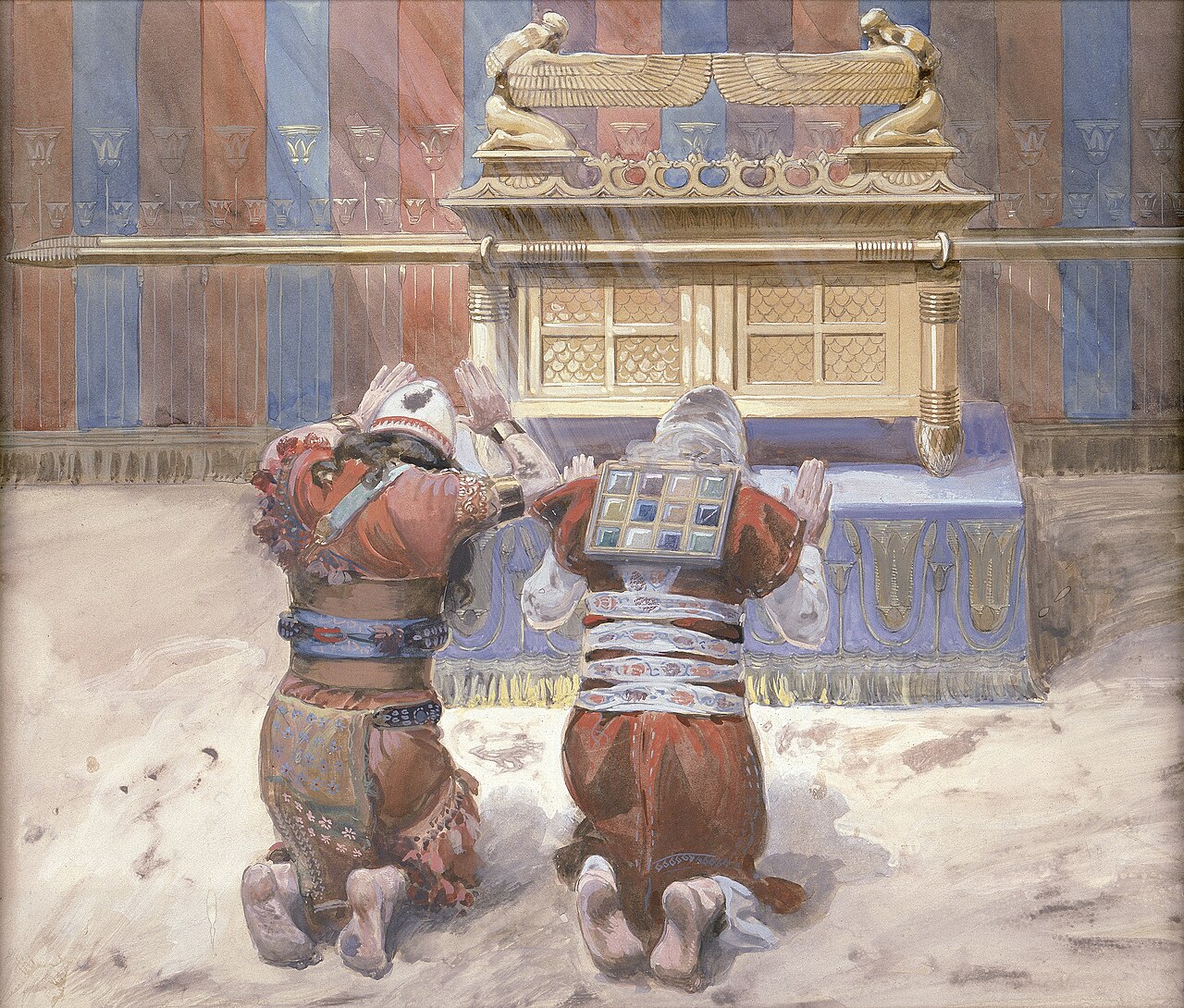 Source: James Tissot, Moses and Joshua in the Tabernacle, public domain via Wikimedia Commons. Western biblical artwork, not Orthodox iconography.
Spiritual Fruit 🍇
Leviticus 8-10 asks three hard questions.
First, have I accepted consecration, or am I trying to serve God while remaining unformed? Second, do I desire God’s glory, or do I want religious activity that displays myself? Third, am I offering the fire God commanded, or strange fire born from ego, impatience, novelty, anger, or carelessness?
For clergy and deacons, this passage should create humility. For laypeople, it should create prayer for those who serve. For everyone, it teaches that holiness is not theatrical severity. Holiness is the truth of God’s nearness.
- Do not improvise with holy things to display yourself.
- Let consecration mark ear, hand, and foot: hearing, work, and walk.
- Remember that priestly nearness is mercy and responsibility together.
Teacher's Notes
- Why does priesthood require washing, vesting, anointing, blood, and waiting?
- What does the blood on ear, hand, and foot teach about consecrated service?
- How do Leviticus 9 and 10 together distinguish true divine fire from strange fire?
- What forms can strange fire take in modern church service?
- How can holy fear be taught without making people afraid to approach God?
- How does Christ fulfill Aaron’s priesthood while surpassing it?
Teach this unit slowly. Do not isolate Nadab and Abihu from the ordination narrative. The tragedy only makes sense after the glory of proper worship appears. Avoid speculation beyond the text. Emphasize the stated issue: they offered what God had not commanded.
For a deacon class, this is one of the most important Leviticus units. Connect it to reverence, preparation, obedience, sobriety, and service that points to God’s glory rather than the servant’s personality.
Where to linger: ear, hand, foot, anointing, glory appearing, and the death of Nadab and Abihu. Where to compress: vestment and offering sequence once the ordination movement is understood. Pastoral guardrail: do not use strange fire only to condemn others; let it search every servant’s preparation and obedience.
Visual teaching: show the priestly family tree before Nadab and Abihu. It keeps the warning personal and prevents the chapter from becoming abstract clergy-talk.
Glossary
- Consecration: Consecration is the setting apart of Aaron and his sons for priestly service through washing, vesting, anointing, sacrifice, and obedient waiting. It teaches that ministry is received from God rather than self-assigned.
- Anointing oil: The anointing oil marks persons and holy things as belonging to the Lord’s service. It helps the teacher connect priesthood with sanctification, not merely with religious office.
- Strange fire: Strange fire is unauthorized worship offered by Nadab and Abihu in defiance of the Lord’s command. It warns that zeal without obedience can become dangerous before a holy God.
- Glory of the Lord: The glory of the Lord is God’s manifested presence among His people. In this unit it confirms the priesthood and the altar, but also makes disobedience more serious.
- Aaron was pricked in his heart: Brenton’s wording describes Aaron’s grief-stricken silence after the judgment of his sons. It gives the teacher language for reverent sorrow before God without turning the scene into easy moralism.
- Priestly discernment: Priestly discernment is the ability to distinguish holy from common, clean from unclean, and faithful worship from presumption. It is essential to the priestly calling and to pastoral service.
Translation and Source Notes
Scripture quotations are from Brenton’s English Septuagint. This guide preserves Brenton’s distinctive wording where it shapes the teaching, including Aaron being pricked in heart, and uses Hebrews’ priesthood and sanctuary fulfillment as Christian reception rather than direct commentary on every verse of Leviticus 8-10.
This passage has no established place in the Coptic Orthodox lectionary.
Sources
Primary sources
- Leviticus 8-10 in Brenton’s English Septuagint.
- Hebrews 7 and 9, as New Testament priesthood and sanctuary fulfillment passages used in the guide.
- John Chrysostom, Homilies on Hebrews, where the guide discusses Hebrews’ fulfillment of sacrifice, priesthood, sanctuary, blood, or atonement themes.
Secondary academic sources
- Gordon J. Wenham, The Book of Leviticus.
- Jacob Milgrom, Leviticus volumes in the Anchor Yale Bible series.
- Mary Douglas, Leviticus as Literature.
- Jay Sklar, Leviticus.
Coptic Orthodox / pastoral sources
- The Divine Liturgy of St. Basil, for Orthodox language of offering, thanksgiving, altar, priesthood, and communion.
- Local Coptic Orthodox lectionary reference material, used cautiously; no exact Coptic placement is claimed for Leviticus 8-10.