


Leviticus 6-7 revisits the offerings from the priestly side. The altar fire, holy portions, priestly eating, thanksgiving bread, fat, and blood teach that holy things must be handled with reverence, order, and gratitude.
Leviticus 6-7 retells the offerings from the priestly side. The worshipper has already learned what to bring in Leviticus 1-5. Now the priests learn how to guard the altar fire, handle holy portions, distinguish what is most holy, eat what belongs to priestly service, and preserve thanksgiving and communion in the peace offering.
Modern readers often become impatient when Leviticus repeats sacrificial categories. But the repetition is theological. In chapters 1-5 the offerings are viewed mainly from the approach of the worshipper: burnt, grain, peace, sin, and guilt. In chapters 6-7, the same sacrificial world is viewed from the responsibility of the priest. The shift teaches that worship involves both offering and guardianship.
Historical and Scriptural Context
Leviticus 6-7 belongs to the approved Leviticus literary-unit plan. It should be read in light of the whole book’s movement from holy approach, priesthood, purity, atonement, holiness, covenant warning, and truthful dedication.
Geographical Significance ⛰️
The altar, the place of ashes, the sanctuary court, and the priestly portions shape the geography of holiness. The text is concerned with ordered nearness, not travel.
The Characters 👥
Aaron and his sons stand at the center, receiving the priestly handling of the offerings. Worshippers bring gifts, but priests must guard the fire, portions, blood, and holy boundaries.
🕯️ Light from the Word
Leviticus 6
1 And the Lord spoke to Moses, saying, 2 Charge Aaron and his sons, saying, This is the law of whole-burnt-offering; this is the whole-burnt-offering in its burning on the altar all the night till the morning; and the fire of the altar shall burn on it, it shall not be put out. 3 And the priest shall put on the linen tunic, and he shall put the linen drawers on his body; and shall take away that which has been thoroughly burnt, which the fire shall have consumed, even the whole-burnt-offering from the altar, and he shall put it near the altar. 4 And he shall put off his robe, and put on another robe, and he shall take forth the offering that has been burnt without the camp into a clean place. 5 And the fire on the altar shall be kept burning on it, and shall not be extinguished; and the priest shall burn on it wood every morning, and shall heap on it the whole-burnt-offering, and shall lay on it the fat of the peace-offering. 6 And the fire shall always burn on the altar; it shall not be extinguished. 7 This is the law of the sacrifice, which the sons of Aaron shall bring near before the Lord, before the altar. 8 And he shall take from it a handful of the fine flour of the sacrifice with its oil, and with all its frankincense, which are upon the sacrifice; and he shall offer up on the altar a burnt-offering as a sweet-smelling savour, a memorial of it to the Lord. 9 And Aaron and his sons shall eat that which is left of it: it shall be eaten without leaven in a holy place, they shall eat it in the court of the tabernacle of witness. 10 It shall not be baked with leaven. I have given it as a portion to them of the burnt-offerings of the Lord: it is most holy, as the offering for sin, and as the offering for trespass. 11 Every male of the priests shall eat it: it is a perpetual ordinance throughout your generations of the burnt-offerings of the Lord; whosoever shall touch them shall be hallowed.
12 And the Lord spoke to Moses, saying, 13 This is the gift of Aaron and of his sons, which they shall offer to the Lord in the day in which thou shalt anoint him; the tenth of an ephah of fine flour for a sacrifice continually, the half of it in the morning, and the half of it in the evening. 14 It shall be made with oil in a frying-pan; he shall offer it kneaded and in rolls, an offering of fragments, an offering of a sweet savour unto the Lord. 15 The anointed priest who is in his place, one of his sons, shall offer it: it is a perpetual statute, it shall all be consumed. 16 And every sacrifice of a priest shall be thoroughly burnt, and shall not be eaten. 17 And the Lord spoke to Moses, saying, 18 Speak to Aaron and to his sons, saying, This is the law of the sin-offering; - in the place where they slay the whole-burnt-offering, they shall slay the sin-offerings before the Lord: they are most holy. 19 The priest that offers it shall eat it: in a holy place it shall be eaten, in the court of the tabernacle of witness. 20 Every one that touches the flesh of it shall be holy, and on whosesoever garment any of its blood shall have been sprinkled, whosoever shall have it sprinkled, shall be washed in the holy place. 21 And the earthen vessel, in whichsoever it shall have been sodden, shall be broken; and if it shall have been sodden in a brazen vessel, he shall scour it and wash it with water. 22 Every male among the priests shall eat it: it is most holy to the Lord. 23 And no offerings for sin, of whose blood there shall be brought any into the tabernacle of witness to make atonement in the holy place, shall be eaten: they shall be burned with fire.
Lesson Guide
- Key phrases: Leviticus 6.
- Emphasize: Keep the literal sense clear before drawing typology. Show how the command forms worship, holiness, and mercy.
- Avoid: Do not turn the passage into either obsolete ritual detail or free-floating moralism.
Leviticus 7
1 And this is the law of the ram for the trespass-offering; it is most holy. 2 In the place where they slay the whole-burnt-offering, they shall slay the ram of the trespass-offering before the Lord, and he shall pour out the blood at the bottom of the altar round about. 3 And he shall offer all the fat from it; and the loins, and all the fat that covers the inwards, and all the fat that is upon the inwards, 4 and the two kidneys, and the fat that is upon them, that which is upon the thighs, and the caul upon the liver with the kidneys, he shall take them away. 5 And the priest shall offer them on the altar a burnt-offering to the Lord; it is for trespass. 6 Every male of the priests shall eat them, in the holy place they shall eat them: they are most holy. 7 As the sin-offering, so also is the trespass-offering. There is one law of them; the priest who shall make atonement with it, his it shall be. 8 And as for the priest who offers a man’s whole-burnt-offering, the skin of the whole-burnt-offering which he offers, shall be his. 9 And every sacrifice which shall be prepared in the oven, and every one which shall be prepared on the hearth, or on a frying-pan, it is the property of the priest that offers it; it shall be his. 10 And every sacrifice made up with oil, or not made up with oil, shall belong to the sons of Aaron, an equal portion to each.
11 This is the law of the sacrifice of peace-offering, which they shall bring to the Lord. 12 If a man should offer it for praise, then shall he bring, for the sacrifice of praise, loaves of fine flour made up with oil, and unleavened cakes anointed with oil, and fine flour kneaded with oil. 13 With leavened bread he shall offer his gifts, with the peace-offering of praise. 14 And he shall bring one of all his gifts, a separate offering to the Lord: it shall belong to the priest who pours forth the blood of the peace-offering. 15 And the flesh of the sacrifice of the peace-offering of praise shall be his, and it shall be eaten in the day in which it is offered: they shall not leave of it till the morning. 16 And if it be a vow, or he offer his gift of his own will, on whatsoever day he shall offer his sacrifice, it shall be eaten, and on the morrow. 17 And that which is left of the flesh of the sacrifice till the third day, shall be consumed with fire. 18 And if he do at all eat of the flesh on the third day, it shall not be accepted for him that offers: it shall not be reckoned to him, it is pollution; and whatsoever soul shall eat of it, shall bear his iniquity. 19 And whatsoever flesh shall have touched any unclean thing, it shall not be eaten, it shall be consumed with fire; every one that is clean shall eat the flesh. 20 And whatsoever soul shall eat of the flesh of the sacrifice of the peace-offering which is the Lord’s, and his uncleanness be upon him, that soul shall perish from his people. 21 And whatsoever soul shall touch any unclean thing, either of the uncleanness of a man, or of unclean quadrupeds, or any unclean abominable thing, and shall eat of the flesh of the sacrifice of the peace-offering, which is the Lord’s, that soul shall perish from his people.
22 And the Lord spoke to Moses, saying, 23 Speak to the children of Israel, saying, Ye shall eat no fat of oxen or sheep or goats. 24 And the fat of such animals as have died of themselves, or have been seized of beasts, may be employed for any work; but it shall not be eaten for food. 25 Every one that eats fat off the beasts, from which he will bring a burnt-offering to the Lord - that soul shall perish from his people. 26 Ye shall eat no blood in all your habitations, either of beasts or of birds. 27 Every soul that shall eat blood, that soul shall perish from his people.
28 And the Lord spoke to Moses, saying, 29 Thou shalt also speak to the children of Israel, saying, He that offers a sacrifice of peace-offering, shall bring his gift to the Lord also from the sacrifice of peace-offering. 30 His hands shall bring the burnt-offerings to the Lord; the fat which is on the breast and the lobe of the liver, he shall bring them, so as to set them for a gift before the Lord. 31 And the priest shall offer the fat upon the altar, and the breast shall be Aaron’s and his sons, 32 and ye shall give the right shoulder for a choice piece to the priest of your sacrifices of peace-offering. 33 He that offers the blood of the peace-offering, and the fat, of the sons of Aaron, his shall be the right shoulder for a portion. 34 For I have taken the wave-breast and shoulder of separation from the children of Israel from the sacrifices of your peace-offerings, and I have given them to Aaron the priest and his sons, a perpetual ordinance due from the children of Israel. 35 This is the anointing of Aaron, and the anointing of his sons, their portion of the burnt-offerings of the Lord, in the day in which he brought them forward to minister as priests to the Lord; 36 as the Lord commanded to give to them in the day in which he anointed them of the sons of Israel, a perpetual statute through their generations. 37 This is the law of the whole-burnt-offerings, and of sacrifice, and of sin-offering, and of offering for transgression, and of the sacrifice of consecration, and of the sacrifice of peace-offering; 38 as the Lord commanded Moses in the mount Sina, in the day in which he commanded the children of Israel to offer their gifts before the Lord in the wilderness of Sina.
Lesson Guide
- Key phrases: Leviticus 7.
- Emphasize: Keep the literal sense clear before drawing typology. Show how the command forms worship, holiness, and mercy.
- Avoid: Do not turn the passage into either obsolete ritual detail or free-floating moralism.
A numbering note for readers using modern English Bibles
Brenton’s chapter 6 begins with the law of the whole-burnt-offering. Many modern English Bibles begin chapter 6 earlier, because what Brenton numbers as Leviticus 5:20-26 is often printed as Leviticus 6:1-7. So if a reader compares Brenton to an MT-based Bible, Brenton 6:1 corresponds roughly to Leviticus 6:8 in many other editions.
Lesson Guide
- Key phrases: A numbering note for readers using modern English Bibles.
- Emphasize: Keep the literal sense clear before drawing typology. Show how the command forms worship, holiness, and mercy.
- Avoid: Do not turn the passage into either obsolete ritual detail or free-floating moralism.
The altar fire: worship that must not go out
One of the strongest images in Leviticus 6 is the continual altar fire. The fire is to be kept burning. It is not to go out. The priest removes ashes, changes garments, tends the altar, and maintains the fire through ordered service.
This image has immense spiritual power. The fire is not manufactured human enthusiasm. It is guarded service before God. In the spiritual life, zeal must be tended. Prayer must be kept. Repentance must be renewed. The Church’s liturgy likewise guards a fire that no individual invented. Every generation receives it and must not let it go out through negligence, casualness, or self-will.
The priest’s ash removal also matters. Holy service includes humble maintenance. Not every priestly act looks dramatic. Someone must tend the fire, remove ashes, prepare wood, and keep the altar ready. This protects us from romanticizing ministry. Much holy service is hidden fidelity.
Lesson Guide
- Key phrases: The altar fire: worship that must not go out.
- Emphasize: Keep the literal sense clear before drawing typology. Show how the command forms worship, holiness, and mercy.
- Avoid: Do not turn the passage into either obsolete ritual detail or free-floating moralism.
Most holy things and priestly boundaries
Leviticus repeatedly distinguishes offerings and portions that are most holy. Some are eaten by priests in a holy place. Some are burned entirely. Some have restrictions depending on time, purity, and purpose. These distinctions train reverence.
The point is not that God is anxious about ritual details. The point is that nearness to holy things forms the person. The priest is not an owner of the offerings. He is a steward. The holy portion does not become common because he handles it. If anything, the priest is under greater responsibility because he is near the holy.
This also helps explain the priestly portions in chapter 7. The breast, shoulder, skin, and grain portions are not perks handed out to create a religious elite. They are God’s provision for men whose service keeps them bound to the sanctuary and its demands. The same law that feeds them also limits them, marks them, and holds them accountable. St. John Chrysostom’s wider pastoral instinct is useful here: nearness to holy things increases accountability rather than status.
This has direct spiritual relevance for clergy, deacons, servants, and anyone entrusted with church life. Familiarity with holy things can become dangerous if it produces casualness. The one who stands near the altar must not treat the altar as ordinary.
Lesson Guide
- Key phrases: Most holy things and priestly boundaries.
- Emphasize: Keep the literal sense clear before drawing typology. Show how the command forms worship, holiness, and mercy.
- Avoid: Do not turn the passage into either obsolete ritual detail or free-floating moralism.
The grain offering and consecrated labor
The grain offering returns in Leviticus 6 with priestly instructions. The memorial portion is burned, and the remainder is eaten as most holy. Flour, oil, frankincense, and fire become a language of consecrated labor and thanksgiving.
This is a needed correction to a narrow idea of sacrifice. Not all offering is blood. The work of human hands comes before God. Bread, labor, and daily provision can be sanctified. Yet they must be brought rightly. The offering is not merely “my work.” It becomes holy by being given to God according to His command.
In the Eucharistic life of the Church, creation and labor are offered as bread and wine and received back as communion. Leviticus does not explain the Eucharist directly, but it trains the heart to understand that material offering, thanksgiving, priestly handling, and divine reception belong together.
Lesson Guide
- Key phrases: The grain offering and consecrated labor.
- Emphasize: Keep the literal sense clear before drawing typology. Show how the command forms worship, holiness, and mercy.
- Avoid: Do not turn the passage into either obsolete ritual detail or free-floating moralism.
Sin, guilt, and priestly eating
The instructions for sin and guilt offerings include the priestly eating of holy portions. This can feel strange, but it teaches participation in the ministry of reconciliation. The priest does not merely watch sin be addressed from a distance. His service is bound up with the holy process of restoration.
Christian readers must not collapse this into a simplistic one-to-one mapping. Christ alone bears sin perfectly. Yet priestly ministry in the Church still participates in Christ’s reconciliation. The priest hears confession, prays absolution, offers the Eucharist, and serves the restoration of the person to communion. Leviticus gives the ancient grammar of that holy responsibility.
Lesson Guide
- Key phrases: Sin, guilt, and priestly eating.
- Emphasize: Keep the literal sense clear before drawing typology. Show how the command forms worship, holiness, and mercy.
- Avoid: Do not turn the passage into either obsolete ritual detail or free-floating moralism.
Thanksgiving, leavened bread, and the peace offering
Leviticus 7 develops the peace offering in relation to thanksgiving, vows, and freewill offerings. The thanksgiving sacrifice must be eaten the same day. The vow or freewill offering has its own timing. What remains too long becomes unacceptable.
This teaches that thanksgiving must be fresh, truthful, and disciplined. Joy before God is not careless. Communion has boundaries. The peace offering is not a private snack with religious symbolism. It is holy fellowship ordered by God.
The presence of leavened bread in 7:13 should therefore be read with care. It does not cancel the earlier prohibition of leaven in altar offerings from Leviticus 2 and 6. In chapter 7, the leavened bread accompanies the thanksgiving peace offering; it is not described as the memorial portion turned into smoke on the altar. The altar portions remain set apart. The distinction matters because it shows that Leviticus is not issuing a flat anti-leaven rule. It is teaching ordered differences within worship.
This helps Orthodox Christians understand why Eucharistic communion is both joyful and disciplined. Thanksgiving does not abolish preparation. Communion is not individual entitlement. It is received in the Church, with reverence, repentance, and unity.
Lesson Guide
- Key phrases: Thanksgiving, leavened bread, and the peace offering.
- Emphasize: Keep the literal sense clear before drawing typology. Show how the command forms worship, holiness, and mercy.
- Avoid: Do not turn the passage into either obsolete ritual detail or free-floating moralism.
Fat and blood
The prohibition of fat and blood continues to guard the meaning of life and offering. Blood belongs to God because life belongs to God. Fat, as the rich portion, is offered to God. The worshipper learns that the best and the life are not his to consume casually.
This prepares the Christian imagination for the Blood of Christ. We should be cautious here: Leviticus is not the Eucharist. But Leviticus teaches reverence for blood as life, and the Eucharist reveals the astonishing fulfillment: Christ gives His own Blood not as forbidden consumption but as saving communion, because He Himself commands and gives it.
Lesson Guide
- Key phrases: Fat and blood.
- Emphasize: Keep the literal sense clear before drawing typology. Show how the command forms worship, holiness, and mercy.
- Avoid: Do not turn the passage into either obsolete ritual detail or free-floating moralism.
Christological reading
Christ fulfills Leviticus 6-7 as the true Priest who perfectly handles the holy offering because He is Himself the offering. He keeps the fire of divine love without negligence. He offers Himself wholly, cleanses sin, restores guilt, and brings peace. He does not merely perform priestly service; He is the priestly service in person.
Hebrews helps us read this without despising the old rites. The law had repeated offerings and priestly service because it taught the people the shape of approach. Christ fulfills that service once for all, entering the true sanctuary with His own Blood. The repeated fire, portions, and priestly actions all find their perfection in Him.
Lesson Guide
- Key phrases: Christological reading.
- Emphasize: Keep the literal sense clear before drawing typology. Show how the command forms worship, holiness, and mercy.
- Avoid: Do not turn the passage into either obsolete ritual detail or free-floating moralism.
The Church’s Voice in Worship
No exact Coptic placement is claimed for this Leviticus unit. The local Coptic Orthodox lectionary reference data has not yielded an exact occurrence for this passage, so this section gives thematic worship resonance rather than a fixed reading claim.
This passage has no established place in the Coptic Orthodox lectionary.
Coptic liturgy is full of priestly stewardship: altar, incense, vestments, veiling, unveiling, washing, offering, thanksgiving, and communion. Leviticus 6-7 does not give the Coptic rite, but it helps explain why Orthodox worship treats holy things with holy care. The priest is not an event host. He is a steward of mysteries.
For deacons, this unit is especially useful. The hidden details matter: preparation, order, attention, and reverence. The altar fire is not kept by mood. It is kept by faithful service.
Iconography and Visual Teaching 🖼️
Leviticus 6-7 benefits from sacred-space visuals because the chapter is about how holy things are handled after the offering is brought. The altar, holy portions, priestly eating, and fire on the altar all teach that worship continues after the visible act. Visuals should support reverence for holy handling, not curiosity about ancient technique.
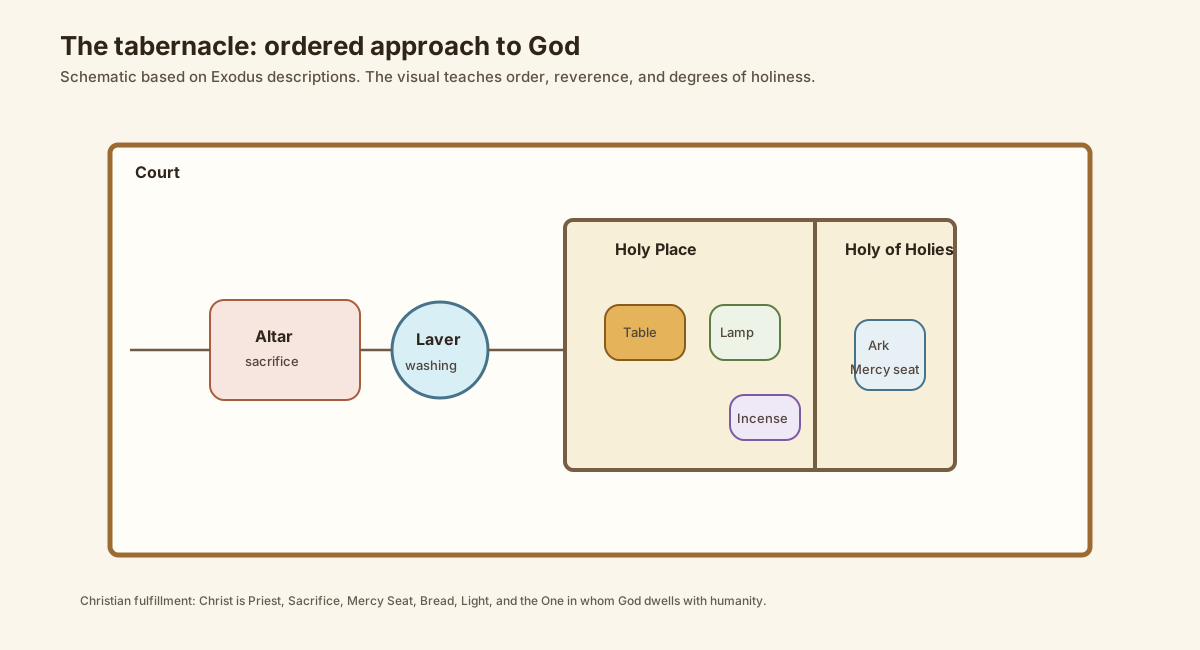 Source: Local project teaching schematic copied from the Exodus asset set. Use as a teaching aid for altar and sanctuary order.
Spiritual Fruit 🍇
Leviticus 6-7 asks: what fire has God entrusted to me, and am I keeping it burning? It asks whether familiarity with holy things has made me reverent or careless. It asks whether thanksgiving is fresh or stale. It asks whether I treat communion as gift or entitlement.
The priest changing garments to remove ashes is a powerful image of humble service. Some work is seen by the congregation. Some is known only to God. But the altar depends on both.
- Handle holy things with reverence after the public act is over.
- Let service continue when no one is watching.
- Receive Communion and ministry as gifts that demand care, not entitlement.
Teacher's Notes
- Why does Leviticus retell the offerings from the priestly side?
- What does the continual altar fire teach about prayer, zeal, and liturgical faithfulness?
- Why are priestly portions better understood as provision for service than as privilege?
- How does Leviticus 7:13 fit with the earlier ban on leaven in altar offerings?
- How can familiarity with holy things become spiritually dangerous?
- What does the thanksgiving offering teach about Eucharistic preparation and joy?
- How does Christ fulfill priestly handling of offerings, not only the offering itself?
Do not rush through the details as boring repetition. The details are the lesson. This unit is ideal for deacons, servants, and anyone responsible for church order. Emphasize stewardship, hidden service, holy boundaries, and thanksgiving. Avoid turning priestly discipline into clericalism. The priest is accountable because he serves holy things; he does not own them.
Be sure to explain the leaven question carefully. Leviticus is not contradicting itself; it is distinguishing altar burning from the broader thanksgiving meal.
Where to linger: the continuing fire, holy portions, priestly eating, thanksgiving, and the leaven distinction. Where to compress: repeated handling rules after the pattern of reverence is clear. Pastoral guardrail: do not let holy service become casual because it is familiar.
Visual teaching: point to altar and holy place on the tabernacle plan. Emphasize that holy handling continues after the offering is brought.
Glossary
- Continual fire: The continual fire is the altar flame that must not be allowed to go out. It teaches the servant to speak of worship as steady faithfulness before God, not occasional religious enthusiasm.
- Most holy portion: The most holy portion is the priestly share of certain offerings, eaten only in a holy place by those appointed to serve. It shows that holy things are received with reverence, boundaries, and responsibility.
- Thanksgiving sacrifice: The thanksgiving sacrifice is a peace offering given in grateful response to God’s mercy. It helps the teacher connect sacrifice with praise, memory, and communion.
- Leavened thanksgiving bread: The leavened bread offered with thanksgiving shows that the worshipper’s ordinary food and household life are brought before God. It is not placed on the altar as incense, but it belongs to the shared sacrificial meal.
- Fat and blood: Fat and blood are reserved to the Lord because life and the choicest portion belong to Him. This distinction trains Israel to receive life as sacred rather than as something to consume carelessly.
- Priestly eating: Priestly eating is the holy reception of portions assigned to the priests from the sacrifices. It teaches that service at the altar includes both privilege and accountability.
Translation and Source Notes
Scripture quotations are from Brenton’s English Septuagint. This guide uses Hebrews’ priesthood and sacrifice fulfillment as Christian reception of the Levitical pattern, not as a claim that every detail of Leviticus 6-7 has direct patristic commentary.
This passage has no established place in the Coptic Orthodox lectionary.
Sources
Primary sources
- Leviticus 6-7 in Brenton’s English Septuagint.
- Hebrews 7, 9, and 10, as New Testament fulfillment passages used in the guide.
- John Chrysostom, Homilies on Hebrews, where the guide discusses Hebrews’ fulfillment of sacrifice, priesthood, sanctuary, blood, or atonement themes.
Secondary academic sources
- Gordon J. Wenham, The Book of Leviticus.
- Jacob Milgrom, Leviticus volumes in the Anchor Yale Bible series.
- Mary Douglas, Leviticus as Literature.
- Jay Sklar, Leviticus.
Coptic Orthodox / pastoral sources
- The Divine Liturgy of St. Basil, for Orthodox language of offering, thanksgiving, altar, priesthood, and communion.
- Local Coptic Orthodox lectionary reference material, used cautiously; no exact Coptic placement is claimed for Leviticus 6-7.