


Leviticus 4-5 moves from gift to purification, confession, and repair. Sin wounds worship and neighbor, so God gives a path that joins blood, confession, restitution, and mercy for the poor.
Leviticus 4-5 moves from offerings of approach and communion to offerings that address sin, guilt, impurity, confession, and restitution. The first three offerings taught how the worshipper draws near with surrender, thanksgiving, and peace. These chapters teach what happens when sin, neglect, uncleanness, false speech, or damage has wounded that communion.
This unit is essential because it refuses to treat sin as only a private feeling. Sin affects the worshipper, the priesthood, the congregation, the neighbor, and the sanctuary. Leviticus 4-5 teaches that forgiveness is not vague. Sin must be named. Confession matters. Restitution matters. Blood matters. Priestly ministry matters. And God provides a way back.
Historical and Scriptural Context
Leviticus 4-5 belongs to the approved Leviticus literary-unit plan. It should be read in light of the whole book’s movement from holy approach, priesthood, purity, atonement, holiness, covenant warning, and truthful dedication.
Geographical Significance ⛰️
The tabernacle, altar, veil, and camp carry the spatial meaning. Sin is not private damage; it touches the worshipping community and must be brought back into ordered communion before God.
The Characters 👥
The Lord instructs Moses, priests handle blood and holy portions, leaders and ordinary Israelites confess guilt, and poor worshippers are explicitly protected by the graded offering.
🕯️ Light from the Word
Leviticus 4
1 And the Lord spoke to Moses, saying, 2 Speak to the children of Israel, saying, If a soul shall sin unwillingly before the Lord, in any of the commandments of the Lord concerning things which he ought not to do, and shall do some of them; 3 if the anointed priest sin so as to cause the people to sin, then shall he bring for his sin, which he has sinned, an unblemished calf of the herd to the Lord for his sin. 4 And he shall bring the calf to the door of the tabernacle of witness before the Lord, and he shall put his hand on the head of the calf before the Lord, and shall slay the calf in the presence of the Lord. 5 And the anointed priest who has been consecrated having received of the blood of the calf, shall then bring it into the tabernacle of witness. 6 And the priest shall dip his finger into the blood, and sprinkle of the blood seven times before the Lord, over against the holy veil. 7 And the priest shall put of the blood of the calf on the horns of the altar of the compound incense which is before the Lord, which is in the tabernacle of witness; and all the blood of the calf shall he pour out by the foot of the altar of whole-burnt-offerings, which is by the doors of the tabernacle of witness. 8 And all the fat of the calf of the sin-offering shall he take off from it; the fat that covers the inwards, and all the fat that is on the inwards, 9 and the two kidneys, and the fat that is upon them, that which is on the thighs, and the caul that is on the liver with the kidneys, them shall he take away, 10 as he takes it away from the calf of the sacrifice of peace-offering, so shall the priest offer it on the altar of burnt-offering. 11 And they shall take the skin of the calf, and all his flesh with the head and the extremities and the belly and the dung, 12 and they shall carry out the whole calf out of the camp into a clean place, where they pour out the ashes, and they shall consume it there on wood with fire: it shall be burnt on the ashes poured out.
13 And if the whole congregation of Israel trespass ignorantly, and a thing should escape the notice of the congregation, and they should do one thing forbidden of any of the commands of the Lord, which ought not to be done, and should transgress: 14 and the sin wherein they have sinned should become known to them, then shall the congregation bring an unblemished calf of the herd for a sin-offering, and they shall bring it to the doors of the tabernacle of witness. 15 And the elders of the congregation shall lay their hands on the head of the calf before the Lord, and they shall slay the calf before the Lord. 16 And the anointed priest shall bring in of the blood of the calf into the tabernacle of witness. 17 And the priest shall dip his finger into some of the blood of the calf, and shall sprinkle it seven times before the Lord, in front of the veil of the sanctuary. 18 And the priest shall put some of the blood on the horns of the altar of the incense of composition, which is before the Lord, which is in the tabernacle of witness; and he shall pour out all the blood at the bottom of the altar of whole-burnt-offerings, which is by the door of the tabernacle of witness. 19 And he shall take away all the fat from it, and shall offer it up on the altar. 20 And he shall do to the calf as he did to the calf of the sin-offering, so shall it be done; and the priest shall make atonement for them, and the trespass shall be forgiven them. 21 And they shall carry forth the calf whole without the camp, and they shall burn the calf as they burnt the former calf: it is the sin-offering of the congregation.
22 And if a ruler sin, and break one of all the commands of the Lord his God, doing the thing which ought not to be done, unwillingly, and shall sin and trespass, 23 and his trespass wherein he has sinned, be known to him, - then shall he offer for his gift a kid of the goats, a male without blemish. 24 And he shall lay his hand on the head of the kid, and they shall kill it in the place where they kill the victims for whole-burnt-offerings before the Lord; it is a sin-offering. 25 And the priest shall put some of the blood of the sin-offering with his finger on the horns of the altar of whole-burnt-offering; and he shall pour out all its blood by the bottom of the altar of whole-burnt-offerings. 26 And he shall offer up all his fat on the altar, as the fat of the sacrifice of peace-offering; and the priest shall make atonement for him concerning his sin, and it shall be forgiven him.
27 And if a soul of the people of the land should sin unwillingly, in doing a thing contrary to any of the commandments of the Lord, which ought not to be done, and shall transgress, 28 and his sin should be known to him, wherein he has sinned, then shall he bring a kid of the goats, a female without blemish shall he bring for his sin, which he has sinned. 29 And he shall lay his hand on the head of his sin-offering, and they shall slay the kid of the sin-offering in the place where they slay the victims for whole-burnt-offerings. 30 And the priest shall take of its blood with his finger, and shall put it on the horns of the altar of whole-burnt-offerings; and all its blood he shall pour forth by the foot of the altar. 31 And he shall take away all the fat, as the fat is taken away from the sacrifice of peace-offering, and the priest shall offer it on the altar for a smell of sweet savour to the Lord; and the priest shall make atonement for him, and his sin shall be forgiven him.
32 And if he should offer a lamb for his sin-offering, he shall offer it a female without blemish. 33 And he shall lay his hand on the head of the sin-offering, and they shall kill it in the place where they kill the victims for whole-burnt-offerings. 34 And the priest shall take of the blood of the sin-offering with his finger, and shall put it on the horns of the altar of whole-burnt-offerings, and he shall pour out all its blood by the bottom of the altar of whole-burnt-offering. 35 And he shall take away all his fat, as the fat of the lamb of the sacrifice of peace-offering is taken away, and the priest shall put it on the altar for a whole-burnt-offering to the Lord; and the priest shall make atonement for him for the sin which he sinned, and it shall be forgiven him.
Lesson Guide
- Key phrases: Leviticus 4.
- Emphasize: Keep the literal sense clear before drawing typology. Show how the command forms worship, holiness, and mercy.
- Avoid: Do not turn the passage into either obsolete ritual detail or free-floating moralism.
Leviticus 5
1 And if a soul sin, and hear the voice of swearing, and he is a witness or has seen or been conscious, if he do not report it, he shall bear his iniquity. 2 That soul which shall touch any unclean thing, or carcase, or that which is unclean being taken of beasts, or the dead bodies of abominable reptiles which are unclean, or carcases of unclean cattle, 3 or should touch the uncleanness of a man, of whatever kind, which he may touch and be defiled by, and it should have escaped him, but afterwards he should know, - then he shall have transgressed. 4 That unrighteous soul, which determines with his lips to do evil or to do good according to whatsoever a man may determine with an oath, and it shall have escaped his notice, and he shall afterwards know it, and so he should sin in some one of these things: - 5 then shall he declare his sin in the things wherein he has sinned by that sin. 6 And he shall bring for his transgressions against the Lord, for his sin which he has sinned, a ewe lamb of the flock, or a kid of the goats, for a sin-offering; and the priest shall make an atonement for him for his sin which he has sinned, and his sin shall be forgiven him. 7 And if he cannot afford a sheep, he shall bring for his sin which he has sinned, two turtle-doves or two young pigeons to the Lord; one for a sin-offering, and the other for a burnt-offering. 8 And he shall bring them to the priest, and the priest shall bring the sin-offering first; and the priest shall pinch off the head from the neck, and shall not divide the body. 9 And he shall sprinkle of the blood of the sin-offering on the side of the altar, but the rest of the blood he shall drop at the foot of the altar, for it is a sin-offering. 10 And he shall make the second a whole-burnt-offering, as it is fit; and the priest shall make atonement for his sin which he has sinned, and it shall be forgiven him.
11 And if he cannot afford a pair of turtle-doves, or two young pigeons, then shall he bring as his gift for his sin, the tenth part of an ephah of fine flour for a sin-offering; he shall not pour oil upon it, nor shall he put frankincense upon it, because it is a sin-offering. 12 And he shall bring it to the priest; and the priest having taken a handful of it, shall lay the memorial of it on the altar of whole-burnt-offerings to the Lord; it is a sin-offering. 13 And the priest shall make atonement for him for his sin, which he has sinned in one of these things, and it shall be forgiven him; and that which is left shall be the priest’s, as an offering of fine flour.
14 And the Lord spoke to Moses, saying, 15 The soul which shall be really unconscious, and shall sin unwillingly in any of the holy things of the Lord, shall even bring to the Lord for his transgression, a ram of the flock without blemish, valued according to shekels of silver according to the shekel of the sanctuary, for his transgression wherein he transgressed. 16 And he shall make compensation for that wherein he has sinned in the holy things; and he shall add the fifth part to it, and give it to the priest; and the priest shall make atonement for him with the ram of transgression, and his sin shall be forgiven him. 17 And the soul which shall sin, and do one thing against any of the commandments of the Lord, which it is not right to do, and has not known it, and shall have transgressed, and shall have contracted guilt, 18 he shall even bring a ram without blemish from the flock, valued at a price of silver for his transgression to the priest; and the priest shall make atonement for his trespass of ignorance, wherein he ignorantly trespassed, and he knew it not; and it shall be forgiven him. 19 For he has surely been guilty of transgression before the Lord.
20 And the Lord spoke to Moses, saying, 21 The soul which shall have sinned, and wilfully overlooked the commandments of the Lord, and shall have dealt falsely in the affairs of his neighbour in the matter of a deposit, or concerning fellowship, or concerning plunder, or has in anything wronged his neighbour, 22 or has found that which was lost, and shall have lied concerning it, and shall have sworn unjustly concerning any one of all the things, whatsoever a man may do, so as to sin hereby; 23 it shall come to pass, whensoever he shall have sinned, and transgressed, that he shall restore the plunder which he has seized, or redress the injury which he has committed, or restore the deposit which was entrusted to him, or the lost article which he has found 24 of any kind, about which he swore unjustly, he shall even restore it in full; and he shall add to it a fifth part besides; he shall restore it to him whose it is in the day in which he happens to be convicted. 25 And he shall bring to the Lord for his trespass, a ram of the flock, without blemish, of value to the amount of the thing in which he trespassed. 26 And the priest shall make atonement for him before the Lord, and he shall be forgiven for any one of all the things which he did and trespassed in it.
Lesson Guide
- Key phrases: Leviticus 5.
- Emphasize: Keep the literal sense clear before drawing typology. Show how the command forms worship, holiness, and mercy.
- Avoid: Do not turn the passage into either obsolete ritual detail or free-floating moralism.
A numbering note for readers using modern English Bibles
If you compare Brenton with many Masoretic-based English Bibles, the end of this guide may look shifted. Brenton keeps the neighbor-restitution case in Leviticus 5:20-26. Many modern Bibles number those same verses as Leviticus 6:1-7. That means Brenton’s Leviticus 6 begins where many readers expect Leviticus 6:8. The content is the same; the chapter division differs.
Lesson Guide
- Key phrases: A numbering note for readers using modern English Bibles.
- Emphasize: Keep the literal sense clear before drawing typology. Show how the command forms worship, holiness, and mercy.
- Avoid: Do not turn the passage into either obsolete ritual detail or free-floating moralism.
The shift from gift to repair
Leviticus 1-3 begins with worship as gift: burnt offering, grain offering, and peace offering. Leviticus 4-5 turns to repair. This sequence is spiritually important. The Bible does not begin the sacrificial system by saying, “You are guilty, so pay.” It begins by saying, “God calls, and you may draw near.” Only after establishing worship as approach does Leviticus address what must happen when sin disrupts that approach.
The sin offering and guilt offering are often difficult for modern readers because the categories do not map perfectly onto later theological vocabulary. In Leviticus, sin can defile, guilt can require reparation, impurity can interrupt access, and ignorance does not make an act harmless. The point is not legal technicality for its own sake. The point is that life before God is real. Worship is not imaginary. Damage must be healed in the way God gives.
Lesson Guide
- Key phrases: The shift from gift to repair.
- Emphasize: Keep the literal sense clear before drawing typology. Show how the command forms worship, holiness, and mercy.
- Avoid: Do not turn the passage into either obsolete ritual detail or free-floating moralism.
Leviticus 4: the “sin offering” as purification offering
Leviticus 4 repeatedly speaks about sin committed unintentionally. This is one of the chapter’s most important pastoral lessons. Not all sin is high-handed rebellion. Some sin arises from ignorance, weakness, negligence, blindness, social confusion, inherited habit, or failure to discern. Yet even unintentional sin still matters. It can still wound communion.
Readers will often hear scholars describe the chapter 4 offering as a purification offering as well as a “sin offering.” That clarification is useful because the rite does more than register guilt. The blood is placed at different points of the sanctuary or altar depending on who has sinned, and the goal is cleansing as well as forgiveness. The offering addresses the pollution sin introduces into the worshipping world. Brenton’s “sin-offering” is not wrong, but it can sound narrower than the chapter itself. Leviticus is teaching that sin stains persons and also defiles the holy environment in which God dwells with His people.
The chapter moves through social levels: the anointed priest, the whole congregation, a ruler, and one from the common people. This structure teaches that responsibility increases with vocation. If the priest sins, the consequence touches the people because the priest stands near the sanctuary and serves publicly. If the congregation sins, the whole body must be restored. If a ruler sins, his office does not make him untouchable. If an ordinary person sins, the way back remains open.
This is deeply relevant for Orthodox ecclesial life. Sin is personal, but never merely individual. The Church is one body. Clergy, leaders, parents, servants, and ordinary believers all affect one another. Leviticus does not let anyone hide behind status, but neither does it close the door of mercy. The offering exists because God desires restoration.
Lesson Guide
- Key phrases: Leviticus 4: the “sin offering” as purification offering.
- Emphasize: Keep the literal sense clear before drawing typology. Show how the command forms worship, holiness, and mercy.
- Avoid: Do not turn the passage into either obsolete ritual detail or free-floating moralism.
The laying on of hands and the seriousness of identification
As in Leviticus 1, the worshipper lays a hand on the animal. In the context of the chapter 4 offering, this gesture carries the weight of identification and confession. The worshipper does not remain abstractly sorry. He comes forward, brings what God commands, and acknowledges that the disorder must be dealt with.
This is not a mechanical transfer that avoids repentance. The rite teaches embodied repentance. In the Church, confession also refuses abstraction. We name sin, receive priestly counsel and absolution, and return to communion not through self-justification but through mercy.
Lesson Guide
- Key phrases: The laying on of hands and the seriousness of identification.
- Emphasize: Keep the literal sense clear before drawing typology. Show how the command forms worship, holiness, and mercy.
- Avoid: Do not turn the passage into either obsolete ritual detail or free-floating moralism.
Blood, altar, and sanctuary
The blood rites differ depending on whose sin is being addressed. When the anointed priest or whole congregation sins, blood is brought into the tabernacle and placed before the veil and on the horns of the altar of incense. When a ruler or common person sins, the blood is applied to the altar of burnt offering. The details teach that sin’s effects are not flat. Some sins pollute more deeply because of public office, priestly nearness, or corporate involvement.
A modern reader may want to skip these details, but Leviticus insists on them. Sin is not only a mood in the sinner. Sin damages the worshipping order. The sanctuary must be cleansed because God dwells among His people. This prepares us for Hebrews, where Christ enters not an earthly sanctuary with repeated blood but the heavenly reality with His own Blood.
St. John Chrysostom, when he preaches on Hebrews, keeps pressing the difference between the repeated Levitical rites and Christ’s definitive offering. Yet that difference only makes sense if the Levitical rites were already teaching something real: sin truly defiles, cleansing is truly needed, and mediation is not optional.
Lesson Guide
- Key phrases: Blood, altar, and sanctuary.
- Emphasize: Keep the literal sense clear before drawing typology. Show how the command forms worship, holiness, and mercy.
- Avoid: Do not turn the passage into either obsolete ritual detail or free-floating moralism.
Leviticus 5: confession, impurity, speech, and the poor person’s offering
Leviticus 5 widens the focus. It includes failure to testify when one has heard an oath, touching uncleanness, rash speech, and sins requiring guilt offering. These examples teach that holiness includes truthfulness, bodily awareness, speech, memory, responsibility, and repair.
The chapter explicitly mentions confession: the sinner shall confess the sin which he has committed. This is a crucial bridge to Orthodox practice. Confession is not a later invention detached from Scripture. Leviticus already shows that sin must be named before God and restored through the means He provides.
The provision for the poor is especially important. Not everyone can bring the same offering. Some bring a female from the flock, others birds, and the poorest may bring fine flour. Mercy is built into the sacrificial system. God does not make restoration impossible for the poor.
Leviticus 5:11-13 deserves special attention because it corrects an oversimplified way of speaking about sacrifice. Blood is central in Leviticus, but not every atoning rite is identical in material form. The poor person’s flour offering is still called a sin offering in Brenton, but it is carefully stripped of oil and frankincense, the festive signs found in the grain offering of chapter 2. It is not a cheerful gift of praise. It is a poverty-marked act of repentance. The priest still makes atonement, and forgiveness is still granted. The lesson is not that blood suddenly stops mattering, but that God’s mercy does not close the door of restoration to the poor.
This matters pastorally. One can speak so strongly about sacrifice that the poor are made invisible. Leviticus does the opposite. The same holy God who requires truthful repentance also makes sure the poor can come back.
Lesson Guide
- Key phrases: Leviticus 5: confession, impurity, speech, and the poor person’s offering.
- Emphasize: Keep the literal sense clear before drawing typology. Show how the command forms worship, holiness, and mercy.
- Avoid: Do not turn the passage into either obsolete ritual detail or free-floating moralism.
Guilt, reparation, and the neighbor
The guilt offering introduces the logic of restitution. Sin is not only feeling bad before God. If holy things have been misused, or a neighbor has been wronged, restoration includes repayment and an added fifth. This is profoundly practical. Repentance must repair what it can.
This is one of the places where Leviticus challenges shallow spirituality. A person may want forgiveness without restitution. Leviticus does not allow that. The worshipper must not use sacrifice to evade justice. In Christian terms, Zacchaeus is a living commentary on this principle: when salvation comes to his house, he restores what he stole. Grace does not make repair unnecessary. Grace makes repair possible.
Lesson Guide
- Key phrases: Guilt, reparation, and the neighbor.
- Emphasize: Keep the literal sense clear before drawing typology. Show how the command forms worship, holiness, and mercy.
- Avoid: Do not turn the passage into either obsolete ritual detail or free-floating moralism.
Christological reading
Christ fulfills the sin and guilt offerings not by making sin trivial but by revealing its full seriousness and bearing it completely. Hebrews teaches that the blood of bulls and goats could not finally take away sins. Yet these offerings were not meaningless. They trained Israel to know that sin requires cleansing, mediation, and costly restoration.
Christ is the true sin-bearer and the true guilt offering. He heals the conscience, cleanses the sanctuary of the heart, restores communion, and makes confession hopeful rather than despairing. He is also the priest who does not stand apart from the sinner in contempt. He enters into our condition without sin and offers Himself for our return.
The provision for the poor also points toward Christ’s mercy. God does not despise the poor worshipper. The small offering, when given according to the command, is received. In the Gospel, the widow’s two mites carry the same spiritual world: God sees the poverty, the faithfulness, and the heart of the offering.
Lesson Guide
- Key phrases: Christological reading.
- Emphasize: Keep the literal sense clear before drawing typology. Show how the command forms worship, holiness, and mercy.
- Avoid: Do not turn the passage into either obsolete ritual detail or free-floating moralism.
The Church’s Voice in Worship
No exact Coptic placement is claimed for this Leviticus unit. The local Coptic Orthodox lectionary reference data has not yielded an exact occurrence for this passage, so this section gives thematic worship resonance rather than a fixed reading claim.
For a Coptic Orthodox study, Leviticus 4-5 naturally connects to confession, absolution, restitution, priestly ministry, and preparation for communion. The connection should be made carefully. Christian confession is not a repetition of Levitical sacrifice. It stands inside Christ’s once-for-all sacrifice. But Leviticus teaches the grammar: sin is named, mediation is received, and communion is restored.
This passage has no established place in the Coptic Orthodox lectionary.
Iconography and Visual Teaching 🖼️
This unit is visually strongest when taught through movement toward the altar and movement back toward the neighbor. A tabernacle plan helps show where blood and offering are brought, while the teacher should verbally stress confession, restitution, and repair. Avoid images that make sin offerings look like spectacle; the chapter is about restored communion and truthful accountability.
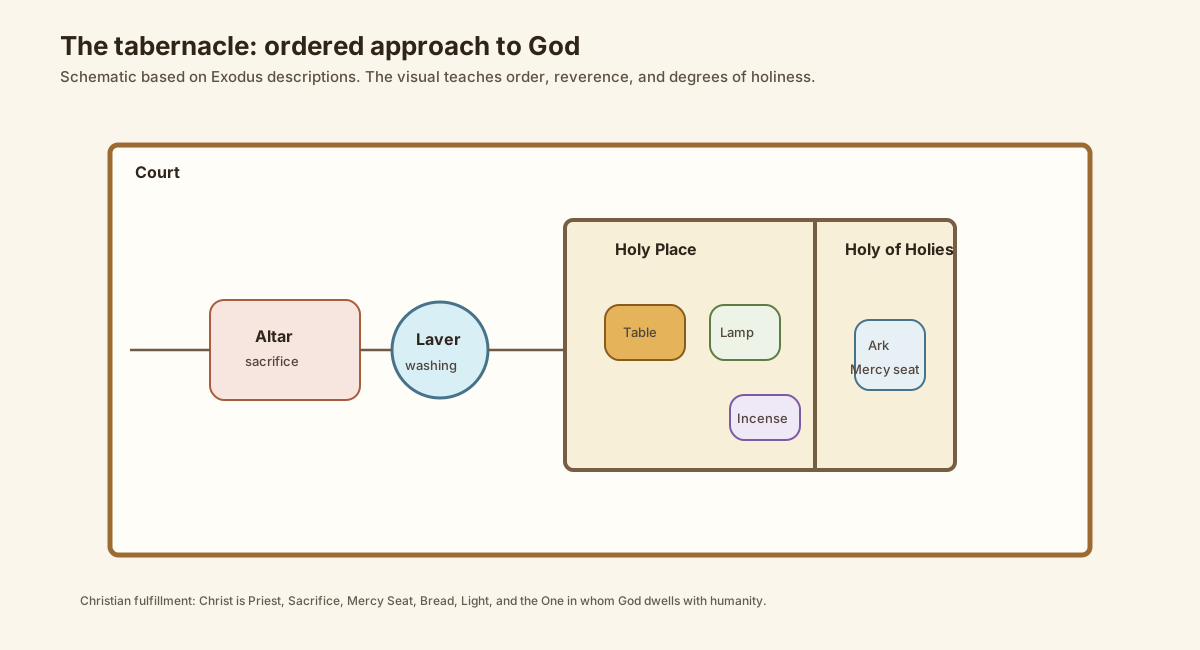 Source: Local project teaching schematic copied from the Exodus asset set. Use as liturgical-space orientation only.
Spiritual Fruit 🍇
Leviticus 4-5 moves from gift to purification, confession, and repair. Sin wounds worship and neighbor, so God gives a path that joins blood, confession, restitution, and mercy for the poor. The spiritual fruit is concrete: bring the whole life before God, receive His holiness with humility, and let the passage correct both casual worship and shallow moralism.
- Name sin honestly, especially when it was unintentional but still harmful.
- Repair what can be repaired; confession and restitution belong together.
- Receive Christ’s mercy as cleansing that sends you back toward your neighbor.
Teacher's Notes
Leviticus 4-5 should not be taught as if every suffering person is guilty of a specific sin. That would be spiritually abusive and biblically careless. The passage deals with sacrificial restoration under the Mosaic covenant, not a simplistic explanation for every affliction.
It should also not be taught as if unintentional sin is “no big deal.” The chapter says the opposite. Ignorance may reduce defiance, but it does not erase damage. Orthodox spirituality preserves both truths: God is merciful toward weakness, and we still ask Him to reveal hidden faults.
Finally, restitution must be taught concretely. If someone has stolen, lied, slandered, damaged, withheld wages, manipulated, or broken trust, repentance includes repair where repair is possible. Prayer without truth is not Levitical, prophetic, or Christian.
- Why does Leviticus treat unintentional sin as still needing atonement?
- How does the chapter’s order of priest, congregation, ruler, and common person teach responsibility?
- Why is “purification offering” a useful way to hear part of Leviticus 4’s logic?
- What is the difference between feeling sorry and confessing sin?
- Why does Leviticus make explicit provision for the poorest worshipper?
- Why does restitution matter when a neighbor has been wronged?
- How does Christ fulfill the sin and guilt offerings without making confession unnecessary?
Teach this unit as restoration, not as ritual bookkeeping. The central pastoral message is that God gives a way back, but the way back is truthful. Avoid vague statements like “the Old Testament was about guilt and the New Testament is about grace.” Leviticus is already full of grace because God provides atonement, confession, and restoration. The New Testament reveals the fullness of that grace in Christ.
Also emphasize the social dimension of sin. Leviticus does not support a privatized spirituality. Priests, leaders, communities, neighbors, and the sanctuary are all affected by sin. That makes confession and reconciliation ecclesial acts, not only personal improvement projects.
Do not skip 5:11-13. The flour offering for the poor is one of the chapter’s most important pastoral texts.
Where to linger: unintentional sin, confession, the poor person’s flour offering, and restitution. Where to compress: repeated animal categories once the graded mercy is clear. Pastoral guardrail: do not turn guilt into shame without hope; teach confession and repair as restoration to communion.
Visual teaching: use the tabernacle plan briefly, then move from altar to restitution. The visual should support confession and repair, not distract into ritual mechanics.
Glossary
- purification offering: The sin offering in Leviticus 4 functions as a purification rite that cleanses both the worshipper and the sanctuary from the defilement sin introduces into the holy space where God dwells with His people.
- guilt offering: The reparation offering in Leviticus 5 addresses sins that damage holy things or neighbor relationships, requiring both atonement through sacrifice and concrete restitution plus a fifth part to the injured party.
- confession: Leviticus 5:5 requires the sinner to declare the specific sin committed, establishing that repentance involves naming the fault before God rather than vague remorse.
- reparation: When a neighbor is wronged or holy things misused, Leviticus requires full restoration of the loss plus an additional fifth, showing that forgiveness does not bypass justice or repair.
- atonement: The priestly act of making reconciliation through blood or offering that restores the broken relationship between the sinner and God, always tied to confession and, where applicable, restitution.
- graded offering: God provides scaled sacrifices according to the worshipper’s means - flock animal, birds, or fine flour - so that the poor are not excluded from the path of repentance and restoration.
Translation and Source Notes
Scripture is from Brenton’s English Septuagint. Patristic citations anchor New Testament fulfillment (Hebrews on sacrifice, priesthood, and sanctuary; relevant Gospel and Pauline passages) rather than direct Leviticus commentary.
Sources
Primary sources
- Leviticus 4-5; Brenton Septuagint; selected New Testament fulfillment passages named in the note.
- John Chrysostom, Homilies on Hebrews, used where the note explicitly names Hebrews fulfillment of sacrifice, priesthood, sanctuary, blood, or atonement themes.
Secondary academic sources
- Gordon J. Wenham, The Book of Leviticus.
- Jacob Milgrom, Leviticus volumes in the Anchor Yale Bible series.
- Mary Douglas, Leviticus as Literature.
- Jay Sklar, Leviticus.
Coptic Orthodox / pastoral sources
- The Divine Liturgy of St. Basil, for Orthodox language of offering, thanksgiving, altar, priesthood, and communion.
- The Coptic Orthodox lectionary references was used cautiously. No exact Coptic placement is claimed for this Leviticus passage.
Web pages and non-academic sources cited
- No online-direct patristic source was added in this pass.