


Leviticus 11-12 teaches discernment through food laws and purification after childbirth. The passage must be read without shame: impurity is not identical to personal guilt, and Christ fulfills the law by healing and sanctifying human life.
Leviticus 11-12 begins the purity section of the book. Chapter 11 teaches Israel to distinguish clean and unclean animals. Chapter 12 addresses purification after childbirth. Together, these chapters move holiness into the embodied details of eating, birth, blood, time, and restored access to worship.
This unit is easy to distort. It should not be taught as if the body is dirty, women are morally guilty for childbirth, or food laws are simply arbitrary religious oddities. Leviticus is teaching Israel discernment around holiness, life, death, order, boundary, and approach to God. Ritual impurity is not the same as personal sin. The mother who gives birth has not committed a moral fault. The Israelite who touches what is unclean is not automatically wicked. The issue is access to holy space in a world marked by mortality.
Historical and Scriptural Context
Leviticus 11-12 belongs to the approved Leviticus literary-unit plan. It should be read in light of the whole book’s movement from holy approach, priesthood, purity, atonement, holiness, covenant warning, and truthful dedication.
Geographical Significance ⛰️
The geography is the boundary between the camp, the home, and the holy place. Israel learns holiness in kitchens, birth, bodies, and communal life, not only at the altar.
The Characters 👥
Israel is trained as a holy people, priests teach discernment, mothers are restored to worship, and the childbearing body is treated with ritual seriousness rather than contempt.
🕯️ Light from the Word
Leviticus 11
1 And the Lord spoke to Moses and Aaron, saying, 2 Speak ye to the sons of Israel, saying, These are the beasts which ye shall eat of all beasts that are upon the earth. 3 Every beast parting the hoof and making divisions of two claws, and chewing the cud among beasts, these ye shall eat. 4 But of these ye shall not eat, of those that chew the cud, and of those that part the hoofs, and divide claws; the camel, because it chews the cud, but does not divide the hoof, this is unclean to you. 5 And the rabbit, because it chews the cud, but does not divide the hoof, this is unclean to you. 6 And the hare, because it does not chew the cud, and does not divide the hoof, this is unclean to you. 7 And the swine, because this animal divides the hoof, and makes claws of the hoof, and it does not chew the cud, is unclean to you. 8 Ye shall not eat of their flesh, and ye shall not touch their carcases; these are unclean to you.
9 And these are what ye shall eat of all that are in the waters: all things that have fins and scales in the waters, and in the seas, and in the brooks, these ye shall eat. 10 And all things which have not fins or scales in the water, or in the seas, and in the brooks, of all which the waters produce, and of every soul living in the water, are an abomination; and they shall be abominations to you. 11 Ye shall not eat of their flesh, and ye shall abhor their carcases. 12 And all things that have not fins or scales of those that are in the waters, these are an abomination to you. 13 And these are the things which ye shall abhor of birds, and they shall not be eaten, they are an abomination: the eagle and the ossifrage, and the sea-eagle. 14 And the vulture, and the kite, and the like to it; 15 and the sparrow, and the owl, and the sea-mew, and the like to it: 16 and every raven, and the birds like it, and the hawk and his like, 17 and the night-raven and the cormorant and the stork, 18 and the red-bill, and pelican, and swan, 19 and the heron, and the lapwing, and the like to it, and the hoopoe and the bat. 20 And all winged creatures that creep, which go upon four feet, are abominations to you. 21 But these ye shall eat of the creeping winged animals, which go upon four feet, which have legs above their feet, to leap with on the earth. 22 And these of them ye shall eat: the caterpillar and his like, and the attacus and his like, and the cantharus and his like, and the locust and his like. 23 Every creeping thing from among the birds, which has four feet, is an abomination to you. 24 And by these ye shall be defiled; every one that touches their carcases shall be unclean till the evening. 25 And every one that takes of their dead bodies shall wash his garments, and shall be unclean till the evening. 26 And whichever among the beasts divides the hoof and makes claws, and does not chew the cud, shall be unclean to you; every one that touches their dead bodies shall be unclean till evening. 27 And every one among all the wild beasts that moves upon its fore feet, which goes on all four, is unclean to you; every one that touches their dead bodies shall be unclean till evening. 28 And he that takes of their dead bodies shall wash his garments, and shall be unclean till evening: these are unclean to you.
29 And these are unclean to you of reptiles upon the earth, the weasel, and the mouse, and the lizard, 30 the ferret, and the chameleon, and the evet, and the newt, and the mole. 31 These are unclean to you of all the reptiles which are on the earth; every one who touches their carcases shall be unclean till evening. 32 And on whatsoever one of their dead bodies shall fall it shall be unclean; whatever wooden vessel, or garment, or skin, or sack it may be, every vessel in which work should be done, shall be dipped in water, and shall be unclean till evening; and then it shall be clean. 33 And every earthen vessel into which one of these things shall fall, whatsoever is inside it, shall be unclean, and it shall be broken. 34 And all food that is eaten, on which water shall come from such a vessel, shall be unclean; and every beverage which is drunk in any such vessel, shall be unclean. 35 And every thing on which there shall fall of their dead bodies shall be unclean; ovens and stands for jars shall be broken down: these are unclean, and they shall be unclean to you. 36 Only if the water be of fountains of water, or a pool, or confluence of water, it shall be clean; but he that touches their carcases shall be unclean. 37 And if one of their carcases should fall upon any sowing seed which shall be sown, it shall be clean. 38 But if water be poured on any seed, and one of their dead bodies fall upon it, it is unclean to you. 39 And if one of the cattle die, which it is lawful for you to eat, he that touches their carcases shall be unclean till evening. 40 And he that eats of their carcases shall wash his garments, and be unclean till evening; and he that carries any of their carcases shall wash his garments, and bathe himself in water, and be unclean till evening. 41 And every reptile that creeps on the earth, this shall be an abomination to you; it shall not be eaten. 42 And every animal that creeps on its belly, and every one that goes on four feet continually, which abounds with feet among all the reptiles creeping upon the earth - ye shall not eat it, for it is an abomination to you. 43 And ye shall not defile your souls with any of the reptiles that creep upon the earth, and ye shall not be polluted with them, and ye shall not be unclean by them. 44 For I am the Lord your God; and ye shall be sanctified, and ye shall be holy, because I the Lord your God am holy; and ye shall not defile your souls with any of the reptiles creeping upon the earth. 45 For I am the Lord who brought you up out of the land of Egypt to be your God; and ye shall be holy, for I the Lord am holy. 46 This is the law concerning beasts and birds and every living creature moving in the water, and every living creature creeping on the earth; 47 to distinguish between the unclean and the clean; and between those that bring forth alive, such as should be eaten, and those that bring forth alive, such as should not be eaten.
Lesson Guide
- Key phrases: Leviticus 11.
- Emphasize: Keep the literal sense clear before drawing typology. Show how the command forms worship, holiness, and mercy.
- Avoid: Do not turn the passage into either obsolete ritual detail or free-floating moralism.
Leviticus 12
1 And the Lord spoke to Moses, saying, 2 Speak to the children of Israel, and thou shalt say to them, Whatsoever woman shall have conceived and born a male child shall be unclean seven days, she shall be unclean according to the days of separation for her monthly courses. 3 And on the eighth day she shall circumcise the flesh of his foreskin. 4 And for thirty-three days she shall continue in her unclean blood; she shall touch nothing holy, and shall not enter the sanctuary, until the days of her purification be fulfilled. 5 But if she should have born a female child, then she shall be unclean twice seven days, according to the time of her monthly courses; and for sixty-six days shall she remain in her unclean blood.
6 And when the days of her purification shall have been fulfilled for a son or a daughter, she shall bring a lamb of a year old without blemish for a whole-burnt-offering, and a young pigeon or turtle-dove for a sin-offering to the door of the tabernacle of witness, to the priest. 7 And he shall present it before the Lord, and the priest shall make atonement for her, and shall purge her from the fountain of her blood; this is the law of her who bears a male or a female. 8 And if she cannot afford a lamb, then shall she take two turtle-doves or two young pigeons, one for a whole-burnt-offering, and one for a sin-offering; and the priest shall make atonement for her, and she shall be purified.
Lesson Guide
- Key phrases: Leviticus 12.
- Emphasize: Keep the literal sense clear before drawing typology. Show how the command forms worship, holiness, and mercy.
- Avoid: Do not turn the passage into either obsolete ritual detail or free-floating moralism.
Clean and unclean as formation in discernment
Leviticus 11 trains Israel to distinguish. The repeated contrast between clean and unclean is not only dietary administration. It forms a people who must learn that not everything is the same before God. Creation has order. Bodies matter. Appetite must be governed. Holiness reaches even the table.
Modern readers often want either a biological explanation or a symbolic explanation. Some animals may indeed have practical associations with disease, scavenging, or boundary-crossing, but Leviticus is doing more than health regulation. The laws train Israel to perceive the world as morally and spiritually ordered. The people who eat differently are reminded daily that they belong to God.
For Christians, Mark 7 and Acts 10 are essential, but they must be read carefully. Acts 10 is not merely a proof-text that food rules disappeared. Peter’s vision serves the inclusion of the Gentiles and the repair of table fellowship in the messianic people. What had marked Israel off from the nations is fulfilled in Christ as Jews and Gentiles are gathered into one body. The Church therefore does not reimpose Leviticus 11 as a covenant boundary marker. Yet the spiritual lesson remains: appetite needs sanctification. A Christian who says, “All foods are clean,” but lives as a slave to appetite has missed the deeper point. In Orthodox practice, fasting continues this pedagogy of discernment. We do not keep Leviticus 11 as Mosaic dietary law, but we do learn that the body must be trained for holiness.
Lesson Guide
- Key phrases: Clean and unclean as formation in discernment.
- Emphasize: Keep the literal sense clear before drawing typology. Show how the command forms worship, holiness, and mercy.
- Avoid: Do not turn the passage into either obsolete ritual detail or free-floating moralism.
Food, identity, and holiness
Food is never only fuel in Scripture. In Genesis, the fall is linked to eating wrongly. In Exodus, Israel is formed by Passover and manna. In Leviticus, eating becomes a daily marker of covenant identity. In the Gospels, Christ feeds, eats with sinners, blesses bread, gives His Body and Blood, and is known in the breaking of bread.
Leviticus 11 therefore prepares a sacramental imagination. What enters the mouth matters. How one receives creation matters. The Christian fulfillment is not a less embodied spirituality; it is a transfigured one. The Eucharist is the great sign that God saves bodies and sanctifies creation.
Lesson Guide
- Key phrases: Food, identity, and holiness.
- Emphasize: Keep the literal sense clear before drawing typology. Show how the command forms worship, holiness, and mercy.
- Avoid: Do not turn the passage into either obsolete ritual detail or free-floating moralism.
The pastoral difficulty of Leviticus 12
Leviticus 12 must be taught with care. Childbirth is not treated as sin. The chapter does not say the mother has done evil. It places birth within the purity system because childbirth involves blood, bodily transition, vulnerability, and the mystery of life emerging in a mortal world.
This distinction matters pastorally. If ritual impurity is confused with moral blame, the chapter becomes cruel. But if ritual impurity is understood as a temporary condition affecting access to holy space, the chapter can be read more honestly. The mother is not rejected by God. She passes through a period and returns with an offering.
The birth of a child is joyful, but in a fallen world it is also surrounded by blood, pain, danger, and mortality. Leviticus does not sentimentalize the body. It brings embodied reality into the presence of God.
Lesson Guide
- Key phrases: The pastoral difficulty of Leviticus 12.
- Emphasize: Keep the literal sense clear before drawing typology. Show how the command forms worship, holiness, and mercy.
- Avoid: Do not turn the passage into either obsolete ritual detail or free-floating moralism.
The doubled period after the birth of a daughter
Leviticus 12:5 gives a doubled period after the birth of a daughter: fourteen days and then sixty-six more. That detail troubles many readers. It should not be explained away, but neither should it be turned into a doctrine that daughters are less valuable than sons. Scripture itself will not support that conclusion.
Several explanations have been proposed. Some see a ritual intensification connected to the chapter’s concern with blood and time. Some connect it with the social and symbolic patterns of the old covenant. Others simply admit that the text does not explain the doubling for us. The safest pastoral conclusion is modesty: the law marks a different ritual duration, but it does not say that giving birth to a girl is a greater moral evil. The mother is not more sinful, and the daughter is not less beloved.
Lesson Guide
- Key phrases: The doubled period after the birth of a daughter.
- Emphasize: Keep the literal sense clear before drawing typology. Show how the command forms worship, holiness, and mercy.
- Avoid: Do not turn the passage into either obsolete ritual detail or free-floating moralism.
Offering after childbirth: purification, not moral blame
Leviticus 12:6-8 says the mother brings a whole-burnt-offering and, in Brenton’s wording, a “sin-offering.” That phrase can mislead modern ears. In this context the offering addresses ritual purification and restored access, not moral guilt for giving birth. Many scholars therefore explain the term here in its ritual function as a purification offering.
That matters greatly in church teaching. The mother is not making atonement because maternity is sinful. She is passing through a rite of cleansing tied to sanctuary holiness. The old covenant taught Israel to tell the truth about birth, blood, life, and mortality without collapsing all of that into personal blame.
Lesson Guide
- Key phrases: Offering after childbirth: purification, not moral blame.
- Emphasize: Keep the literal sense clear before drawing typology. Show how the command forms worship, holiness, and mercy.
- Avoid: Do not turn the passage into either obsolete ritual detail or free-floating moralism.
The Presentation of Christ and the humility of the Theotokos
Luke 2 is the major Christian connection. The Theotokos comes for purification, and Christ is presented in the temple. The sinless Lord and His all-holy Mother submit humbly to the law. This does not mean the Theotokos was morally defiled by bearing Christ. It means the Incarnation enters Israel’s life completely and humbly.
For Orthodox Christians, this is a profound point. Christ does not redeem humanity from a distance. He enters the rhythms of birth, law, temple, offering, poverty, and obedience. The offering of birds in Luke also shows the poverty of the Holy Family. The Lord of glory is presented according to the provision available to the poor.
Lesson Guide
- Key phrases: The Presentation of Christ and the humility of the Theotokos.
- Emphasize: Keep the literal sense clear before drawing typology. Show how the command forms worship, holiness, and mercy.
- Avoid: Do not turn the passage into either obsolete ritual detail or free-floating moralism.
Christological reading
Christ fulfills Leviticus 11-12 by transforming purity from boundary marker into healing communion. He declares foods clean, not because holiness no longer matters, but because the kingdom is no longer guarded by Israel’s dietary boundary. He touches the unclean and is not defiled. He heals the woman with the flow of blood. He receives children. He is presented in the temple under the law and fulfills the law from within.
The old system taught distinction from uncleanness. Christ reveals a holiness stronger than uncleanness. In Him, purity is not fragile avoidance only; it becomes victorious healing.
Lesson Guide
- Key phrases: Christological reading.
- Emphasize: Keep the literal sense clear before drawing typology. Show how the command forms worship, holiness, and mercy.
- Avoid: Do not turn the passage into either obsolete ritual detail or free-floating moralism.
Source and Translation Notes
- Scripture text: Brenton English Septuagint.
- Brenton’s wording in Leviticus 12 uses “sin-offering” or “sin offering,” but the offering’s function here is purification after childbirth, not moral blame for motherhood.
- Main biblical cross-references: Mark 7; Acts 10-11; Luke 2:22-24; Luke 8:43-48; Romans 14; 1 Timothy 4:4-5.
- Teaching emphasis: Acts 10 should be read in connection with Gentile inclusion and restored table fellowship, not merely as a slogan for appetite without discipline.
Lesson guide
- Key phrases: Source and translation notes.
- Emphasize: Keep the literal sense clear before drawing typology. Show how the command forms worship, holiness, and mercy.
- Avoid: Do not turn the passage into either obsolete ritual detail or free-floating moralism.
The Church’s Voice in Worship
No exact Coptic placement is claimed for this Leviticus unit. The local Coptic Orthodox lectionary reference data has not yielded an exact occurrence for this passage, so this section gives thematic worship resonance rather than a fixed reading claim.
Rather than tying this lesson to a specific local lectionary claim, it is better to teach the clear thematic links: these chapters stand naturally beside Orthodox fasting, bodily discipline, the blessing of mothers and children, and above all the Presentation of Christ and the humility of the Theotokos.
Coptic spirituality should not treat the body as an enemy. The body fasts, bows, receives baptism, is anointed, eats the Eucharist, and will rise. Leviticus 11-12 helps us teach that holiness is embodied without becoming body-hating.
Iconography and Visual Teaching 🖼️
For clean and unclean laws, visuals should be modest and conceptual. The camp-around-tabernacle schematic is useful because it shows that purity laws protect life around God’s dwelling. Do not use humiliating or sensational images of childbirth, food, or bodily impurity. The point is restoration to worship, not disgust.
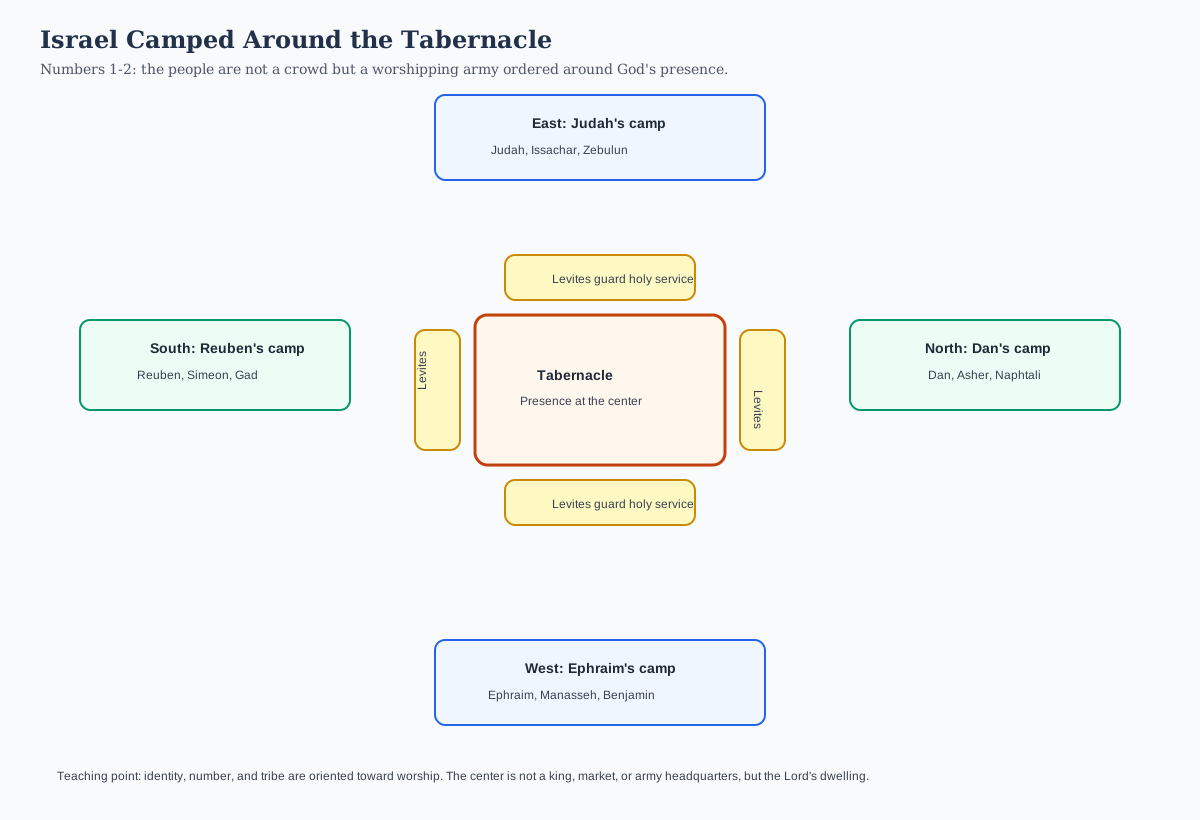 Source: Local project teaching schematic copied from the Numbers asset set. Schematic only; use to show holiness ordered around God’s presence.
Spiritual Fruit 🍇
This unit asks whether I let God teach my appetite, my body, and my ordinary habits. It also asks whether I confuse weakness, bodily processes, or vulnerability with moral failure. God is holy, but He is not cruel. He teaches His people to draw near truthfully.
A class on this passage should help people repent of two opposite errors. The first error is lawlessness: the assumption that because Christians are not under the Mosaic food laws, the body no longer needs discipline. That is not Orthodox Christianity. The Church fasts because appetite can either rule the person or be offered to God. The fast is not a return to Leviticus 11 as covenant law, but it preserves the deeper training: the mouth, stomach, will, and heart are connected.
The second error is shame: the assumption that bodily processes, childbirth, weakness, bleeding, illness, or poverty make a person spiritually inferior. Leviticus must not be used that way. Ritual impurity regulated access to sanctuary under the old covenant; it was not a ranking of human worth. Christ exposes this clearly in the Gospels. He does not recoil from embodied weakness. He touches, heals, blesses, receives, and restores.
This is why Leviticus 12 must be read beside the Presentation of Christ. The Theotokos, who bore God the Word in her womb, humbly enters the rhythm of the law. The Lord submits to the law as an infant. The offering of the poor is accepted. The scene is not about humiliation, but about divine humility entering the real conditions of Israel’s worship and human bodily life.
For Coptic Orthodox teaching, this passage can also open a practical conversation about how the Church blesses homes, children, mothers, food, water, oil, and bodies. Orthodox faith does not escape material life. It heals and consecrates it. The lesson is not “food laws are gone, so matter does not matter.” The lesson is that in Christ, matter is brought into a deeper holiness.
- Refuse disgust toward bodies while still taking holiness seriously.
- Let daily habits, food, birth, and weakness become places of gratitude and restoration.
- See Christ’s cleansing mercy without mocking the old forms God used to teach Israel.
Teacher's Notes
- Why does Leviticus teach holiness through food?
- How do Mark 7 and Acts 10 change Christian practice without making bodily discipline irrelevant?
- Why is ritual impurity not the same as personal sin?
- How should Christians speak about the doubled purification period after the birth of a daughter without turning it into a claim about lesser worth?
- How does Luke 2 help Christians read Leviticus 12?
- How can Orthodox fasting preserve the spiritual lesson of discernment without returning to Mosaic dietary law?
Be explicit: childbirth is not moral guilt. Do not let the class leave with the idea that women are spiritually inferior or that bodies are dirty. Teach the distinction between ritual impurity and sin. Explain that Brenton’s “sin-offering” in Leviticus 12 can sound harsher in English than the ritual function actually requires. Then show how Christ fulfills purity by healing and sanctifying embodied life.
Where to linger: the difference between ritual impurity and moral guilt, and the pastoral care needed around childbirth and bodily weakness. Where to compress: food categories once the point of holy discernment is clear. Pastoral guardrail: never imply that women, bodies, birth, or illness are dirty in a moral sense.
Visual teaching: use the camp schematic to show restoration to worship and community. Avoid visuals that shame childbirth, diet, or bodily weakness.
Glossary
- clean and unclean: Ritual categories that mark what may approach holy space versus what carries the sign of death or disorder. These are not moral judgments on the person but temporary states requiring restoration before entering God’s presence.
- purification: The ritual process restoring a person to full worship participation after contact with birth, blood, or mortality; it anticipates Christ’s work of healing and sanctification.
- childbirth offering: The prescribed sacrifice acknowledging God’s gift of life and restoring the mother’s access to the sanctuary after the flow of blood; fulfilled in the Presentation of Christ.
- discernment: The cultivated ability to distinguish holy from common, life from death, and order from disorder so that Israel may live as a people set apart for God.
- Presentation of Christ: The event in Luke 2 where Mary and Joseph bring the infant Jesus to the temple, fulfilling the purification law while revealing the true Lamb who sanctifies all.
- ritual impurity: A temporary condition arising from contact with mortality, blood, or birth that bars access to holy space until purification restores the person; distinct from personal sin.
Translation and Source Notes
Sources
Primary sources
- Leviticus 11-12; Brenton Septuagint; selected New Testament fulfillment passages named in the note.
- Local patristic corpus queries for the Leviticus unit, recorded in the Translation and Source Notes section.
- John Chrysostom, Homilies on Hebrews, used where the note explicitly names Hebrews fulfillment of sacrifice, priesthood, sanctuary, blood, or atonement themes.
Secondary academic sources
- Gordon J. Wenham, The Book of Leviticus.
- Jacob Milgrom, Leviticus volumes in the Anchor Yale Bible series.
- Mary Douglas, Leviticus as Literature.
- Jay Sklar, Leviticus.
Coptic Orthodox / pastoral sources
- The Divine Liturgy of St. Basil, for Orthodox language of offering, thanksgiving, altar, priesthood, and communion.
- The Coptic Orthodox lectionary references was used cautiously. No exact Coptic placement is claimed for this Leviticus passage.
Web pages and non-academic sources cited
- No online-direct patristic source was added in this first-draft pass. The later audit pass should add direct URLs for any online sources it verifies.