


Leviticus opens worship with gift, surrender, and communion before it speaks at length about sin and repair. Burnt, grain, and peace offerings teach the people how the whole life, ordinary labor, and restored fellowship are offered to God and fulfilled in Christ.
Leviticus opens with three foundational offerings: the burnt offering, the grain offering, and the peace offering. These chapters teach the basic grammar of worship before moving into sin and guilt offerings. The movement is important. The first word is not punishment. The first word is approach: the holy God calls, and the worshipper comes near with an offering.
Leviticus 1-3 must not be reduced to “animal sacrifice before Jesus.” These chapters teach Israel how communion with God is embodied: through gift, surrender, mediation, blood, fire, thanksgiving, grain, oil, frankincense, salt, and shared peace. In Christ, these signs are fulfilled, but their spiritual meaning is not erased. The burnt offering teaches total self-offering. The grain offering teaches consecrated labor and thanksgiving. The peace offering teaches communion, fellowship, thanksgiving, vow, and joy before God.
Historical and Scriptural Context
The opening line matters: “And the Lord called Moses.” Leviticus begins from the tabernacle after the glory of the Lord filled it at the end of Exodus. The people are no longer merely escaping Egypt. God now dwells in their midst. The question is no longer only, “How will we be freed?” It is, “How shall we live near the Holy One?”
Leviticus 1-7 presents offerings twice. Chapters 1-5 describe them primarily from the worshipper’s side: what is brought and why. Chapters 6-7 revisit them from the priestly side: how the priests handle holy things. That means Leviticus 1-3 are the first layer of sacrificial theology. They show worship as voluntary approach, ordered gift, and communion with God.
The Hebrew word often translated “offering,” qorban, is connected with drawing near. The point is not that God needs food or blood. The point is that the worshipper cannot approach casually. God graciously provides a way to come near. The offering becomes a visible confession: my life belongs to God; my labor belongs to God; my peace comes from God.
Geographical Significance ⛰️
The main spatial world is the tabernacle of witness and its altar. The movement is not a journey across land, but a movement of approach from the camp to the holy place God has opened.
The Characters 👥
The Lord calls from the tabernacle, Moses receives the instruction, Aaron’s sons serve at the altar, and the worshipper comes near with a gift. The animals and grain are not characters, but they become sacramental signs of life, labor, thanksgiving, and peace offered to God.
🕯️ Light from the Word
Leviticus 1
1 And the Lord called Moses again and spoke to him out of the tabernacle of witness, saying, Speak to the children of Israel, and thou shalt say to them, 2 If any man of you shall bring gifts to the Lord, ye shall bring your gifts of the cattle and of the oxen and of the sheep. 3 If his gift be a whole-burnt-offering, he shall bring an unblemished male of the herd to the door of the tabernacle of witness, he shall bring it as acceptable before the Lord. 4 And he shall lay his hand on the head of the burnt-offering as a thing acceptable for him, to make atonement for him. 5 And they shall slay the calf before the Lord; and the sons of Aaron the priests shall bring the blood, and they shall pour the blood round about on the altar, which is at the doors of the tabernacle of witness. 6 And having flayed the whole burnt-offering, they shall divide it by its limbs. 7 And the sons of Aaron the priests shall put fire on the altar, and shall pile wood on the fire. 8 And the sons of Aaron the priests shall pile up the divided parts, and the head, and the fat on the wood on the fire, the wood which is on the altar. 9 And the entrails and the feet they shall wash in water, and the priests shall put all on the altar: it is a burnt-offering, a sacrifice, a smell of sweet savour to the Lord. 10 And if his gift be of the sheep to the Lord, or of the lambs, or of the kids for whole-burnt-offerings, he shall bring it a male without blemish. 11 And he shall lay his hand on its head; and they shall kill it by the side of the altar, toward the north before the Lord, and the sons of Aaron the priests shall pour its blood on the altar round about. 12 And they shall divide it by its limbs, and its head and its fat, and the priests shall pile them up on the wood which is on the fire, on the altar. 13 And they shall wash the entrails and the feet with water, and the priest shall bring all the parts and put them on the altar: it is a burnt-offering, a sacrifice, a smell of sweet savour to the Lord. 14 And if he bring his gift, a burnt-offering to the Lord, of birds, then shall he bring his gift of doves or pigeons. 15 And the priest shall bring it to the altar, and shall wring off its head; and the priest shall put it on the altar, and shall wring out the blood at the bottom of the altar. 16 And he shall take away the crop with the feathers, and shall cast it forth by the altar toward the east to the place of the ashes. 17 And he shall break it off from the wings and shall not separate it, and the priest shall put it on the altar on the wood which is on the fire: it is a burnt-offering, a sacrifice, a sweet-smelling savour to the Lord.
Lesson Guide
- Key phrases: Leviticus 1.
- Emphasize: Keep the literal sense clear before drawing typology. Show how the command forms worship, holiness, and mercy.
- Avoid: Do not turn the passage into either obsolete ritual detail or free-floating moralism.
Leviticus 2
1 And if a soul bring a gift, a sacrifice to the Lord, his gift shall be fine flour; and he shall pour oil upon it, and shall put frankincense on it: it is a sacrifice. 2 And he shall bring it to the priests the sons of Aaron: and having taken from it a handful of the fine flour with the oil, and all its frankincense, then the priest shall put the memorial of it on the altar: it is a sacrifice, an odour of sweet savour to the Lord. 3 And the remainder of the sacrifice shall be for Aaron and his sons, a most holy portion from the sacrifices of the Lord. 4 And if he bring as a gift a sacrifice baked from the oven, a gift to the Lord of fine flour, he shall bring unleavened bread kneaded with oil, and unleavened cakes anointed with oil. 5 And if thy gift be a sacrifice from a pan, it is fine flour mingled with oil, unleavened offerings. 6 And thou shalt break them into fragments and pour oil upon them: it is a sacrifice to the Lord. 7 And if thy gift be a sacrifice from the hearth, it shall be made of fine flour with oil. 8 And he shall offer the sacrifice which he shall make of these to the Lord, and shall bring it to the priest. 9 And the priest shall approach the altar, and shall take away from the sacrifice a memorial of it, and the priest shall place it on the altar: a burnt offering, a smell of sweet savour to the Lord. 10 And that which is left of the sacrifice shall be for Aaron and his sons, most holy from the burnt-offerings of the Lord. 11 Ye shall not leaven any sacrifice which ye shall bring to the Lord; for as to any leaven, or any honey, ye shall not bring of it to offer a gift to the Lord. 12 Ye shall bring them in the way of fruits to the Lord, but they shall not be offered on the altar for a sweet-smelling savour to the Lord. 13 And every gift of your sacrifice shall be seasoned with salt; omit not the salt of the covenant of the Lord from your sacrifices: on every gift of yours ye shall offer salt to the Lord your God. 14 And if thou wouldest offer a sacrifice of first-fruits to the Lord, it shall be new grains ground and roasted for the Lord; so shalt thou bring the sacrifice of the first-fruits. 15 And thou shalt pour oil upon it, and shalt put frankincense on it: it is a sacrifice. 16 And the priest shall offer the memorial of it taken from the grains with the oil, and all its frankincense: it is a burnt-offering to the Lord.
Lesson Guide
- Key phrases: Leviticus 2.
- Emphasize: Keep the literal sense clear before drawing typology. Show how the command forms worship, holiness, and mercy.
- Avoid: Do not turn the passage into either obsolete ritual detail or free-floating moralism.
Leviticus 3
1 And if his gift to the Lord be a peace-offering, if he should bring it of the oxen, whether it be male or whether it be female, he shall bring it unblemished before the Lord. 2 And he shall lay his hands on the head of the gift, and shall slay it before the Lord, by the doors of the tabernacle of witness. And the priests the sons of Aaron shall pour the blood on the altar of burnt-offerings round about. 3 And they shall bring of the peace-offering a burnt-sacrifice to the Lord, the fat covering the belly, and all the fat on the belly. 4 And the two kidneys and the fat that is upon them; he shall take away that which is on the thighs, and the caul above the liver together with the kidneys. 5 And the priests the sons of Aaron shall offer them on the altar on the burnt-offering, on the wood which is on the fire upon the altar: it is a burnt-offering, a smell of sweet savour to the Lord. 6 And if his gift be of the sheep, a peace-offering to the Lord, male or female, he shall bring it unblemished. 7 If he bring a lamb for his gift, he shall bring it before the Lord. 8 And he shall lay his hands on the head of his offering, and shall slay it by the doors of the tabernacle of witness; and the priests the sons of Aaron shall pour out the blood on the altar round about. 9 And he shall bring of the peace-offering a burnt-sacrifice to the Lord: the fat and the hinder part unblemished he shall take away with the loins, and having taken away all the fat that covers the belly, and all the fat that is on the belly, 10 and both the kidneys and the fat that is upon them, and that which is on the thighs, and the caul which is on the liver with the kidneys, 11 the priest shall offer these on the altar: it is a sacrifice of sweet savour, a burnt-offering to the Lord.
12 And if his offering be of the goats, then shall he bring it before the Lord. 13 And he shall lay his hands on its head; and they shall slay it before the Lord by the doors of the tabernacle of witness; and the priests the sons of Aaron shall pour out the blood on the altar round about. 14 And he shall offer of it a burnt-offering to the Lord, even the fat that covers the belly, and all the fat that is on the belly. 15 And both the kidneys, and all the fat that is upon them, that which is upon the thighs, and the caul of the liver with the kidneys, shall he take away. 16 And the priest shall offer it upon the altar: it is a burnt-offering, a smell of sweet savour to the Lord. All the fat belongs to the Lord. 17 It is a perpetual statute throughout your generations, in all your habitations; ye shall eat no fat and no blood.
Lesson Guide
- Key phrases: Leviticus 3.
- Emphasize: Keep the literal sense clear before drawing typology. Show how the command forms worship, holiness, and mercy.
- Avoid: Do not turn the passage into either obsolete ritual detail or free-floating moralism.
Leviticus 1: the burnt offering
The burnt offering is the offering of ascent. Brenton’s wording whole-burnt-offering is especially helpful here. It keeps before the reader what can disappear in shorter English phrasing: the victim is not partly retained but wholly given up to God in fire. The whole life ascends. The worshipper lays his hand upon the head of the animal. This gesture is not magic. It identifies the worshipper with the gift. The animal represents a life offered before God, and the worshipper confesses that he comes not as owner of himself but as one whose life must be given back.
The repeated phrase in Brenton, “a smell of sweet savour to the Lord,” must be read carefully. God is not physically fed by smoke. The language is relational and covenantal. The offering rises, and God receives the worshipper’s obedient approach. In Orthodox language, this helps us understand why worship is not merely mental. Prayer rises like incense. Bread and wine are offered. Bodies bow. Hands are lifted. Fire, fragrance, bread, oil, and movement all become part of a sanctified language of communion.
Christ fulfills the burnt offering as the One who offers Himself wholly to the Father. He is not dragged unwillingly to the altar. He gives Himself freely. The Cross is the complete self-offering of the Son in love, obedience, and priestly sacrifice. For the Christian, the response is Romans 12: to present the body as a living sacrifice. This is not a metaphor for vague sincerity. It means that worship must become embodied obedience.
Lesson Guide
- Key phrases: Leviticus 1: the burnt offering.
- Emphasize: Keep the literal sense clear before drawing typology. Show how the command forms worship, holiness, and mercy.
- Avoid: Do not turn the passage into either obsolete ritual detail or free-floating moralism.
Leviticus 2: the grain offering
The grain offering is bloodless, but not casual. It includes fine flour, oil, frankincense, and salt. It excludes leaven and honey from altar burning. A memorial portion is burned to God, and the remainder belongs to the priests as most holy.
This offering teaches that not only crisis and sin come before God. Ordinary labor comes before Him. Flour is cultivated, harvested, ground, prepared, and offered. Oil evokes gladness, healing, anointing, and richness. Frankincense evokes prayer and holy fragrance. Salt evokes covenant permanence and preservation. Leviticus 2 therefore teaches the sanctification of daily work.
The absence of leaven and honey from the altar offering should not be over-allegorized. The text itself already gives an important restraint: these things are not absolutely evil, because Brenton 2:12 says they may be brought as first-fruits. The point is more exact. Not everything that is good in ordinary life is suitable for altar burning in the same way. Worship is received and ordered by God. The altar is not the place for the worshipper to improvise sweetness, luxury, or fermentation on his own terms.
This is especially important for an Orthodox study. A false spirituality despises ordinary labor and looks only for dramatic religious experiences. Leviticus does the opposite. It takes flour, oil, salt, and fire and teaches that the daily life of the people can be offered to God. The Christian fulfillment is not less concrete. In the Eucharist, bread and wine, fruits of creation and human labor, are offered and become the sacramental communion of Christ’s Body and Blood.
Lesson Guide
- Key phrases: Leviticus 2: the grain offering.
- Emphasize: Keep the literal sense clear before drawing typology. Show how the command forms worship, holiness, and mercy.
- Avoid: Do not turn the passage into either obsolete ritual detail or free-floating moralism.
Leviticus 3: the peace offering
The peace offering, often called a fellowship, communion, or well-being offering, adds a dimension not explicit in the burnt offering. It is an offering of peace, thanksgiving, vow, and shared joy. Leviticus 3 introduces the category; Leviticus 7 will widen its practical forms. Portions are burned to God, blood is handled with reverence, and the meal dimension becomes clearer in the later priestly instructions.
The word “peace” points beyond the absence of conflict. Biblically, peace means wholeness, restored order, covenant fellowship, and life rightly arranged before God. The peace offering teaches that salvation is not only forgiveness from guilt. It is restored communion. “Fellowship offering” brings out the shared meal dimension; “well-being offering” emphasizes restored life; “peace offering” preserves the larger covenant horizon. In Orthodox teaching, these meanings should be held together rather than played against one another.
This chapter has deep Eucharistic resonance, but it should be handled with care. The Eucharist is not simply one more peace offering. Christ fulfills the sacrificial system once for all. Yet the peace offering helps us understand why thanksgiving, communion, sacrifice, and meal belong together. The Church does not gather only to hear ideas. She gathers to offer, give thanks, receive, and become one body in Christ.
Lesson Guide
- Key phrases: Leviticus 3: the peace offering.
- Emphasize: Keep the literal sense clear before drawing typology. Show how the command forms worship, holiness, and mercy.
- Avoid: Do not turn the passage into either obsolete ritual detail or free-floating moralism.
LXX and translation observations
The Brenton Septuagint regularly uses language of offering, altar, sacrifice, and “sweet savour.” In Greek tradition, this vocabulary shaped Christian liturgical and theological language. The phrase whole-burnt-offering keeps the emphasis on totality. It is not a partial religious gesture. The whole life ascends to God.
Brenton’s tabernacle of witness is also worth hearing. The sanctuary is not only a tent of meeting; it is a place where God’s dwelling bears witness before Israel. That wording heightens the public and covenantal character of sacrifice. Worship happens before the God who reveals Himself, not before an anonymous sacred mechanism.
When comparing English translations, some will distinguish “peace offering,” “fellowship offering,” or “well-being offering.” Each captures something true. Readers should not be alarmed by the variation. The underlying sacrificial logic remains the same, and the guide will note when a translation choice affects the theological emphasis.
Lesson Guide
- Key phrases: LXX and translation observations.
- Emphasize: Keep the literal sense clear before drawing typology. Show how the command forms worship, holiness, and mercy.
- Avoid: Do not turn the passage into either obsolete ritual detail or free-floating moralism.
Christological and Orthodox reading
Christ is the fulfillment of all three offerings, but in distinct ways.
As whole-burnt-offering, He offers Himself wholly to the Father in loving obedience. As grain offering, He receives and sanctifies human life, labor, bread, oil, and thanksgiving. As peace offering, He is our peace and makes communion possible. He does not only remove a legal obstacle. He heals the relationship and gathers a people into shared life.
Hebrews is essential here. The repeated sacrifices of the law were shadows and preparations. They could teach, cleanse ritually, and sustain covenant worship, but they could not perfect the conscience or open final access to God. Christ’s sacrifice is once-for-all. That does not make Leviticus meaningless. It reveals what Leviticus was always training the people to desire: true access, true cleansing, true communion.
Lesson Guide
- Key phrases: Christological and Orthodox reading.
- Emphasize: Keep the literal sense clear before drawing typology. Show how the command forms worship, holiness, and mercy.
- Avoid: Do not turn the passage into either obsolete ritual detail or free-floating moralism.
The Church’s Voice in Worship
No exact Coptic placement is claimed for this Leviticus unit. The local Coptic Orthodox lectionary reference data has not yielded an exact occurrence for this passage, so this section gives thematic worship resonance rather than a fixed reading claim.
This passage has no established place in the Coptic Orthodox lectionary.
The thematic connection, however, is strong. Leviticus 1-3 supplies the sacrificial language that stands behind Christian worship: altar, offering, fire, fragrance, priesthood, thanksgiving, and communion. In the Coptic Liturgy, the Church offers bread and wine, incense rises, priests serve at the altar, and the people participate in thanksgiving. The fulfillment is Christ, not a repetition of animal sacrifice. But the grammar of reverent offering is deeply Levitical.
The grain offering especially helps explain why material creation is not rejected. Bread, wine, oil, incense, water, vestments, candles, and bodies at prayer all matter. The peace offering helps explain why Eucharistic communion is not private spirituality. It is restored fellowship in the one sacrifice of Christ.
Iconography and Visual Teaching 🖼️
For Leviticus 1-3, the best visual support is not graphic sacrifice but ordered approach: altar, court, tabernacle, and communion with God. The schematic below helps readers see that offerings are brought to the doorway God appoints. The point is not ritual curiosity; it is surrender, thanksgiving, fellowship, and atonement before the Lord.
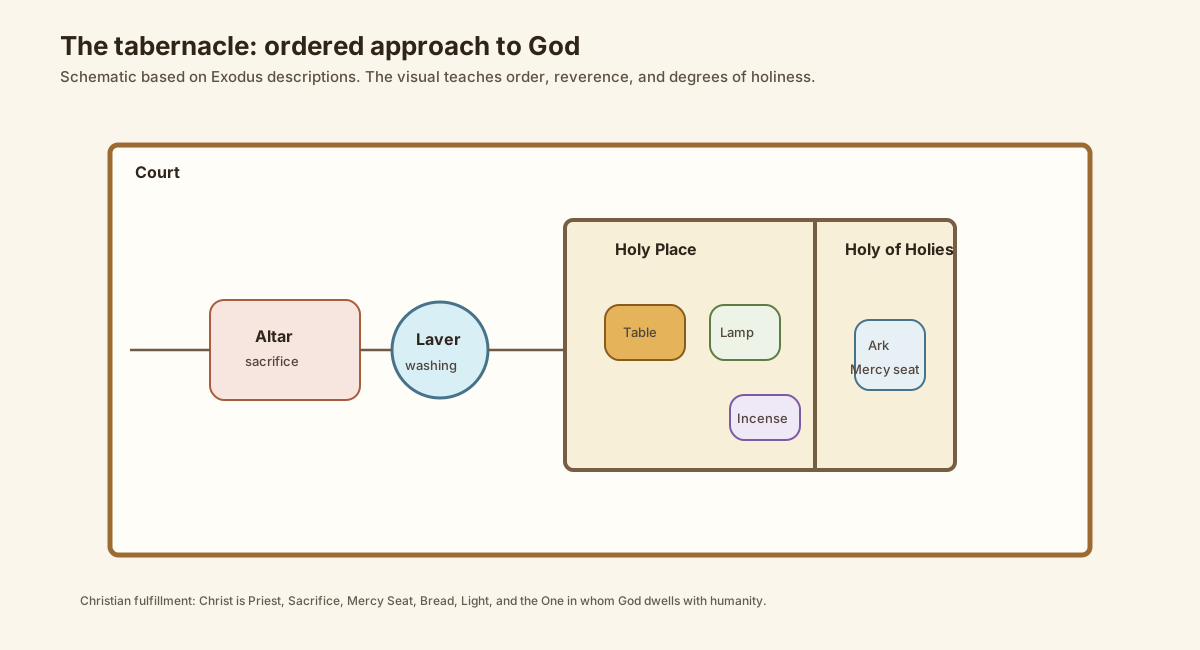 Source: Local project teaching schematic copied from the Exodus asset set. Schematic only; not archaeological reconstruction.
The public-domain tabernacle illustration in the Resources gallery may also help a class picture wilderness worship, but it should be labeled as historical illustration, not Orthodox iconography.
Spiritual Fruit 🍇
A shallow reading asks, “Which of these rules still apply?” A better Orthodox reading asks, “What kind of person is God forming?” Leviticus 1-3 forms a person who knows that life belongs to God, work belongs to God, and peace comes from God.
The burnt offering asks whether anything is being withheld. The grain offering asks whether ordinary work is offered or merely consumed. The peace offering asks whether worship has become communion or only obligation.
- Bring God the whole self, not leftovers disguised as devotion.
- Let thanksgiving include work, bread, oil, and fellowship, not only inward feeling.
- Seek peace with God as communion, not merely relief from guilt.
Teacher's Notes
- Why does Leviticus begin with offerings of approach before dealing at length with sin and impurity?
- What does the laying on of hands teach about identification, offering, and responsibility?
- How does the grain offering change the way we think about ordinary labor?
- Why are leaven and honey restricted on the altar while salt is required?
- What is the difference between forgiveness and restored communion?
- How does Christ fulfill these offerings without making their spiritual grammar irrelevant?
Do not teach Leviticus 1-3 as a crude system of appeasing an angry deity. Teach it as God’s gracious instruction for approach, consecration, and communion. Also avoid collapsing all offerings into one generic “Jesus died for us” category. The distinctions matter. Burnt, grain, and peace offerings each reveal a different facet of life with God.
Give readers permission to notice Brenton’s wording. Whole-burnt-offering is not a trivial stylistic quirk, and the leaven/honey restriction should not be moralized simplistically. These details are part of the chapter’s theology.
Where to linger: the differences between whole-burnt, grain, and peace offerings, because each teaches a distinct dimension of approach to God. Where to compress: repeated sacrificial mechanics once the movement to the altar is clear. Pastoral guardrail: do not make sacrifice sound like manipulation of God; teach surrender, thanksgiving, communion, and mercy.
Visual teaching: show the tabernacle plan while explaining the doorway, altar, and movement of approach. Keep the focus on surrender, thanksgiving, and communion.
Glossary
- Whole-burnt-offering (olah): The whole-burnt-offering is the sacrifice wholly consumed on the altar, expressing total surrender and consecration to God. It helps the teacher show that worship is not a token gift but the offering of the whole life to the Lord.
- Grain offering (minchah): The grain offering consecrates the fruit of ordinary labor through fine flour, oil, and frankincense. It teaches gratitude, daily faithfulness, and the sanctification of work before God.
- Peace offering (shelamim): The peace offering is a communion sacrifice shared before God in thanksgiving, vow, or freewill joy. It prepares the teacher to connect sacrifice with reconciled fellowship, not only with guilt or fear.
Translation and Source Notes
Scripture quotations are from Brenton’s English Septuagint. This guide uses New Testament fulfillment language, especially Hebrews and Pauline themes of self-offering, thanksgiving, and communion, as Christian reception of Leviticus rather than as verse-by-verse patristic commentary on Leviticus 1-3.
This passage has no established place in the Coptic Orthodox lectionary.
Sources
Primary sources
- Leviticus 1-3 in Brenton’s English Septuagint.
- Hebrews 10:5-10; Romans 12:1; Ephesians 2:14-18, as New Testament fulfillment and pastoral application passages used in the guide.
- John Chrysostom, Homilies on Hebrews, where the guide discusses Hebrews’ fulfillment of sacrifice, priesthood, sanctuary, blood, or atonement themes.
Secondary academic sources
- Gordon J. Wenham, The Book of Leviticus.
- Jacob Milgrom, Leviticus volumes in the Anchor Yale Bible series.
- Mary Douglas, Leviticus as Literature.
- Jay Sklar, Leviticus.
Coptic Orthodox / pastoral sources
- The Divine Liturgy of St. Basil, for Orthodox language of offering, thanksgiving, altar, priesthood, and communion.
- Local Coptic Orthodox lectionary reference material, used cautiously; no exact Coptic placement is claimed for Leviticus 1-3.