


Deuteronomy 29 and 30 move from solemn covenant renewal to one of Scripture’s clearest calls to repentance and life. Moses gathers all Israel, from heads of tribes to drawers of water, and reminds them that covenant is not for leaders only. He warns against secret apostasy, hardened self-blessing, and the disastrous root of bitterness. Yet chapter 30 opens a door of hope. Even after exile and scattering, if the people return, the Lord will gather, heal, and circumcise the heart. The climax is unforgettable: life and death are set before the people, and they are commanded to choose life.
Deuteronomy 29-30 - Covenant Renewal and Choose Life
Historical and Scriptural Context
These chapters stand near the close of Deuteronomy and function as a renewal of the covenant in Moab, “besides the covenant which he made with them in Choreb.” Sinai is not erased, but renewed for a new generation poised to enter the land.
The chapters are historically sober. Moses already foresees future rebellion, exile, and the need for restoration. Yet the restoration promised is not merely political. It reaches inward to the heart. This is one reason the Church hears these chapters as prophetic of the deeper work God will accomplish in Christ and by the Holy Spirit.
Saint Paul cites Deuteronomy 30 in Romans 10, reading the nearness of the word in light of the word of faith preached in Christ. The law’s language of nearness becomes, in the apostolic reading, a witness to the accessibility of salvation.
Geographical Significance ⛰️
- The land of Moab: a liminal place of recommitment before crossing.
- The Jordan: the near boundary of inheritance.
- The nations of scattering: chapter 30 expands Israel’s horizon outward, imagining dispersion to the ends of heaven and return by divine mercy.
The geography stretches from camp assembly to exile and back again. The Lord’s covenant lordship is not limited by distance.
Characters
- Moses: renewing the covenant and opening a path of hope.
- All Israel: leaders, families, children, and strangers alike.
- The future apostate: the one who hears the curse yet blesses himself in his own heart.
- The returning penitent: the scattered one gathered again by mercy.
Text Broken Open
1. Everyone stands before the Lord
“Ye all stand to-day before the Lord your God… your wives, and your children, and the stranger who is in the midst of your camp, from your hewer of wood even to your drawer of water.” (Deuteronomy 29:10-11, Brenton)
Covenant renewal is total. No class is spiritually exempt. The whole people stand before God together. This is a strong corrective to the illusion that religion belongs to clergy only, or to the visibly educated only. In the Church too, every baptised person stands under the call of holiness.
2. The danger of self-blessing in rebellion
“And it shall be if one shall hear the words of this curse, and shall flatter himself in his heart, saying, Let good happen to me, for I will walk in the error of my heart…” (Deuteronomy 29:19, Brenton)
This is one of the most searching lines in Deuteronomy. The sinner does not openly deny God. He simply assumes judgment will not apply to him. He blesses himself. He canonizes his own preference.
This is the spiritual disease of presumption. It appears whenever a person hears the gospel, hears the commandments, hears the warning, and yet secretly says, “Peace, still peace, while I keep my chosen sin.”
3. The revealed and the secret
“The secret things belong to the Lord our God, but the things that are revealed belong to us and to our children for ever, to do all the words of this law.” (Deuteronomy 29:29, Brenton)
This verse is a necessary medicine against curiosity without obedience. Human beings often want what God has not revealed, while neglecting what He has plainly spoken. Orthodox life prizes mystery, but never as an excuse for indifference. Reverence toward the hidden things of God should increase obedience to the revealed things of God.
4. Return after scattering
“If thy dispersion be from one end of heaven to the other, thence will the Lord thy God gather thee.” (Deuteronomy 30:4, Brenton)
This is a magnificent promise. No distance defeats divine mercy. Even when sin has scattered the life into fragments, God can gather. The movement of chapter 30 is essential to Orthodox repentance: remembrance, return, healing, renewal.
5. Circumcision of the heart
“And the Lord shall purge thy heart, and the heart of thy seed, to love the Lord thy God with all thy heart, and with all thy soul, that thou mayest live.” (Deuteronomy 30:6, Brenton)
This verse looks beyond external compliance. The people need inner surgery. They need the heart purified for love. Here Deuteronomy anticipates the prophetic promise of a new heart and points forward to the grace of the Holy Spirit.
The Macarian tradition is especially helpful here, because it treats the heart as the battlefield and dwelling place of the whole person. Saint Ephrem likewise returns again and again to the need for the inner temple to be purified for God’s presence. The Christian does not discard the commandment; he asks God to make obedience possible by cleansing the heart.
6. The word is very near
“The word is very near thee, in thy mouth, and in thine heart, and in thine hands to do it.” (Deuteronomy 30:14, Brenton)
This is not a denial of grace, but a denial of excuse. Israel cannot claim that the command is hidden in heaven or across the sea. God’s will has been spoken. Saint Paul receives this text christologically in Romans 10. The saving word is near in the proclamation of Christ.
7. Choose life, and the mystery of synergy
“I have set before you life and death, the blessing and the curse: choose thou life, that thou and thy seed may live.” (Deuteronomy 30:19, Brenton)
This is covenant urgency in its clearest form. The command to choose life is not bare moralism. Moses immediately explains what life means: to love the Lord, hear His voice, and cleave to Him. Life is not a detached principle. Life is communion.
Orthodox theology receives this without collapsing either divine grace or human response. God must circumcise the heart, yet man must truly turn, hear, and cleave. Saint Maximus is valuable here because he insists that salvation is neither mechanical nor self-generated. Grace heals and enables, and the human person truly cooperates. To choose life is therefore not Pelagian self-salvation. It is a real human yes to the God who first calls and heals.
Visual aid: covenant movement and return
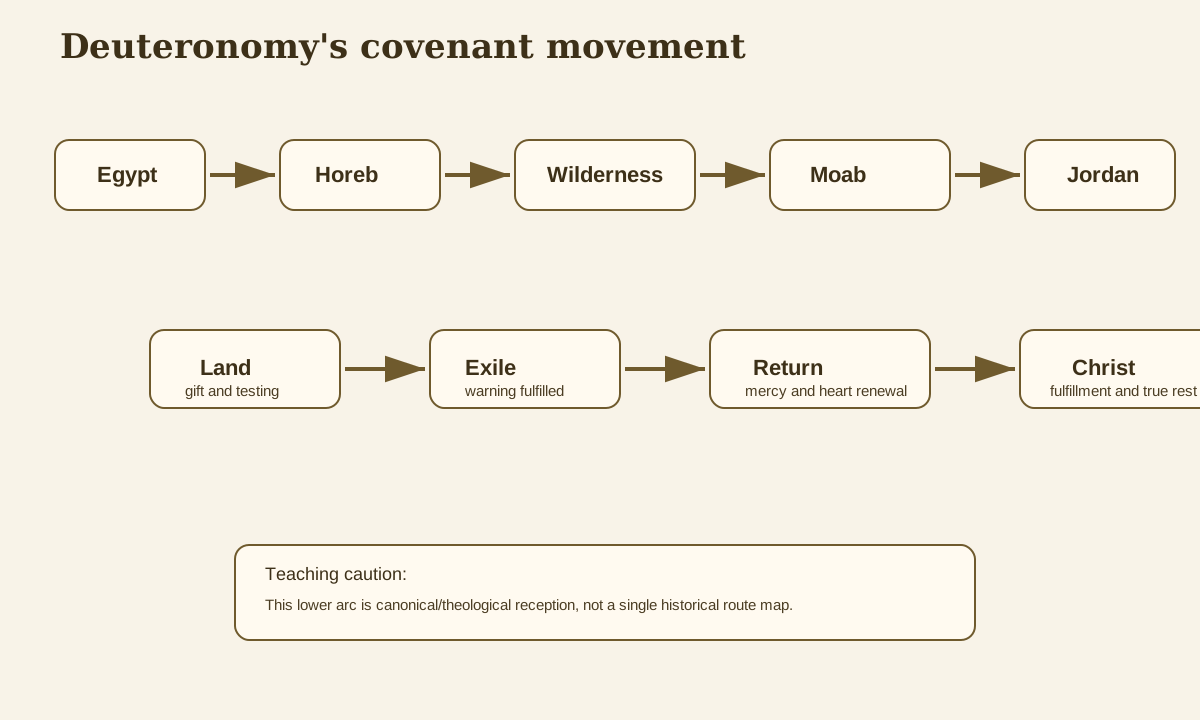 Source: Original project chart, 2026-06-19. The lower arc is canonical and theological reception, not one historical route map.
This chart helps readers see why chapter 30 is not cheap optimism. The call to choose life stands inside a larger movement: rescue, commandment, failure, exile, return, and finally the nearness of the saving word in Christ. Romans 10 should be taught as apostolic reception of Deuteronomy, not as a detached proof-text. The word is near because God comes near in mercy and calls for a real human answer.
Church’s Voice in Worship
These chapters speak directly to themes central to Orthodox prayer and ascetic practice:
- standing before God together as a people
- rejecting hard-hearted presumption
- repenting after scattering
- seeking purification of heart
- hearing the word made near
- choosing life by cleaving to the Lord
The line about the word being near is especially fruitful when read alongside Romans 10. The Church hears here both a summons to repentance and a Christological promise: the saving word is not distant, because Christ has come near.
Spiritual Fruit 🍇
- Corporate responsibility: no one stands outside the covenant call.
- Repentance: return is possible, even after grave wandering.
- Humility before mystery: obey what has been revealed.
- Purity of heart: we need inward healing, not only better arguments.
- Synergy: grace does not abolish the need to answer God.
- Decision for communion: choosing life means cleaving to God.
Questions for reflection:
- Do I secretly bless myself while resisting God’s command?
- What revealed duty have I neglected while chasing speculative questions?
- Where has my life become spiritually scattered?
- Do I ask God to purify my heart, or merely to excuse it?
- What concrete act of obedience would “choose life” mean for me today?
Teacher's Notes
- Show: Use the covenant movement flow chart to prevent “choose life” from becoming generic positivity; in the text, life means returning, hearing, loving, and cleaving to the Lord.
- Stress that chapter 30 is not cheap optimism. It comes after the full seriousness of covenant breach.
- Deuteronomy 29:29 is often misused to shut down all questions. Teach it instead as a call to humility and obedience.
- Romans 10 should be brought in briefly and clearly.
- The phrase “choose life” should not be reduced to general positivity. In the text it means covenantal love and fidelity to God.
- This is a strong place to explain Orthodox synergy carefully: grace first, grace sustaining, and a real human response.
Glossary
- Covenant renewal: the solemn reaffirmation of Israel’s bond with the Lord.
- Root of bitterness: an inward source of apostasy and corruption that can spread through a people.
- Circumcision of heart: inward purification and consecration to God.
- Presumption: false confidence that blessing can coexist with persistent rebellion.
- Synergy: the Orthodox confession that human response cooperates with divine grace rather than replacing it.
Translation and Source Notes
- Old Testament quotations are from the Brenton Septuagint.
- Romans 10 provides the chief New Testament point of contact.
- Brenton’s wording “purge thy heart” in 30:6 expresses the inward, cleansing aspect strongly.
- Patristic observations are summarized thematically unless tied to clearly identifiable primary works.
Sources
Primary sources
- Deuteronomy 29-30 (Brenton Septuagint)
- Romans 10:5-10
- The Fifty Spiritual Homilies attributed to Saint Macarius
- Saint Ephrem the Syrian, hymns and commentaries on repentance and purity of heart
- Saint Maximus the Confessor, Chapters on Love and related ascetical writings on grace and human response
Secondary academic sources
- Peter C. Craigie, The Book of Deuteronomy
- J. G. McConville, Deuteronomy
- Christopher J. H. Wright, Deuteronomy
Coptic Orthodox / pastoral sources
- Orthodox Study Bible, notes on Deuteronomy and Romans
- Fr. Tadros Y. Malaty, commentary on Deuteronomy
Web pages and non-academic sources cited
- None cited directly in this guide