
Before Wisdom leads Israel through the sea, she goes down into a prison. The chapter begins even earlier, with Adam being brought out of his fall. Its history is held together by that fidelity: God’s wisdom reaches the place where a human life has become endangered, disgraced, or trapped, and keeps His saving purpose alive. In Christ, the Wisdom of God, we meet the Lord to whom this long history of preservation belongs.
Orientation
Solomon’s prayer in Wisdom 9 ends with salvation through Wisdom. Chapter 10 recalls that saving work from Adam to Moses, usually leaving the figures unnamed so that God’s action holds our attention. Genesis and Exodus provide the stories; the chapter selects what reveals preservation, faithfulness, and deliverance. Its closing praise prepares the wilderness reflection in Wisdom 11.
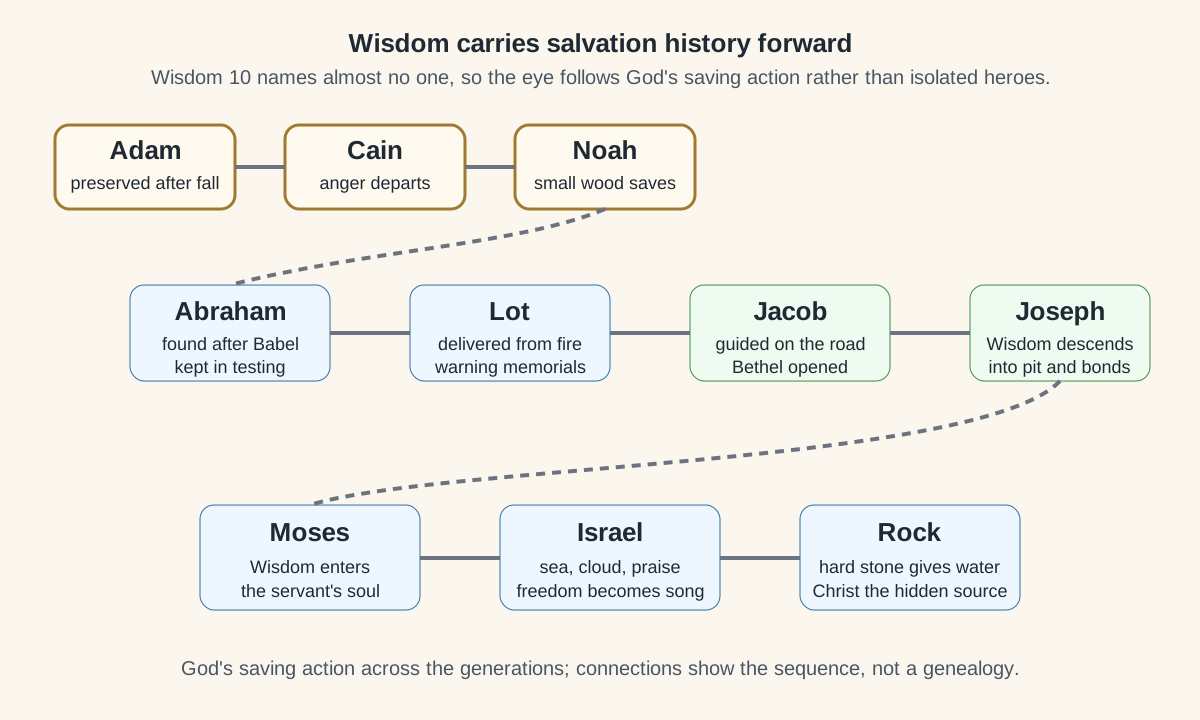 Wisdom’s saving history from Adam through Israel. Schematic based on Wisdom 10:1-11:14.
Wisdom preserves the first father and the righteous remnant (Wisdom 10:1-4)
1 She preserved the first formed father of the world, that was created alone, and brought him out of his fall, 2 and gave him power to rule all things.
3 But when the unrighteous went away from her in his anger, he perished also in the fury wherewith he murdered his brother. 4 For whose cause the earth being drowned with the flood, wisdom again preserved it, and directed the course of the righteous in a piece of wood of small value.
The first example is Adam. Wisdom preserved the first formed father, brought him out of his fall, and gave him power to rule all things. The wording is full of mercy. Adam falls, but the story does not end with fall. Wisdom does not treat the fallen father as disposable. She preserves him and restores him to the human vocation of rule under God.
Wisdom does not begin her history by celebrating untouched heroes. She begins with the fallen man whom God preserves. The first act is not triumph, but mercy. The wise reader therefore learns not to despair after falling. The history of salvation begins with God seeking, covering, preserving, and keeping the human vocation alive even after sin has entered.
Verse 3 turns to Cain without naming him. He goes away from Wisdom in anger and perishes in the fury by which he murdered his brother. The passage treats murder as a departure from Wisdom before it becomes an act against Abel. Anger severs the soul from the light, then the hand becomes violent. This is a severe warning for the inner life. Wrath does not remain safely inside the mind. If it is fed, it drives the person away from wisdom and toward destruction.
Verse 4 compresses the history from first murder to the flood. The violence that begins with Cain fills the earth, and the earth is drowned. Yet Wisdom again preserves the world through “the righteous” in a small piece of wood. This is Noah, carried through judgment by the ark. The phrase “of small value” sets the weakness of the vessel beside the hand that guides it. The wood cannot account for the survival of the world; God can.
For Christians, this first unit already opens into Christ and the Church. The ark is not powerful by outward appearance. It saves because God directs it. The Cross also appears as weakness to the world, yet it is the saving wood by which the righteous are carried through judgment. Wisdom teaches us to trust the small, obedient, God-directed vessel more than the impressive structures that anger and violence build.
First Peter 3:20-21 explicitly joins Noah’s preservation through water to baptism, while Wisdom 14:6-7 returns to the weak vessel and its blessed wood. These connections give the Christian reading its order: first Noah and the ark, then the saving passage fulfilled through Christ’s Resurrection. Baptism is received from the crucified and risen Lord, not from water treated as an independent power. A fallen person need not manufacture an unbroken past before approaching Him. The chapter begins with Adam being brought out of his fall.
Wisdom finds Abraham and delivers Lot from the cities (Wisdom 10:5-9)
5 Moreover, the nations in their wicked conspiracy being confounded, she found out the righteous, and preserved him blameless unto God, and kept him strong against his tender compassion toward his son.
6 When the ungodly perished, she delivered the righteous man, who fled from the fire which fell down upon the five cities. 7 Of whose wickedness, even to this day the waste land that smoketh is a testimony, and plants bearing fruit that never come to ripeness: and a standing pillar of salt is a monument of an unbelieving soul. 8 For regarding not wisdom, they gat not only this hurt, that they knew not the things which were good; but also left behind them to the world a memorial of their foolishness: so that in the things wherein they offended they could not so much as be hid. 9 But wisdom delivered from pain those that attended upon her.
Verse 5 moves from the confusion of the nations to the calling and testing of Abraham. The nations are confounded in their wicked conspiracy, an echo of Babel, where human pride tries to build a name apart from God. In that world of scattered speech and proud ambition, Wisdom finds the righteous man and preserves him blameless before God.
The line about being kept strong against tender compassion toward his son points to the sacrifice of Isaac in Genesis 22. Wisdom praises fidelity, while Genesis 22:11-13 explicitly stops Abraham from killing Isaac. This story gives no parent, religious leader, or private visionary permission to harm a child. Abraham’s love for Isaac is real, and that is why the test is terrible. The passage says Wisdom keeps him faithful to God when even the most tender natural love could become disobedience if it were set above the Lord. In the end, God does not delight in Isaac’s death. He provides the ram and reveals that the promised seed is preserved by divine mercy.
This points toward Christ without erasing Genesis. Abraham is not a model of cold religion. He is the father of faith who learns that the promise belongs to God. Hebrews 11:17-19 reads Abraham’s obedience through trust that God could raise the dead. Romans 8:32 then gives the Christian comparison: the Father did not spare His own Son. The comparison reaches its fulfillment in the Son’s willing self-offering, not in a supposed divine delight in cruelty. Wisdom holds together obedience, promise, and mercy.
Verses 6-8 turn to Lot and the destruction of the cities. Wisdom delivers the righteous man who flees the fire, while the land itself becomes testimony. The waste land, the unripe fruit, and the pillar of salt are described as memorials. Sin tries to hide, but it leaves marks. The passage says that those who disregard Wisdom not only fail to know what is good; they leave behind a witness to their foolishness.
Second Peter 2:6-8 also calls Lot righteous and describes his distress in a corrupt city. Luke 17:32 recalls his wife as a warning against looking back. Wisdom’s rescued man and standing pillar belong to that same account in Genesis 19:15-29. Their contrast makes repentance concrete: rescue calls for departure from what is destroying us. It is possible to leave a place while still feeding the desires that made it dangerous.
This is a sober spiritual principle. A community can train itself not to see what is good. A soul can normalize corruption until judgment feels like surprise. Wisdom delivers those who attend upon her, but she also exposes the ruin left by refusing her. The application is not to look down on Sodom as if the warning belongs only to others. The application is to ask where our own lives are becoming memorials of foolishness: habits that will not ripen, pleasures that turn to salt, choices that leave spiritual waste behind.
Verse 9 gathers the unit: Wisdom delivers from pain those who attend upon her. The righteous are not delivered because they are strong enough to save themselves. They attend upon Wisdom. They remain near her, obey her, and are carried by her.
Wisdom guides Jacob and descends with Joseph (Wisdom 10:10-14)
10 When the righteous fled from his brother’s wrath, she guided him in right paths, shewed him the kingdom of God, and gave him knowledge of holy things, made him rich in his travels, and multiplied the fruit of his labours. 11 In the covetousness of such as oppressed him she stood by him, and made him rich. 12 She defended him from his enemies, and kept him safe from those that lay in wait, and in a sore conflict she gave him the victory; that he might know that godliness is stronger than all.
13 When the righteous was sold, she forsook him not, but delivered him from sin: she went down with him into the pit, 14 and left him not in bonds, till she brought him the sceptre of the kingdom, and power against those that oppressed him: as for them that had accused him, she shewed them to be liars, and gave him perpetual glory.
Jacob is the righteous man fleeing from his brother’s wrath. The phrase is generous, because Genesis shows Jacob as complicated, fearful, wounded, and still being formed. Wisdom does not wait until Jacob is simple and settled before guiding him. She guides him in right paths while he is fleeing, shows him the kingdom of God, gives him knowledge of holy things, and multiplies the fruit of his labors.
The reference to seeing the kingdom of God recalls Bethel in Genesis 28:12-17, where Jacob sees the ladder reaching from earth to heaven and hears the Lord’s promise. John 1:51 places the ascending and descending angels in relation to the Son of Man: Christ Himself is the living meeting of heaven and earth. This is a Christian fulfillment of Jacob’s vision, not a claim that Wisdom explicitly names Christ as a ladder. In a moment of flight and vulnerability, the fugitive discovers that heaven is open and God is present. Wisdom is not only instruction after life becomes stable. Wisdom meets the soul on the road, in fear, between home and exile, and reveals that God is nearer than the frightened heart imagined.
Verses 11-12 recall Jacob’s years under Laban and the struggle at the ford in Genesis 32:24-30. Hosea 12:3-4 remembers this encounter through both wrestling and supplication. Jacob receives the blessing as one who clings to God, not as a strong man who overpowers Him. The sentence ends with a key lesson: “godliness is stronger than all.” This strength is not domination. It is the power of communion with God to endure manipulation, fear, danger, and conflict without losing the promise.
Then the passage turns to Joseph. He is sold, but Wisdom does not forsake him. She delivers him from sin, goes down with him into the pit, leaves him not in bonds, and brings him to the scepter of the kingdom. This is one of the clearest places where Wisdom is more than advice. The verbs make providence personal: Wisdom goes down and remains. God’s faithful presence reaches the prisoner in humiliation.
Joseph’s story also guards the reader from shallow providence. Wisdom does not prevent the sale, the pit, the false accusation, or the prison. She enters them and carries Joseph through them without letting sin possess him. His chastity, patience, and forgiveness are not self-made virtues. They are signs that Wisdom stayed with him where everyone else seemed to have abandoned him.
Psalm 105:17-22 (LXX Ps 104:17-22) remembers Joseph’s chains and the testing that preceded his authority. Acts 7:9-10 places the brothers’ envy beside God’s presence with Joseph. Both passages keep us from confusing abandonment by human beings with abandonment by God. Someone falsely accused may need protection, a truthful hearing, and years of patient help. Providence does not make the injustice good; it means injustice cannot prevent God from remaining with His servant.
Gems from the Fathers 💎: Faith that outlives visible success
In Homily 26 on Hebrews §3, St. John Chrysostom considers Joseph’s confidence in the promised Exodus even as he dies in Egypt. Joseph does not make the unfulfilled promise an accusation against God: “He said nothing of all this, but by Faith he both conquered and went beyond all these things.”1 This is a thematic companion to Wisdom 10, not a commentary on its verses. It sharpens the comfort already present in the pit: God’s faithfulness can be trusted before the result can be seen. Joseph’s final concern for his bones helps the next generation look toward God’s promise rather than settle its hope in Egypt.
Wisdom brings Israel through the sea in praise (Wisdom 10:15-21)
15 She delivered the righteous people and blameless seed from the nation that oppressed them.
16 She entered into the soul of the servant of the Lord, and withstood dreadful kings in wonders and signs; 17 rendered to the righteous a reward of their labours, guided them in a marvellous way, and was unto them for a cover by day, and a light of stars in the night season; 18 brought them through the Red sea, and led them through much water: 19 but she drowned their enemies, and cast them up out of the bottom of the deep. 20 Therefore the righteous spoiled the ungodly, and praised thy holy name, O Lord, and magnified with one accord thine hand, that fought for them. 21 For wisdom opened the mouth of the dumb, and made the tongues of them that cannot speak eloquent.
The movement now reaches Israel and Moses. Wisdom delivers the righteous people and blameless seed from the oppressing nation. She enters the soul of the servant of the Lord and withstands dreadful kings in wonders and signs. The account runs from the servant commissioned before Pharaoh to the song on the far shore in Exodus 15:1-21. Hebrews 3:5 remembers Moses’ faithfulness as a servant in God’s house. His greatness lies in serving the saving work entrusted to him.
The phrase “entered into the soul of the servant of the Lord” is important. Wisdom does not merely give Moses a strategy. Wisdom enters him, animates him, and makes him able to stand before kings. Exodus 4:10-12 has already shown Moses troubled by his speech and receiving God’s promise to teach him what to say. The chapter’s ending, where Wisdom opens mouths, answers that earlier fear. Mark 7:37 offers a later Gospel resonance in Christ’s restoration of hearing and speech: the Lord who sends His servants also gives the capacity to answer Him.
Verse 17 holds guidance and protection together. Wisdom gives reward for labors, guides in a marvelous way, covers by day, and gives light by night. The Exodus is not only a rescue from slavery; it is a school of dependence. Israel must follow the cloud and fire, walk where there is no road, and learn that deliverance does not end at leaving Egypt. The saved people must still be guided.
Verses 18-19 place the Red Sea at the center of the unit. Wisdom brings the people through much water and drowns their enemies. The same sea becomes path for Israel and judgment for Egypt. That double action is not arbitrary. It reveals God as the defender of the oppressed and the judge of the oppressor. The sea does not belong to Pharaoh. Creation belongs to the Lord and serves His saving purpose.
The response is praise. The righteous spoil the ungodly, praise the holy name, and magnify with one accord the hand that fought for them. Wisdom opens the mouth of the dumb and makes speech eloquent. The people who groaned under bondage are given a hymn. The ones whose cries rose up in slavery now praise with one accord. Deliverance is incomplete if it does not become worship.
This points toward Christ and the Church. The Red Sea prepares the Christian imagination for baptism, where the old bondage is drowned and the people of God pass into a new life. Christ, the Wisdom of God, does not merely tell us how to escape slavery. He enters the contest, defeats the tyrant, leads His people through death, and gives them the song of salvation.
Gems from the Fathers 💎: Delivered from darkness for worship
St. John Chrysostom’s Homily 27 on Hebrews §§1-2 reads the Passover blood and passage through the sea as historical deliverance received in faith, then directs Christians to confidence in Christ’s sacrifice. His application is exact and searching: “For God has brought us out from Egypt, from darkness, from idolatry.”2 The same Lord delivers a people and claims their worship. A baptized Christian who keeps returning to an old bondage needs more than nostalgia for a powerful religious moment. He needs to live by the deliverance already given, drawing near to Christ rather than making peace with the tyrant again.
The Church’s Voice in Worship ⛪
The First Hoos, or First Canticle, of Coptic Midnight Praise sings the song of Moses and Israel from Exodus 15.3 Wisdom 10:20-21 describes the same passage from rescue into a shared voice of thanksgiving. When the Church sings it, Israel’s deliverance becomes the language of her own gratitude to Christ. The song carries the memory of bondage into worship, so that freedom is received as mercy rather than possessed as an achievement. This is a Psalmody connection, not a lectionary appointment for Wisdom 10.
Glossary
- Wisdom: God’s wise saving activity, personified here as a woman; Christian reading reaches its fulfillment in Christ, the Wisdom of God.
- Babel: The confusion of nations in Genesis 11, recalled before Abraham’s appearance.
- Providence: God’s faithful care and governance, present even amid betrayal and delay.
- Type: A real person or event in Israel’s history that prepares for a fuller saving reality in Christ.
- First Hoos: The first canticle of Coptic Midnight Praise, singing Moses’ song from Exodus 15.
Spiritual Fruit 🍇
Bring a fall to the God who preserves. Adam’s restoration stands at the beginning. If shame has made prayer feel dishonest, confess the actual sin instead of waiting until you feel worthy to begin. Mercy restores the vocation that sin has damaged.
Interrupt anger before it becomes a history. Cain goes away from Wisdom in anger. Refuse the rehearsal of an injury that makes another person’s destruction seem desirable. Where harm has occurred, seek truthful help and protection without feeding revenge.
Remember the presence in the pit. Joseph’s betrayal did not make him spiritually abandoned. In a season of false accusation or hidden labor, keep the next obedience within reach: truthful speech, chastity, patient work, a request for help. God’s faithfulness need not be measured by how quickly people recognize you.
Let rescue receive a voice. Give thanks for one concrete deliverance rather than passing immediately to the next anxiety. Join the Church’s praise even when your own words are poor. Wisdom opens mouths by giving people something true to sing.
On the far shore, the people remember the waters they could not part for themselves. Their song belongs to the Lord whose hand carried them. Bring Him the bondage from which you have been delivered and the fear that still follows you. Ask to live today as one who has been led out, and let gratitude become the beginning of obedience.
Teaching Notes
Wisdom preserves the first father and the righteous remnant (Wisdom 10:1-4)
- Ask: Why does Wisdom’s history begin with Adam after the fall rather than with an untouched hero?
- Emphasize: Wisdom begins with mercy. God preserves the fallen father and keeps the human vocation alive.
- Watch for: Treating Cain’s anger as a private feeling without consequences. The text shows anger as departure from Wisdom.
- Connect: The ark’s small wood can prepare the class to see the Cross as saving weakness, not worldly strength.
- Show: Use the salvation-history schematic to show Adam, Cain, Noah, and the ark as the opening movement: fall, anger, judgment, and preservation.
- Show: The retained diagram extends beyond chapter 10 to the wilderness rock. Keep that final sign as a forward pointer to Wisdom 11; the diagram is a relationship and salvation-history schematic, not a complete genealogy.
Wisdom finds Abraham and delivers Lot from the cities (Wisdom 10:5-9)
- Ask: What does Wisdom do after the nations are confounded at Babel?
- Emphasize: Wisdom finds the righteous and preserves them amid confusion, testing, fire, and corrupt surroundings.
- Watch for: Teaching Abraham and Isaac as emotional hardness. The passage is about obedience, promise, and God’s mercy, not cruelty.
- Connect: Abraham’s test opens toward Christ, the beloved Son freely offered, while Lot’s deliverance warns against souls that disregard Wisdom.
- Show: Contrast two memorials: Abraham preserved blameless before God and the pillar of salt as a monument of unbelief.
- Watch for: Using Abraham’s test to legitimate harm to a child. Genesis 22:11-13 explicitly halts the sacrifice; no private religious claim authorizes abuse.
Wisdom guides Jacob and descends with Joseph (Wisdom 10:10-14)
- Ask: How does Wisdom act when Jacob is fleeing and Joseph is sold?
- Emphasize: Wisdom guides on the road and goes down into the pit. She is God’s presence in unstable and humiliating places.
- Watch for: Making providence sound painless. The passage includes flight, oppression, conflict, sale, pit, bonds, and false accusation.
- Connect: Hebrews 11 helps show patriarchal faith as trust in promises not fully enjoyed at once.
- Show: Point to Jacob and Joseph on the schematic, then ask how Wisdom acts on the road and in the pit.
Wisdom brings Israel through the sea in praise (Wisdom 10:15-21)
- Ask: Why does deliverance end with the people praising God’s holy name?
- Emphasize: Exodus is not only escape from oppression. It is the birth of worship and the opening of mouths once silenced.
- Watch for: Flattening Exodus into political victory. Keep the spiritual center: God’s hand fights, creation serves Him, and the people magnify His name.
- Connect: The Red Sea prepares the Christian reading of baptism and Christ’s victory over bondage.
- Show: Trace the schematic from Moses to Israel and the sea: oppression, servant of the Lord, signs, cloud and light, sea, drowned enemies, praise.
- Connect: The First Hoos sings Exodus 15 in Coptic Midnight Praise. Keep this Psalmody connection distinct from an appointed Wisdom reading.
Sources
Embedded Scripture is from Brenton’s English Septuagint (LXX).
St. John Chrysostom, Homilies on Hebrews, Homilies 26-27, cited at the relevant passages.
The First Hoos, Coptic Midnight Praise, cited above.
Footnotes
-
St. John Chrysostom, Homilies on Hebrews, Homily 26, §3, NPNF1 14, CCEL. ↩
-
St. John Chrysostom, Homilies on Hebrews, Homily 27, §§1-2, NPNF1 14, CCEL. ↩
-
The First Hoos, Coptic Midnight Praise, Tasbeha.org Hymn Library, containing the song of Moses and Israel from Exodus 15. No service-book wording is quoted here. ↩