


Leviticus 20-22 holds covenant judgment, priestly holiness, and acceptable offerings together. It must distinguish ancient Israel’s civil penalties from the Church’s sacramental and pastoral life while still taking holiness seriously.
Leviticus 20-22 gathers three connected concerns: judgment against grave covenant violations, heightened holiness for priests, and acceptable offerings before the Lord. The unit teaches that holiness is not vague sincerity. It includes moral seriousness, priestly responsibility, bodily and ritual integrity, and reverence for what is offered to God.
Leviticus 20 continues the moral boundaries of chapter 18 but adds covenant consequences. Leviticus 21 turns to the priests, whose proximity to holy things increases responsibility. Leviticus 22 then guards the holy offerings, so that what is brought to God is not polluted, careless, or defective. Together the chapters ask: What happens when a holy people becomes casual about sin, priesthood, and offering?
Historical and Scriptural Context
Leviticus 20-22 belongs to the approved Leviticus literary-unit plan. It should be read in light of the whole book’s movement from holy approach, priesthood, purity, atonement, holiness, covenant warning, and truthful dedication.
Geographical Significance ⛰️
The camp, sanctuary, priestly household, and altar form the setting. Holiness is spatially ordered because Israel lives around God’s presence.
The Characters 👥
Israel, priests, priestly families, the wounded and disabled, strangers, and worshippers all appear under the demand that God be sanctified among His people.
🕯️ Light from the Word
Leviticus 20
1 And the Lord spoke to Moses, saying, 2 Thou shalt also say to the children of Israel, If there shall be any of the children of Israel, or of those who have become proselytes in Israel, who shall give of his seed to Moloch, let him be surely put to death; the nation upon the land shall stone him with stones. 3 And I will set my face against that man, and will cut him off from his people, because he has given of his seed to Moloch, to defile my sanctuary, and profane the name of them that are consecrated to me. 4 And if the natives of the land should in anywise overlook that man in giving of his seed to Moloch, so as not to put him to death; 5 then will I set my face against that man and his family, and I will destroy him, and all who have been of one mind with him, so that he should go a whoring to the princes, from their people.
6 And the soul that shall follow those who have in them divining spirits, or enchanters, so as to go a whoring after them; I will set my face against that soul, and will destroy it from among its people. 7 And ye shall be holy, for I the Lord your God am holy. 8 And ye shall observe my ordinances, and do them: I am the Lord that sanctifies you. 9 Every man who shall speak evil of his father or of his mother, let him die the death; has he spoken evil of his father or his mother? he shall be guilty.
10 Whatever man shall commit adultery with the wife of a man, or whoever shall commit adultery with the wife of his neighbour, let them die the death, the adulterer and the adulteress. 11 And if any one should lie with his father’s wife, he has uncovered his father’s nakedness: let them both die the death, they are guilty. 12 And if any one should lie with his daughter-in-law, let them both be put to death; for they have wrought impiety, they are guilty. 13 And whoever shall lie with a male as with a woman, they have both wrought abomination; let them die the death, they are guilty. 14 Whosoever shall take a woman and her mother, it is iniquity: they shall burn him and them with fire; so there shall not be iniquity among you. 15 And whosoever shall lie with a beast, let him die the death; and ye shall kill the beast. 16 And whatever woman shall approach any beast, so as to have connexion with it, ye shall kill the woman and the beast: let them die the death, they are guilty. 17 Whosoever shall take his sister by his father or by his mother, and shall see her nakedness, and she see his nakedness, it is a reproach: they shall be destroyed before the children of their family; he has uncovered his sister’s nakedness, they shall bear their sin. 18 And whatever man shall lie with a woman that is set apart for a flux, and shall uncover her nakedness, he has uncovered her fountain, and she has uncovered the flux of her blood: they shall both be destroyed from among their generation. 19 And thou shalt not uncover the nakedness of thy father’s sister, or of the sister of thy mother; for that man has uncovered the nakedness of one near akin: they shall bear their iniquity. 20 Whosoever shall lie with his near kinswoman, has uncovered the nakedness of one near akin to him: they shall die childless. 21 Whoever shall take his brother’s wife, it is uncleanness; he has uncovered his brother’s nakedness; they shall die childless.
22 And keep ye all my ordinances, and my judgments; and ye shall do them, and the land shall not be aggrieved with you, into which I bring you to dwell upon it. 23 And walk ye not in the customs of the nations which I drive out from before you; for they have done all these things, and I have abhorred them: 24 and I said to you, Ye shall inherit their land, and I will give it to you for a possession, even a land flowing with milk and honey: I am the Lord your God, who have separated you from all people. 25 And ye shall make a distinction between the clean and the unclean cattle, and between clean and unclean birds; and ye shall not defile your souls with cattle, or with birds, or with any creeping things of the earth, which I have separated for you by reason of uncleanness. 26 And ye shall be holy to me; because I the Lord your God am holy, who separated you from all nations, to be mine.
27 And as for a man or woman whosoever of them shall have in them a divining spirit, or be an enchanter, let them both die the death: ye shall stone them with stones, they are guilty.
Lesson Guide
- Key phrases: Leviticus 20.
- Emphasize: Keep the literal sense clear before drawing typology. Show how the command forms worship, holiness, and mercy.
- Avoid: Do not turn the passage into either obsolete ritual detail or free-floating moralism.
Leviticus 21
1 And the Lord spoke to Moses, saying, Speak to the priests the sons of Aaron, and thou shalt tell them that they shall not defile themselves in their nation for the dead, 2 but they may mourn for a relative who is very near to them, for a father and mother, and sons and daughters, for a brother, 3 and for a virgin sister that is near to one, that is not espoused to a man; for these one shall defile himself. 4 He shall not defile himself suddenly among his people to profane himself. 5 And ye shall not shave your head for the dead with a baldness on the top; and they shall not shave their beard, neither shall they make gashes on their flesh. 6 They shall be holy to their God, and they shall not profane the name of their God; for they offer the sacrifices of the Lord as the gifts of their God, and they shall be holy. 7 They shall not take a woman who is a harlot and profaned, or a woman put away from her husband; for he is holy to the Lord his God. 8 And thou shalt hallow him; he offers the gifts of the Lord your God: he shall be holy, for I the Lord that sanctify them am holy. 9 And if the daughter of a priest should be profaned to go a whoring, she profanes the name of her father: she shall be burnt with fire.
10 And the priest that is chief among his brethren, the oil having been poured upon the head of the anointed one, and he having been consecrated to put on the garments, shall not take the mitre off his head, and shall not rend his garments: 11 neither shall he go in to any dead body, neither shall he defile himself for his father or his mother. 12 And he shall not go forth out of the sanctuary, and he shall not profane the sanctuary of his God, because the holy anointing oil of God is upon him: I am the Lord. 13 He shall take for a wife a virgin of his own tribe. 14 But a widow, or one that is put away, or profaned, or a harlot, these he shall not take; but he shall take for a wife a virgin of his own people. 15 And he shall not profane his seed among his people: I am the Lord that sanctifies him. 16 And the Lord spoke to Moses, saying, 17 Say to Aaron, A man of thy tribe throughout your generations, who shall have a blemish on him, shall not draw nigh to offer the gifts of his God. 18 No man who has a blemish on him shall draw nigh; a man lame, blind, with his nose disfigured, or his ears cut, 19 a man who has a broken hand or a broken foot, 20 or hump-backed, or blear-eyed, or that has lost his eye-lashes, or a man who has a malignant ulcer, or tetter, or one that has lost a testicle. 21 Whoever of the seed of Aaron the priest has a blemish on him, shall not draw nigh to offer sacrifices to thy God, because he has a blemish on him; he shall not draw nigh to offer the gifts of God. 22 The gifts of God are most holy, and he shall eat of the holy things. 23 Only he shall not approach the veil, and he shall not draw nigh to the altar, because he has a blemish; and he shall not profane the sanctuary of his God, for I am the Lord that sanctifies them. 24 And Moses spoke to Aaron and his sons, and to all the children of Israel.
Lesson Guide
- Key phrases: Leviticus 21.
- Emphasize: Keep the literal sense clear before drawing typology. Show how the command forms worship, holiness, and mercy.
- Avoid: Do not turn the passage into either obsolete ritual detail or free-floating moralism.
Leviticus 22
1 And the Lord spoke to Moses, saying, 2 Speak to Aaron and to his sons, and let them take heed concerning the holy things of the children of Israel, so they shall not profane my holy name in any of the things which they consecrate to me: I am the Lord. 3 Say to them, Every man throughout your generations, whoever of all your seed shall approach to the holy things, whatsoever the children of Israel shall consecrate to the Lord, while his uncleanness is upon him, that soul shall be cut off from me: I am the Lord your God. 4 And the man of the seed of Aaron the priest, if he should have leprosy or issue of the reins, shall not eat of the holy things, until he be cleansed; and he that touches any uncleanness of a dead body, or the man whose seed of copulation shall have gone out from him, 5 or whosoever shall touch any unclean reptile, which will defile him, or who shall touch a man, whereby he shall defile him according to all his uncleanness: 6 whatsoever soul shall touch them shall be unclean until evening; he shall not eat of the holy things, unless he bathe his body in water, 7 and the sun go down, and then he shall be clean; and then shall he eat of all the holy things, for they are his bread. 8 He shall not eat that which dies of itself, or is taken of beasts, so that he should be polluted by them: I am the Lord. 9 And they shall keep my ordinances, that they do not bear iniquity because of them, and die because of them, if they shall profane them: I am the Lord God that sanctifies them. 10 And no stranger shall eat the holy things: one that sojourns with a priest, or a hireling, shall not eat the holy things. 11 But if a priest should have a soul purchased for money, he shall eat of his bread; and they that are born in his house, they also shall eat of his bread. 12 And if the daughter of a priest should marry a stranger, she shall not eat of the offerings of the sanctuary. 13 And if the daughter of a priest should be a widow, or put away, and have no seed, she shall return to her father’s house, as in her youth: she shall eat of her father’s bread, but no stranger shall eat of it. 14 And the man who shall ignorantly eat holy things, shall add the fifth part to it, and give the holy thing to the priest. 15 And they shall not profane the holy things of the children of Israel, which they offer to the Lord. 16 So should they bring upon themselves the iniquity of trespass in their eating their holy things: for I am the Lord that sanctifies them.
17 And the Lord spoke to Moses, saying, 18 Speak to Aaron and his sons, and to all the congregation of Israel, and thou shalt say to them, Any man of the children of Israel, or of the strangers that abide among them in Israel, who shall offer his gifts according to all their confession and according to all their choice, whatsoever they may bring to the Lord for whole-burnt-offerings - 19 your free-will-offerings shall be males without blemish of the herds, or of the sheep, or of the goats. 20 They shall not bring to the Lord anything that has a blemish in it, for it shall not be acceptable for you. 21 And whatsoever man shall offer a peace-offering to the Lord, discharging a vow, or in the way of free-will-offering, or an offering in your feasts, of the herds or of the sheep, it shall be without blemish for acceptance: there shall be no blemish in it. 22 One that is blind, or broken, or has its tongue cut out, or is troubled with warts, or has a malignant ulcer, or tetters, they shall not offer these to the Lord; neither shall ye offer any of them for a burnt-offering on the altar of the Lord. 23 And a calf or a sheep with the ears cut off, or that has lost its tail, thou shalt slay them for thyself; but they shall not be accepted for thy vow. 24 That which has broken testicles, or is crushed or gelt or mutilated, - thou shalt not offer them to the Lord, neither shall ye sacrifice them upon your land. 25 Neither shall ye offer the gifts of your God of all these things by the hand of a stranger, because there is corruption in them, a blemish in them: these shall not be accepted for you. 26 And the Lord spoke to Moses, saying, 27 As for a calf, or a sheep, or a goat, whenever it is born, then shall it be seven days under its mother; and on the eighth day and after they shall be accepted for sacrifices, a burnt-offering to the Lord. 28 And a bullock and a ewe, it and its young, thou shalt not kill in one day.
29 And if thou shouldest offer a sacrifice, a vow of rejoicing to the Lord, ye shall offer it so as to be accepted for you. 30 In that same day it shall be eaten; ye shall not leave of the flesh till the morrow: I am the Lord. 31 And ye shall keep my commandments and do them. 32 And ye shall not profane the name of the Holy One, and I will be sanctified in the midst of the children of Israel. I am the Lord that sanctifies you, 33 who brought you out of the land of Egypt, to be your God: I am the Lord.
Lesson Guide
- Key phrases: Leviticus 22.
- Emphasize: Keep the literal sense clear before drawing typology. Show how the command forms worship, holiness, and mercy.
- Avoid: Do not turn the passage into either obsolete ritual detail or free-floating moralism.
Leviticus 20: judgment and covenant seriousness
Leviticus 20 is severe. It names sins that corrupt worship, family, sexuality, and communal life. Modern readers often struggle with the penalties. A study guide should not pretend the severity is easy. But it should explain what the chapter is doing: Israel is being taught that covenant life cannot absorb everything without consequence.
The chapter is not a permission slip for private vengeance. It belongs to Israel’s covenantal legal order. Christians do not administer the civil penalties of ancient Israel. But the moral seriousness remains. The Church must not treat idolatry, exploitation, sexual disorder, occult practices, or contempt for family as harmless.
Lesson Guide
- Key phrases: Leviticus 20: judgment and covenant seriousness.
- Emphasize: Keep the literal sense clear before drawing typology. Show how the command forms worship, holiness, and mercy.
- Avoid: Do not turn the passage into either obsolete ritual detail or free-floating moralism.
Distinguishing fulfillment from dismissal
One common mistake is to say, “We do not apply the penalties, therefore the chapter has no moral value.” That is lazy reading. Christians receive Leviticus through Christ, the apostles, and the Church. The civil form is not carried over as a national legal code, but the holiness of God, the danger of sin, and the call to repentance remain.
Another mistake is to wield the chapter harshly without Christ. The Church’s discipline is medicinal. Excommunication, confession, penance, correction, and restoration are not civil execution. They are ways the Church protects communion and seeks healing.
Lesson Guide
- Key phrases: Distinguishing fulfillment from dismissal.
- Emphasize: Keep the literal sense clear before drawing typology. Show how the command forms worship, holiness, and mercy.
- Avoid: Do not turn the passage into either obsolete ritual detail or free-floating moralism.
Leviticus 20:22-26 and the clean-unclean distinction beside moral law
Leviticus 20:26 gives the theological reason for this distinction: Israel is to be holy because the Lord has separated them for Himself.
The end of chapter 20 deserves special care. After sexual sins, family violations, and occult practices, the text suddenly speaks about distinguishing clean from unclean animals and birds. That shift can feel abrupt to modern readers, but in Leviticus it is deliberate. Israel’s holiness is not divided into unrelated compartments. Bed, table, sanctuary, speech, and land all belong to the same covenant life.
Verses 22-26 say that the land itself will not tolerate Israel if Israel adopts the nations’ practices. Then the people are told to distinguish between clean and unclean creatures because the Lord has separated them from the peoples. The point is not that food laws are morally identical to adultery or child sacrifice. The point is that holiness is total. Israel must learn distinction everywhere. A people unable to distinguish at the table will soon stop distinguishing in worship and morality as well.
Lesson Guide
- Key phrases: Leviticus 20:22-26 and the clean-unclean distinction beside moral law.
- Emphasize: Keep the literal sense clear before drawing typology. Show how the command forms worship, holiness, and mercy.
- Avoid: Do not turn the passage into either obsolete ritual detail or free-floating moralism.
Leviticus 21: priestly holiness
The priests are held to heightened standards because they draw near to the altar and bear the public responsibility of holy service. The chapter’s rules concerning mourning, marriage, bodily condition, and priestly contact are difficult for modern readers, but the core principle is clear: those who serve near holy things must not treat their service casually.
St John Chrysostom, especially in On the Priesthood and in his homilies on Hebrews, presses this same point in a Christian register: nearness to holy things increases accountability. The priest is not called to theatrical holiness, but to disciplined, watchful service. Leviticus 21 gives the Old Covenant grammar for that truth.
Lesson Guide
- Key phrases: Leviticus 21: priestly holiness.
- Emphasize: Keep the literal sense clear before drawing typology. Show how the command forms worship, holiness, and mercy.
- Avoid: Do not turn the passage into either obsolete ritual detail or free-floating moralism.
Priesthood, bodily wholeness, and the dignity of the wounded
The bodily regulations in Leviticus 21 must be handled honestly and carefully. In the Old Covenant, priestly bodily wholeness functioned as a sign of the perfection required before the holy God. But the text itself also preserves dignity. The priest with a blemish is restricted from certain altar functions, yet he still eats the holy bread. He is not treated as disposable, cursed, or less than human.
For Christians, this must never be turned into contempt for disabled persons. Christ heals, receives, and dignifies the wounded. He touches lepers, opens blind eyes, and draws the broken into communion. The typological point is not that disabled people are unwelcome to God. It is that the priestly sign points beyond itself to the perfect High Priest.
Lesson Guide
- Key phrases: Priesthood, bodily wholeness, and the dignity of the wounded.
- Emphasize: Keep the literal sense clear before drawing typology. Show how the command forms worship, holiness, and mercy.
- Avoid: Do not turn the passage into either obsolete ritual detail or free-floating moralism.
Christ the true Priest
Christ fulfills priestly holiness not by excluding the wounded, but by becoming the sinless High Priest who touches lepers, heals the blind, receives the broken, and brings them into communion. He is personally without blemish and yet merciful toward the blemished. This is the difference between typology and cruelty.
Lesson Guide
- Key phrases: Christ the true Priest.
- Emphasize: Keep the literal sense clear before drawing typology. Show how the command forms worship, holiness, and mercy.
- Avoid: Do not turn the passage into either obsolete ritual detail or free-floating moralism.
Leviticus 22: holy offerings and acceptable sacrifice
Leviticus 22 guards the holy things from careless handling. Priests must not eat holy things while unclean. Offerings must not be defective. Vows and freewill offerings must be acceptable. Thanksgiving offerings must be eaten properly. Even the timing of an animal with its mother is regulated.
The point is not that God is picky in a petty way. The point is that what is offered to God should not be treated as leftovers, defects, or religious disposal. Worship reveals the heart. A careless offering teaches a careless love.
Lesson Guide
- Key phrases: Leviticus 22: holy offerings and acceptable sacrifice.
- Emphasize: Keep the literal sense clear before drawing typology. Show how the command forms worship, holiness, and mercy.
- Avoid: Do not turn the passage into either obsolete ritual detail or free-floating moralism.
“I will be sanctified in the midst of the children of Israel”
Leviticus 22:32-33 gives one of the chapter’s deepest lines, and Leviticus 22:33 grounds that holiness in the Exodus: “ye shall not profane the name of the Holy One, and I will be sanctified in the midst of the children of Israel.” God does not become holier than He already is. Rather, His holiness is manifested, confessed, and honored in the life of His people.
This is why the verse joins sanctification to the Exodus: “I am the Lord that sanctifies you, who brought you out of the land of Egypt.” Redemption was not merely rescue from oppression. It was rescue into holiness. St Cyprian, when teaching the Lord’s Prayer, explains “Hallowed be Thy name” in this same patristic way: we ask not that God become holy, but that His holiness be hallowed in us. Leviticus 22 already teaches that logic.
Brenton’s Septuagint wording is also worth noticing here. The phrase “the name of the Holy One” makes the issue especially vivid. The offerings, the priests, and the people must all proclaim the holiness of the God whose Name they bear.
Lesson Guide
- Key phrases: “I will be sanctified in the midst of the children of Israel”.
- Emphasize: Keep the literal sense clear before drawing typology. Show how the command forms worship, holiness, and mercy.
- Avoid: Do not turn the passage into either obsolete ritual detail or free-floating moralism.
Orthodox application: what do we offer?
Christians do not bring animal offerings, but the principle remains. We offer ourselves, our prayers, our alms, our time, our repentance, our work, and above all the Eucharistic offering in Christ. A person should ask: Am I offering God the first and best, or what is left after every other priority has fed?
For deacons and servants, this is especially direct. Service near the altar should be marked by preparation, sobriety, obedience, and reverence. The person who serves holy things must not become casual because of familiarity.
Lesson Guide
- Key phrases: Orthodox application: what do we offer?.
- Emphasize: Keep the literal sense clear before drawing typology. Show how the command forms worship, holiness, and mercy.
- Avoid: Do not turn the passage into either obsolete ritual detail or free-floating moralism.
Handling hard pastoral questions
These chapters require careful tone. Do not teach them as if God despises the weak, disabled, grieving, or wounded. Christ’s ministry forbids that reading. Also do not teach them as if holiness standards are cruel obstacles. The Church’s challenge is to preserve reverence and mercy together.
When teaching penalties, distinguish between ancient Israel’s civil covenant and the Church’s sacramental discipline. When teaching priestly bodily requirements, distinguish typological wholeness from the dignity of persons with disabilities. When teaching acceptable offerings, distinguish reverence from perfectionism. The point is not anxiety; the point is faithful love.
Lesson Guide
Key phrases: Handling hard pastoral questions.
Emphasize: Keep the literal sense clear before drawing typology. Show how the command forms worship, holiness, and mercy.
Avoid: Do not turn the passage into either obsolete ritual detail or free-floating moralism.
Christological Types and Prophecies
| Element in Leviticus 20-22 | Spiritual meaning | Fulfillment in Christ and the Church |
|---|---|---|
| Judgment on Molech and sexual sin | Covenant betrayal and the protection of life and family | Christ restores the dignity of the human person and the sanctity of the body as temple of the Holy Spirit. |
| Priestly blemish restrictions | Ritual wholeness for altar service | Christ the spotless High Priest offers Himself without blemish; the Church honors the dignity of the wounded while maintaining the symbolism of wholeness in worship. |
| Acceptable offerings | Worship that gives God the best | Christ is the acceptable offering; the Church offers herself as a living sacrifice in union with Him. |
| “I will be sanctified in the midst of the children of Israel” | God’s holiness is to be visibly honored in His people | The Church is called to be holy as God is holy; the Name of Christ is hallowed in the life of the Body. |
Patristic Commentary Highlights
St John Chrysostom, in his Homilies on Hebrews, repeatedly contrasts the old priesthood with Christ. The old priests were weak and sinful; Christ is sinless and eternal. This anchors the reading of Leviticus 21 as fulfilled in the true Priest who needs no offering for Himself.
The Church’s Voice in Worship
No exact Coptic placement is claimed for this Leviticus unit. The local Coptic Orthodox lectionary reference data has not yielded an exact occurrence for this passage, so this section gives thematic worship resonance rather than a fixed reading claim.
I have not verified an exact Coptic lectionary placement for these chapters, so I make no precise lectionary claim here. The thematic connection, however, is strong. Coptic liturgy assumes that priesthood, offering, purity, repentance, and reverence matter. The priest’s preparation, the deacon’s order, the care around the Eucharistic vessels, fasting before Communion, confession, absolution, and the prayers of reconciliation all belong to a fulfilled holiness, not a relaxed one.
The Church does not merely say, “Christ fulfilled sacrifice, so reverence no longer matters.” She says Christ fulfilled sacrifice, therefore the holy gifts are approached with deeper reverence.
Iconography and Visual Teaching 🖼️
For Leviticus 20-22, visuals should reinforce priestly responsibility and acceptable offering without making the hard texts sensational. The priestly family tree can remind readers that priestly holiness is embodied in real persons and households. The tabernacle plan helps show why blemish, offering, and priestly access are treated seriously.
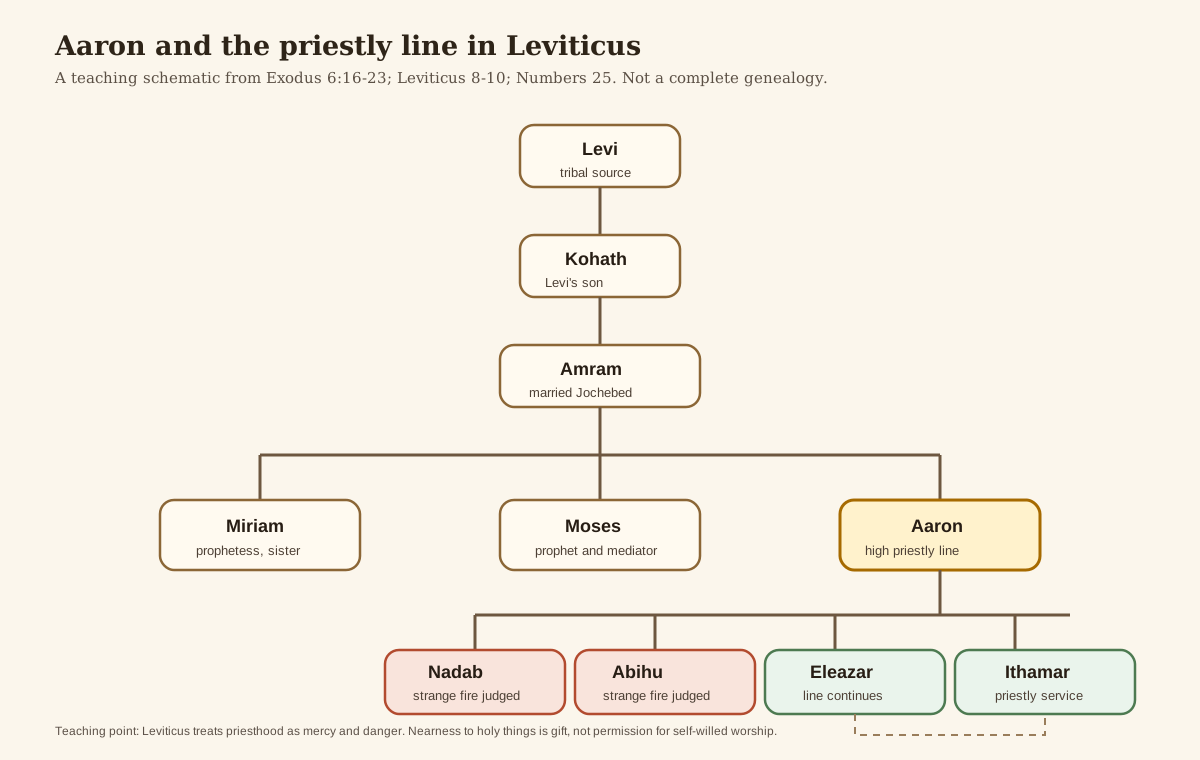 Source: Hermes-generated teaching schematic from Exodus 6:16-23, Leviticus 8-10, and Numbers 25. Partial teaching genealogy.
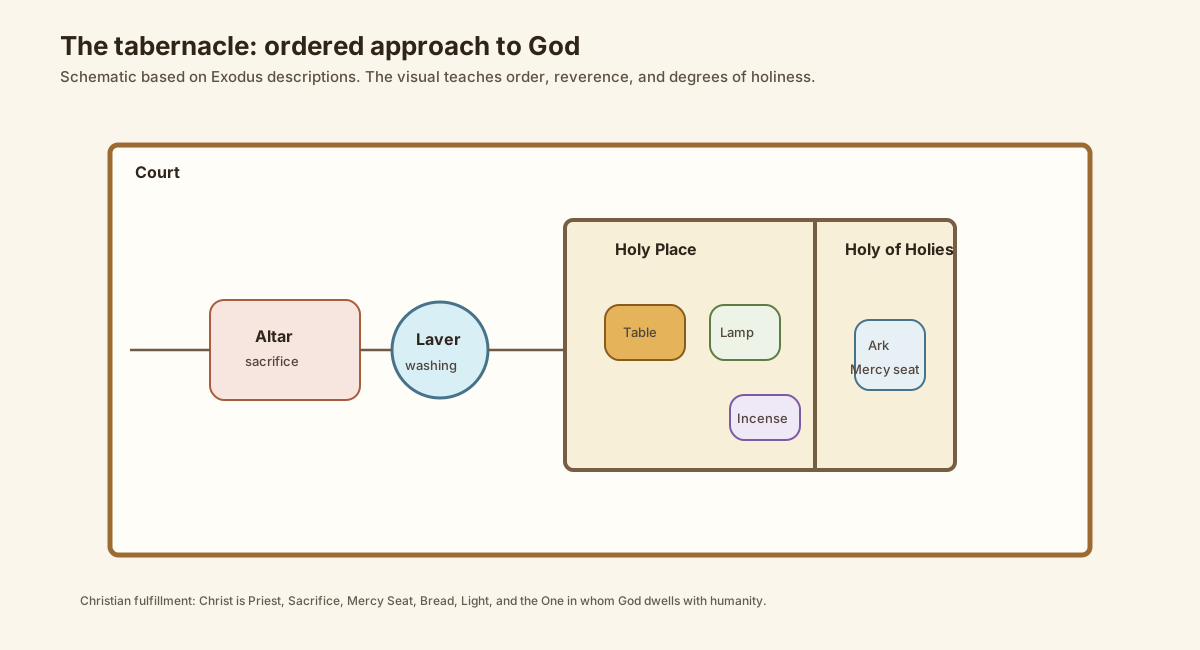 Source: Local project teaching schematic copied from the Exodus asset set. Use as sanctuary orientation only.
Spiritual Fruit 🍇
These chapters ask whether I take sin seriously without losing hope. They ask whether proximity to holy things has made me reverent or casual. They ask whether I offer God my best or my leftovers.
They also ask whether I can hold truth and mercy together. If I remove truth, holiness dissolves into sentiment. If I remove mercy, holiness becomes cruelty. Christ reveals both: He is the spotless High Priest who receives the wounded and makes them whole.
- Do not separate moral holiness from liturgical reverence.
- Let the severity of judgment protect the vulnerable and sober the priestly heart.
- Bring God offerings that are truthful, not blemished by hypocrisy or contempt.
Teacher's Notes
- Why does Leviticus 20 attach consequences to sins already named in chapter 18?
- How should Christians read Old Testament penalties without applying them as civil law?
- Why does Leviticus 20 end by placing clean and unclean creatures beside moral boundaries?
- Why are priests held to heightened standards?
- How does Christ fulfill priestly wholeness without despising wounded people?
- What does Leviticus 22 teach about offering God the best?
- What does “I will be sanctified in the midst of the children of Israel” mean?
- Where can church servants become casual around holy things?
Teach this unit with clarity and restraint. Do not hide the severity of the text, but do not weaponize it. Explain covenant context, fulfillment in Christ, and Orthodox sacramental application. Keep repeating the central balance: holiness is real, sin is serious, priestly service matters, offerings matter, and mercy in Christ remains the goal.
When you teach Leviticus 20:22-26, do not let the class treat the clean-unclean material as an accidental appendix. Show that Leviticus is training a whole pattern of discernment. When you teach Leviticus 21, explicitly say that typological priestly restrictions do not cancel the dignity of disabled persons. When you teach Leviticus 22, linger over verse 32 so that reverence for God’s Name is seen as a communal vocation.
Start with Leviticus 20 as covenant seriousness. Then move to Leviticus 20:22-26 as a summary of total holiness, where moral and ritual distinction meet. Then teach Leviticus 21 as priestly responsibility, with careful pastoral attention to dignity and typology. Finish with Leviticus 22 as reverent offering and the sanctification of God’s Name.
End with Christ: the spotless Priest, the acceptable offering, and the merciful healer of the blemished.
Where to linger: the link between priestly nearness, moral seriousness, and acceptable offering. Where to compress: technical priestly restrictions that do not serve the class. Pastoral guardrail: teach judgment soberly, without mockery or fear theater.
Visual teaching: use the priestly family tree and tabernacle plan to keep judgment, priesthood, and acceptable offering connected without sensationalism.
Glossary
- Molech: Molech refers to a pagan cult associated here with child sacrifice and covenant betrayal. The teacher should treat this as a grave warning against giving what belongs to God, especially children and family life, to destructive powers.
- Holiness: Holiness is God’s own otherness and purity shared with His people as a calling. In this unit it includes worship, justice, sexuality, priesthood, bodily dignity, and the integrity of offerings.
- Priestly blemish: A priestly blemish is a bodily condition that restricts altar service in the Levitical order without removing the person’s dignity or covenant belonging. It must be taught carefully so the class does not confuse ritual symbolism with human worth.
- Acceptable offering: An acceptable offering is whole, fitting, and brought according to God’s command. It teaches that worship is not merely sincere feeling but obedient reverence.
- Profaning the Name: To profane the Name is to treat the Lord’s holiness as common through disobedience, careless worship, or corrupt service. The phrase gives the teacher a way to connect ethics and worship without separating them.
- Stranger: The stranger is the non-Israelite living among the covenant people. Leviticus includes the stranger in moral accountability and, at key points, in the protection of God’s holy order.
Translation and Source Notes
Scripture quotations are from Brenton’s English Septuagint. This guide uses New Testament priesthood, holiness, and offering language as fulfillment and pastoral application of Levitical themes rather than as forced direct commentary on every judgment or priestly regulation in Leviticus 20-22.
This passage has no established place in the Coptic Orthodox lectionary.
Sources
Primary sources
- Leviticus 20-22 in Brenton’s English Septuagint.
- Hebrews 7, 9, and 10; 1 Peter 1:15-16, as New Testament fulfillment and holiness passages used in the guide.
- John Chrysostom, Homilies on Hebrews, where the guide discusses Hebrews’ fulfillment of sacrifice, priesthood, sanctuary, blood, or atonement themes.
Secondary academic sources
- Gordon J. Wenham, The Book of Leviticus.
- Jacob Milgrom, Leviticus volumes in the Anchor Yale Bible series.
- Mary Douglas, Leviticus as Literature.
- Jay Sklar, Leviticus.
Coptic Orthodox / pastoral sources
- The Divine Liturgy of St. Basil, for Orthodox language of offering, thanksgiving, altar, priesthood, and communion.
- Local Coptic Orthodox lectionary reference material, used cautiously; no exact Coptic placement is claimed for Leviticus 20-22.