
One figure descends from the royal throne carrying judgment like a sword. Another hurries into the wilderness carrying prayer and incense, then stands between the dead and the living. Wisdom places these images within the same account of God’s faithfulness. The Lord brings an end to bondage, and He appoints intercession for His own endangered people. His salvation is neither indifference to evil nor abandonment of the guilty to death.
Orientation
The heavy night of Wisdom 17 gives way to light for Israel. Chapter 18 recalls the killing of Hebrew infants, the rescue of Moses, Passover night, and the acknowledgment of Israel as God’s son. It then moves forward to Aaron’s intercession during the wilderness plague. These are distinct events, drawn together to show judgment, covenant, and mercy.
Israel’s sonship holds the chapter together. Before the final plague, the Lord names Israel His firstborn in Exodus 4:22-23. Wisdom returns to that identity when Egypt finally acknowledges the people as God’s sons in verse 13. Christians receive this history in the light of Christ, the Son who fulfills Israel’s calling, the living Word, and the High Priest who opens the way to life.
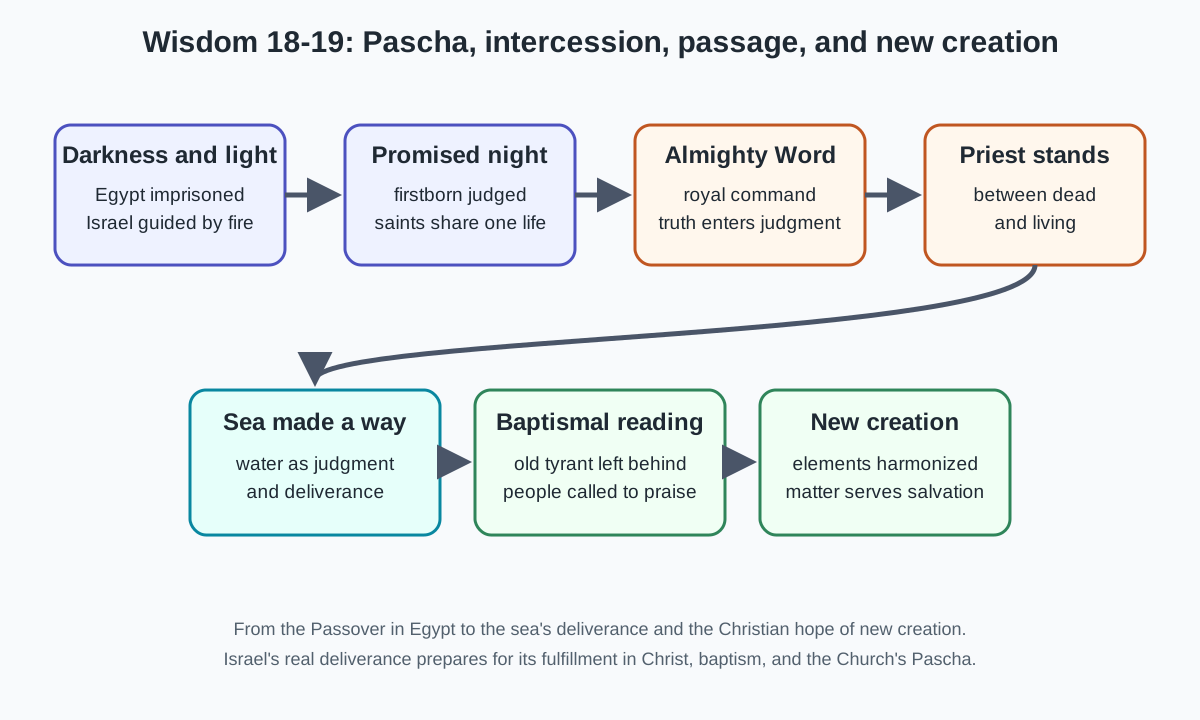 Pascha and new creation: a schematic of Wisdom 18-19 and their biblical parallels.
Light given for the world’s sake (Wisdom 18:1-4)
1 Nevertheless thy saints had a very great light, whose voice they hearing, and not seeing their shape, because they also had not suffered the same things, they counted them happy. 2 But for that they did not hurt them now, of whom they had been wronged before, they thanked them, and besought them pardon for that they had been enemies. 3 Instead whereof thou gavest them a burning pillar of fire, both to be a guide of the unknown journey, and a harmless sun to entertain them honourably. 4 For they were worthy to be deprived of light, and imprisoned in darkness, who had kept thy sons shut up, by whom the uncorrupt light of the law was to be given unto the world.
The Egyptians hear the people whom they cannot see and recognize their happiness. Israel has light while its former masters remain confined. Verse 2 adds a quieter distinction: those who had been wronged do not take the opportunity to injure their enemies. The oppressed are not simply handed the oppressor’s habits with the positions reversed. Mercy has begun to alter the relations that tyranny made.
This does not ask the enslaved to call their suffering harmless. The wrong is named, and those who inflicted it are brought to acknowledgment. The absence of revenge is something different from the absence of justice. For the Christian, relinquishing vengeance may require strong boundaries, truthful testimony, and protection of others from further injury. Christ’s mercy never requires calling oppression good.
The pillar of fire gives light for an “unknown journey”. Deliverance does not come with a map that makes dependence unnecessary. Israel is guided through what it does not yet know. The same fire is described as a harmless sun, a source of warmth and illumination under God’s care rather than an object of worship. The Lord who breaks the prison also accompanies the people beyond it.
Verse 4 names the wider purpose of their freedom. Through these people the incorrupt light of the law was to be given to the world. Their rescue serves a vocation: they are to bear God’s revelation. To imprison them is to oppose the gift God means to communicate through them. Their dignity rests in His call, not in their usefulness to the empire.
The sonship of Exodus 4:22 therefore belongs beside this light. Hosea 11:1 remembers God calling His son out of Egypt; Matthew 2:13-15 receives that history in the flight and return of the child Jesus. Christ fulfills Israel’s calling from within its story. Christian gratitude for this fulfillment must honor, rather than erase, the people through whom the light of the law was given.
Our own deliverance also has a purpose beyond relief. A person freed from bitterness can become able to reconcile; a household rescued from destructive habits can become hospitable; one who has received patient care can learn to bear another’s burden. The light is a gift to be inhabited and shared, not proof that we have become better than the people still needing it.
The promised night and the firstborn (Wisdom 18:5-13)
5 And when they had determined to slay the babes of the saints, one child being cast forth, and saved, to reprove them, thou tookest away the multitude of their children, and destroyedst them all together in a mighty water. 6 Of that night were our fathers certified afore, that assuredly knowing unto what oaths they had given credence, they might afterwards be of good cheer. 7 So of thy people was accepted both the salvation of the righteous, and destruction of the enemies. 8 For wherewith thou didst punish our adversaries, by the same thou didst glorify us, whom thou hadst called. 9 For the righteous children of good men did sacrifice secretly, and with one consent made a holy law, that the saints should be like partakers of the same good and evil, the fathers now singing out the songs of praise. 10 But on the other side there sounded an ill according cry of the enemies, and a lamentable noise was carried abroad for children that were bewailed. 11 The master and the servant were punished after one manner; and like as the king, so suffered the common person. 12 So they all together had innumerable dead with one kind of death; neither were the living sufficient to bury them: for in one moment the noblest offspring of them was destroyed. 13 For whereas they would not believe any thing by reason of the enchantments; upon the destruction of the firstborn, they acknowledged this people to be the sons of God.
The remembrance begins with the children. Exodus 1:22 records Pharaoh’s command against the Hebrew boys; Exodus 2:1-10 tells how Moses was placed among the reeds and preserved. Wisdom compresses the rescue of that one child, the judgment upon Egypt’s firstborn, and the later destruction of its pursuing force in the sea. Exodus 14:28 identifies the force overwhelmed there. The text’s compression should not make us imagine that Exodus narrates the drowning of all Egypt’s children.
The connection is morally severe. An empire that treated Hebrew life as disposable discovers that it cannot secure its own life by power. Yet the cries in verses 10-12 prevent a bloodless reading. There are children mourned and households overwhelmed. Wisdom does not invite delight in those tears, nor does the narrative authorize assigning an adult tyrant’s personal guilt to each child who suffers within his order. It confronts us with divine judgment in a history wounded by collective violence. We may acknowledge the gravity without pretending to have a simple explanation of every person’s suffering.
Israel, meanwhile, has been prepared for the night. Genesis 15:13-14 foretells bondage and deliverance; Exodus 11:4-7 announces the coming judgment; Exodus 12:3-13 gives the households a way to await it in obedience. The fathers’ confidence rests upon a promise received beforehand. They do not know that danger is unreal. They know whom they have believed while danger remains real.
Verse 9 places sacrifice, agreement, and shared life together. Exodus 12:3-11 gives the meal its household form, and Exodus 12:26-27 gives its remembrance to the children who will ask what it means. Wisdom draws out the people’s solidarity: they share the same good and evil, the benefits and the dangers of belonging to the covenant. Their obedience is undertaken together, with praise already sounding before the night is over.
The contrast is then heard. The praise of the covenant people stands beside the dissonant cry from Egypt. The text does not make one sound less human than the other. It distinguishes a people living by God’s promise from a political order whose power has collapsed. Master and servant, king and ordinary person discover that rank cannot shelter them. Their final acknowledgment in verse 13 concerns the very identity Pharaoh had refused: Israel is God’s son.
This is the heart of the firstborn contrast. The Lord’s claim upon Israel precedes Egypt’s concession. Divine sonship is received from God’s call, not from the enemy’s permission. In Christ, it comes to its fullness in the eternal Son who has entered our human life and brings us into filial communion with the Father. No institution that humiliates or enslaves a human being can be allowed to define that person’s ultimate worth.
For the Church, the shared Passover life reaches toward the one Body gathered around Christ our Passover, as 1 Corinthians 5:7-8 names Him. First Corinthians 12:26 gives the communal consequence: another member’s suffering and honor concern the whole body. A parish cannot truly celebrate deliverance while treating the grieving, poor, or difficult member as someone else’s problem. Communion becomes visible when the other’s burden interrupts our arrangements.
Gems from the Fathers 💎: The blood and the confident people
St. John Chrysostom’s Homily 27 on Hebrews, §1, reads Hebrews 11:28 through the reality of Christ’s sacrifice. The blood on the doorposts belongs to the genuine Passover history; it points beyond itself to the blood of Christ. He brings the Christian congregation into that deliverance: “For God has brought us out from Egypt, from darkness, from idolatry.”1
This is a thematic witness through Hebrews, not direct exposition of Wisdom 18. It clarifies the kind of confidence Wisdom describes. The saints are not courageous because they have become invulnerable or have earned a superior position. They trust the mercy God has appointed. In the Church, confidence likewise rests upon Christ’s self-offering and calls for a life worthy of the deliverance received.
The Almighty Word enters the night (Wisdom 18:14-19)
14 For while all things were in quiet silence, and that night was in the midst of her swift course, 15 thine Almighty word leaped from heaven out of thy royal throne, as a fierce man of war into the midst of a land of destruction, 16 and brought thine unfeigned commandment as a sharp sword, and standing up filled all things with death; and it touched the heaven, but it stood upon the earth. 17 Then suddenly visions of horrible dreams troubled them sore, and terrors came upon them unlooked for. 18 And one thrown here, and another there, half dead, shewed the cause of his death. 19 For the dreams that troubled them did foreshew this, lest they should perish, and not know why they were afflicted.
The silence of verse 14 belongs to Passover night. Wisdom gives the moment an immense stillness, then depicts the royal word leaping into the land of destruction. God’s speech is no mere report upon events. It accomplishes His judgment. The command is carried as a sword because the false security of the oppressing kingdom cannot stand against it.
Exodus 15:3 praises the Lord as the warrior who delivers His people. First Chronicles 21:16 pictures the angel with a drawn sword between heaven and earth. These help us hear the scale of Wisdom’s image: heaven’s decree reaches the place in which human power has seemed absolute. The command is “unfeigned”, without pretense. Egypt’s enchantments promised an authority they could not supply; the Lord’s word proves effective.
Language insight: “Almighty word” and “fierce man of war”
Verse 15 calls the word “ὁ παντοδύναμός σου λόγος”, ho pantodynamos sou logos, Your almighty word, and describes it as “ἀπότομος πολεμιστής”, apotomos polemistēs, a stern or relentless warrior. The Elpenor Greek text thus joins divine speech to royal and martial imagery. The original setting is God’s effective judgment in the Exodus; the word “λόγος” alone does not turn the scene into a narration of the Incarnation.2
Revelation 19:11-16 offers a powerful Christian parallel: the rider judges righteously, bears the name “The Word of God”, and strikes with the sword from His mouth. The images can be read together within Scripture’s revelation of Christ’s victorious judgment. Their resemblance does not by itself establish that Revelation is directly borrowing this passage. Hebrews 4:12 similarly uses the sharp sword to speak of the word of God exposing the heart. Before treating divine judgment as a picture of what will happen to others, we may let that searching word reach our own defended falsehood.
Christ’s judgment and His salvation belong to one Lord. The Son does not save by declaring cruelty unreal. On the Cross He exposes sin’s violence, freely enters death, and rises victorious over it. Christians therefore hear Wisdom’s royal word in the fullness of the eternal Son whom John 1:1-3 reveals, while preserving the difference between this personification of God’s command and John’s explicit confession of who the Word is.
Verses 17-19 return from the great image to troubled human experience. Dreams disclose the reason for the affliction. Wisdom presents the judgment as morally intelligible rather than a meaningless eruption of terror. That does not give us a method for decoding the dreams or illnesses of our neighbors. Here the explanation belongs to the inspired account of a particular night. Its enduring demand is to stop treating evil as if it could finally remain unnamed.
Gems from the Fathers 💎: The Word is truly God
St. Cyril of Alexandria, in Commentary on John I.3, explains John 1:1 against the notion of a Son inferior in divine nature. The Word shares the Father’s divine life, rather than serving as a created instrument between God and the world. Cyril writes: “Perfect then clearly the Son too, the Wisdom and the Power, the Light and the Truth, the Righteousness and the Counsel of the Father.”3
His argument is about John’s Gospel, and it is used here thematically. It supplies a necessary Christian guardrail: when we turn from Wisdom’s royal command to Christ, we are confessing the Son who is God by nature. The One who saves us is not a lesser power that we might place between ourselves and an inaccessible Father. In Him, the Father’s own life and mercy are given to us.
The priest who stood between (Wisdom 18:20-25)
20 Yea, the tasting of death touched the righteous also, and there was a destruction of the multitude in the wilderness: but the wrath endured not long. 21 For then the blameless man made haste, and stood forth to defend them; and bringing the shield of his proper ministry, even prayer, and the propitiation of incense, set himself against the wrath, and so brought the calamity to an end, declaring that he was thy servant. 22 So he overcame the destroyer, not with might of body, nor force of arms, but with a word subdued him that punished, alleging the oaths and covenants made with the fathers. 23 For when the dead were now fallen down by heaps one upon another, standing between, he stayed the wrath, and parted the way to the living. 24 For in the long garment was the whole world, and in the four rows of the stones was the glory of the fathers graven, and thy Majesty upon the diadem of his head. 25 Unto these the destroyer gave place, and they were afraid of them: for it was enough that they only tasted of the wrath.
The next turn prevents Israel’s deliverance from becoming a story of inherent innocence. Death touches the righteous people too. Wisdom moves from Egypt to the wilderness rebellion and plague of Numbers 16:41-50. In the Septuagint division, Aaron’s decisive action appears in Numbers 17:11-13. The delivered people still need mercy, and their continued life depends upon the Lord’s covenant rather than a claim to immunity.
Aaron runs into the threatened congregation. His weapon is the ministry appointed to him: prayer and the offering of incense. He stands between the dead and the living, and the plague ceases. Moses has directed him to take fire from the altar; this is not an improvised attempt to manipulate a divine power. The action belongs to the means of atonement that God has given His people.
Verse 22 makes the ground of intercession explicit. Aaron recalls the oaths and covenants with the fathers. He does not defeat God by discovering a stronger argument than God had considered. The Lord’s own promises give the priest something to plead. The same pattern appears when Moses intercedes in Exodus 32:11-14. Intercession is covenant faithfulness exercised within God’s mercy, not a human kindness opposed to a divine cruelty.
The vestments show whom the priest carries before God. Exodus 28:4 names Aaron’s garments of ministry; Exodus 28:9-21 describes the names of Israel’s tribes borne upon the stones, and Exodus 28:36-38 the holy inscription upon the forehead. Wisdom extends the vision to the whole world represented in the garment. Priesthood faces God with the life of others, not with a concern for religious importance. The garment’s glory declares a responsibility.
Language insight: “the long garment”
The adjective in verse 24 is “ποδήρους”, from “ποδήρης”, podērēs, reaching to the feet. Revelation 1:13 uses another form of this adjective for the long robe of the risen Christ. The shared term helps a Christian notice the priestly resonance of the vision; it cannot, by itself, prove a direct allusion to Wisdom. The wider fulfillment rests upon Christ’s priesthood, explicitly taught in Hebrews 7:25 and Hebrews 9:11-12.4
Christ’s intercession surpasses Aaron’s without making Aaron’s prayer unreal. The Son offers Himself and enters the holy place through His own blood. He is able to save those who draw near through Him because He lives to intercede for them. The Father who sends Him and the Son who offers Himself share one saving will. In prayer, we approach that mercy, not a quarrel within God that we hope Christ will resolve in our favor.
Aaron’s haste gives this doctrine a human urgency. When another person’s life is being consumed by sickness, temptation, or grief, indifference is an inadequate response. We cannot do the High Priest’s saving work in His place. We can carry names before Him, go to the person in danger, call for help, and refuse the distance that turns suffering into a subject of conversation. Intercession joins prayer to loving attention.
The Church’s Voice in Worship ⛪
The Coptic Raising of Incense gathers the needs of others into the Church’s prayer. Vespers remembers the departed; weekday morning incense includes intercession for the sick and travelers, with differences according to the day. The practice lets us recognize the world carried in Aaron’s ministry: those who cannot stand visibly among the congregation are still remembered before God.5
Psalm 141:2 (LXX Ps 140:2) brings prayer and incense together, and Revelation 8:3-4 depicts incense ascending with the prayers of the saints. The incense is not a substitute for the heart’s prayer, nor a means of controlling God’s will. It gives bodily expression to the Church’s participation in Christ’s intercession. Wisdom 18 is illuminated by this worship; no appointment of this passage as a Coptic reading is asserted.
Glossary
- Pascha: Passover; in Christian fulfillment, Christ’s saving passage through death into life and the Church’s participation in it.
- Firstborn: In this chapter, central both to the judgment upon Egypt and to God’s naming Israel as His son in Exodus 4:22-23.
- Almighty Word: Wisdom’s image of God’s effective royal command in the Passover judgment, read by Christians in the light of the eternal Son.
- Intercession: Prayer offered for others, grounded in God’s mercy and promises.
- Propitiation of incense: Here, Aaron’s appointed offering for the people’s atonement, not a magical property of incense.
- Vestments: Garments of priestly ministry, whose names and symbols signify the people represented before God.
Spiritual Fruit 🍇
Receive freedom as a vocation. Name a place where Christ has begun to free you from a destructive habit. Ask whom that freedom now enables you to serve. The light given to Israel was meant to reach the world; healing grows fruitful when it loosens our grip upon ourselves.
Share the life of the Body. Learn the name and actual need of one person whose burden has remained distant. A meal, a visit, help obtaining care, or a quiet act of practical support can make 1 Corinthians 12:26 visible. Communion is weakened when someone suffers within reach of us and we remain interested only in our own peace.
Carry names before the High Priest. Pray deliberately for the sick, the departed, the person traveling, and the person whose choices frighten you. Add the name of someone you find difficult to love. Aaron’s prayer rests upon God’s promise; yours rests upon Christ who lives to intercede. Let that confidence lead to attention, not to the assumption that your task is merely to watch.
Aaron stands where death seems to be advancing, carrying the ministry he has received. The people behind him do not live because he has made them suddenly deserving. Mercy opens a way. Bring the names entrusted to you before Christ, and ask Him to teach you the haste of love.
Teaching Notes
Light given for the world’s sake (Wisdom 18:1-4)
- Ask: What is the difference between receiving light for safety and receiving it for a vocation?
- Emphasize: Exodus 4:22-23 names Israel as God’s son before Egypt acknowledges it. Matthew 2:13-15 fulfills rather than cancels Israel’s history.
- Watch for: Conflating forgiveness with unrestricted access for an abuser or using Christian fulfillment to demean Israel.
- Show: Use the schematic as a theological sequence, not as a geographical map. Keep Israel’s history first and the Christian fulfillment second.
The promised night and the firstborn (Wisdom 18:5-13)
- Ask: How does a promise received beforehand give courage while danger remains?
- Emphasize: Verse 5 compresses different events. Distinguish Pharaoh’s attack on infants, Moses’ rescue, the firstborn judgment, and the sea’s destruction of the pursuing force.
- Watch for: Cruel speech about Egyptian grief or assigning personal culpability to the children. Preserve the reader-facing caution in the exposition.
- Connect: Exodus 12:3-13 and Exodus 12:26-27 give the meal and its remembrance; 1 Corinthians 12:26 develops the shared life.
The Almighty Word enters the night (Wisdom 18:14-19)
- Ask: Why does effective divine speech appear as a warrior carrying a sword?
- Emphasize: Christian readers must be careful and bold: explain the Exodus command before confessing the eternal Son through John 1:1-3.
- Watch for: Treating Revelation 19:11-16 as demonstrable borrowing or making the Greek word alone prove the full doctrine of the Incarnation.
- Connect: The Word’s judgment exposes evil; the Cross and Resurrection reveal Christ’s victory over it. Cyril I.3 is a thematic doctrinal witness.
The priest who stood between (Wisdom 18:20-25)
- Ask: What does Aaron’s haste reveal about the vocation of intercession?
- Emphasize: Numbers 16:46-48 corresponds to Numbers 17:11-13 in the displayed Brenton Septuagint. Covenant promises ground Aaron’s plea.
- Watch for: Opposing a merciful Son to a cruel Father, treating incense as magic, or making prayer an alternative to urgently needed practical help.
- Connect: Hebrews 7:25 and Hebrews 9:11-12 give the full Christian foundation. The Raising of Incense is a worship resonance; no exact prayer wording or chapter appointment is claimed.
Sources
Embedded Scripture is from Brenton’s English Septuagint (LXX).
- Wisdom 18, Brenton; Exodus 1:22; Exodus 2:1-10; Exodus 4:22-23; Exodus 11:4-7; Exodus 12:3-27; Exodus 14:28; Hosea 11:1; Matthew 2:13-15.
- Numbers 17:11-13, Brenton, corresponding to Numbers 16:46-48 in Hebrew-based numbering; Exodus 28:9-38; Hebrews 7:25; Hebrews 9:11-12.
- Wisdom 18, Greek and English; Revelation 1:13; Revelation 19:11-16. The parallels support a Christian reading without settling literary dependence.
- St. John Chrysostom, Homilies on Hebrews, Homily 27, §1; St. Cyril of Alexandria, Commentary on John I.3. Their use here is thematic, through their interpretation of the New Testament.
- Coptic Sunday School, “Matins and Vespers”, section on the litanies. The worship description is paraphrased; no exact service-book wording is quoted.
This passage does not appear in the Coptic lectionary readings we follow.
Footnotes
-
St. John Chrysostom, Homilies on Hebrews, Homily 27, §1, on Hebrews 11:28, NPNF1 14, Passover blood and Christian deliverance. ↩
-
Wisdom 18:15-16, Elpenor Greek Septuagint. The note concerns the text displayed by this edition. ↩
-
St. Cyril of Alexandria, Commentary on John I.3, on John 1:1, translated by P. E. Pusey, the Son’s perfection and divine nature. ↩
-
Wisdom 18:24, Elpenor Greek Septuagint; Thayer, “ποδήρης”, with Revelation 1:13 and the Septuagint’s priestly garment passages. ↩
-
Coptic Sunday School, “Matins and Vespers”, “The Litany”, describing the litanies for the departed, sick, and travelers. The Aaron connection is also made there. These are descriptions of worship, not a claim of lectionary use for Wisdom 18. ↩