


Core burden
Numbers 13-14 is the turning point where fear changes the shape of Israel’s future. Twelve spies see the same land, the same fruit, and the same fortified cities, but only Joshua and Caleb interpret reality through God’s promise. The people choose fear over faith, accuse God of cruelty, and turn a journey of inheritance into forty years of wandering.
Why this passage matters
This passage matters because it shows how unbelief works after grace. Israel has seen God’s power, but fear still edits the future. The chapter is not a simplistic lesson about optimism. It is about whether God’s promise is more real to us than visible giants.
1: And the Lord spoke to Moses, saying, 2: Send for thee men, and let them spy the land of the Chananites, which I give to the sons of Israel for a possession; one man for a tribe, thou shalt send them away according to their families, every one of them a prince. 3: And Moses sent them out of the wilderness of Pharan by the word of the Lord; all these were the princes of the sons of Israel. 4: And these are their names: of the tribe of Ruben, Samuel the son of Zachur. 5: Of the tribe of Symeon, Saphat the son of Suri. 6: Of the tribe of Judah, Chaleb the son of Jephonne. 7: Of the tribe of Issachar, Ilaal the son of Joseph. 8: Of the tribe of Ephraim, Ause the son of Naue. 9: Of the tribe of Benjamin, Phalti the son of Raphu. 10: Of the tribe of Zabulon, Gudiel the son of Sudi. 11: Of the tribe of Joseph of the sons of Manasse, Gaddi the son of Susi. 12: Of the tribe of Dan, Amiel the son of Gamali. 13: Of the tribe of Aser, Sathur the son of Michael. 14: Of the tribe of Nephthali, Nabi the son of Sabi. 15: Of the tribe of Gad, Gudiel the son of Macchi. 16: These are the names of the men whom Moses sent to spy out the land; and Moses called Ause the son of Naue, Joshua. 17: And Moses sent them to spy out the land of Chanaan, and said to them, Go up by this wilderness; and ye shall go up to the mountain, 18: and ye shall see the land, what it is, and the people that dwells on it, whether it is strong or weak, or whether they are few or many. 19: And what the land is on which they dwell, whether it is good or bad; and what the cities are wherein these dwell, whether they dwell in walled cities or unwalled. 20: And what the land is, whether rich or poor; whether there are trees in it or no: and ye shall persevere and take of the fruits of the land: and the days were the days of spring, the forerunners of the grape. 21: And they went up and surveyed the land from the wilderness of Sin to Rhoob, as men go in to Æmath. 22: And they went up by the wilderness, and departed as far as Chebron; and there was Achiman, and Sessi, and Thelami, the progeny of Enach. Now Chebron was built seven years before Tanin of Egypt. 23: And they came to the valley of the cluster and surveyed it; and they cut down thence a bough and one cluster of grapes upon it, and bore it on staves, and they took of the pomegranates and the figs. 24: And they called that place, The valley of the cluster, because of the cluster which the children of Israel cut down from thence. 25: And they returned from thence, having surveyed the land, after forty days. 26: And they proceeded and came to Moses and Aaron and all the congregation of the children of Israel, to the wilderness of Pharan Cades; and they brought word to them and to all the congregation, and they shewed the fruit of the land: 27: and they reported to him, and said, We came into the land into which thou sentest us, a land flowing with milk and honey; and this is the fruit of it. 28: Only the nation that dwells upon it is bold, and they have very great and strong walled towns, and we saw there the children of Enach. 29: And Amalec dwells in the land toward the south: and the Chettite and the Evite, and the Jebusite, and the Amorite dwells in the hill country: and the Chananite dwells by the sea, and by the river Jordan. 30: And Chaleb stayed the people from speaking before Moses, and said to him, Nay, but we will go up by all means, and will inherit it, for we shall surely prevail against them. 31: But the men that went up together with him said, We will not go up, for we shall not by any means be able to go up against the nation, for it is much stronger than we. 32: And they brought a horror of that land which they surveyed upon the children of Israel, saying, The land which we passed by to survey it, is a land that eats up its inhabitants; and all the people whom we saw in it are men of extraordinary stature. 33: And there we saw the giants; and we were before them as locusts, yea even so were we before them.
1: And all the congregation lifted up their voice and cried; and the people wept all that night. 2: And all the children of Israel murmured against Moses and Aaron; and all the congregation said to them, 3: Would we had died in the land of Egypt! or in this wilderness, would we had died! and why does the Lord bring us into this land to fall in war? our wives and our children shall be for a prey: now then it is better to return into Egypt. 4: And they said one to another, Let us make a ruler, and return into Egypt. 5: And Moses and Aaron fell upon their face before all the congregation of the children of Israel. 6: But Joshua the son of Naue, and Chaleb the son of Jephonne, of the number of them that spied out the land, rent their garments, 7: and spoke to all the congregation of the children of Israel, saying, The land which we surveyed is indeed extremely good. 8: If the Lord choose us, he will bring us into this land, and give it us; a land which flows with milk and honey. 9: Only depart not from the Lord; and fear ye not the people of the land, for they are meat for us; for the season of prosperity is departed from them, but the Lord is among us: fear them not. 10: And all the congregation bade stone them with stones; and the glory of the Lord appeared in the cloud on the tabernacle of witness to all the children of Israel. 11: And the Lord said to Moses, How long does this people provoke me? and how long do they refuse to believe me for all the signs which I have wrought among them? 12: I will smite them with death, and destroy them; and I will make of thee and of thy father’s house a great nation, and much greater than this. 13: And Moses said to the Lord, So Egypt shall hear, for thou hast brought up this people from them by thy might. 14: Moreover all the dwellers upon this land have heard that thou art Lord in the midst of this people, who, O Lord, art seen by them face to face, and thy cloud rests upon them, and thou goest before them by day in a pillar of a cloud, and by night in a pillar of fire. 15: And if thou shalt destroy this nation as one man; then all the nations that have heard thy name shall speak, saying, 16: Because the Lord could not bring this people into the land which he sware to them, he has overthrown them in the wilderness. 17: And now, O Lord, let thy strength be exalted, as thou spakest, saying, 18: The Lord is long-suffering and merciful, and true, removing transgressions and iniquities and sins, and he will by no means clear the guilty, visiting the sins of the fathers upon the children to the third and fourth generation. 19: Forgive this people their sin according to thy great mercy, as thou wast favourable to them from Egypt until now. 20: And the Lord said to Moses, I am gracious to them according to thy word. 21: But as I live and my name is living, so the glory of the Lord shall fill all the earth. 22: For all the men who see my glory, and the signs which I wrought in Egypt, and in the wilderness, and have tempted me this tenth time, and have not hearkened to my voice, 23: surely they shall not see the land, which I sware to their fathers; but their children which are with me here, as many as know not good or evil, every inexperienced youth, to them will I give the land; but none who have provoked me shall see it. 24: But my servant Chaleb, because there was another spirit in him, and he followed me, I will bring him into the land into which he entered, and his seed shall inherit it. 25: But Amalec and the Chananite dwell in the valley: to-morrow turn and depart for the wilderness by the way of the Red Sea. 26: And the Lord spoke to Moses and Aaron, saying, 27: How long shall I endure this wicked congregation? I have heard their murmurings against me, even the murmuring of the children of Israel, which they have murmured concerning you. 28: Say to them, As I live, saith the Lord: surely as ye spoke into my ears, so will I do to you. 29: Your carcases shall fall in this wilderness; and all those of you that were reviewed, and those of you that were numbered from twenty years old and upward, all that murmured against me, 30: ye shall not enter into the land for which I stretched out my hand to establish you upon it; except only Chaleb the son of Jephonne, and Joshua the son of Naue. 31: And your little ones, who ye said should be a prey, them will I bring into the land; and they shall inherit the land, which ye rejected. 32: And your carcases shall fall in this wilderness. 33: And your sons shall be fed in the wilderness forty years, and they shall bear your fornication, until your carcases be consumed in the wilderness. 34: According to the number of the days during which ye spied the land, forty days, a day for a year, ye shall bear your sins forty years, and ye shall know my fierce anger. 35: I the Lord have spoken, Surely will I do thus to this evil congregation that has risen up together against me: in this wilderness they shall be utterly consumed, and there they shall die. 36: And the men whom Moses sent to spy out the land, and who came and murmured against it to the assembly so as to bring out evil words concerning the land,— 37: the men that spoke evil reports against the land, even died of the plague before the Lord. 38: And Joshua the son of Naue and Chaleb the son of Jephonne still lived of those men that went to spy out the land. 39: And Moses spoke these words to all the children of Israel; and the people mourned exceedingly. 40: And they rose early in the morning and went up to the top of the mountain, saying, Behold, we that are here will go up to the place of which the Lord has spoken, because we have sinned. 41: And Moses said, Why do ye transgress the word of the Lord? ye shall not prosper. 42: Go not up, for the Lord is not with you; so shall ye fall before the face of your enemies. 43: For Amalec and the Chananite are there before you, and ye shall fall by the sword; because ye have disobeyed the Lord and turned aside, and the Lord will not be among you. 44: And having forced their passage, they went up to the top of the mountain; but the ark of the covenant of the Lord and Moses stirred not out of the camp. 45: And Amalec and the Chananite that dwelt in that mountain came down, and routed them, and destroyed them unto Herman; and they returned to the camp.
Historical and Scriptural Context
After leaving Sinai and experiencing internal complaints, Israel reaches the threshold of Canaan. Moses sends leaders to spy out the land. They return with real fruit and real fear. The majority report is factually mixed but spiritually faithless. The people’s revolt leads to God’s judgment: the generation that refused to enter will die in the wilderness, while Joshua and Caleb will enter.
Lesson Guide
- Key phrases: The giants are real, but they are not ultimate. Fear eventually slanders God. Realism without God can become unbelief.
- Emphasize: the difference between honest facts and faithless interpretation.
- Avoid: turning the lesson into shallow optimism or mocking fearful people.
Light from the Word 🕯️
1. The land is good and the fear is real
The spies bring grapes, pomegranates, and figs. The land is not imaginary. The obstacles are not imaginary either. Faith does not deny fortified cities. It refuses to make them more ultimate than God.
2. The majority report weaponizes realism
The ten spies begin with truth, then interpret it without God. ‘We are not able’ becomes the controlling sentence. This is one of the most dangerous forms of unbelief, because it sounds responsible.
3. Joshua and Caleb have another spirit
Caleb quiets the people and urges immediate obedience. Later God says Caleb has another spirit. The difference is not information; it is trust. Two people can see the same facts and inhabit different spiritual worlds.
4. The people accuse God of harm
They say God brought them out to fall by the sword and want to return to Egypt. Fear eventually slanders God. It recasts deliverance as cruelty and slavery as safety.
5. Presumption follows unbelief
After judgment is announced, the people try to go up anyway, but the Lord is not with them. Refusing God’s command and then attempting God’s promise on our own terms are two sides of the same disobedience.
Gems from the Fathers 💎
St. Gregory of Nyssa’s Life of Moses helps frame the promised land as the soul’s movement into deeper communion, but Numbers 13-14 warns that ascent requires trust. St. John Chrysostom often exposes the way fear and human calculation can disguise disobedience. Origen’s inward reading asks where the soul magnifies giants and minimizes grace. The Fathers do not teach denial of danger; they teach that danger must be interpreted under providence.
Christological and ecclesial fulfillment
Joshua and Caleb point toward Christ and faithful discipleship. Joshua, whose name is connected to Jesus, will lead where Moses cannot. Caleb represents wholehearted following. The true entry into inheritance comes through Christ, who conquers not by avoiding giants but by passing through death. The wilderness judgment also echoes Hebrews 3-4, where unbelief prevents entry into rest.
Iconography and Visual Teaching 🖼️
Use the journey schematic to show Kadesh as a spiritual hinge. The visual should serve the passage’s main burden: Israel stands near promise but interprets the land through fear. Do not overstate the exact spy route. The teachable contrast is between God’s promise and the imagination that magnifies giants until obedience feels impossible.
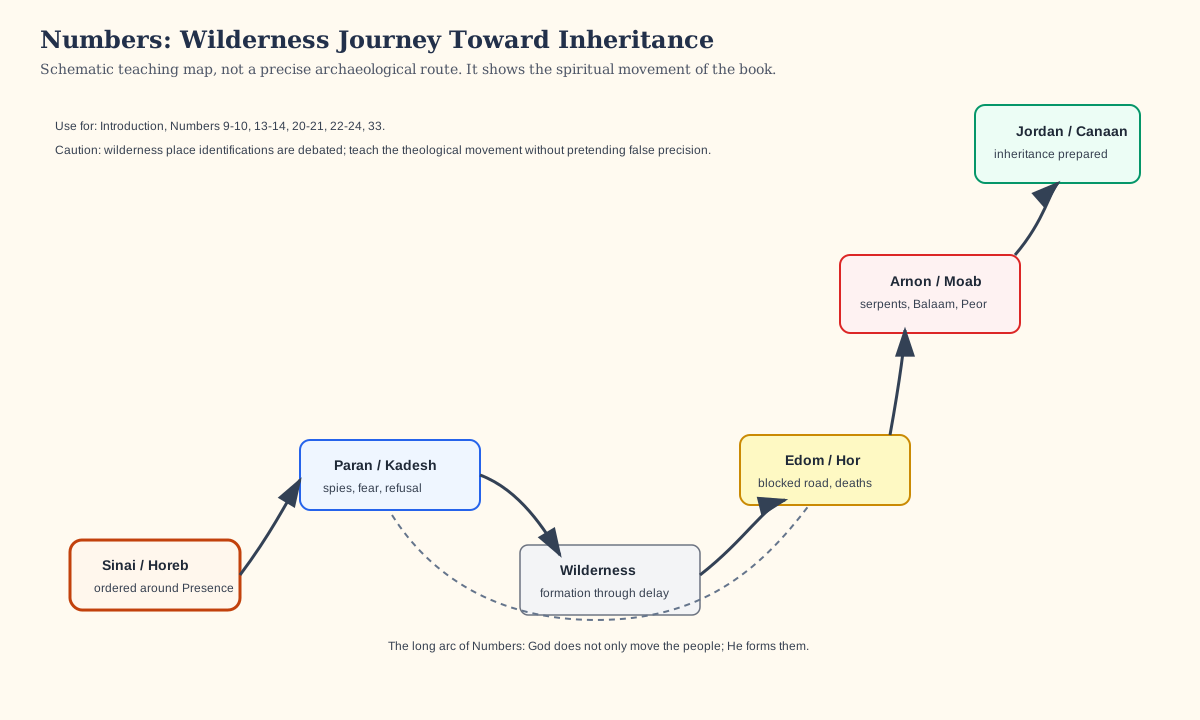 Source: Hermes-generated teaching schematic from the biblical movement of Numbers, 2026-06-18. Schematic only; route details are debated.
The Church’s Voice in Worship ⛪
This passage has no established place in the Coptic Orthodox lectionary.
Deeper spiritual insight and teaching emphasis
The spies do not lie about the difficulty. The land really has fortified cities and strong inhabitants. Their sin is not noticing danger; their sin is interpreting danger without God. Faith is not denial of facts. Faith is refusing to let facts become larger than the promise.
The majority report weaponizes realism. It sounds sober, responsible, and evidence-based, but it drains courage from the people. This is one of the most common adult spiritual failures. We call it realism when we have stopped praying. We call it prudence when we have surrendered hope. Caleb and Joshua do not deny the giants. They simply refuse to remove God from the calculation.
The people’s accusation is devastating: they say God brought them out to kill them. This is what fear eventually does. It rewrites mercy as malice. The Exodus becomes a trap, the Lord becomes dangerous, and Egypt becomes attractive. In pastoral teaching, this should be connected to suffering and disappointment. When life hurts, the heart is tempted to reinterpret God’s past kindness as deception.
The failed attempt to enter after judgment is equally important. Presumption is unbelief wearing a religious costume. Yesterday they would not go with God; today they try to go without Him. The spiritual life requires timely obedience. Repentance is not seizing control after refusing trust. It is returning to God in the place where His word now meets us.
Second-pass teaching refinement
The spies do not merely report facts; they interpret facts without faith. The giants are real, the fortified cities are real, and the land is truly good. The failure is not observation but imagination severed from God’s promise. Fear becomes a false prophet, teaching Israel to see itself as grasshoppers and God as absent. This is why unbelief spreads so quickly through the congregation. Fear rarely stays private.
Joshua and Caleb show a different kind of realism. They do not deny danger; they refuse to let danger become ultimate. Adult teaching should linger here because many people think faith means minimizing the hard thing. It does not. Faith means telling the truth about the hard thing while telling a deeper truth about God. The wilderness judgment is severe because Israel’s refusal is not a momentary weakness; it is a settled decision to return inwardly to Egypt. The spiritual question is painful but necessary: where have I made fear more authoritative than the promise of God?
Spiritual Fruit 🍇
- Do not call fear wisdom too quickly. Some caution is discernment; some caution is unbelief wearing mature clothing.
- Ask what your report does to hope. Do your words help people trust God, or do they make obedience seem foolish?
- Refuse nostalgia for slavery. When obedience feels costly, Egypt will advertise itself as safety.
- Do not confuse delayed obedience with repentance. Going up after God has said no is not courage. It is presumption.
- Cultivate another spirit. Caleb’s courage came from a heart trained to interpret reality with God at the center.
Discussion Questions
- How can a report be factually accurate but spiritually faithless?
- Where does fear make obedience look irresponsible to you?
- Why does the people’s fear turn into accusation against God?
- What is the difference between repentance and presumption at the end of chapter 14?
- What would it mean to have another spirit in a current struggle?
Teaching Notes
Timing: 15 minutes spying and report, 15 minutes rebellion, 10 minutes judgment, 10 minutes Hebrews/rest connection.
Where to linger: the majority report as realism without faith.
Where to compress: the full list of tribal spy names.
Pastoral warnings: do not shame people with trauma or anxiety. The call is not denial of fear, but bringing fear under God’s promise.
Key sentence to say slowly: Fear does not only predict disaster; eventually it accuses God of being the author of disaster.
This passage has no established place in the Coptic Orthodox lectionary.
Show: the journey schematic and ask where fear turns a near entrance into a long wilderness.
Glossary
- Spies: tribal leaders sent to inspect Canaan.
- Caleb: faithful spy from Judah who follows the Lord wholeheartedly.
- Joshua: faithful spy and future leader; his name is connected to Jesus/Yeshua.
- Presumption: religious action taken after refusing obedience, without God’s command or presence.
Sources
Primary sources
- Scripture: Numbers in Brenton’s English Septuagint; brief New Testament cross-references where noted.
- Origen, Homilies on Numbers, used cautiously for spiritual and typological interpretation of the wilderness narratives.
- St. Gregory of Nyssa, The Life of Moses, for the wilderness as purification, ascent, and training in desire for God.
- St. Cyril of Alexandria, Christological and sacramental interpretation of Old Testament signs where relevant.
- St. John Chrysostom, pastoral teaching on repentance, humility, obedience, speech, leadership, and the passions.
- St. John Cassian, Conferences and Institutes, for ascetic discernment, murmuring, watchfulness, and obedience.
- Hebrews 3:7-19 and Hebrews 4:1-11 receive this passage as a warning about unbelief and failure to enter rest.
Secondary academic sources
Jacob Milgrom, Numbers, JPS Torah Commentary.
Baruch A. Levine, Numbers 1-20 and Numbers 21-36, Anchor Yale Bible.
Gordon J. Wenham, Numbers, Tyndale Old Testament Commentaries.
Timothy R. Ashley, The Book of Numbers, NICOT.
Dennis T. Olson, Numbers, Interpretation Commentary.
Coptic Orthodox / pastoral sources
The Orthodox Study Bible, notes on Numbers and New Testament fulfillment.
Fr. Tadros Yacoub Malaty, pastoral and patristic-style reflections on the Pentateuch.
Pope Shenouda III, pastoral teaching on repentance, obedience, humility, and wilderness testing.
Fr. Bishoy Kamel, pastoral themes of liturgy, service, repentance, and the healing life of the Church.
Web pages and non-academic sources cited
- CCEL and New Advent Fathers as public-domain access points for patristic texts.
- Coptic Orthodox lectionary reference tables, used only where exact placements are stated.