


Core burden
Numbers 22-24 is the story of a man who can hear true words from God while his heart remains dangerously divided. Balaam is hired to curse Israel, but God turns curse into blessing and gives one of the Torah’s great messianic prophecies: a star shall rise out of Jacob. The unit is both promise and warning: God blesses His people, but spiritual gifts without obedience can become ruin.
Why this passage matters
This unit matters because it contains the Star prophecy, a major messianic text, and because the New Testament repeatedly remembers Balaam as a warning. He is not a cartoon villain. He is spiritually gifted, religiously articulate, and morally compromised. That combination is terrifying.
1: And the children of Israel departed, and encamped on the west of Moab by Jordan toward Jericho. 2: And when Balac son of Sepphor saw all that Israel did to the Amorite, 3: then Moab feared the people exceedingly because they were many; and Moab was grieved before the face of the children of Israel. 4: And Moab said to the elders of Madiam, Now shall this assembly lick up all that are round about us, as a calf would lick up the green herbs of the field:—and Balac son of Sepphor was king of Moab at that time. 5: And he sent ambassadors to Balaam the son of Beor, to Phathura, which is on a river of the land of the sons of his people, to call him, saying, Behold, a people is come out of Egypt, and behold it has covered the face of the earth, and it has encamped close to me. 6: And now come, curse me this people, for it is stronger than we; if we may be able to smite some of them, and I will cast them out of the land: for I know that whomsoever thou dost bless, they are blessed, and whomsoever thou dost curse, they are cursed. 7: And the elders of Moab went, and the elders of Madiam, and their divining instruments were in their hands; and they came to Balaam, and spoke to him the words of Balac. 8: And he said to them, Tarry here the night, and I will answer you the things which the Lord shall say to me; and the princes of Moab stayed with Balaam. 9: And God came to Balaam, and said to him, Who are these men with thee? 10: And Balaam said to God, Balac son of Sepphor, king of Moab, sent them to me, saying, 11: Behold, a people has come forth out of Egypt, and has covered the face of the land, and it has encamped near to me; and now come, curse it for me, if indeed I shall be able to smite it, and cast it out of the land. 12: And God said to Balaam, Thou shalt not go with them, neither shalt thou curse the people; for they are blessed. 13: And Balaam rose up in the morning, and said to the princes of Balac, Depart quickly to your lord; God does not permit me to go with you. 14: And the princes of Moab rose, and came to Balac, and said, Balaam will not come with us. 15: And Balac yet again sent more princes and more honourable than they. 16: And they came to Balaam, and they say to him, Thus says Balac the son of Sepphor: I beseech thee, delay not to come to me. 17: For I will greatly honour thee, and will do for thee whatsoever thou shalt say; come then, curse me this people. 18: And Balaam answered and said to the princes of Balac, If Balac would give me his house full of silver and gold, I shall not be able to go beyond the word of the Lord God, to make it little or great in my mind. 19: And now do ye also tarry here this night, and I shall know what the Lord will yet say to me. 20: And God came to Balaam by night, and said to him, If these men are come to call thee, rise and follow them; nevertheless the word which I shall speak to thee, it shalt thou do. 21: And Balaam rose up in the morning, and saddled his ass, and went with the princes of Moab. 22: And God was very angry because he went; and the angel of the Lord rose up to withstand him. Now he had mounted his ass, and his two servants were with him. 23: And when the ass saw the angel of God standing opposite in the way, and his sword drawn in his hand, then the ass turned aside out of the way, and went into the field; and Balaam smote the ass with his staff to direct her in the way. 24: And the angel of the Lord stood in the avenues of the vines, a fence being on this side and a fence on that. 25: And when the ass saw the angel of God, she thrust herself against the wall, and crushed Balaam’s foot against the wall, and he smote her again. 26: And the angel of the Lord went farther, and came and stood in a narrow place where it was impossible to turn to the right or the left. 27: And when the ass saw the angel of God, she lay down under Balaam; and Balaam was angry, and struck the ass with his staff. 28: And God opened the mouth of the ass, and she says to Balaam, What have I done to thee, that thou hast smitten me this third time? 29: And Balaam said to the ass, Because thou hast mocked me; and if I had had a sword in my hand, I would now have killed thee. 30: And the ass says to Balaam, Am not I thine ass on which thou hast ridden since thy youth till this day? did I ever do thus to thee, utterly disregarding thee? and he said, No. 31: And God opened the eyes of Balaam, and he sees the angel of the Lord withstanding him in the way, and his sword drawn in his hand, and he stooped down and worshipped on his face. 32: And the angel of God said to him, Why hast thou smitten thine ass this third time? and, behold, I came out to withstand thee, for thy way was not seemly before me; and when the ass saw me, she turned away from me this third time. 33: And if she had not turned out of the way, surely now, I should have slain thee, and should have saved her alive. 34: And Balaam said to the angel of the Lord, I have sinned, for I did not know that thou wert standing opposite in the way to meet me; and now if it shall not be pleasing to thee for me to go on, I will return. 35: And the angel of the Lord said to Balaam, Go with the men: nevertheless the word which I shall speak to thee, that thou shalt take heed to speak. And Balaam went with the princes of Balac. 36: And when Balac heard that Balaam was come, he went out to meet him, to a city of Moab, which is on the borders of Arnon, which is on the extreme part of the borders. 37: And Balac said to Balaam, Did I not send to thee to call thee? why hast thou not come to me? shall I not indeed be able to honour thee? 38: And Balaam said to Balac, Behold, I am now come to thee: shall I be able to say anything? the word which God shall put into my mouth, that I shall speak. 39: And Balaam went with Balac, and they came to the cities of streets. 40: And Balac offered sheep and calves, and sent to Balaam and to his princes who were with him. 41: And it was morning; and Balac took Balaam, and brought him up to the pillar of Baal, and shewed him thence a part of the people.
1: And Balaam said to Balac, Build me here seven altars, and prepare me here seven calves, and seven rams. 2: And Balac did as Balaam told him; and he offered up a calf and a ram on every altar. 3: And Balaam said to Balac, Stand by thy sacrifice, and I will go and see if God will appear to me and meet me, and the word which he shall shew me, I will report to thee. And Balac stood by his sacrifice. 4: And Balaam went to enquire of God; and he went straight forward, and God appeared to Balaam; and Balaam said to him, I have prepared the seven altars, and have offered a calf and a ram on every altar. 5: And God put a word into the mouth of Balaam, and said, Thou shalt return to Balac, and thus shalt thou speak. 6: And he returned to him, and moreover he stood over his whole-burnt-offerings, and all the princes of Moab with him; and the Spirit of God came upon him. 7: And he took up his parable, and said, Balac king of Moab sent for me out of Mesopotamia, out of the mountains of the east, saying, Come, curse me Jacob, and Come, call for a curse for me upon Israel. 8: How can I curse whom the Lord curses not? or how can I devote whom God devotes not? 9: For from the top of the mountains I shall see him, and from the hills I shall observe him: behold, the people shall dwell alone, and shall not be reckoned among the nations. 10: Who has exactly calculated the seed of Jacob, and who shall number the families of Israel? let my soul die with the souls of the righteous, and let my seed be as their seed. 11: And Balac said to Balaam, What hast thou done to me? I called thee to curse my enemies, and behold thou hast greatly blessed them. 12: And Balaam said to Balac, Whatsoever the Lord shall put into my mouth, shall I not take heed to speak this? 13: And Balac said to him, Come yet with me to another place where thou shalt not see the people, but only thou shalt see a part of them, and shalt not see them all; and curse me them from thence. 14: And he took him to a high place of the field to the top of the quarried rock, and he built there seven altars, and offered a calf and a ram on every altar. 15: And Balaam said to Balac, Stand by thy sacrifice, and I will go to enquire of God. 16: And God met Balaam, and put a word into his mouth, and said, Return to Balac, and thus shalt thou speak. 17: And he returned to him: and he also was standing by his whole-burnt-sacrifice, and all the princes of Moab with him; and Balac said to him, What has the Lord spoken? 18: And he took up his parable, and said, Rise up, Balac, and hear; hearken as a witness, thou son of Sepphor. 19: God is not as man to waver, nor as the son of man to be threatened; shall he say and not perform? shall he speak and not keep to his word? 20: Behold, I have received commandment to bless: I will bless, and not turn back. 21: There shall not be trouble in Jacob, neither shall sorrow be seen in Israel: the Lord his God is with him, the glories of rulers are in him. 22: It was God who brought him out of Egypt; he has as it were the glory of a unicorn. 23: For there is no divination in Jacob, nor enchantment in Israel; in season it shall be told to Jacob and Israel what God shall perform. 24: Behold, the people shall rise up as a lion’s whelp, and shall exalt himself as a lion; he shall not lie down till he have eaten the prey, and he shall drink the blood of the slain. 25: And Balac said to Balaam, Neither curse the people at all for me, nor bless them at all. 26: And Balaam answered and said to Balac, Spoke I not to thee, saying, Whatsoever thing God shall speak to me, that will I do? 27: And Balac said to Balaam, Come and I will remove thee to another place, if it shall please God, and curse me them from thence. 28: And Balac took Balaam to the top of Phogor, which extends to the wilderness. 29: And Balaam said to Balac, Build me here seven altars, and prepare me here seven calves, and seven rams. 30: And Balac did as Balaam told him, and offered a calf and a ram on every altar.
1: And when Balaam saw that it pleased God to bless Israel, he did not go according to his custom to meet the omens, but turned his face toward the wilderness. 2: And Balaam lifted up his eyes, and sees Israel encamped by their tribes; and the Spirit of God came upon him. 3: And he took up his parable and said, Balaam son of Beor says, the man who sees truly says, 4: he says who hears the oracle of the Mighty One, who saw a vision of God in sleep; his eyes were opened: 5: How goodly are thy habitations, Jacob, and thy tents, Israel! 6: as shady groves, and as gardens by a river, and as tents which God pitched, and as cedars by the waters. 7: There shall come a man out of his seed, and he shall rule over many nations; and the kingdom of Gog shall be exalted, and his kingdom shall be increased. 8: God led him out of Egypt; he has as it were the glory of a unicorn: he shall consume the nations of his enemies, and he shall drain their marrow, and with his darts he shall shoot through the enemy. 9: He lay down, he rested as a lion, and as a young lion; who shall stir him up? they that bless thee are blessed, and they that curse thee are cursed. 10: And Balac was angry with Balaam, and clapped his hands together; and Balac said to Balaam, I called thee to curse my enemy, and behold thou hast decidedly blessed him this third time. 11: Now therefore flee to thy place: I said, I will honour thee, but now the Lord has deprived thee of glory. 12: And Balaam said to Balac, Did I not speak to thy messengers also whom thou sentest to me, saying, 13: If Balac should give me his house full of silver and gold, I shall not be able to transgress the word of the Lord to make it good or bad by myself; whatsoever things God shall say, them will I speak. 14: And now, behold, I return to my place; come, I will advise thee of what this people shall do to thy people in the last days. 15: And he took up his parable and said, Balaam the son of Beor says, the man who sees truly says, 16: hearing the oracles of God, receiving knowledge from the Most High, and having seen a vision of God in sleep; his eyes were opened. 17: I will point to him, but not now; I bless him, but he draws not near: a star shall rise out of Jacob, a man shall spring out of Israel; and shall crush the princes of Moab, and shall spoil all the sons of Seth. 18: And Edom shall be an inheritance, and Esau his enemy shall be an inheritance of Israel, and Israel wrought valiantly. 19: And one shall arise out of Jacob, and destroy out of the city him that escapes. 20: And having seen Amalec, he took up his parable and said, Amalec is the first of the nations; yet his seed shall perish. 21: And having seen the Kenite, he took up his parable and said, Thy dwelling-place is strong; yet though thou shouldest put thy nest in a rock, 22: and though Beor should have a skilfully contrived hiding-place, the Assyrians shall carry thee away captive. 23: And he looked upon Og, and took up his parable and said, Oh, oh, who shall live, when God shall do these things? 24: And one shall come forth from the hands of the Citians, and shall afflict Assur, and shall afflict the Hebrews, and they shall perish together. 25: And Balaam rose up and departed and returned to his place, and Balac went to his own home.
Historical and Scriptural Context
Balak king of Moab fears Israel and hires Balaam to curse them. Balaam receives divine warnings but is drawn by reward and prestige. His donkey sees the angel before he does. When he finally speaks over Israel, he blesses instead of curses. Yet later Scripture connects Balaam with the counsel that led Israel into sin at Baal Peor.
Lesson Guide
- Key phrases: Spiritual office does not guarantee spiritual vision. The donkey sees what the seer misses. True words do not purify a divided heart.
- Emphasize: messianic prophecy and warning against corrupted spiritual gifts.
- Avoid: making Balaam only comic relief or ignoring the later Baal Peor connection.
Light from the Word 🕯️
1. Balak wants spiritual power for political fear
Balak does not seek truth; he wants a curse as a weapon. This is religious manipulation. He treats spiritual speech as technology for control.
2. Balaam obeys externally while desiring reward
Balaam says pious things about only speaking God’s word, yet the narrative keeps exposing his divided desire. This is the danger of religious correctness without purity of heart.
3. The donkey sees what the seer misses
The humiliation is deliberate. The prophet’s animal perceives the angel before the prophet does. God uses the lowly to expose corrupted sight. Spiritual office does not guarantee spiritual vision.
4. God turns curse into blessing
Balaam repeatedly blesses Israel because God has blessed them. The people in the camp may be weak, but God’s covenant mercy is stronger than external curse.
5. The star rises from Jacob
The prophecy of the star and scepter points beyond immediate monarchy toward messianic hope. Christian tradition receives this as fulfilled in Christ, and it resonates with the Magi who follow the star to the King.
Here the Brenton / Septuagint wording is worth noticing because it says, “a star shall rise out of Jacob, a man shall spring out of Israel.” The prophecy is not only a heavenly sign but a Person. That keeps the class from reducing the passage to an interesting Christmas symbol. The star points to the King Himself, and the King is the One who comes from Israel for the life of the nations.
Gems from the Fathers 💎
Origen gives significant attention to Balaam in his homilies on Numbers, often reading him as the dangerous figure of spiritual knowledge without purified love. St. John Chrysostom’s warnings about greed and religious ambition are also crucial. Eusebius of Caesarea also receives Numbers 24:17 as a messianic witness in Proof of the Gospel, treating Balaam’s oracle as part of the scriptural testimony to Christ. The New Testament is explicit: 2 Peter speaks of Balaam’s love of wages, Jude names Balaam’s error, and Revelation refers to Balaam teaching Balak to put a stumbling block before Israel.
Christological and ecclesial fulfillment
The Star prophecy opens directly to Christ. The scepter from Israel is fulfilled not in worldly domination but in the crucified and risen King. Balaam’s unwilling blessing shows that God’s promise does not depend on the purity of hostile voices. Yet Balaam himself warns the Church that speaking true things about Christ is not the same as belonging to Him with an undivided heart.
Iconography and Visual Teaching 🖼️
Balaam artwork can help the class see the humiliation of corrupted spiritual sight: the donkey sees what the prophet refuses to see. Still, do not let the donkey scene crowd out the Star prophecy. The image below is Western public-domain artwork, not Orthodox iconography. Use it to open the question of divided sight, then move toward Numbers 24:17 and the messianic hope of the Star.
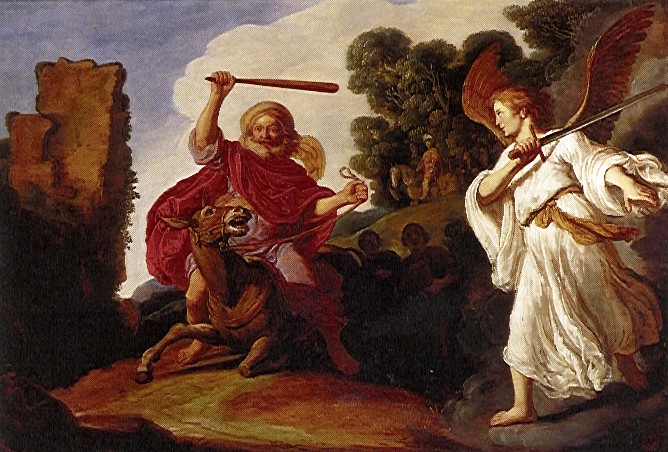 Source: Balaam i osioł, public-domain Commons record. Use as Western teaching artwork, not Orthodox iconography.
The Church’s Voice in Worship ⛪
This passage has no established place in the Coptic Orthodox lectionary.
Deeper spiritual insight and teaching emphasis
Balaam is frightening because he is not ignorant. He hears God. He speaks true oracles. He knows that Israel is blessed. Yet his desire remains negotiable. That is why the New Testament remembers him with such severity. The danger is not lack of religious information. The danger is a heart that can handle holy words while still loving reward.
Balak wants spiritual power as a weapon. Balaam wants to remain technically obedient while keeping the possibility of profit alive. This is a pattern worth naming for adults: doing the minimum to keep a clean image while leaving the door open for ambition, approval, money, or influence. Balaam’s repeated consultations can sound pious, but they also reveal reluctance to accept the first clear word.
The donkey is not comic relief only. The lowly beast sees the angel before the seer does. God humiliates Balaam mercifully before Balaam destroys himself. In church life, God may use someone we consider beneath us, a child, spouse, critic, stranger, or inconvenient interruption, to show what our spiritual self-image cannot see.
The Star prophecy must be taught as more than a Christmas proof text. A star rises from Jacob, and a scepter comes from Israel, but the King who fulfills this reigns from the Cross. His kingship is not Balak’s fear or Balaam’s ambition. It is royal self-giving. This is why the Magi later become such a fitting icon of Gentile worship: the nations do not hire prophecy to control God; they follow light, bow down, and offer gifts.
For teaching, let Balaam warn servants directly. A person can preach Christ, chant beautifully, counsel others, write spiritual material, and still be in danger if obedience is divided. The cure is not silence alone. It is repentance, poverty of spirit, and refusing to sell holy speech for any reward.
Second-pass teaching refinement
Balaam is frightening because he is spiritually perceptive without being spiritually whole. He can hear true words, speak blessing, and still love reward. This makes him one of Scripture’s clearest warnings to religious people: giftedness is not holiness, accurate speech is not obedience, and proximity to revelation does not purify a divided heart automatically. The donkey sees what the seer does not because God is willing to humble a prophet through what he considers beneath him.
The Star prophecy must be taught with wonder, but also in contrast to Balaam himself. Christ rises from Jacob as the true King, while Balaam remains a man whose mouth can bless what his heart does not love. Adult application should be direct: where do I speak beautifully about God while negotiating secretly with Balak? Where do I want the honor of obedience without the surrender of obedience? The passage invites us not merely to admire the Star, but to leave the road of Balaam and worship the King he unwillingly announces.
Spiritual Fruit 🍇
- Fear religious gifts without repentance. Balaam can speak truth and still be spiritually endangered.
- Let the donkey humble you. God may use someone lowly, inconvenient, or embarrassing to show what you refuse to see.
- Trust God’s blessing over hostile speech. Balak’s curses cannot undo covenant mercy.
- Do not sell spiritual speech. Influence, money, admiration, and access can corrupt a servant.
- Follow the Star to the King. The prophecy is not an idea to admire; it is a summons to worship Christ.
Discussion Questions
- What makes Balaam spiritually dangerous rather than merely foolish?
- How does the donkey episode expose corrupted vision?
- Why does the New Testament remember Balaam so negatively?
- How does the Star prophecy point to Christ?
- Where can religious language become a tool for reward or influence?
Teaching Notes
Timing: 15 minutes Balaam’s divided heart, 10 minutes donkey, 15 minutes blessings/star, 10 minutes NT warning.
Where to linger: the gap between Balaam’s true words and impure desire.
Where to compress: repetition of all oracle details if time is short.
Pastoral warnings: do not turn Balaam into an anti-Jewish trope or generic outsider condemnation. The warning is for religious people.
Key sentence to say slowly: Balaam teaches us that a person can speak true words from God and still love the wages of unrighteousness.
This passage has no established place in the Coptic Orthodox lectionary.
Show: the Balaam artwork briefly for spiritual blindness, then move the class to the Star prophecy rather than staying with the novelty of the donkey.
Glossary
- Balaam: seer hired by Balak; speaks blessings but later remembered as corrupt.
- Balak: king of Moab who seeks to curse Israel.
- Oracle: formal prophetic utterance or blessing.
- Star prophecy: Numbers 24:17, received by Christians as messianic and fulfilled in Christ.
Sources
Primary sources
- Scripture: Numbers in Brenton’s English Septuagint; brief New Testament cross-references where noted.
- Origen, Homilies on Numbers, used cautiously for spiritual and typological interpretation of the wilderness narratives.
- St. Gregory of Nyssa, The Life of Moses, for the wilderness as purification, ascent, and training in desire for God.
- St. Cyril of Alexandria, Christological and sacramental interpretation of Old Testament signs where relevant.
- St. John Chrysostom, pastoral teaching on repentance, humility, obedience, speech, leadership, and the passions.
- St. John Cassian, Conferences and Institutes, for ascetic discernment, murmuring, watchfulness, and obedience.
- Matthew 2:1-12; 2 Peter 2:15-16; Jude 11; Revelation 2:14.
- Eusebius of Caesarea, Proof of the Gospel, Book 9, chapter 1, for messianic reception of Numbers 24:17: https://www.tertullian.org/fathers/eusebius_de_11_book9.htm#C1
Secondary academic sources
Jacob Milgrom, Numbers, JPS Torah Commentary.
Baruch A. Levine, Numbers 1-20 and Numbers 21-36, Anchor Yale Bible.
Gordon J. Wenham, Numbers, Tyndale Old Testament Commentaries.
Timothy R. Ashley, The Book of Numbers, NICOT.
Dennis T. Olson, Numbers, Interpretation Commentary.
Coptic Orthodox / pastoral sources
The Orthodox Study Bible, notes on Numbers and New Testament fulfillment.
Fr. Tadros Yacoub Malaty, pastoral and patristic-style reflections on the Pentateuch.
Pope Shenouda III, pastoral teaching on repentance, obedience, humility, and wilderness testing.
Fr. Bishoy Kamel, pastoral themes of liturgy, service, repentance, and the healing life of the Church.
Web pages and non-academic sources cited
- CCEL and New Advent Fathers as public-domain access points for patristic texts.
- Coptic Orthodox lectionary reference tables, used only where exact placements are stated.