


Ezekiel 8-11 is one of the spine passages of the whole book. The glory that appeared to Ezekiel by Chobar is now shown inside the defiled temple, and then it departs by stages from the house and the city. This departure is not casual, sudden, or temperamental. The Lord shows the prophet the hidden abominations, corrupt worship, violence, and arrogant leadership that have made the sanctuary a place of betrayal.
The vision is hard because Scripture wants the reader to stop using holy language as a shield for unrepented sin. Judgment begins at the sanctuary because false holiness is more dangerous than obvious paganism. Yet mercy is already present. God marks those who groan over iniquity, hears Ezekiel’s intercession, promises to be a little sanctuary for the scattered, and begins restoration with His own gift: another heart and a new spirit.
Christological reading must be careful here. This unit is mainly about departure, defilement, judgment, and the promise that restoration will be God’s work. It points forward to the Word who tabernacles among us in John 1:14, to Christ’s body as the true temple in John 2:19-21, to the Lord’s lament over the desolate house in Matthew 23:37-39, and to new-covenant life in the Spirit in 2 Corinthians 3 and Romans 8. But Ezekiel 8-11 should not be rushed into triumph. The class must first feel why the glory leaves.
Historical and Scriptural Context
The vision is dated in the sixth year, fifth month, and fifth day, while Ezekiel sits in his house and the elders of Judah sit before him. Jerusalem still stands, but its fall is coming. The exiles can still imagine that the temple guarantees the city’s safety, and the Jerusalem leaders can still speak as if they own the land and the promise. Ezekiel is carried in a vision to Jerusalem so that the Lord Himself may show why such confidence is false.
The unit follows chapters 6-7, where judgment widened from high places to the whole land, and it precedes the exile signs and false-prophet indictments of chapters 12-14. In the book’s larger movement, Ezekiel 8-11 explains why the temple can be judged without God being defeated. The problem is not that Babylon is stronger than the Lord. The problem is that the house bearing the Lord’s name has become a theater of idolatry, denial, violence, and self-protection.
Scripturally, the vision completes a painful sequence. Ezekiel 1 showed the glory on the mobile throne-chariot by Chobar. Ezekiel 8 shows that the same glory is still present at the temple while abominations are being practiced. Ezekiel 9 shows the glory moving from the cherubim to the threshold as judgment is commanded. Ezekiel 10 shows the glory departing from the house and standing at the east gate. Ezekiel 11 shows it going from the city to the mountain east of it. The movement is slow enough to teach that the Lord is patient; it is final enough to teach that holiness will not be mocked.
Geographical Significance ⛰️
The geographical movement matters. Ezekiel is physically among the exiles in the land of the Chaldeans, but in the vision the Spirit lifts him between earth and heaven and brings him to Jerusalem. The reader is forced to hold two places together: the exile settlement by Chobar and the temple city. God sees both. The exiles are not forgotten, and Jerusalem is not hidden.
Inside Jerusalem, the vision moves through temple spaces: the north gate, the porch of the court, the entrance of the house of the Lord, the inner court between porch and altar, the threshold, and the east-facing gate. These are not neutral locations. They are supposed to be places of holy approach. Instead, Ezekiel sees idolatry in hidden rooms, lament for Thammuz at the temple porch, worship of the sun with backs turned toward the temple, and leaders giving deadly counsel at the gate.
The final movement to the mountain east of the city is severe. The glory does not vanish into the air. It stands outside, over against the city. The place anticipates later biblical sorrow over Jerusalem, including Christ’s lament that the house is left desolate. A teacher should not over-identify every detail with later geography, but the eastward departure should be felt: the Lord leaves the violated center and stands as witness against it.
The Characters 👥
- The Lord of glory: He reveals, judges, marks, scatters, gathers, and gives the new heart. His holiness refuses to bless death as worship.
- Ezekiel: Priest, prophet, seer, and intercessor. He does not watch judgment coldly; he falls on his face and cries for the remnant.
- The elders and worshippers in the temple: Some seek Ezekiel’s word in exile, while others in Jerusalem burn incense before images, lament for Thammuz, and worship the sun with their backs toward the house of the Lord.
- The man clothed with a long robe and girdle: He marks those who groan and grieve over the abominations, showing that mercy distinguishes a repentant remnant before judgment falls.
- The six men with weapons: They enact judgment in the vision. They are not a model for human violence, but a revelation that God will not let holy places shelter unrepented violence forever.
- Jechonias and Phaltias: Brenton names leaders at the east gate who devise vanities and give evil counsel. Phaltias dies while Ezekiel prophesies, and Ezekiel intercedes again.
- The scattered brethren: Jerusalem despises them as far from the Lord, but God promises to be a little sanctuary for them and to give another heart and a new spirit.
- The cherubim and wheels: The same living creature from Ezekiel 1 now carries the departing glory, proving that God’s throne is living, free, and not bound to a defiled building.
Hidden abominations in the temple (Ezekiel 8:1-18)
1 And it came to pass in the sixth year, in the fifth month, on the fifth day of the month, I was sitting in the house, and the elders of Juda were sitting before me: and the hand of the Lord came upon me. 2 And I looked, and, behold, the likeness of a man: from his loins and downwards there was fire, and from his loins upwards there was as the appearance of amber. 3 And he stretched forth the likeness of a hand, and took me up by the crown of my head; and the Spirit lifted me up between the earth and sky, and brought me to Jerusalem in a vision of God, to the porch of the gate that looks to the north, where was the pillar of the Purchaser. 4 And, behold, the glory of the Lord God of Israel was there, according to the vision which I saw in the plain. 5 And he said to me, Son of man, lift up thine eyes toward the north. So I lifted up mine eyes toward the north, and, behold, I looked from the north toward the eastern gate. 6 And he said to me, Son of man, hast thou seen what these do? They commit great abominations here so that I should keep away from my sanctuary: and thou shalt see yet greater iniquities. 7 And he brought me to the porch of the court. 8 And he said to me, Son of man, dig: so I dug, and behold a door. 9 And he said to me, Go in, and behold the iniquities which they practise here. 10 So I went in and looked; and beheld vain abominations, and all the idols of the house of Israel, portrayed upon them round about. 11 And seventy men of the elders of the house of Israel, and Jechonias the son of Saphan stood in their presence in the midst of them, and each one held his censer in his hand; and the smoke of the incense went up. 12 And he said to me, Thou hast seen, son of man, what the elders of the house of Israel do, each one of them in their secret chamber: because they have said, The Lord sees not; The Lord has forsaken the earth. 13 And he said to me, Thou shalt see yet greater iniquities which these do. 14 And he brought me in to the porch of the house of the Lord that looks to the north; and, behold, there were women sitting there lamenting for Thammuz. 15 And he said to me, Son of man, thou hast seen; but thou shalt yet see evil practices greater than these. 16 And he brought me into the inner court of the house of the Lord, and at the entrance of the temple of the Lord, between the porch and the altar, were about twenty men, with their back parts toward the temple of the Lord, and their faces turned the opposite way; and these were worshipping the sun. 17 And he said to me, Son of man, thou hast seen this. Is it a little thing to the house of Juda to practise the iniquities which they have practised here? for they have filled the land with iniquity: and, behold, these are as scorners. 18 Therefore will I deal with them in wrath: mine eye shall not spare, nor will I have any mercy.
The first shock is that the glory is still there. Ezekiel sees the glory of the Lord at the temple according to the vision he saw in the plain. The Lord shows the prophet the sanctuary before the departure so that no one will mistake judgment for divine weakness or impatience.
The phrase “so that I should keep away from my sanctuary” is central. The abominations are driving the Lord’s presence away. Secret idolatry is not secret before God. The elders burn incense before images and say, “The Lord sees not; The Lord has forsaken the earth.” That sentence is the theology of every concealed sin.
The corruption is layered: hidden images, false ritual grief for Thammuz, and men in the inner court turning their backs on the temple to worship the sun. This is not harmless religious variety. It is leadership training the people to give their bodies, grief, and hope to another lord. Read toward Christ, the warning becomes sharper: if the Word has truly tabernacled among us, then Christian worship must be truthful in heart, not only correct in form.
The marked remnant and the slaughter vision (Ezekiel 9:1-11)
1 And he cried in mine ears with a loud voice, saying, The judgment of the city has drawn nigh; and each had the weapons of destruction in his hand. 2 And, behold, six men came from the way of the high gate that looks toward the north, and each one’s axe was in his hand; and there was one man in the midst of them clothed with a long robe down to the feet, and a sapphire girdle was on his loins: and they came in and stood near the brazen altar. 3 And the glory of the God of Israel, that was upon them, went up from the cherubs to the porch of the house. And he called the man that was clothed with the long robe, who had the girdle on his loins; 4 and said to him, Go through the midst of Jerusalem, and set a mark on the foreheads of the men that groan and that grieve for all the iniquities that are done in the midst of them. 5 And he said to the first in my hearing, Go after him into the city, and smite: and let not your eyes spare, and have no mercy. 6 Slay utterly old man and youth, and virgin, and infants, and women: but go ye not nigh any on whom is the mark: begin at my sanctuary. So they began with the elder men who were within in the house. 7 And he said to them, Defile the house, and go out and fill the ways with dead bodies, and smite. 8 And it came to pass as they were smiting, that I fell upon my face, and cried out, and said, Alas, O Lord! wilt thou destroy the remnant of Israel, in pouring out thy wrath upon Jerusalem? 9 Then said he to me, The iniquity of the house of Israel and Juda is become very exceedingly great: for the land is filled with many nations, and the city is filled with iniquity and uncleanness: because they have said, The Lord has forsaken the earth, The Lord looks not upon it. 10 Therefore mine eye shall not spare, neither will I have any mercy: I have recompensed their ways upon their heads. 11 And, behold, the man clothed with the long robe, and girt with the girdle about his loins, answered and said, I have done as thou didst command me.
This is one of the hardest scenes in Ezekiel. The man clothed with the long robe marks those who groan and grieve over the iniquities, and then judgment begins at the sanctuary. Holy proximity increases responsibility. The elders within the house are judged first because they have used holy nearness to hide unholiness.
The mark is not a badge of superiority. It is the sign of grief. The protected ones are not those who mastered the crisis, but those whose hearts broke over the abominations. St John Chrysostom teaches that the faithful should grieve over those under judgment rather than rejoice over punishment. Ezekiel himself models this. He falls on his face and cries, “Alas, O Lord!”
The slaughter vision must be taught with trembling. It is a prophetic disclosure of divine judgment, not permission for human vengeance. The city is filled with iniquity and uncleanness because its people have lived by the lie that God does not see. Judgment answers that lie, while the mark shows that mercy knows the grieving remnant by name.
Coals, cherubim, and the glory departing from the house (Ezekiel 10:1-22)
1 Then I looked, and, behold, over the firmament that was above the head of the cherubs there was a likeness of a throne over them, as a sapphire stone. 2 And he said to the man clothed with the long robe, Go in between the wheels that are under the cherubs, and fill thine hands with coals of fire from between the cherubs, and scatter them over the city. And he went in in my sight. 3 And the cherubs stood on the right hand of the house, as the man went in; and the cloud filled the inner court. 4 Then the glory of the Lord departed from the cherubs to the porch of the house; and the cloud filled the house, and the court was filled with the brightness of the glory of the Lord. 5 And the sound of the cherubs’ wings was heard as far as the outer court, as the voice of the Almighty God speaking. 6 And it came to pass, when he gave a charge to the man clothed with the sacred robe, saying, Take fire from between the wheels from between the cherubs, that he went in, and stood near the wheels. 7 And he stretched forth his hand into the midst of the fire that was between the cherubs, and took thereof, and put it into the hands of the man clothed with the sacred robe: and he took it, and went out. 8 And I saw the cherubs having the likeness of men’s hands under their wings. 9 And I saw, and behold, four wheels stood by the cherubs, one wheel by each cherub: and the appearance of the wheels was as the appearance of a carbuncle stone. 10 And as for their appearance, there was one likeness to the four, as if there should be a wheel in the midst of a wheel. 11 When they went, they went on their four sides; they turned not when they went, for whichever way the first head looked, they went; and they turned not as they went. 12 And their backs, and their hands, and their wings, and the wheels, were full of eyes round about the four wheels. 13 And these wheels were called Gelgel in my hearing. 15 And the cherubs were the same living creature which I saw by the river of Chobar. 16 And when the cherubs went, the wheels went, and they were close to them: and when the cherubs lifted up their wings to mount up from the earth, their wheels turned not. 17 When they stood, the wheels stood; and when they mounted up, the wheels mounted up with them: because the spirit of life was in them. 18 Then the glory of the Lord departed from the house, and went up on the cherubs. 19 And the cherubs lifted up their wings, and mounted up from the earth in my sight: when they went forth, the wheels were also beside them, and they stood at the entrance of the front gate of the house of the Lord; and the glory of the God of Israel was upon them above. 20 This is the living creature which I saw under the God of Israel by the river of Chobar; and I knew that they were cherubs. 21 Each one had four faces, and each one had eight wings; and under their wings was the likeness of men’s hands. 22 And as for the likeness of their faces, these are the same faces which I saw under the glory of the God of Israel by the river of Chobar: and they went each straight forward.
The throne vision from Ezekiel 1 returns inside Jerusalem’s judgment. The firmament, sapphire likeness, cherubim, wheels, eyes, and spirit of life show that the glory leaving the temple is the same glory Ezekiel saw by Chobar. The Lord who meets the prophet in exile is the Lord who departs from the defiled house.
The coals from between the cherubim are scattered over the city. Fire near the throne can purify, illumine, or judge. Here it declares that worship and violence cannot live together. The court is filled with brightness even as judgment is commanded, because Ezekiel will not divide God’s beauty from His holiness.
Leaders, violence, false security, and Ezekiel’s cry (Ezekiel 11:1-13)
1 Moreover the Spirit took me up, and brought me to the front gate of the house of the Lord, that looks eastward: and behold at the entrance of the gate were about five and twenty men; and I saw in the midst of them Jechonias the son of Ezer, and Phaltias the son of Banæas, the leaders of the people. 2 And the Lord said to me, Son of man, these are the men that devise vanities, and take evil counsel in this city: 3 who say, Have not the houses been newly built? This is the caldron, and we are the flesh. 4 Therefore prophesy against them, prophesy, son of man. 5 And the Spirit of the Lord fell upon me, and said to me, say; Thus saith the Lord; Thus have ye said, O house of Israel: and I know the devices of your spirit. 6 Ye have multiplied your dead in this city, and ye have filled your ways with slain men. 7 Therefore thus saith the Lord; Your dead whom ye have smitten in the midst of it, these are the flesh, and thiscity is the caldron: but I will bring you forth out of the midst of it. 8 Ye fear the sword; and I will bring a sword upon you, saith the Lord. 9 And I will bring you forth out of the midst of it, and will deliver you into the hands of strangers, and will execute judgments among you. 10 Ye shall fall by the sword; I will judge you on the mountains of Israel; and ye shall know that I am the Lord. 13 And it came to pass, while I was prophesying, that Phaltias the son of Banæas died. And I fell upon my face, and cried with a loud voice, and said, Alas, alas, O Lord! wilt thou utterly destroy the remnant of Israel?
At the east-facing gate, leaders counsel the city into false confidence. They say, “This is the caldron, and we are the flesh,” meaning that Jerusalem protects them. The Lord reverses the image. The slain whom they multiplied are the flesh, and the city is the caldron. Their violence exposes the lie of their security.
This is a direct word about leaders corrupting public life. They devise vanities and fill the city with dead. Ezekiel refuses to separate liturgical corruption from civic violence. A city that worships falsely will eventually treat human beings falsely. When God is treated as absent, the weak become disposable.
Phaltias dies while Ezekiel prophesies, and the prophet again cries out for the remnant. Prophetic courage without tears becomes cruelty. Compassion without truth becomes sentimentality. Christ’s lament in Matthew 23 belongs beside this scene: He does not rejoice that the house is left desolate. He weeps over the city that refuses to be gathered.
A little sanctuary, another heart, and the final departure (Ezekiel 11:14-25)
14 And the word of the Lord came to me, saying, 15 Son of man, thy brethren, and the men of thy captivity, and all the house of Israel are come to the full, to whom the inhabitants of Jerusalem said, Keep ye far away from the Lord: the land is given to us for an inheritance. 16 Therefore say thou, Thus saith the Lord; I will cast them off among the nations, and will disperse them into every land, yet will I be to them for a little sanctuary in the countries which they shall enter. 17 Therefore say thou, Thus saith the Lord; I will also take them from the heathen, and gather them out of the lands wherein I have scattered them, and will give them the land of Israel. 18 And they shall enter in there, and shall remove all the abominations of it, and all its iniquities from it. 19 And I will give them another heart, and will put a new spirit within them; and will extract the heart of stone from their flesh, and give them a heart of flesh: 20 that they may walk in my commandments, and keep mine ordinances, and do them: and they shall be to me a people, and I will be to them a God. 21 And as for the heart set upon their abominations and their iniquities, as their heart went after them, I have recompensed their ways on their heads, saith the Lord. 22 Then the cherubs lifted up their wings, and the wheels beside them; and the glory of the God of Israel was over them above. 23 And the glory of the Lord went up from the midst of the city, and stood on the mountain which was in front of the city. 24 And the Spirit took me up, and brought me to the land of the Chaldeans, to the captivity, in a vision by the Spirit of God: and I went up after the vision which I saw. 25 And I spoke to the captivity all the words of the Lord which he had shewed me.
The Lord now speaks of the exiles whom Jerusalem has despised. The inhabitants of Jerusalem say, “Keep ye far away from the Lord: the land is given to us for an inheritance.” They assume that distance from the city means distance from God. The Lord overturns them: He will be a little sanctuary for the scattered in the countries where they enter.
This promise judges the false use of temple holiness without denying the temple’s holiness. The Lord who leaves a defiled sanctuary can become sanctuary for the humbled. Eusebius preserves Ezekiel 11:16 as an early Christian witness to God’s presence among a dispersed people. Exile is not automatically abandonment, and visible nearness is not automatically communion.
Restoration begins with God’s gift: “I will give them another heart, and will put a new spirit within them.” This promise appears before the vision ends, while the glory is still departing. John 1:14 and John 2:19-21 show the fulfillment in Christ, the incarnate Word and true temple. 2 Corinthians 3 and Romans 8 show the inner form of that fulfillment: unveiled transformation and life governed by the Spirit.
The Church’s Voice in Worship ⛪
The resonance is strong. The Church knows that worship can be beautiful outwardly while the heart is far from God. The fasts, prostrations, litanies, confession, and prayers for mercy all train the faithful not to say, “The Lord sees not.” Ezekiel 8-11 belongs spiritually to repentance because it teaches that God sees hidden rooms, corrupt leadership, violence, and the grief of the remnant.
The Divine Liturgy also stands under this warning. We do not gather to control the presence of God. We gather because God has had mercy and made us His temple by grace. The prayers before Communion, the confession of sins, and the repeated cry for mercy protect the Church from the lie that holy things can be handled safely by an unrepentant heart.
Matthew 23:37-39 gives a sober Gospel echo. Christ laments Jerusalem and says that the house is left desolate. The Church hears this not as permission for contempt, but as a call to receive the One who gathers. A Christian community can lose the living heart of worship while preserving religious structure. Ezekiel teaches us to fear that loss and repent before the glory is grieved.
Iconography Connection 🖼️
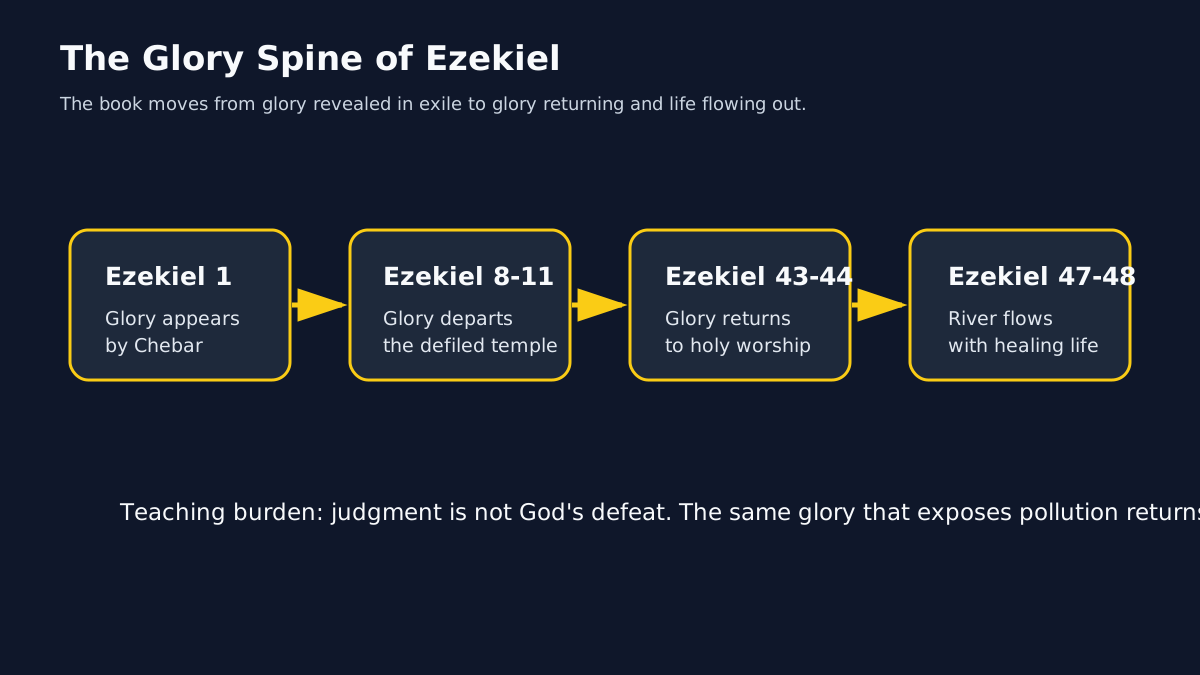 Source: Hermes schematic, 2026-06-19.
Use this schematic to show that the departure of glory is judgment on polluted worship, not the Lord becoming weak or absent. The same glory that departs in grief returns in Ezekiel 43, so judgment and restoration belong to one holy movement.
This unit does not have to be forced into an invented iconographic tradition. The grounded connection is through the cherubim, wheels, glory, and temple imagery already introduced in Ezekiel 1 and identified again in Ezekiel 10. Orthodox iconography receives Ezekiel as a prophet of divine glory, and the living creatures of the vision are connected in Christian reception with the four Evangelists. In Ezekiel 10, those living creatures are now named as cherubim and shown carrying the departing glory.
For teaching, an icon of the Prophet Ezekiel or a careful image of the tetramorph can help the class remember that this is not fantasy imagery. It is worship imagery. The living creatures stand in obedience before the throne. The wheels full of eyes remind us that God sees. The departing glory warns that icons, church buildings, and sacred vessels are not magic protection if the heart worships idols.
The temple itself should be treated with reverence. Do not use images of temple destruction merely for drama. If visual aids are used, they should help students locate the north gate, inner court, threshold, east gate, and mountain east of the city. The goal is to see the movement of the glory, not to sensationalize catastrophe.
Spiritual Fruit 🍇
-
Let God search the hidden room. Ezekiel is told to dig through the wall and look. Every Christian has places of thought, memory, fantasy, resentment, envy, fear, or secret control where the soul says, “The Lord sees not.” A concrete practice is to pray Psalm 50 (LXX) / Psalm 50 (LXX; 51 MT) (MT) daily for a week and ask God to show one hidden chamber without despair.
-
Grieve without self-righteousness. The marked remnant groans over abominations. They are not marked because they mock others, but because sin wounds them. When the Church sees corruption, scandal, or violence, the first response should be tears, repentance, protection of the vulnerable, and truthful action, not gossip or superiority.
-
Do not use worship to hide from justice. Ezekiel joins defiled temple worship with violence in the city. If we pray beautifully while excusing cruelty, exploitation, abuse, or indifference to suffering, we are acting out the same lie. Before Liturgy, ask: whom have I harmed, ignored, or refused to forgive?
-
Receive the little sanctuary. The exiles were told they were far from the Lord, yet God promised to be sanctuary for them. A person who feels displaced, ashamed, or cut off should not conclude that God is absent. The humbled heart can meet Him in a hospital room, prison cell, small apartment, commute, or quiet corner of repentance.
-
Ask for the new heart, not only better habits. Ezekiel does not end with advice. God says He will give another heart and a new spirit. Christian discipline matters, but it must be prayer for God to change the heart. A simple prayer from this unit is: “Lord, remove the stony heart that loves its idols. Give me a heart that can receive Your Spirit.”
Teaching Notes
Ezekiel 8:1-18 - Hidden abominations in the temple
- Ask: Why does the Lord show the abominations while the glory is still present?
- Emphasize: The glory does not depart without witness. God exposes the wound before judgment falls.
- Watch for: Softening the idolatry into generic distraction. Secret sin, corrupt worship, and false theology are named plainly here.
- Connect: If the Word has tabernacled among us, Christian worship must be truthful in heart.
Ezekiel 9:1-11 - The marked remnant and the slaughter vision
- Ask: What marks the remnant that is protected?
- Emphasize: The remnant is marked by grief, repentance, and fidelity, not by pride.
- Watch for: Presenting the slaughter vision as human permission to punish others. It is a prophetic vision of God’s judgment and a call to trembling repentance.
- Connect: Judgment begins at the sanctuary; holy proximity increases responsibility.
Ezekiel 10:1-22 - Coals, cherubim, and the glory departing from the house
- Ask: Why is the same glory from Chobar the one that departs?
- Emphasize: The departure is gradual, visible, and morally explained by the previous chapter.
- Watch for: Turning the cherubim and wheels into a code puzzle. Their force here is the free, seeing, living movement of God’s glory.
- Connect: The Lord who meets the prophet in exile is the Lord who departs from the defiled house.
Ezekiel 11:1-13 - Leaders, violence, false security, and Ezekiel’s cry
- Ask: Why does corrupt leadership belong inside the temple judgment vision?
- Emphasize: Corrupt leadership and violence belong inside the temple-judgment vision. Worship and justice cannot be separated.
- Watch for: Politicizing the passage into a simple attack on other groups. Let it search the leaders, servants, and worshippers in the room first.
- Connect: Prophetic courage without tears becomes cruelty; compassion without truth becomes sentimentality.
Ezekiel 11:14-25 - A little sanctuary, another heart, and the final departure
Ask: How can God be a little sanctuary for the scattered while the glory departs the city?
Emphasize: Restoration begins with God’s gift of a renewed heart and spirit. It is not self-improvement with religious language.
Watch for: Rushing past the final departure. Hope is spoken from inside judgment, not as denial of judgment.
Connect: The new heart and new spirit point to life in the Spirit in Christ.
Glossary
- Abomination: A practice that defiles worship and covenant relationship, especially idolatry and violence in holy places.
- Glory of the Lord: The visible manifestation of God’s presence and holiness, seen in the throne-chariot and departing from the temple.
- Cherubim: Heavenly beings associated with God’s throne; in Ezekiel 10 identified with the living creatures of chapter 1.
- Mark on the forehead: The sign of those who groan and grieve over abominations; a sign of mercy distinguishing the repentant remnant.
- Little sanctuary: God’s promise to be present with the scattered exiles even when the temple is defiled and the glory departs.
- New heart and new spirit: God’s gift of inner renewal that enables obedience; a key new-covenant promise.
- Oath and covenant: Pledged words before God that carry accountability even in political humiliation.
Translation and Source Notes
Embedded Scripture is from Brenton’s English Septuagint (LXX).
Embedded Old Testament Scripture in this guide uses Brenton’s English Septuagint, public domain. The Scripture blocks preserve Brenton’s spellings and phrasing. The commentary uses familiar English forms where needed for clarity.
Patristic support is drawn from verified sources including John Chrysostom on grief over judgment and Eusebius on God’s presence among the dispersed.
Revelation and John references are canonical resonance and fulfillment pointers, not direct commentary on Ezekiel 8-11.
Sources
Primary Scripture
- Ezekiel 8-11, Brenton Septuagint, public domain.
- John 1:14; John 2:19-21; Matthew 23:37-39; 2 Corinthians 3; Romans 8 for canonical resonance and fulfillment.
- 1 Peter 2:24 for bearing sins in the body.
Patristic and ancient Christian sources
- St John Chrysostom on grief over those under judgment and prophetic visions as condescension (verified CCEL sources).
- Eusebius of Caesarea, Proof of the Gospel, on God’s presence among dispersed people (Ezekiel 11:16).
Orthodox reception and iconography
- Orthodox Church in America, “Prophet Ezekiel”: https://www.oca.org/saints/lives/2000/07/21/102064-prophet-ezekiel.
- OCA Prophet Ezekiel icon image: https://images.oca.org/icons/lg/july/0721prophetezekiel.jpg.
Teaching and historical background
- Read Ezekiel 6-7 before this unit and Ezekiel 12-15 after it to see the movement from land judgment to temple exposure to false hope among exiles.
- Daniel I. Block, The Book of Ezekiel, Chapters 1-24, New International Commentary on the Old Testament.
- Walther Zimmerli, Ezekiel 1, Hermeneia.
- Leslie C. Allen, Ezekiel 1-19, Word Biblical Commentary.