


The first movement of Baruch begins where spiritual healing must begin: the people hear the written word, weep, fast, pray, give, and confess. Exile has not made them spiritually mute. The scroll becomes a place where scattered people learn to pray truthfully before God.
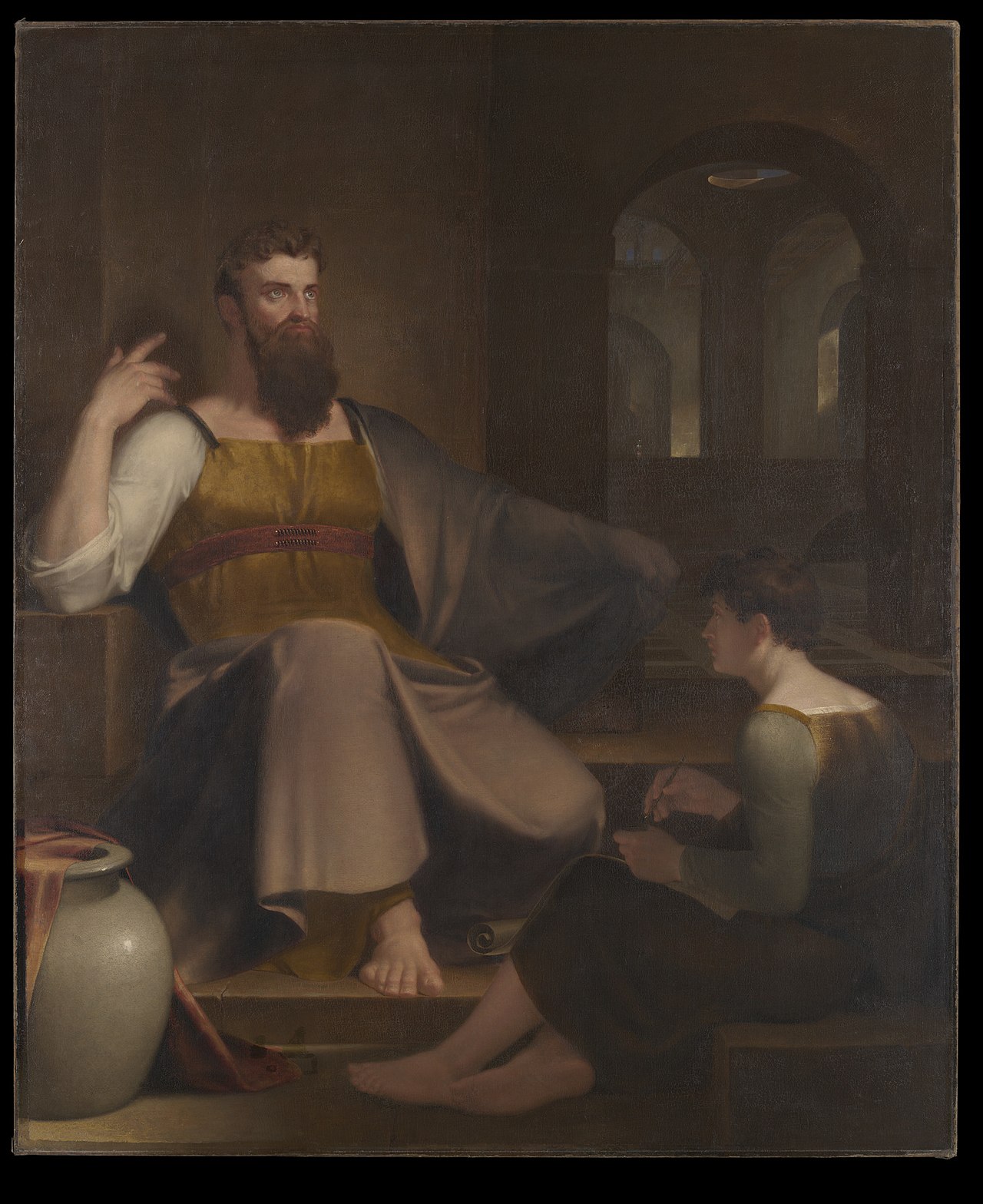 Source: Washington Allston, Jeremiah Dictating His Prophecy of the Destruction of Jerusalem to Baruch the Scribe, 1820, Yale University Art Gallery via Wikimedia Commons, public domain. This is Western biblical artwork related to Jeremiah 36, not an Orthodox icon and not a literal depiction of Baruch 1.
The Scroll Read in Exile (Baruch 1:1-14)
1 And these are the words of the book, which Baruch the son of Nerias, the son of Maasias, the son of Sedecias, the son of Asadias, the son of Chelcias, wrote in Babylon, 2 in the fifth year, and in the seventh day of the month, what time as the Chaldeans took Jerusalem, and burnt it with fire.
3 And Baruch did read the words of this book in the hearing of Jechonias the son of Joachim king of Juda, and in the ears of all the people that came to hear the book, 4 and in the hearing of the nobles, and of the king’s sons, and in the hearing of the elders, and of all the people, from the lowest unto the highest, even of all them that dwelt at Babylon by the river Sud. 5 Whereupon they wept, fasted, and prayed before the Lord.
6 They made also a collection of money according to every man’s power: 7 and they sent it to Jerusalem unto Joachim the high priest, the son of Chelcias, son of Salom, and to the priests, and to all the people which were found with him at Jerusalem, 8 at the same time when he received the vessels of the house of the Lord, that were carried out of the temple, to return them into the land of Juda, the tenth day of the month Sivan, namely, silver vessels, which Sedecias the son of Josias king of Juda had made, 9 after that Nabuchodonosor king of Babylon had carried away Jechonias, and the princes, and the captives, and the mighty men, and the people of the land, from Jerusalem, and brought them unto Babylon.
10 And they said, Behold, we have sent you money to buy you burnt offerings, and sin offerings, and incense, and prepare ye manna, and offer upon the altar of the Lord our God; 11 and pray for the life of Nabuchodonosor king of Babylon, and for the life of Balthasar his son, that their days may be upon earth as the days of heaven: 12 and the Lord will give us strength, and lighten our eyes, and we shall live under the shadow of Nabuchodonosor king of Babylon, and under the shadow of Balthasar his son, and we shall serve them many days, and find favour in their sight.
13 Pray for us also unto the Lord our God, for we have sinned against the Lord our God; and unto this day the fury of the Lord and his wrath is not turned from us. 14 And ye shall read this book which we have sent unto you, to make confession in the house of the Lord, upon the feasts and solemn days.
Baruch is introduced through ancestry because the book wants the reader to feel continuity. The exile is not a spiritual orphanage. The people still have memory, fathers, priests, vessels, feasts, solemn days, and the written word. The relationship chart below is a reading aid for those names, not a complete genealogy.
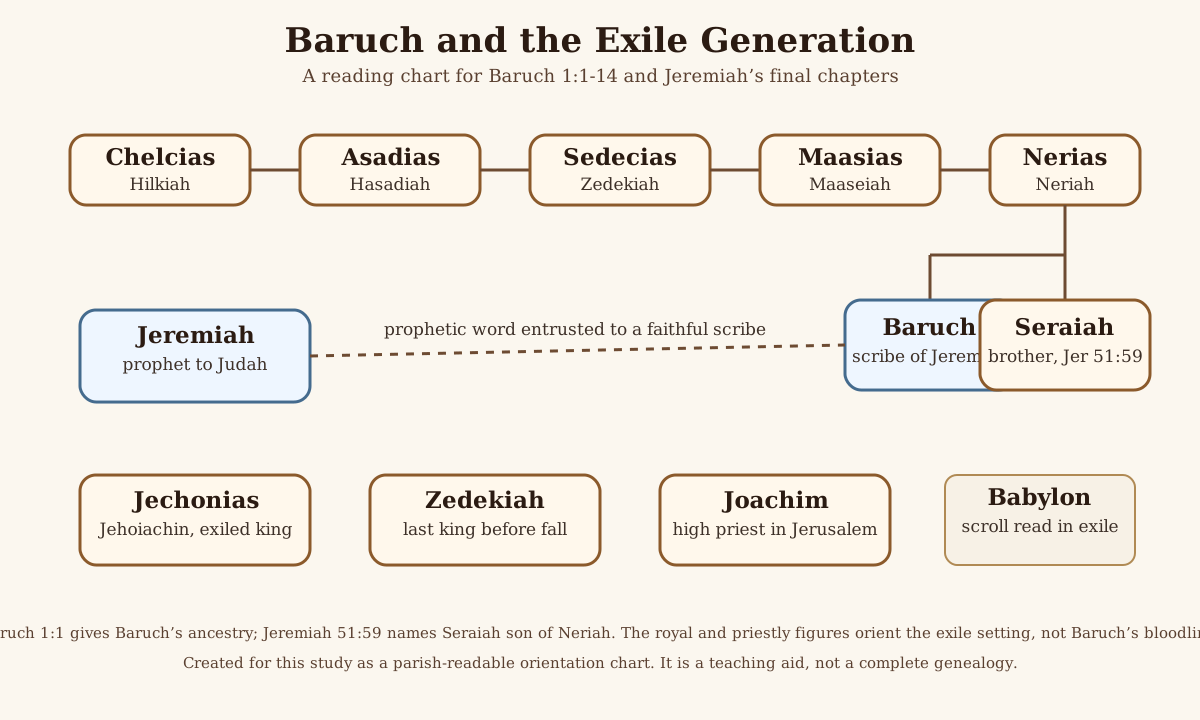 Source: Created for this study from Baruch 1:1, Jeremiah 36, Jeremiah 45, and Jeremiah 51:59. Teaching aid only, not a complete genealogy tree.
The people’s first response to the scroll is not debate. They weep, fast, pray, and give. That order matters. True hearing produces embodied repentance. Their collection for the altar shows that exile has not severed love for worship. Even when the people cannot all stand in Jerusalem, their repentance moves toward the house called by God’s name.
Brenton’s phrase “prepare ye manna” in verse 10 can confuse modern readers. In the offering list it functions as the grain offering prepared for altar worship, not as a new miracle of wilderness manna. The point is practical and liturgical: the exiles send what is needed for sacrifice, incense, and prayer.
The command to pray for Nabuchodonosor and Balthasar is also spiritually demanding. This is not approval of Babylon’s violence. It is repentance learning to pray under chastening without hatred, as Jeremiah had told the exiles to seek the peace of the city where they were carried. The faithful can pray for rulers while still refusing to call injustice righteous.
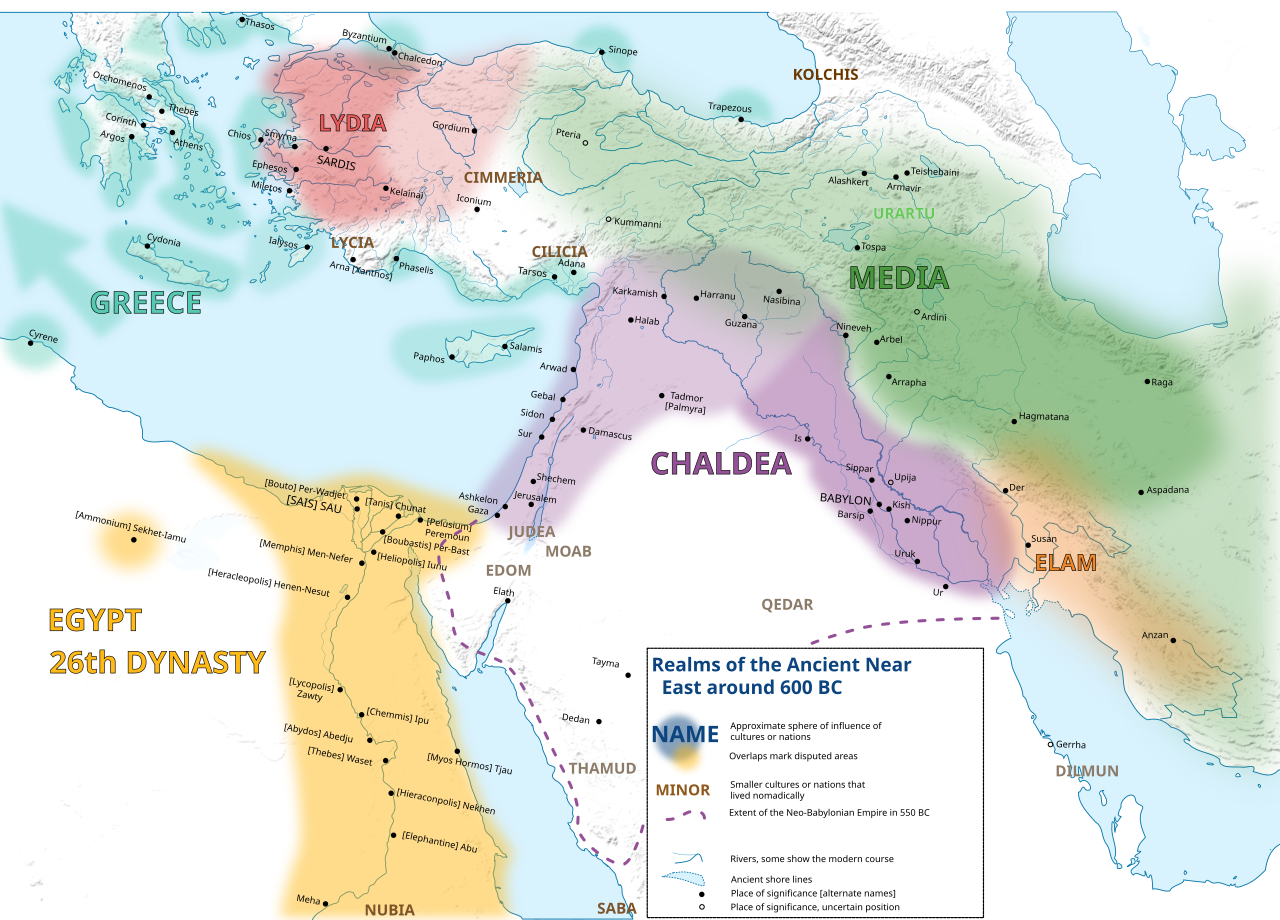 Source: Near East 600BC, Wikimedia Commons, CC BY-SA 4.0, converted to PNG for local display. Use as a regional orientation map for Judah, Babylon, Egypt, and neighboring powers, not as a precise deportation route.
Truthful Shame Before the Righteous God (Baruch 1:15-22)
15 And ye shall say, To the Lord our God belongeth righteousness, but unto us the confusion of faces, as it is come to pass this day, unto them of Juda, and to the inhabitants of Jerusalem, 16 and to our kings, and to our princes, and to our priests, and to our prophets, and to our fathers: 17 for we have sinned before the Lord, 18 and disobeyed him, and have not hearkened unto the voice of the Lord our God, to walk in the commandments that he gave us openly: 19 since the day that the Lord brought our forefathers out of the land of Egypt, unto this present day, we have been disobedient unto the Lord our God, and we have been negligent in not hearing his voice.
20 Wherefore the evils cleaved unto us, and the curse, which the Lord appointed by Moses his servant at the time that he brought our fathers out of the land of Egypt, to give us a land that floweth with milk and honey, like as it is to see this day. 21 Nevertheless we have not hearkened unto the voice of the Lord our God, according unto all the words of the prophets, whom he sent unto us: 22 but every man followed the imagination of his own wicked heart, to serve strange gods, and to do evil in the sight of the Lord our God.
The Lord Makes Good His Word (Baruch 2:1-10)
1 Therefore the Lord hath made good his word, which he pronounced against us, and against our judges that judged Israel, and against our kings, and against our princes, and against the men of Israel and Juda, 2 to bring upon us great plagues, such as never happened under the whole heaven, as it came to pass in Jerusalem, according to the things that were written in the law of Moses; 3 that a man should eat the flesh of his own son, and the flesh of his own daughter. 4 Moreover he hath delivered them to be in subjection to all the kingdoms that are round about us, to be as a reproach and desolation among all the people round about, where the Lord hath scattered them.
5 Thus we were cast down, and not exalted, because we have sinned against the Lord our God, and have not been obedient unto his voice.
6 To the Lord our God appertaineth righteousness: but unto us and to our fathers open shame, as appeareth this day. 7 For all these plagues are come upon us, which the Lord hath pronounced against us. 8 Yet have we not prayed before the Lord, that we might turn every one from the imaginations of his wicked heart. 9 Wherefore the Lord watched over us for evil, and the Lord hath brought it upon us: for the Lord is righteous in all his works which he hath commanded us. 10 Yet we have not hearkened unto his voice, to walk in the commandments of the Lord, that he hath set before us.
The prayer begins with a contrast: righteousness belongs to God; shame belongs to us. This is not self-hatred. It is sanity. Repentance becomes possible only when God is allowed to be righteous and the people stop defending what destroyed them.
The confession is corporate. Kings, princes, priests, prophets, fathers, and the present generation are all named. The prayer does not use ancestry as an excuse. It says, in effect, “our fathers sinned, and we have continued in the same refusal to hear.” Orthodox repentance has this same shape. We confess personally, but we also stand as members of one body.
Verse 2:3 is one of the hardest lines in the book. It points back to the covenant curses and to the horror of siege, where famine can become so severe that creation seems to collapse. The guide should not sensationalize it. The point is that sin is not symbolic only. When a people refuse God long enough, the breakdown touches bodies, families, food, worship, and public life.
Prayer for God’s Name and the Vexed Soul (Baruch 2:11-20)
11 And now, O Lord God of Israel, that hast brought thy people out of the land of Egypt with a mighty hand, and high arm, and with signs, and with wonders, and with great power, and hast gotten thyself a name, as appeareth this day: 12 O Lord our God, we have sinned, we have done ungodly, we have dealt unrighteously in all thine ordinances.
13 Let thy wrath turn from us: for we are but a few left among the heathen, where thou hast scattered us.
14 Hear our prayers, O Lord, and our petitions, and deliver us for thine own sake, and give us favour in the sight of them which have led us away: 15 that all the earth may know that thou art the Lord our God, because Israel and his posterity is called by thy name.
16 O Lord, look down from thine holy house, and consider us: bow down thine ear, O Lord, to hear us.
17 Open thine eyes, and behold; for the dead that are in the graves, whose souls are taken from their bodies, will give unto the Lord neither praise nor righteousness: 18 but the soul that is greatly vexed, which goeth stooping and feeble, and the eyes that fail, and the hungry soul, will give thee praise and righteousness, O Lord.
19 Therefore we do not make our humble supplication before thee, O Lord our God, for the righteousness of our fathers, and of our kings, 20 for thou hast sent out thy wrath and indignation upon us, as thou hast spoken by thy servants the prophets, saying,
The prayer turns from guilt to God’s name. “Deliver us for thine own sake” is not manipulation. It is covenant faith. Israel has no righteousness to present as payment. The people ask God to act because His name has been placed on them.
Verse 17 should be read as urgent covenant-prayer language, not as a complete doctrinal statement about the departed. The contrast is between deathly silence and the living soul that can still repent. The “vexed” soul, stooping, feeble, hungry, and nearly spent, can still praise God. That is deeply pastoral. Baruch gives hope to the person who says, “I have almost nothing left.” If the soul can still turn and cry, it can still offer praise.
Submission Under Judgment (Baruch 2:21-26)
21 Thus saith the Lord, Bow down your shoulders to serve the king of Babylon: so shall ye remain in the land that I gave unto your fathers. 22 But if ye will not hear the voice of the Lord, to serve the king of Babylon, 23 I will cause to cease out of the cities of Juda, and from without Jerusalem, the voice of mirth, and the voice of joy, the voice of the bridegroom, and the voice of the bride: and the whole land shall be desolate of inhabitants. 24 But we would not hearken unto thy voice, to serve the king of Babylon: therefore hast thou made good the words that thou spakest by thy servants the prophets, namely, that the bones of our kings, and the bones of our fathers, should be taken out of their places.
25 And lo, they are cast out to the heat of the day, and to the frost of the night, and they died in great miseries by famine, by sword, and by pestilence. 26 And the house which is called by thy name hast thou laid waste, as it is to be seen this day, for the wickedness of the house of Israel and the house of Juda.
This section depends on Jeremiah’s hard word to Judah: submit to Babylon’s yoke rather than pretend that false confidence will save Jerusalem. Obedience here is humiliating. It does not mean Babylon is good. It means Judah must stop fighting God’s chastening under the cover of patriotism or religious slogans.
For spiritual life, this is a warning against false heroics. Sometimes repentance means accepting a lesser humiliation so that a deeper rebellion can be healed. The Church must teach this carefully. It is never a license for abuse or cowardice. It is a call to discern when resistance is actually pride dressed up as courage.
Covenant Memory and Everlasting Covenant (Baruch 2:27-35)
27 O Lord our God, thou hast dealt with us after all thy goodness, and according to all that great mercy of thine, 28 as thou spakest by thy servant Moses in the day when thou didst command him to write thy law before the children of Israel, saying,
29 If ye will not hear my voice, surely this very great multitude shall be turned into a small number among the nations, where I will scatter them.
30 For I knew that they would not hear me, because it is a stiffnecked people: but in the land of their captivities they shall remember themselves, 31 and shall know that I am the Lord their God: for I will give them an heart, and ears to hear: 32 and they shall praise me in the land of their captivity, and think upon my name, 33 and return from their stiff neck, and from their wicked deeds: for they shall remember the way of their fathers, which sinned before the Lord.
34 And I will bring them again into the land which I promised with an oath unto their fathers, Abraham, Isaac, and Jacob, and they shall be lords of it: and I will increase them, and they shall not be diminished. 35 And I will make an everlasting covenant with them to be their God, and they shall be my people: and I will no more drive my people of Israel out of the land that I have given them.
The prayer ends with mercy because the covenant itself contains hope. God knows the people are stiff-necked, yet He promises that in captivity they will remember themselves. That phrase is spiritually piercing. Sin makes a person forget who he is. Repentance is not only remorse; it is the recovery of memory before God.
The promise of “an heart, and ears to hear” stands close to the great prophetic promises of the new covenant, the cleansed heart, and the Spirit-given life. Baruch 2:35 is therefore more than political return. The everlasting covenant reaches its fullness in Christ, who gives His blood “for the remission of sins” and gathers a people who can truly say, “He is our God, and we are His people.”
Spiritual Fruit 🍇
- Tell the truth about sin without falling into despair.
- Let Scripture move you to prayer, fasting, and concrete mercy.
- Pray for rulers and enemies without baptizing their injustice.
- Receive chastening without calling evil good.
- Remember God’s covenant when visible worship feels weak.
- Repent as a member of a people, not only as an isolated individual.
- When you feel like the “vexed soul,” offer God the praise you still can give.
Teaching Notes
The Scroll Read in Exile (Baruch 1:1-14)
- Ask: What does the people’s response to the scroll show about true hearing?
- Emphasize: Exile does not end worship. The written word gathers the scattered into repentance.
- Watch for: Do not present prayer for Babylonian rulers as approval of Babylon’s violence.
- Connect: Jeremiah 36 shows Baruch as the faithful scribe of the prophetic word; Jeremiah 45 shows the personal cost of that faithfulness.
- Show: Use the Allston painting to explain Baruch’s scribal relationship to Jeremiah. Say clearly that it imagines Jeremiah dictating to Baruch and is Western biblical artwork, not an icon.
- Show: Use the 600 BC map before discussing Babylon, Judah, and Egypt. Explain that it is a regional orientation map, not a route map.
- Show: Use the relationship chart when explaining Baruch 1:1 and the named exile-generation figures.
Truthful Shame Before the Righteous God (Baruch 1:15-2:10)
- Ask: Why does the prayer begin with God’s righteousness before naming human shame?
- Emphasize: Orthodox confession is truthful, corporate, and hopeful.
- Watch for: Do not sensationalize the siege horrors in 2:3. Keep the focus on covenant collapse and repentance.
- Connect: Daniel 9 and Nehemiah 9 give similar patterns of corporate confession.
- Show: No extra visual is needed here. Let the text itself carry the weight.
Prayer for God’s Name and the Vexed Soul (Baruch 2:11-20)
- Ask: What does it mean to pray for God’s name rather than our own righteousness?
- Emphasize: The hungry and exhausted soul can still praise.
- Watch for: Do not use verse 17 as a complete doctrine of the departed. Explain it as urgent prayer language.
- Connect: The prayer anticipates the new covenant hope fulfilled in Christ.
- Show: Use the relationship chart only if the group needs help remembering who Baruch is.
Submission Under Judgment (Baruch 2:21-26)
- Ask: How can obedience sometimes look humiliating?
- Emphasize: Submitting under chastening is not the same as calling evil good.
- Watch for: This passage must never be used to excuse abuse or silence victims. Keep the historical point tied to Jeremiah’s command to Judah.
- Connect: Jeremiah’s yoke imagery helps readers understand this difficult obedience.
- Show: Reuse the map if needed to show why Babylonian power dominated the region.
Covenant Memory and Everlasting Covenant (Baruch 2:27-35)
- Ask: What does it mean that in captivity the people “remember themselves”?
- Emphasize: Repentance restores memory, hearing, and covenant identity.
- Watch for: Do not reduce the promise to a political return only.
- Connect: Jeremiah 31, Ezekiel 36, and the Eucharistic covenant language of Christ.
- Show: No additional visual is needed. End with the covenant promise.
Sources
Scripture quoted here is from Brenton’s English translation of the Septuagint. Brief explanatory cross-references include Jeremiah 29, Jeremiah 31, Jeremiah 36, Jeremiah 45, Daniel 9, Nehemiah 9, Deuteronomy 28 and 30, and Ezekiel 36.
Visual sources used in this guide: Washington Allston’s Jeremiah dictating to Baruch, public domain; Near East 600 BC map, CC BY-SA 4.0; original Baruch relationship chart created for this project. See Resources Used - Baruch for full source and rights notes.