
Holy Communion in a Coptic Orthodox church is for the faithful who belong to the Church’s sacramental communion and are prepared to receive, under the guidance of their priest. It is not open Communion for every baptized Christian. Everyone is welcome to visit and pray, but welcome at the service and admission to the Eucharist are different things.1
If you are visiting, contact the parish priest before the service rather than discovering the answer in the Communion line. Tell him which Church you belong to and whether you hope to receive. If you have not established that you may receive, remain in your place and pray. You are not being rude or failing to participate.
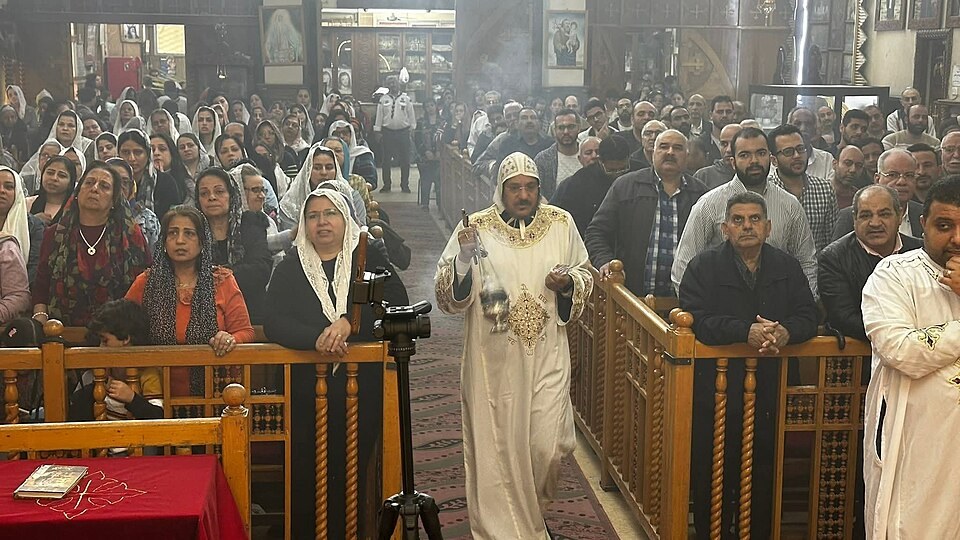 Source: A priest censes the congregation during a Coptic Orthodox Divine Liturgy in Egypt, photograph by Beshoy Makram Zaki, CC BY-SA 4.0; resized without cropping.
Why does the Church make this distinction?
The Eucharist is the true Body and Blood of our Lord Jesus Christ, not simply a reminder of Him or a gesture of friendship. In 1 Corinthians 10:16-17, Saint Paul joins participation in Christ’s Body and Blood with the unity of the Church: the many are one body because they share the one bread. Receiving therefore expresses a communion of faith and ecclesial life that must already be real.
This is not a judgment that visitors love Christ less. Nor does it mean that Coptic Christians have earned access by being better people. Christ gives Himself to heal sinners, but His gift is received within the life He has given His Church.
Saint Justin Martyr describes this connection in his First Apology, chapter 66. Those receiving believe the Church’s teaching, have received the washing of regeneration, and seek to live as Christ commanded. He explains, “For not as common bread and common drink do we receive these.” This ancient witness illuminates the connection between faith, baptism, Christian life, and Eucharist; it is not a substitute for today’s Coptic episcopal guidance.2
What if I belong to another Church?
Coptic Orthodox Christians
Baptism and chrismation, the anointing with Holy Myron, bring a person into sacramental life. But being Coptic by family background is not itself preparation for Communion. A Coptic Orthodox Christian who has been away, has an unresolved sacramental situation, or is uncertain about readiness should speak privately with the priest.
When visiting another parish, introduce yourself beforehand. If needed, your father of confession can help the priest at the parish you are visiting understand your situation. Do not assume he will recognize you or know the guidance you have received.
Other Oriental Orthodox Christians
The Coptic Church belongs to the Oriental Orthodox family. Communion with sister Churches is not the same question as admitting a non-Orthodox visitor. The Los Angeles Diocese records, for example, a joint Coptic, Armenian Apostolic, and Syriac Orthodox Liturgy and explicitly affirms their full communion.3
If you belong to an Oriental Orthodox sister Church, identify your actual parish and jurisdiction to the Coptic priest before receiving. Ask about preparation and any needed contact with your own priest. A familiar word such as “Orthodox” in a congregation’s name does not by itself establish its ecclesial standing. Let the clergy resolve jurisdictional questions rather than trying to settle them at the chalice.
Eastern Orthodox Christians
Greek, Russian, Antiochian, and other Eastern Orthodox Christians should not assume that shared Orthodox identity means automatic admission. The Coptic and Eastern Orthodox Churches are not in full communion. The Southern Diocese states this explicitly.4
If you have heard of a pastoral arrangement, discuss it with the priest and, where necessary, the diocesan authorities. Do not assume that an arrangement described to you applies to you. Wait for guidance from the priest acting under his bishop. Neither personal friendship nor an internet account establishes permission for you.
Catholics, Protestants, and other visitors
Catholic or Protestant baptism does not, by itself, authorize reception in a Coptic Orthodox parish. Catholic rules permitting reception in certain other churches do not establish a reciprocal Coptic rule. The Southern Diocese specifically rejects that inference.5
If you are exploring membership, see How to Become Coptic Orthodox. Do not receive Communion as an experiment or as a way of becoming a member without preparation.
How should someone prepare?
Preparation includes repentance, confession, prayer, fasting, reconciliation, and attentive participation in the Liturgy. The Los Angeles Diocese names good standing, recent confession, and fasting among the conditions for receiving. Your priest should explain how these apply to you, including the appropriate rhythm of confession. Do not invent a universal rule that confession must occur on the same morning.6
Saint Paul’s instruction in 1 Corinthians 11:23-29 is serious: examine yourself and discern the Lord’s Body. Examination is neither pretending to be sinless nor deciding that your sins place you beyond Christ’s mercy. Bring what needs healing into repentance and confession, rather than hiding it behind outward correctness.
Ask your priest for the Eucharistic fasting rule that applies to your circumstances. Do not take a number of hours from an article and apply it indiscriminately to children, pregnancy, diabetes, disability, illness, or frailty. Do not skip prescribed medication or medically necessary food or fluids to satisfy an online fasting instruction. Explain your needs to your priest and seek medical advice where appropriate. An article cannot determine your safe preparation or give you a personal sacramental ruling.
Arrive for worship, not merely for distribution. If travel, work, illness, or another difficulty disrupts your preparation, tell the priest what happened rather than concealing it or deciding the answer yourself.
What can I do while others receive?
Stay and pray. Listen to the hymns, give thanks to Christ, and ask Him to guide you. There is no obligation to join a line because everyone beside you does. For the service’s wider shape, read The Coptic Orthodox Divine Liturgy Explained.
The Los Angeles visitor guide expressly invites non-Orthodox visitors to receive eulogia, or blessed bread, at the end of the Liturgy. This is distinct from the consecrated Eucharist. Ask a greeter where and when it is distributed in that parish; do not assume that every piece of bread being offered during worship is the same thing.7
You can also remain afterward to meet the community. Respecting a sacramental boundary need not mean remaining a stranger. The next helpful step is usually a conversation, not an argument: “Father, this is my background. What should I do next?”
Footnotes
-
Coptic Orthodox Diocese of Los Angeles, Fr. Moses Samaan, “Visiting an Orthodox Church,” especially “Can non-Orthodox receive the Holy Eucharist?”. ↩
-
Saint Justin Martyr, First Apology 66, translated by Marcus Dods and George Reith, Ante-Nicene Fathers, volume 1 (1885), CCEL text; chapter locator and wording also checked in the complete First Apology. ↩
-
Coptic Orthodox Diocese of Los Angeles, “Second Annual Joint Divine Liturgy of the Oriental Churches,” May 11, 2006. ↩
-
Coptic Orthodox Diocese of the Southern United States, Q&A 2471, “Relationship Btwn. EO and OO Churches”. ↩
-
Coptic Orthodox Diocese of the Southern United States, Q&A 1598, “Orthodox and Catholic”. This answer establishes the absence of reciprocal permission; questions about a particular person’s reception into the Coptic Church require current diocesan guidance. ↩
-
Fr. Moses Samaan, “Visiting an Orthodox Church,” Eucharist section. ↩
-
Fr. Moses Samaan, “Visiting an Orthodox Church,” concluding Eucharist paragraph. ↩