
Coptic Orthodox Holy Week in 2027 leads from Palm Sunday, April 25, to the Feast of the Resurrection on Sunday, May 2. Lazarus Saturday falls on April 24, Covenant Thursday on April 29, Good Friday on April 30, and Bright Saturday on May 1. The Resurrection vigil is celebrated on Saturday night according to each parish’s announced schedule.1
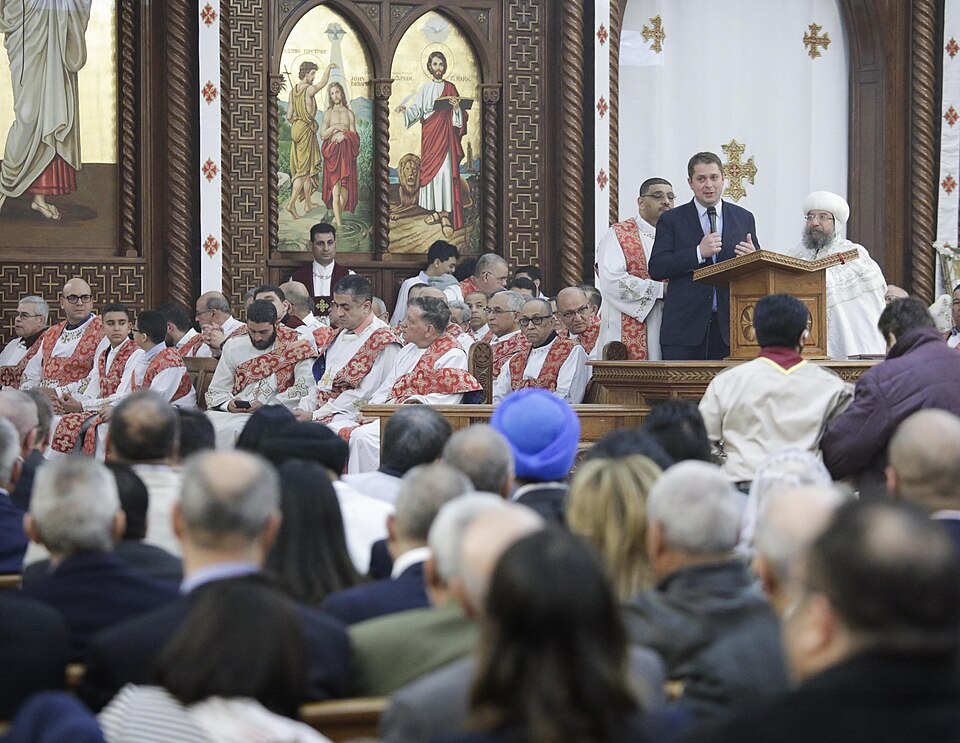 Source: Paschal Divine Liturgy, Church of the Virgin Mary and St. Athanasius, Mississauga, 2019, Andre Forget via Andrew Scheer, CC0; resized without cropping.
This guide is for following the services, not simply marking fasting dates. For the longer preparation and Sunday Gospels, see Great Lent 2027. For the whole year, use the Coptic fasting calendar.
Before you open the service book
Pascha means Passover. In Holy Week the Church follows Christ’s saving passage through suffering and death into the victory of His Resurrection. The services do more than recount events. Prophecies, Psalms, Gospel readings, and repeated praise teach us to recognize the One who freely gives Himself for the world.
A Pascha hour is a liturgical section, not a promise about the clock. The First, Third, Sixth, Ninth, and Eleventh Hours may be grouped together in a parish service. Ask for the parish’s Holy Week timetable rather than converting an hour’s name into an arrival time.
An eve belongs liturgically to the following day. In 2027:
- Sunday evening, April 25, is the Eve of Monday.
- Monday evening, April 26, is the Eve of Tuesday.
- Tuesday evening, April 27, is the Eve of Wednesday.
- Wednesday evening, April 28, is the Eve of Thursday.
- Thursday evening, April 29, is the Eve of Friday.
Some books also use the civil evening’s name. Read the service heading and Gospel together; “Tuesday evening” and “Eve of Wednesday” can describe the same gathering. The selections below identify their day or eve and hour explicitly.2
A day-by-day route through the week
Before following the daily services, read why Copts sing “Thine Is the Power”, the refrain you will hear throughout the Pascha hours.
These are selected reading anchors, not the complete lectionary for a day, hour, or service. A Pascha hour contains more than its Gospel, and some hours proclaim several Gospel accounts. Follow the parish’s service book for the complete appointed order.
Saturday, April 24: Lazarus Saturday
Service: Divine Liturgy. Selected Gospel: John 11:1-45.3
Lazarus Saturday stands at the threshold of Holy Week; it should not be confused with Bright Saturday a week later. Christ weeps before Lazarus’s tomb and then calls the dead man out. His tears do not contradict His authority. The Lord who commands death also enters the grief of those He loves.
Read this Gospel before Palm Sunday if possible. Bring a particular bereavement to Christ without demanding that every sorrow be resolved on your timetable. The raising of Lazarus points toward Christ’s victory, but Lazarus’s return to mortal life is not yet the risen, deathless life of the Lord.
Sunday, April 25: Palm Sunday, then the Pascha threshold
Service: Palm Sunday Liturgy. Selected Gospel: John 12:12-19, one of the four Gospel accounts appointed at this Liturgy.3
The crowd welcomes the King, but the King comes toward the Cross. Palm Sunday is not merely a cheerful pageant before a darker week. It asks what kind of king we are willing to receive: one who serves our ambitions, or the Lord whose victory comes through self-giving love.
Sunday evening begins the Eve of Monday Pascha services. Keep the morning’s entry into Jerusalem distinct from that evening’s liturgical heading. If children carry palms, explain that the branch is a welcome to Christ, not a substitute for listening to Him.
Monday, April 26: Fruit rather than appearance
Service: Monday daytime Pascha, First Hour. Selected Gospel: Mark 11:12-24.2
The fig tree and the cleansing of the temple confront religion that displays leaves without fruit. The passage also speaks of faith and prayer. Its question is not whether we have mastered Holy Week customs, but whether our worship opens our lives to God.
Choose one concrete response: make an overdue apology, stop a dishonest practice, or protect time for undistracted prayer. Do not turn the fig tree into a verdict on somebody else’s spiritual condition.
Tuesday, April 27: Keep the lamp ready
Service: Tuesday evening, Eve of Wednesday, Sixth Hour. Selected Gospel: Matthew 25:1-13.2
The ten virgins wait for the bridegroom. Their outward resemblance does not remove the need for readiness, and borrowed appearances cannot supply another person’s watchfulness. The cry at midnight makes the wedding, not anxiety, the center of the parable.
If this is the only weekday evening you can attend, arrive knowing its proper heading. At home afterward, ask what repeatedly drains attention from Christ. Lay aside one distraction rather than promising a heroic rule you cannot keep.
Wednesday, April 28: Love and betrayal
Service: Wednesday daytime Pascha, Sixth Hour. Selected Gospel: John 12:1-8. At the Ninth Hour, Matthew 26:3-16 includes the plot against Jesus and Judas’s agreement to betray Him.2
Mary pours out costly ointment; Judas counts its price. The contrast reaches beyond money. We can measure devotion by usefulness while withholding ourselves, or perform religious duties while privately negotiating with sin.
Give something that costs attention, not only spare change: patient care for an exhausted relative, restitution for a wrong, or an unadvertised gift. Mary’s act is directed toward Christ and His burial. It is not a general endorsement of extravagance or an excuse to neglect the poor.
Thursday, April 29: Covenant Thursday
Services: Pascha hours, the Laqan, meaning the blessing-of-water service, and the Divine Liturgy. Selected Gospels: John 13:1-17 at the blessing of water; Matthew 26:20-29 at the Liturgy.4
Christ washes His disciples’ feet and gives His Body and Blood. Humility and Eucharistic communion belong together: the Lord who gives Himself also teaches His disciples to serve one another.
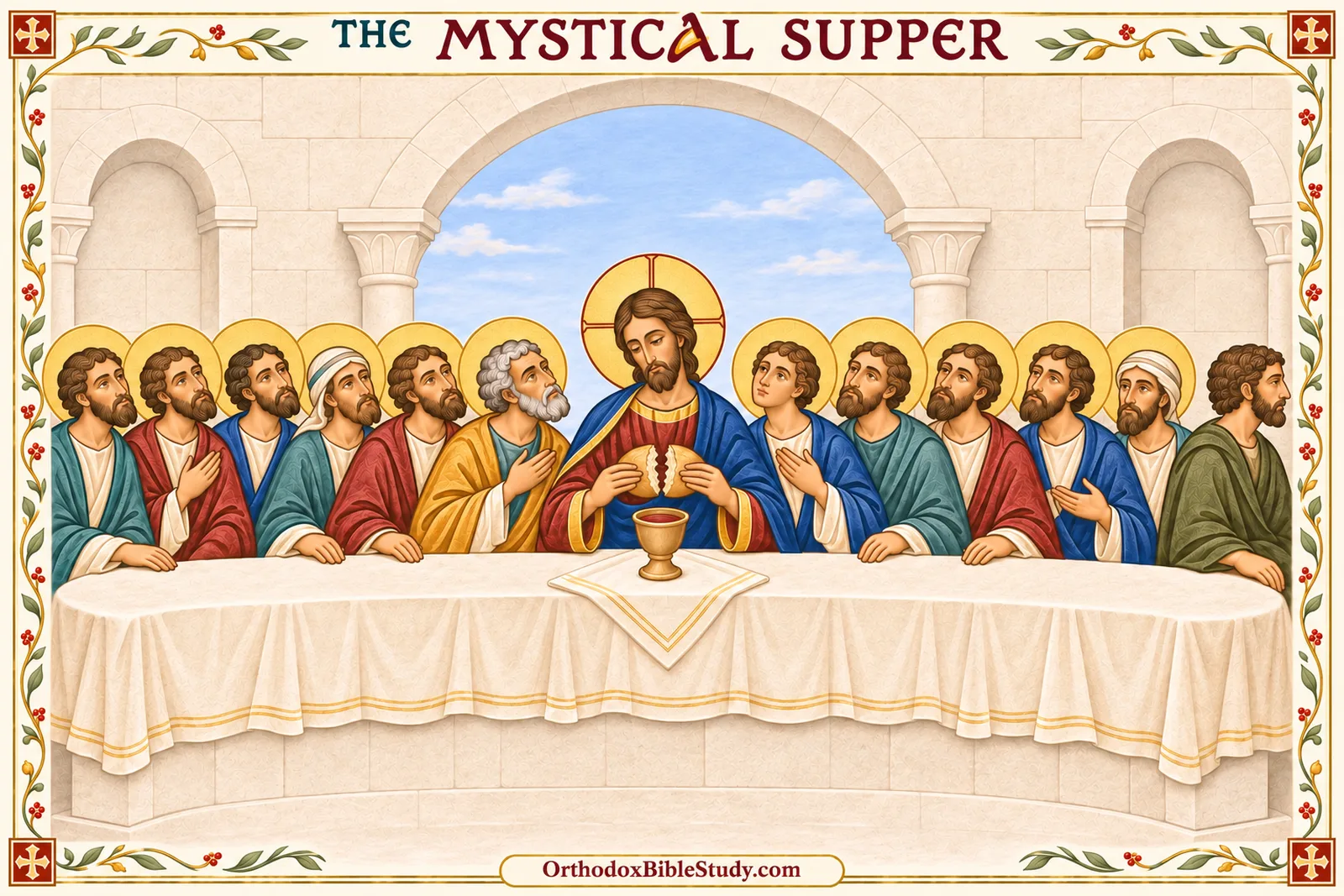 Source: Original generated artwork for Orthodox Bible Study, in the neo-Coptic style.
The bread and the cup connect the scene at the table to the Covenant Thursday Liturgy described here.
St. John Chrysostom notices that Christ personally undertakes the servant’s work: “He did all these things Himself.” The Lord’s humility is deliberate, not ceremonial politeness.5
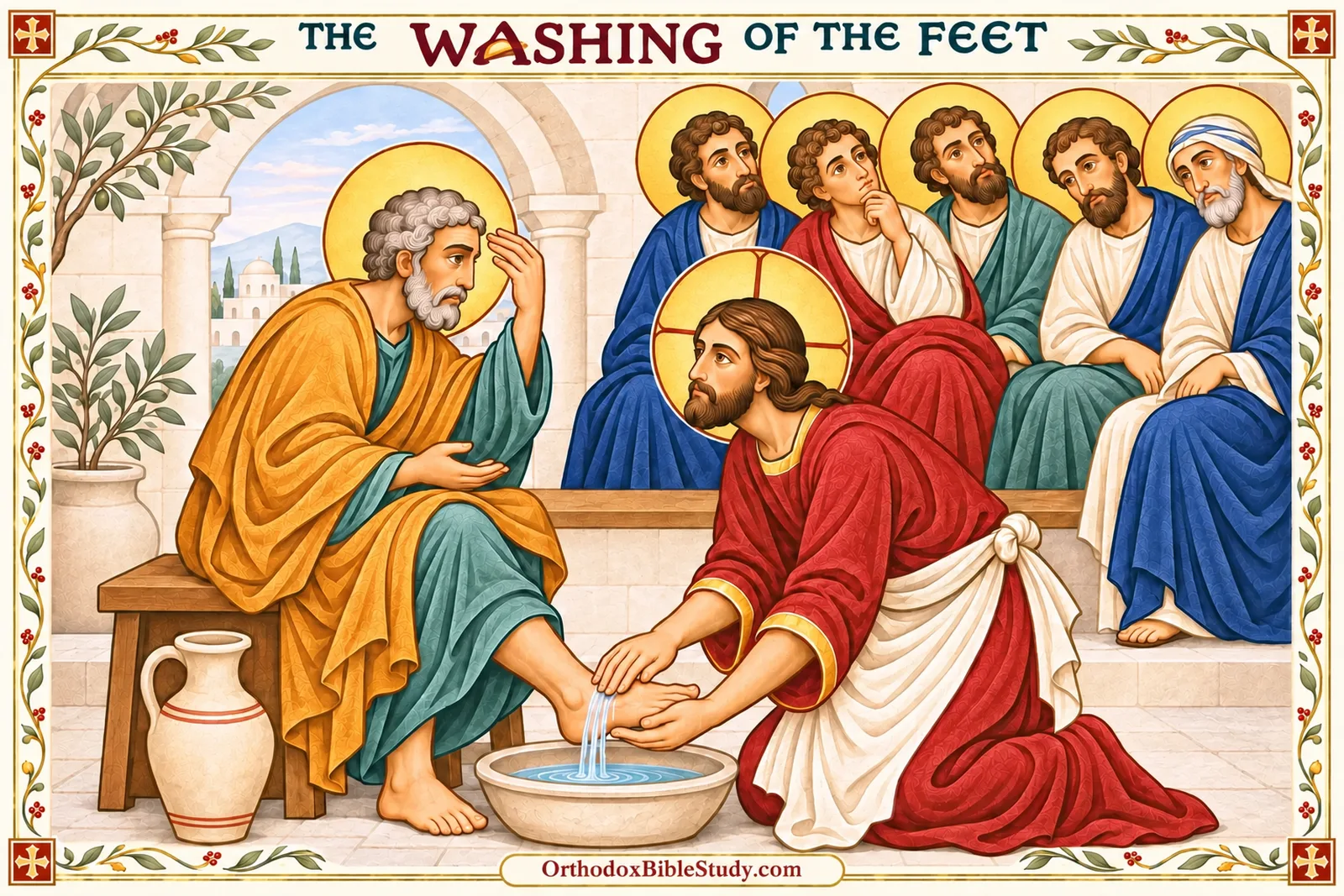 Source: Original generated artwork for Orthodox Bible Study, in the neo-Coptic style.
Christ takes the place of a servant at Peter’s feet. The basin and towel help connect John’s account to the day’s blessing of water.
Speak with your priest beforehand about preparing for confession and see the guide to who can receive Communion. Visitors should not assume that attending means receiving Communion; ask how to participate respectfully. Thursday evening then becomes the Eve of Friday, with Christ’s farewell teaching and prayer. For example, John 13:33-14:25 belongs to its First Hour, not Thursday’s daytime water service.2
Friday, April 30: Good Friday
Service: Good Friday daytime Pascha. Selected Gospels: John 19:13-27 at the Sixth Hour; John 19:28-30 at the Ninth Hour.2
The first selection brings us to Golgotha and the Lord’s care for His mother and beloved disciple. The second brings us to the completion of His work and His voluntary giving up of His spirit. These are selections within the hours’ fuller Gospel witness.
Stay as long as your responsibilities and health allow. If you need to sit, sit without turning bodily strain into a spiritual competition. Listen to the crucified Lord rather than pursuing a particular emotional experience. His saving work does not become more real because we can make ourselves feel more sorrowful.
Saturday, May 1: Bright Saturday and the Apocalypse
Service: The overnight Bright Saturday observance, commonly called Apocalypse Night, continuing into Saturday according to parish arrangements. Reading anchor: the whole book of Revelation (chapters 1–22; see the book overview for a study companion), in its appointed Revelation portion. Selected Liturgy Gospel: Matthew 28:1-20.6
“Apocalypse” means revelation, not merely catastrophe. The slain and living Lamb interprets the Church’s hope. The vigil’s scriptural breadth keeps the tomb from becoming a place of hopelessness: Christ’s death is the defeat of death, not the defeat of His kingdom.
Ask specifically about the service beginning Friday night and the Saturday observance. These are not the same gathering as the Resurrection vigil on Saturday night. Plan rest and transport, especially with children or an overnight drive.
Sunday, May 2: The Feast of the Resurrection
Service: Resurrection feast Liturgy, commonly celebrated during the Saturday-night vigil. Selected Liturgy Gospel: John 20:1-18.1
Mary Magdalene comes grieving and is called by name. The risen Christ is not an idea that cancels grief from a distance; He meets His people and sends them with good news. The Cross and Resurrection are one saving victory, not two competing moods.
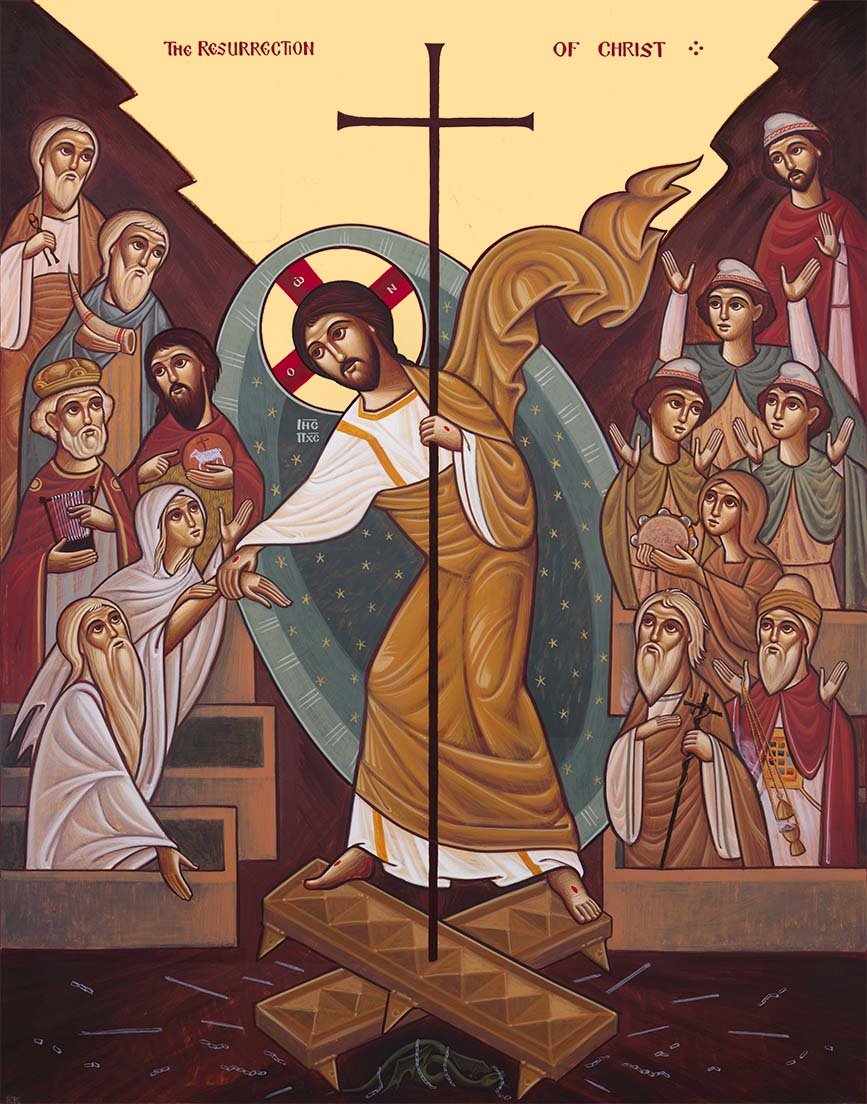 The Resurrection of Christ in the Anastasis tradition. Christ stands on the broken gates and reaches down to raise the dead. Icon by Kirollos Kilada.
In this Coptic Anastasis (Resurrection), Christ reaches into the realm of death to draw the dead out. Compare the Byzantine fresco at Chora.
Participate faithfully, not competitively
Before the week, choose the services you can realistically attend and obtain the correct book or parish-provided text. Read one selected Gospel beforehand. During worship, follow the responses even when you cannot follow every page.
If work, disability, illness, or caregiving keeps you home, read that day’s anchor, pray for those gathered, and ask the priest about pastoral support. A home reading is a real prayerful response, but it is not a replacement performance of the full church service.
Keep fasting under pastoral guidance, especially where health or medication is involved. Let reduced entertainment make room for Scripture, and let repentance become reconciliation rather than irritability. The aim is not to finish the week proud of what we endured. It is to receive the love of Christ and carry His mercy into the life waiting beyond the church doors.
Footnotes
-
Date-resolved Coptic appointments: Resurrection, May 2, 2027, preserved in the Coptic lectionary. The feast date and its preceding evening vigil are distinct calendar descriptions; parish start times vary. ↩ ↩2
-
The 2027 lectionary records these Gospels by day or eve and hour. Its sources include retained Coptic Reader texts for the Eve of Wednesday Sixth Hour and Good Friday Sixth Hour, a Coptic Reader record for Wednesday daytime, and a day-and-hour index for Monday First Hour, Eve of Friday First Hour, and Good Friday Ninth Hour. Holy Pascha service collection. ↩ ↩2 ↩3 ↩4 ↩5 ↩6
-
Date-resolved appointments for Lazarus Saturday, April 24, and Palm Sunday, April 25. Palm Sunday Liturgy includes Matthew 21:1-17; Mark 11:1-11; Luke 19:29-48; John 12:12-19. The guide highlights only the last. ↩ ↩2
-
Covenant Thursday retained Reader appointments: John 13:1-17, Liturgy of Blessing of the Water; Matthew 26:20-29, Divine Liturgy. Preserved selected-date witness of April 9, 2026, with bounded recurrence including 2027, not a fresh 2027 service capture. Coptic Reader service collection. ↩
-
St. John Chrysostom, Homilies on John 70.2, on John 13:1, NPNF, First Series, vol. 14, Oxford translation revised; exact passage. ↩
-
The retained Coptic Reader Revelation portion lists all twenty-two chapters; the Bright Saturday service order lists Matthew 28:1-20 as the Liturgy Gospel. ↩