
Copts sing “Thine is the power, the glory, the blessing, and the honor, forever. Amen” during Holy Week because the suffering Jesus is not a defeated Savior. He is our God and King, freely giving Himself for the life of the world. The hymn is praise addressed to Christ in His Passion, and its repetition teaches us to recognize His majesty precisely where the world sees only humiliation.1
“Thine” simply means “Yours.” If the older English initially feels unfamiliar, you might put its meaning this way: The power is Yours, Lord. The glory is Yours. Even here, at the Cross, You are our King.
What is the Pascha hymn?
Pascha means Passover. In Coptic Holy Week worship, the Church follows the Lord through His suffering toward His saving death and Resurrection. The services contain Scripture readings, prayers, and hymns that hold our attention on Him.
“Thine Is the Power” is often identified by Coptic words transliterated in English as Thok te ti gom. Spellings differ. Pope Shenouda III’s book prints another transliteration, “Thwk Teti Gom,” and translates it “Thine is the Power.”2
The hymn includes addresses such as “Emmanuel our God and King” and “Our Lord Jesus Christ.” These are not decorative additions. Emmanuel means “God with us.” The One being betrayed and condemned is God with us, not someone from whom God has withdrawn His presence.
Pope Shenouda describes the refrain being sung twelve times in the prayer of each Pascha hour. He relates this repetition to the psalms of the Church’s ordinary daily hours of prayer.3 A parish may group several hours into a morning or evening gathering, so do not assume that every named hour has a separate advertised service. Follow your parish’s book and announcements.
Why praise Him while He suffers?
We can mistake Holy Week for an exercise in feeling sorry for Jesus. His suffering should indeed awaken grief for sin and gratitude for His love. But pity alone misses who He is and what He accomplishes.
Jesus says that no one takes His life from Him: He lays it down Himself and has power to take it again (John 10:17-18). His Passion is voluntary. That does not make the wounds unreal or His anguish theatrical. The eternal Son truly became man and truly suffered in the flesh for us. His freedom makes the gift loving; it does not make the suffering imaginary.
St. John Chrysostom draws precisely this connection between Christ’s freedom and the Cross: “He who was under no necessity of being crucified, was crucified for our sake.”4 We are looking at love that gives itself, not at divine weakness caught by surprise.
The refrain trains us to read the Passion with faith. At the arrest, He remains Lord. Before His judges, He remains King. On the Cross, He remains the Savior. We praise Him not because pain is good in itself, but because through His suffering and death He defeats the death that enslaves us.
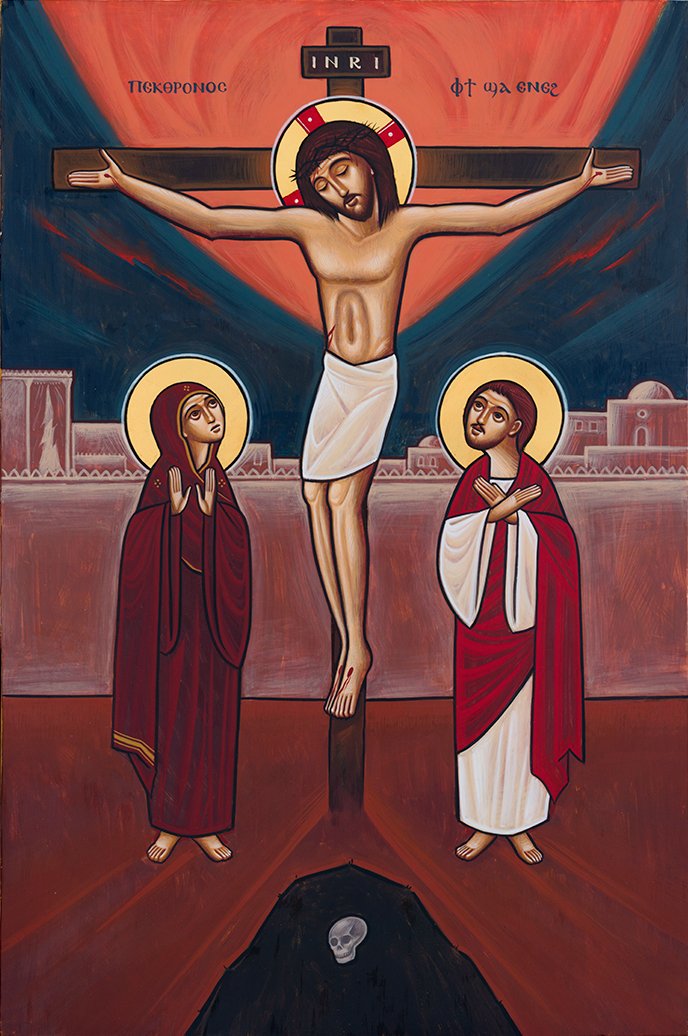 Christ crucified, with the Theotokos and the beloved disciple standing beside Him. Icon by Kirollos Kilada, used with permission.
“The power”: love is not helplessness
In Thine Is the Power and the Glory, Pope Shenouda contrasts worldly force with Christ’s power to love, sacrifice, endure, and give. He writes: “The Lord set an example of the Power which loves and sacrifices, endures and gives without limits.”5
That is not an abstract definition. John names Peter as the disciple who draws the sword and records Jesus telling him to put it away (John 18:10-11). Luke tells us that Jesus heals the wounded servant (Luke 22:50-51). Pope Shenouda asks us to stand beside the arrested Lord who heals the wounded servant, saying, “Thine is the Power.”2
St. Paul makes the same reversal central to the Gospel: the message of the Cross is the power of God to those being saved (1 Corinthians 1:18). What looks like defeat becomes the means of our deliverance.
This challenges ordinary habits of domination. In an argument, is my aim to make someone feel small? At work, do I use authority to protect others or to protect my importance? Christ does not call cruelty strength merely because it wins.
Yet this is not an instruction to remain in danger or hide abuse. If someone is hurting or threatening you, you can seek safety, tell someone who can help, and report the violence. You do not need the person’s permission to seek help. His unique, voluntary saving sacrifice must never become someone else’s excuse to demand our silence.
“The glory”: shame cannot erase who He is
Christ’s enemies mock Him, but their mockery does not determine His identity. The crown of thorns does not make Him less the King.
Philippians 2:5-11 holds His self-emptying obedience and His exaltation together. The One who takes the form of a servant is the Lord before whom every knee will bow. The hymn keeps those truths together while we contemplate His Passion.
Pope Shenouda also explains that our praise does not add glory that God lacks. Rather, we acknowledge the glory that is His.6 Worship heals our sight. We stop treating public approval, comfort, or visible success as the final measure of truth.
“The blessing and the honor”: the condemned One blesses us
Galatians 3:13-14 says that Christ redeemed us from the curse of the law so that the blessing promised to Abraham might come to the nations. He is not personally sinful. He bears what is ours to give us what we could not obtain for ourselves.
Pope Shenouda reads “Thine is the blessing” against this biblical background: the holy Christ bears the curse for us and becomes the source of blessing.7 Our answer to the Cross is therefore more than horror at an execution. It is thanksgiving for redemption.
Revelation 5:6-14 gives a closely related biblical vision: the Lamb who was slain receives heavenly worship, power, honor, glory, and blessing. To give Christ honor is to worship as King the very One whom others treated with contempt. His wounds do not disqualify Him from praise. Revelation helps us hear what the Church confesses: the Lamb who was slain is worthy of worship.
How to pray the repetitions attentively
Start by understanding the words, rather than worrying about mastering the melody. Follow the text used by the congregation. A newcomer can listen prayerfully before joining in.
Bring to mind a Passion reading you have heard during the service. If you have heard about betrayal, praise the faithful Lord. If you have heard about His silence before accusation, consider His freedom from revenge. Do not invent a hidden meaning for every repetition; return to the Christ the Church has just placed before you.
When attention wanders, return without drama. Choose one word, perhaps “power,” and offer it honestly. Ask Him to free you from the desire to overpower someone else. With “glory,” surrender the need to be admired. With “blessing,” give thanks for the salvation you did not earn.
The hymn can also become a brief home prayer after reading John 10:17-18. That is a suggested devotion, not a substitute for the parish’s services or a new private rule.
We repeat the words because our hearts forget. The Cross looks like weakness; faith confesses the Savior. Hour after hour, the Church teaches our frightened, distracted hearts to say what remains true: Yours is the power, Lord Jesus Christ.
Continue reading
- A day-by-day guide to Coptic Holy Week
- John 10: The Good Shepherd lays down His life
- Revelation 5: The scroll and the slain Lamb
Sources
Footnotes
-
Pope Shenouda III, Thine Is the Power and the Glory, trans. St. Mark Coptic Orthodox Church, Los Angeles; second edition, April 1992, revised by Mrs. Wedad Abbas; COEPA revision, 1997. “The Passion Week’s Rite,” pp. 8-9. The quoted wording uses American “honor”; the edition prints “Honour.” ↩
-
Pope Shenouda III, Thine Is the Power and the Glory, “He was Powerful While being Arrested,” pp. 26-28, especially p. 27: full book, p. 27. ↩ ↩2
-
Pope Shenouda III, “The Pascha Hymn,” pp. 15-16. ↩
-
St. John Chrysostom, Homilies on Hebrews, Homily XXVIII, exposition of Hebrews 12:2 within the homily on Hebrews 11:37-38, NPNF, first series, vol. 14, English translation in the Philip Schaff edition: direct text. ↩
-
Pope Shenouda III, Thine Is the Power and the Glory, “The Lord’s New Concept of Power,” pp. 19-24; quotation from p. 19: full book, p. 19. ↩
-
Pope Shenouda III, Thine Is the Power and the Glory, “You Are Our Glorified God” and “We also Glorify You,” pp. 47-50, especially p. 49: full book, p. 49. ↩
-
Pope Shenouda III, Thine Is the Power and the Glory, section on the blessing, pp. 51-56, especially pp. 51 and 54: full book, p. 51. ↩