
To become Coptic Orthodox, contact a Coptic Orthodox parish, begin attending worship, and ask the priest to guide you through instruction and preparation for reception into the Church. You do not need to be Egyptian, speak Arabic, or already understand the service. Ask the priest what preparation will involve and how long it may take in your circumstances.1
You may begin while you still have questions. Visiting is not a promise to convert, and asking for instruction is not a claim that you have resolved every difficulty. It is an honest way to discover whether you can confess and live the Church’s faith.
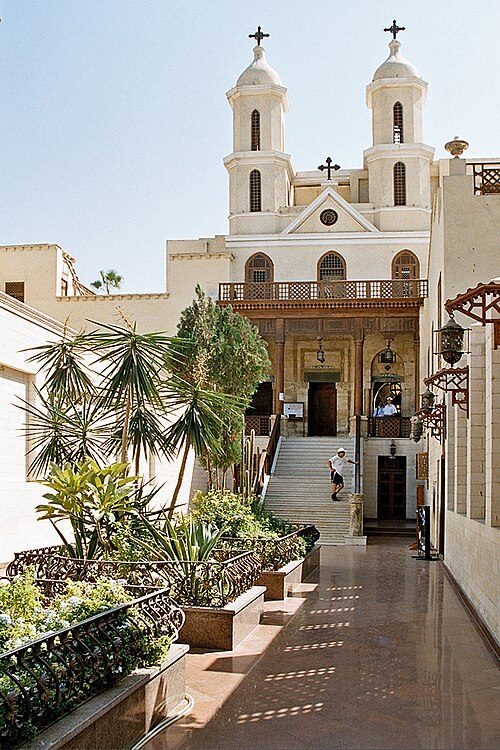 Source: Church of the Virgin Mary (the Hanging Church), Old Cairo, photograph by Przemyslaw “Blueshade” Idzkiewicz, CC BY-SA 2.5; resized without cropping. Its nave rests above a gatehouse of the Roman fortress of Babylon.
You do not have to become Egyptian
“Coptic” names the Church’s Egyptian heritage, not an ethnic entrance requirement. Its life is centered on Jesus Christ, not on acquiring someone else’s ancestry. The Los Angeles Diocese explicitly describes its community as including both people born into Orthodoxy and people who have converted, and welcomes anyone wishing to discover the faith.2
You will encounter an inherited culture: languages, food, family relationships, hymns, and ways of showing respect. Receive these with curiosity rather than treating them as obstacles to eliminate. At the same time, you may ask for understandable teaching, help following prayers, and genuine pastoral attention. Learning the faith is not an examination in Egyptian social customs.
If you cannot follow the language at the first parish you visit, ask which services have substantial English or another language you understand. Do not assume all services in that parish, or all nearby Coptic parishes, use the same language.
Start with one concrete conversation
Find a parish through an official Coptic diocesan directory, check its current service information, and send a short message:
Father, I am interested in learning about the Coptic Orthodox Church. My religious background is ____. I would like to visit and speak about becoming Orthodox. Could we arrange a time, and is there someone who could help me follow the service?
Include any important access needs, language concerns, or travel limitations. You do not need to put your entire personal history in an introductory email. Save sensitive matters for a private conversation.
If you receive no reply, follow up courteously through the parish office or another published contact. A priest may be serving several communities. A missed message is not necessarily a refusal. Ask for an appointment rather than expecting a long conversation while he is preparing for worship or greeting many people afterward.
The Southern Diocese’s advice to an American inquirer is concrete: get to know a local priest, who will guide reading, prayer, fasting, and the spiritual journey. Discipleship matters alongside study.3
What happens during inquiry and catechesis?
An inquirer is someone exploring the faith. A catechumen is someone being instructed in preparation for entering the Church. Ask the priest how the parish organizes this process and when someone formally becomes a catechumen. Some instruction may take place in a class; some may be individual. The Southern Diocese describes teaching in the Church’s dogma, history, and spirituality, normally arranged with the priest.4
Expect more than information about ceremonies. You need to understand whom the Church worships, what it confesses about Christ, what baptism and the Eucharist mean, and how repentance changes ordinary life. Bring serious questions about Scripture, the saints, Mary, icons, authority, or past experiences of Christianity. Pretending agreement will not help you prepare.
For the doctrinal overview, begin with What Do Coptic Orthodox Christians Believe?. For understanding the service, use The Coptic Orthodox Divine Liturgy Explained. Becoming Orthodox is related to both, but is not accomplished merely by reading either guide.
Learn a sustainable Christian life
In Acts 2:37-42, those moved by the apostolic preaching ask what they should do. Peter calls them to repentance and baptism; afterward they continue in the apostles’ teaching, fellowship, breaking of bread, and prayers. Entry into the Church opens a shared life rather than finishing a private research project.
Saint John Chrysostom, commenting on this passage, emphasizes how Peter’s gentleness helped his hearers come to repentance. He then identifies perseverance and concord in the newly baptized community. The point is not to force yourself through a religious checklist, but to learn faithful life with others in Christ.5
Begin with a manageable prayer rule agreed with the priest, regular Gospel reading, and worship as your circumstances allow. The Agpeya is the Coptic book of daily prayer; this introduction can help you understand it. Do not assume you must pray every Hour immediately or adopt the strictest fasting practice you find online. Explain medical needs and existing responsibilities before taking on a rule.
What if I have already been baptized?
Tell the priest your precise church background and, if possible, bring a baptismal certificate or the name of the parish where you were baptized. Explain any previous chrismation, confirmation, or reception into another Church. If records are unavailable, say so plainly.
For someone not previously baptized, preparation leads toward baptism, chrismation with Holy Myron, and Eucharistic life. For a previously baptized Christian, do not assume either that every baptism will be repeated or that no further sacramental reception is needed. Your priest must establish the appropriate course under his bishop’s guidance. Written diocesan answers address particular backgrounds; they are not interchangeable guarantees for every inquirer.6
Membership in an Oriental Orthodox sister Church is also a different situation from entering from outside that communion. Explain your actual jurisdiction rather than simply saying “I am Orthodox.”
If you are seeking reception into the Coptic Orthodox Church, wait until you have been received and your priest has guided you about Communion. If you already belong to an Oriental Orthodox sister Church, speak with the priest before receiving about your parish, jurisdiction, and preparation. Who Can Receive Communion in a Coptic Orthodox Church? explains the distinction between welcome and sacramental admission.
How long will it take?
Ask your priest what preparation will involve and how you will review your progress together. No responsible general article can promise a number of weeks or months. Prior formation, understanding, practical access to parish life, and personal circumstances need pastoral attention.
You may reasonably ask, “What should I be learning now?” and “When can we next discuss readiness?” Patience does not mean remaining indefinitely confused about the next step. Equally, enthusiasm, a wedding date, or completing a reading list should not be treated as an automatic deadline for reception.
Distance, family, and your previous church
If the nearest parish is far away, say so early. Ask whether remote conversations or classes can support preparation, how often you can realistically visit, and whether a nearer mission exists. Online material can sustain learning, but watching services does not itself receive you into the Church.
Speak honestly about your spouse, children, family expectations, and existing church commitments. Do not assume everyone must move at your pace. Explain your reasons without ridiculing the people who first taught you to pray. Ask the priest about marriage or family situations before making promises that affect other people. Where disclosure could expose you to violence or serious danger, seek confidential pastoral and appropriate safeguarding help rather than treating confrontation as proof of faith.
Reception is a beginning. You will still need instruction, friendship, confession, and patience with an imperfect parish community. The aim is not to become an expert outsider who has selected the correct tradition. It is to belong to Christ and learn to follow Him faithfully within His Church.
Footnotes
-
Coptic Orthodox Diocese of the Southern United States, Q&A 1130 on visitors and the catechumenate, and Q&A 2310 on an American inquirer’s path into the Church. ↩
-
Coptic Orthodox Diocese of Los Angeles, Fr. Moses Samaan, “Visiting an Orthodox Church,” opening section. ↩
-
Coptic Orthodox Diocese of the Southern United States, Q&A 2310. ↩
-
Coptic Orthodox Diocese of the Southern United States, Q&A 1130. ↩
-
Saint John Chrysostom, Homilies on Acts, Homily VII on Acts 2:37, opening exposition and discussion of verse 42, Nicene and Post-Nicene Fathers, first series, volume 11 (1889), CCEL. ↩
-
Compare the Southern Diocese’s general account of initiation in Q&A 2310 with its background-specific discussion in Q&A 1598. These sources are not used here to prescribe an individual rite of reception. ↩