
The Coptic Orthodox Church belongs to the Oriental Orthodox family, not the Eastern Orthodox family of Churches such as the Greek, Russian, and Romanian Orthodox Churches. The historic division centers on the Council of Chalcedon in 451 and its reception. Both families confess Jesus Christ as truly God and truly human. Important modern theological agreements have clarified their shared confession, but full communion has not been restored.1
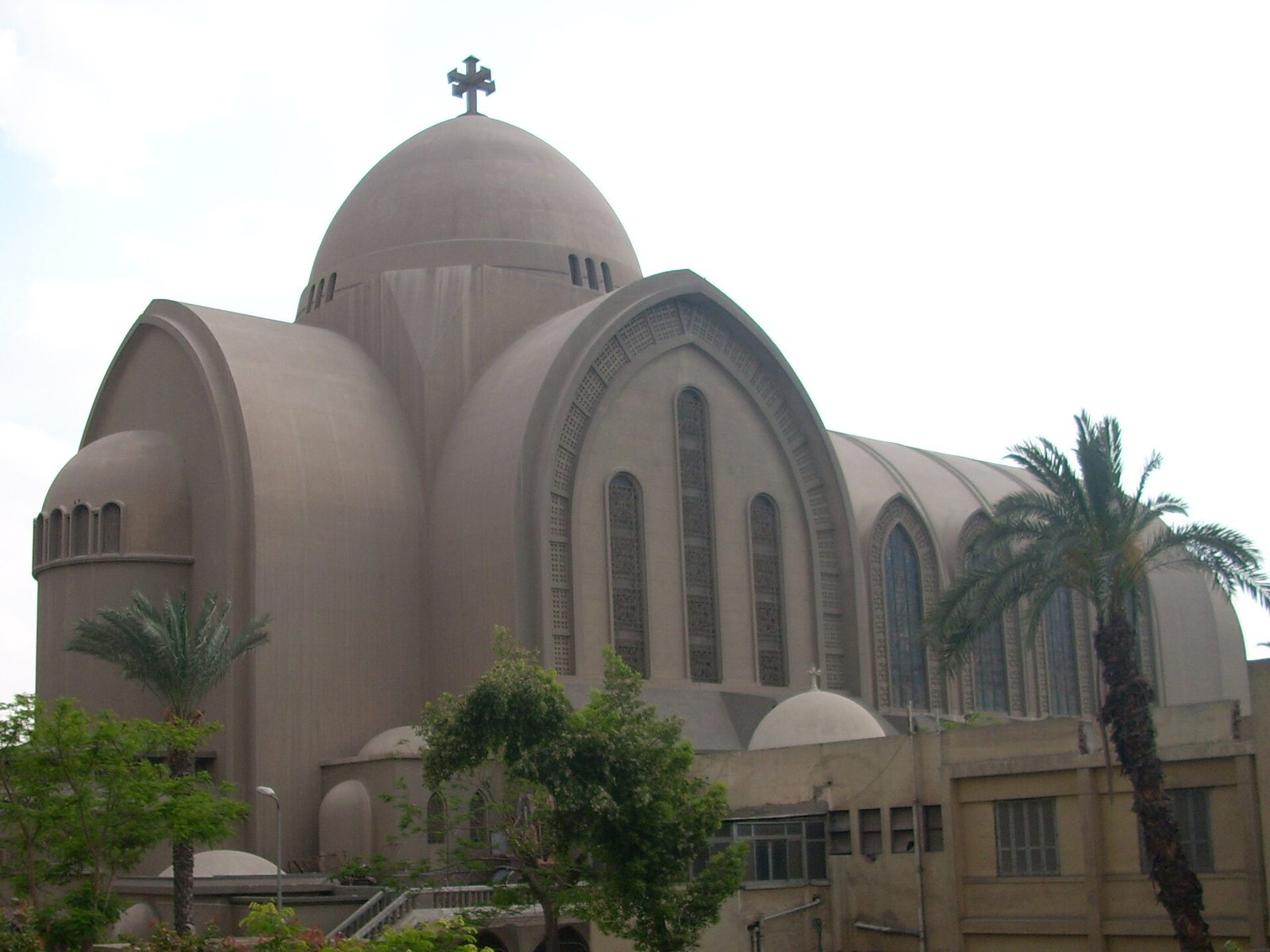 Source: St. Mark’s Coptic Orthodox Cathedral, Abbasiya, Cairo, photograph by Ashashyou, CC BY-SA 3.0; resized without cropping. The cathedral is the seat of the Coptic Orthodox Pope.
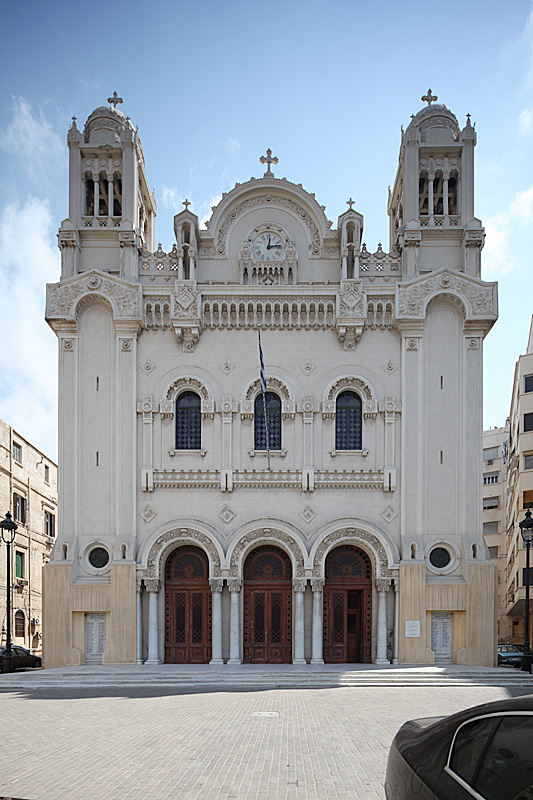 Source: AlexGreekCathedralFront, Roland Unger, CC BY-SA 3.0.
The difference is therefore neither simply Egyptian versus Greek culture nor a choice between believing in Christ’s divinity and believing in His humanity. To understand it fairly, we need to distinguish the faith each Church professes, the councils each receives, and the communion in which its members live.
Two Orthodox families, not two national versions
The Oriental Orthodox family includes the Coptic, Syriac, Armenian, Ethiopian, Eritrean, and Indian Orthodox traditions. Eastern Orthodoxy includes Churches such as Constantinople, Antioch, Alexandria, Jerusalem, Greece, Romania, and Russia. These names describe ecclesial relationships, not racial qualifications. Someone does not have to be Egyptian to become Coptic Orthodox.2
Alexandria itself can cause confusion. There is a Coptic Orthodox patriarchate and a Greek Orthodox patriarchate. They share the inheritance of an ancient Christian city, but they are not the same present-day institution. Our guide to the Pope of Alexandria explains these overlapping names.
Both families receive the Trinity, the Incarnation, Christ’s saving death and bodily Resurrection, sacramental life, ordained ministry, and the intercession of the saints. Their spirituality includes fasting, confession, monasticism, and the Eucharist. The beginner’s guide to Coptic Orthodox beliefs provides that foundation before the historical distinctions.1
Why Chalcedon matters
Both families receive the first three ecumenical councils: Nicaea in 325, Constantinople in 381, and Ephesus in 431. Eastern Orthodox Churches also receive Chalcedon and the three subsequent councils traditionally numbered fifth through seventh. The Coptic Orthodox Church does not receive Chalcedon as an ecumenical council.3
Chalcedon confessed one and the same Son acknowledged in two natures, without confusion, change, division, or separation.4 Its intended teaching was not two sons or two Christs. Coptic Orthodoxy preserves Saint Cyril of Alexandria’s language of the one incarnate nature of God the Word, guarding the concrete unity of the Savior.3
The division involved more than a numerical dispute about natures. The disagreement also concerned which councils the Churches received and which condemnations they upheld.3 Nor was the separation one tidy event after which everyone understood the other side perfectly. Centuries of estrangement hardened judgments that modern dialogue has had to examine patiently.
Still, it would be wrong to dismiss the dispute as meaningless politics. Christians were asking how to confess the One who saves us. Does God the Word Himself truly become human? Is His humanity complete? Is the Savior one? These questions belong to the heart of the Gospel, not its margins.
Does “one nature” mean Christ is not fully human?
No. Coptic Orthodox teaching does not say that Christ’s humanity was swallowed up by His divinity. The term miaphysite is commonly used to describe its confession of the one united incarnate nature of God the Word, from true divinity and true humanity, without confusion or separation.5
That is not the teaching condemned as Eutychianism, which compromises Christ’s complete humanity. Equally, the Eastern Orthodox confession of two natures does not mean two independent persons living alongside one another. Both distortions should be rejected rather than assigned to a neighbor who explicitly denies them.
John 1:14 is the biblical center: the Word becomes flesh. The One who eternally is God genuinely enters human life. He does not cease to be divine, and He does not merely appear human. The language of nature concerns what He is; the language of person identifies the one Son who acts and suffers in the flesh. Ancient terminology requires care because its use developed and was not identical in every writer.
Saint Cyril matters to both families precisely because the confession concerns the one saving Christ. The modern statements invoke his teaching as their common ground. They do not require the Coptic Church to abandon its Cyrillian language in order to acknowledge another family’s intended confession.53
What did the 1989 and 1990 agreements actually say?
The official Joint Commission met at Saint Bishoy Monastery in Egypt in June 1989. Its First Agreed Statement explicitly rejected both the division of Christ and the absorption of His humanity into His divinity. It explained that those speaking of two natures do not thereby deny their indivisible union, while those speaking of one united divine-human nature do not thereby deny the continuing reality of the divine and human.5
The Second Agreed Statement, adopted at Chambésy in September 1990, went further. It affirmed Christ’s divine and human properties, natural wills, and energies in union, with the one incarnate Word as the subject of His willing and acting. In paragraph 7, it recognized the intended Orthodox meaning of both families’ traditional formulas.3
This is substantial agreement, not a polite decision to stop discussing doctrine. But it must be described at the right level: these were the agreed statements of the official theological commission, submitted to the Churches for consideration and action.
Paragraph 8 preserved distinctions over the reception of later councils. Paragraph 10 and the recommendations called for the Churches to lift the condemnations that divide them. A recommendation that something should happen is not a declaration that it has already happened everywhere.
Consequently, neither “the Churches still disagree about whether Jesus is human” nor “reunion was completed in 1990” tells the truth. The agreements supply grounds for hope while leaving ecclesial reception and implementation necessary. The Coptic Church republished these dialogue documents for the Eastern and Oriental Orthodox meeting in 2024.1
What would a visitor notice?
Coptic worship belongs to the Alexandrian tradition. Most familiar Eastern Orthodox parish worship follows the Byzantine tradition. A visitor may notice different melodies, vestments, liturgical languages, iconographic styles, and patterns of movement. The theological seriousness of worship cannot be measured by which style feels more familiar.
Both traditions gather around Scripture and the Eucharist. Both address God through prayers shaped by the Church’s received faith rather than treating worship as a weekly invention. In a Coptic parish, the Divine Liturgy guide explains what a newcomer can expect.
Church leadership also differs in its organization. The Coptic pope presides over his Church’s Holy Synod; he is not a universal ruler over the Oriental Orthodox family. That synodal authority is exercised within the Coptic Orthodox Church.6
Can members receive Communion in one another’s churches?
Not simply because both use the name Orthodox. Eucharistic communion expresses a Church’s actual communion in faith and ecclesial life. Similar worship and agreed theological statements are not personal authorization to approach another Church’s chalice.
Ask the parish priest before the service rather than trying to interpret an ecumenical document at the Communion line. Any particular pastoral provision must come from the competent Church authorities. See who can receive Communion in a Coptic Orthodox church.
Questions about entering another Church, the reception of an earlier baptism, or marriage across ecclesial boundaries also require actual pastoral guidance. There is no responsible universal rule to infer from a comparison article. Someone discerning a lasting commitment can begin with how to become Coptic Orthodox.
Seeking unity without pretending division is healed
In Ephesians 4:1-6, Paul places humility, patience, and bearing with one another in love beside the confession of one body, one Lord, one faith, and one baptism. Unity is neither an excuse to surrender truth nor a reward for winning an argument.
Saint Athanasius closes On the Councils by asking his readers to remain on the apostolic foundation and pray that “all strife and rivalry may cease.” His context was the fourth-century struggle over the Son’s divinity, not today’s dialogue. Yet his joining of doctrinal fidelity and prayer remains instructive.7
Christ’s prayer in John 17:20-23 does not allow us to enjoy estrangement. We can love our own Church without caricaturing another, honor genuine agreement without inventing completed reunion, and pray for our bishops without pretending to take their place. To defend the one incarnate Lord should make us more truthful, more reverent, and less eager to wound those who also confess His name.
Footnotes
-
Coptic Orthodox Church, Eastern and Oriental Orthodox Churches Meeting, September 16-17, 2024, official publication of the dialogue statements and proposals for restoring communion. ↩ ↩2 ↩3
-
Coptic Orthodox Bible Study, What Do Coptic Orthodox Christians Believe?, especially “Oriental Orthodox, not Eastern Orthodox.” ↩
-
Joint Commission, Second Agreed Statement and Recommendations, Chambésy, September 23-28, 1990, paragraphs 3-10 and recommendations A-C. ↩ ↩2 ↩3 ↩4 ↩5
-
Council of Chalcedon, Definition of Faith, final doctrinal paragraph; translated by Henry Percival, Nicene and Post-Nicene Fathers, second series, volume 14. Cited to describe the council’s confession, not to imply Coptic reception of its authority. ↩
-
Joint Commission, First Agreed Statement, Saint Bishoy Monastery, June 20-24, 1989, especially the paragraphs on the hypostatic union and the four adverbs. ↩ ↩2 ↩3
-
Coptic Orthodox Church, Holy Synod session, May 2026, on the pope’s chairmanship and the bishops’ deliberations; see also the Pope of Alexandria guide. ↩
-
Saint Athanasius of Alexandria, On the Councils of Ariminum and Seleucia, section 54, translated by Archibald Robertson, Nicene and Post-Nicene Fathers, second series, volume 4 (1892). ↩