
You are welcome to visit a Coptic Orthodox Divine Liturgy without already knowing the prayers, speaking Coptic, or being Orthodox. Expect extended worship with Scripture, chanting, incense, and a congregation that participates through responses and prayer. Its center is the Eucharist, Holy Communion in the true Body and Blood of Jesus Christ. You may attend without receiving Communion.1
You do not need to master everything before coming. Knowing the service’s direction will help more than trying to decode every movement.
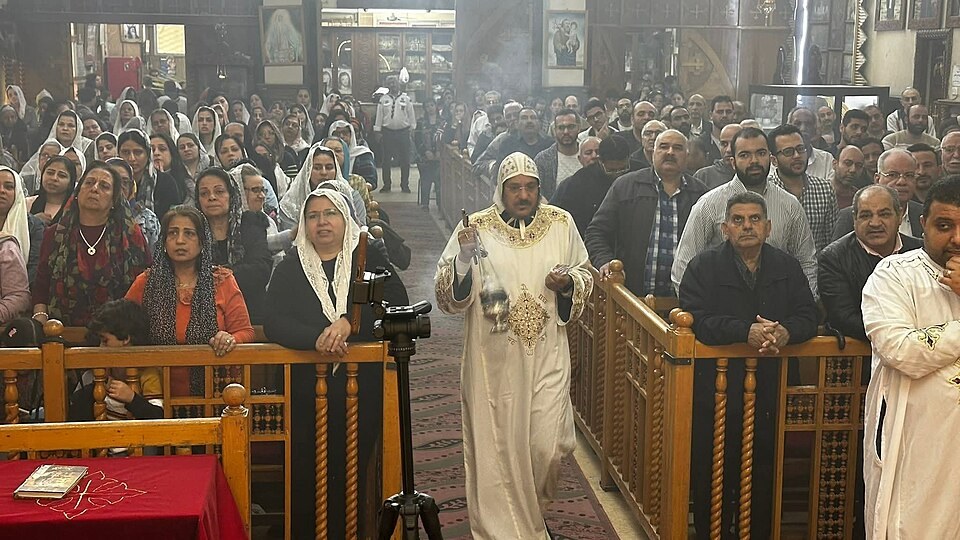 Source: A priest censes the congregation during a Coptic Orthodox Divine Liturgy in Egypt, photograph by Beshoy Makram Zaki, CC BY-SA 4.0; resized without cropping.
In this photograph, the priest carries incense down the aisle among the worshippers. If you are following the service for the first time, moments like this are often easier to recognize than the words of a chant.
Before you arrive
Contact the parish and say, “This will be my first visit. What time should I arrive, which service is in English, and is there someone who can help me follow?” Ask about duration and accessibility, too. Reserve a generous part of the morning, rather than fitting the visit into a spare hour.
Evening and Morning Raising of Incense are distinct services, not simply alternative names for the Eucharistic Liturgy. Morning Raising of Incense commonly precedes it. A parish schedule may list them separately or give one morning start time, so check what that time means.2
The Los Angeles Diocese’s visitor guide describes a roughly three-hour Liturgy in its setting. Its clock times, languages, and arrangements are not universal parish rules. Dress modestly and respectfully. Ask about local customs rather than worrying that an unfamiliar detail will disqualify you from entering.1
If you have pain, fatigue, limited mobility, or sensory needs, mention them beforehand if helpful. Stand when able, especially for the Gospel and solemn prayers, but sit when you need to. Worship is not an endurance examination. If incense affects your breathing, ask about suitable seating or stepping outside.
A journey toward a table
Luke 24:13-35 offers a beautiful lens for understanding what you are entering. On the road to Emmaus, the risen Jesus opens the Scriptures to two bewildered disciples. At table, they recognize Him in the breaking of bread. They return to the gathered disciples with news of His Resurrection.
This is a narrative lens, not a claim that this passage is the appointed Gospel for your visit. It helps us resist two mistakes: treating Scripture as a lecture detached from Christ, and treating Communion as a ceremony detached from hearing and obeying Him.
The Coptic service brings offerings, proclamation, and Eucharistic prayer into one movement toward communion with the living Lord.3
First, the offering
In the Offertory, bread is chosen and offered with wine and water. The selected loaf is called the Lamb, directing attention to Christ, who gives Himself for the life of the world. Thanksgiving and prayers over the offerings accompany their preparation at the altar.3
The spiritual invitation is larger than watching a priest prepare holy vessels. We arrive carrying a whole life: labor, grief, gratitude, unfinished repentance. Nothing needs to be hidden from the Lord. We cannot manufacture His gift, but we can stop pretending that our lives belong to us alone.
A quiet first-visit prayer might be: “Lord, I do not yet understand all this. Teach me how to offer You my life.”
Then, the Word is heard
The Liturgy of the Word includes readings from St. Paul’s letters, a Catholic Epistle, meaning a general apostolic letter, Acts, and a Psalm and Gospel. The Synaxarium, the Church’s book of commemorations and saints’ lives, is also normally read, with seasonal differences. A sermon helps unfold the message.3
Do not worry if you lose your place. Listen for one sentence that addresses you, rather than treating the service book as a test you are failing. Ask for an English text or help finding the current prayer.
The incense is not background atmosphere. Revelation 8:3-4 joins incense with the prayers of the saints before God. In Coptic worship, its fragrance belongs to an offering of prayer in which the body participates, too. Icons likewise are not rival objects of worship. They bear witness to Christ and His saints within the praying Church.2
The repeated “Lord, have mercy” is therefore not empty delay. It gives us time to mean what we are asking.
Reconciliation before Communion
Before the Eucharistic prayer, the Church recites the Creed and prays for reconciliation. The prayer asks God to cleanse the heart of hypocrisy, malice, and the remembrance of evil. The congregation is called to exchange a holy kiss, expressed through the parish’s customary gesture.3
Here the service becomes searchingly personal. It is possible to sing about God’s peace while carefully protecting a grievance. The prayer refuses that division. Christ does not invite us into communion with Himself while blessing our determination to despise one another.
This does not require pretending that abuse never happened or abandoning necessary boundaries. It does mean bringing resentment, injury, and the desire for revenge to God, asking for healing rather than making hatred a permanent home.
The Eucharistic heart
The Anaphora is the central Eucharistic prayer. Listen for the opening exchange. In Fr. Abraam Sleman’s English edition, the priest says, “Lift up your hearts,” and the congregation answers, “They are with the Lord.” Your parish may use different words or another language. It is fine just to listen.3
In the Liturgy bearing St. Basil’s name, thanksgiving opens into praise with the heavenly hosts, remembrance of Christ’s saving work, His words at the Mystical Supper, and the invocation of the Holy Spirit upon the people and the gifts. The Church confesses that the gifts become Christ’s Body and Blood.3
This is not Christ being crucified again. The Church remembers and proclaims His saving death and Resurrection, receiving the communion He instituted, as St. Paul teaches in 1 Corinthians 11:23-26.
Paul calls the cup a sharing in Christ’s Blood and the bread we break a sharing in His Body. Though we are many, we are one body because we share in the one bread (1 Corinthians 10:16–17). St. Cyril of Alexandria explains that Christ “makes us of the same Body with Himself and with each other.”4 Beneath the congregation’s many voices is the unity Jesus prays for in John 17:20–21: not a roomful of people worshipping in isolation, but people drawn into one life in Him.
The prayer also makes room for the Church, the sick, the departed, and the needs of the world. The Fraction, the breaking of the consecrated Bread, leads toward the Lord’s Prayer and Communion. Before Communion, the priest makes a Confession distinct from the earlier Creed: he confesses that the consecrated gift is the life-giving Body the Son took from St. Mary and united to His divinity without mingling or confusion. Even at its most solemn, this worship is not an escape from other people’s lives.3
When people approach for Communion
If you are a non-Orthodox visitor or are unsure of your eligibility, remain in your place and pray. Do not join the line simply because others do. Receiving Communion presupposes belonging to a Church in full communion with the Coptic Orthodox Church and preparing through its sacramental life, including repentance, confession, and fasting. If you belong to another Oriental Orthodox Church in communion with the Coptic Church, speak with the priest before the service about preparation. The Eastern Orthodox churches, despite the shared word Orthodox, are not in full communion with the Coptic Church. If you are unsure, ask before the service and do not approach for Communion unless your eligibility is clear.15
The blessed bread sometimes shared afterward, called eulogia, is distinct from Holy Communion. Ask a host what is being offered and how to receive it locally.1
Leave with one thread to follow
Afterward, introduce yourself to the priest or a parish servant. Ask one real question. If fellowship is offered, stay long enough to meet someone.
Before returning, read the Gospel passage you heard, or revisit one prayer that stayed with you. If you are unsure where to find that reading, the guide to Orthodox daily readings explains how the readings are grouped. A lifelong parishioner can do the same: carry the prayer against malice into one difficult conversation, or make time for someone easily overlooked.
The first visit need not end in complete understanding. It can end in a more honest beginning: “Lord Jesus Christ, help me recognize You, hear You, and follow You.”
Sources
Footnotes
-
Coptic Orthodox Diocese of Los Angeles, “Visiting an Orthodox Church,” especially welcome, duration, posture, and Eucharistic guidance. Scheduling and practical arrangements describe its setting; visitors should confirm local practice and Communion eligibility with their priest. ↩ ↩2 ↩3 ↩4
-
Coptic Orthodox Diocese of the Southern United States, RIT 101: Liturgy, Agpeya and Praises, “The Ritual of the Raising of Incense,” “Liturgy of the Word,” and “Censer and Censing.” ↩ ↩2
-
The Coptic Liturgy of St. Basil, edited by Fr. Abraam D. Sleman, Offertory, Readings, Prayer of Reconciliation, Anaphora, Institution Narrative, Epiclesis, and Confession. The service prayers, rather than the editor’s historical commentary, ground this account. ↩ ↩2 ↩3 ↩4 ↩5 ↩6 ↩7
-
St. Cyril of Alexandria, Commentary on John, book XI, chapter XI, on John 17:20-21, pp. 549-551, translated by T. Randell, Library of the Fathers 48 (1885). ↩
-
St. Mary and St. Moses Abbey, Coptic Orthodox Diocese of the Southern United States, “Retreat House Rules,” Holy Communion Guidelines; and the Southern Diocese’s Q&A on communion with other churches. ↩