
Coptic Orthodox Christians often celebrate Easter on a different date because the Church follows the traditional Alexandrian paschal calculation, using the older Julian calendar framework and lunar tables. Most Catholic and Protestant churches use the Gregorian calculation. Both celebrate the Resurrection of Jesus Christ; their methods for choosing its annual Sunday can produce different civil dates.12
They can also produce the same date. There is no rule that Coptic Easter must be a set number of days later.
Why the moon enters the conversation
Easter is movable: unlike Christmas, it is not attached to one recurring month-and-day date. John places Mary Magdalene at the empty tomb on the first day of the week (John 20:1), and Paul calls Christ our Passover (1 Corinthians 5:7). Scripture gives Sunday and Passover their meaning for the feast. The Church’s calculation brings those together with a spring boundary and a lunar cycle; Scripture does not supply the tables.2
The familiar shorthand is “the Sunday after the first full moon on or after the spring equinox.” But two words need explaining: church calculation.
The equinox used by these traditional calculations is a fixed calendar boundary, March 21, not a new astronomical observation each year. Gregorian March 21 and Julian March 21 are different civil dates; at present, Julian March 21 corresponds to Gregorian April 3. The paschal full moon is also an ecclesiastical full moon, determined by tables, not necessarily the full moon you see overhead that night.34
The two calculations therefore differ in more than a calendar label. They use different lunar tables as well as different calendar frameworks. Sometimes their resulting Sundays coincide; sometimes they fall weeks apart. Looking at an astronomy app, or adding thirteen days to Western Easter, will not reliably produce the Coptic date.4
Here are three examples, with every date expressed in the ordinary Gregorian civil calendar:
| Year | Coptic Feast of the Resurrection | Western Easter |
|---|---|---|
| 2026 | April 125 | April 56 |
| 2027 | May 27 | March 288 |
| 2028 | April 169 | April 1610 |
The changing interval is the point: no fixed delay after somebody else’s celebration.
The Coptic Church shares this Alexandrian inheritance with many other Orthodox churches, but not every Orthodox jurisdiction has identical calendar practice.2
What Nicaea settled, and what it did not
The Council of Nicaea in 325 sought a common celebration of Pascha, another name for Easter.1
We should not turn that history into the claim that Nicaea handed down every technical detail of today’s calculation. Archbishop Peter L’Huillier’s historical account distinguishes the council’s agreement from the later development and reception of particular computational methods.11
One question in the ancient dispute was whether churches should rely on contemporary Jewish date reckoning. L’Huillier distinguishes that question from a supposed ban on Easter and Passover ever coinciding.11 The Coptic Church follows its own paschal calculation. A modern Jewish calendar’s Passover end date is not an input you need to look up.42
Understanding the calculation should make us more truthful, not more combative toward Jewish neighbors or other Christians.
At the tomb, a name rather than a number
The Gospel appointed for the Coptic Resurrection Liturgy in the years shown above is John 20:1-18.579 Its first scene is not a calendar dispute. It is Mary Magdalene arriving while it is still dark.
Mary initially interprets the empty tomb as another loss. Someone has taken the Lord away. Even the presence of Jesus does not immediately end her confusion. Then He speaks her name: “Mary!” (John 20:16, NKJV).
The Resurrection is not merely the persistence of an inspiring memory. The crucified Lord is alive, and He addresses the person who is grieving. Mary moves from searching for a body she thinks has been carried away to announcing that she has seen the Lord. Her love has not created His presence. His living presence transforms her understanding.
St. Athanasius makes the victory equally concrete. He locates death’s defeat in the death and Resurrection of the Savior’s own body, and points to the courage of Christ’s disciples as its continuing fruit. Christ, he writes, “displays the signs of victory over him day by day in His own disciples.”12
That does not require a grieving Christian to stop weeping on Easter morning. Mary herself weeps in this Gospel. It means that grief is no longer evidence that death possesses the final word. The Lord can meet someone whose eyes are still full of tears.
John tells how Mary recognized Jesus when He called her by name. Stéphane René’s Anastasis in Cairo shows another aspect of the same victory: Christ stands on the broken gates of Hades and raises Adam and Eve. The icon is not an illustration of John’s garden scene.
Give the feast room to change something
For a family with relatives in different churches, begin planning early. Explain the date without ranking anyone’s love for Christ. Offer a sincere Easter greeting when others celebrate, while keeping your own Church’s worship and preparation.
Consult your parish’s actual Holy Week and Resurrection service schedule before arranging work, travel, or a family meal. A date in a calendar is not a service timetable. If you are visiting a Coptic church, ask beforehand about arrival and read the first-visit guide to Coptic Liturgy rather than guessing from another parish’s customs.
Then make one preparation that cannot be accomplished by a calendar reminder. Read 1 Corinthians 5:7-8. Paul names Christ as our Passover and connects keeping the feast with removing malice and wickedness, replacing them with sincerity and truth. A cherished resentment is not made harmless by knowing the correct Sunday.
Bring a particular sin honestly to repentance. Where reconciliation is safe and possible, take a concrete step toward it; do not use the feast to pressure someone into an unsafe encounter. Ask your priest for guidance where the situation is tangled.
In Romans 6:3-4, baptism joins us to Christ’s death so that we may walk in newness of life. That is the feast’s claim upon Monday morning: the risen Lord gives a life we are called to inhabit, not merely an anniversary to defend.
We calculate the Sunday so that we can gather. We gather because Christ is risen. And He is risen not to leave us where He found us, but to bring us into His life.
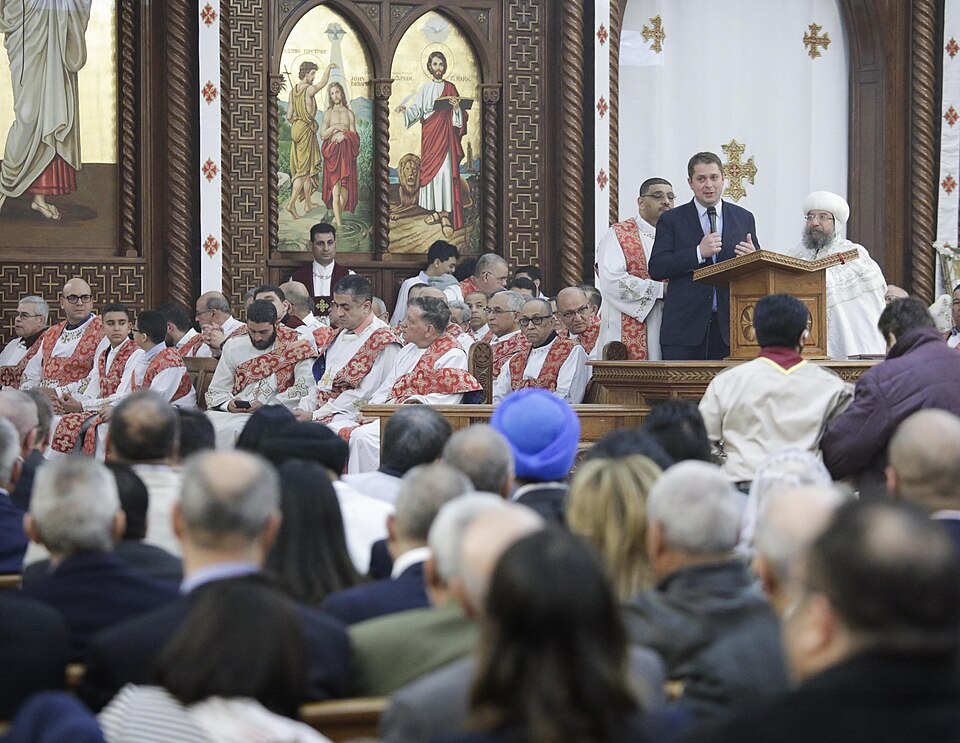 Source: Paschal Divine Liturgy, Church of the Virgin Mary and St. Athanasius, Mississauga, 2019, Andre Forget via Andrew Scheer, CC0; resized without cropping.
Sources
Footnotes
-
Metropolitan Bishoy of Damiette, “Praying and working toward the common date of Easter”, 2001. ↩ ↩2
-
WCC/MECC Aleppo consultation, “Towards a Common Date for Easter,” sections 7-8, 1997. ↩ ↩2 ↩3 ↩4
-
U.S. Naval Observatory, “Introduction to Calendars”. ↩
-
U.S. Naval Observatory, “The Date of Easter”, especially ecclesiastical versus astronomical equinoxes and full moons. ↩ ↩2 ↩3
-
CopticChurch.net, dated Coptic readings for April 12, 2026, Feast of the Resurrection, Liturgy Gospel: John 20:1–18. ↩ ↩2
-
U.S. Naval Observatory, Western Christian observances, 2026. ↩
-
CopticChurch.net, dated Coptic readings for May 2, 2027, Feast of the Resurrection, Liturgy Gospel: John 20:1–18. ↩ ↩2
-
U.S. Naval Observatory, Western Christian observances, 2027. ↩
-
CopticChurch.net, dated Coptic readings for April 16, 2028, Feast of the Resurrection, Liturgy Gospel: John 20:1–18. ↩ ↩2
-
U.S. Naval Observatory, Western Christian observances, 2028. ↩
-
Archbishop Peter L’Huillier, “Concerning the Date of Pascha and the 1st Ecumenical Council”, The Church of the Ancient Councils (1996), pp. 19-26. ↩ ↩2
-
St. Athanasius, On the Incarnation 29.1-4, trans. Archibald Robertson, Nicene and Post-Nicene Fathers, second series, vol. 4 (1892). ↩