
No. Coptic Orthodox Christians worship God alone. We honor icons, but do not adore wood, paint, or the saints depicted on them. Pope Shenouda III explains that venerating an icon honors the person represented, not the material as a god.1
Still, the question is reasonable. A visitor may see someone kiss an icon, bow before it, or pray nearby while incense rises. Those actions deserve an explanation, not a rebuke for asking.
What the commandment protects
Exodus 20:4-5 forbids making images for idolatrous worship. Copts receive that prohibition, not a diluted version of it. No creature may take God’s place.
But the same God commands golden cherubim above the ark of the covenant in Exodus 25:18-22. He also commands Moses to make the bronze serpent in Numbers 21:8-9. These passages show that a material representation is not automatically an idol. Pope Shenouda uses both examples in explaining the Church’s practice.1
The bronze serpent also supplies a necessary warning. When Israel later burns incense to it, Hezekiah breaks it in pieces (2 Kings 18:4). A thing once given for a holy purpose can be misused. Its religious history does not excuse idolatry.
An Orthodox defense of icons must therefore include an Orthodox rejection of superstition. An icon is not a charm, a captive spiritual force, or a device for controlling God. No kiss, candle, or purchase can substitute for repentance and faith.
Because the Word became flesh
The deepest reason for depicting Christ is not that religious art makes a room attractive. It is that the eternal Word truly became flesh and dwelt among us (John 1:14).
Christian faith does not end with an invisible idea about God. The Son entered human history, with a human face that could be seen and a body that could be crucified. St. Athanasius explains that the Word made Himself known through a human body, revealing the truth and knowledge of the Father.2
This does not mean that paint captures the divine essence, or that Christians have seen and can portray the Father’s invisible being. Christ is the image of the invisible God (Colossians 1:15), not a creaturely copy of Him. The icon depicts the one incarnate Son according to His visible humanity; it does not contain or define His Godhead.
The Incarnation gives matter a place in Christian confession without turning matter into God. The same faith that proclaims a real Incarnation refuses to make the painted surface divine.
What does a kiss mean?
Veneration means reverent honor. Adoration, in this distinction, means the worship owed to God alone. A bodily gesture cannot always tell you which is intended. Genesis 33:3 describes Jacob bowing before Esau without presenting Esau as a deity. Context, intention, and the Church’s teaching matter.
A kiss offered to an icon expresses love and reverence for the person depicted. It is not a claim that the board is alive or that a saint is another god. When Copts ask a saint’s intercession, they seek that person’s prayers to God, not an independent source of salvation.1
St. Basil writes that “the honour paid to the image passes on to the prototype.” His immediate argument concerns the Son’s relation to the Father, using a king’s image as an analogy. It is not originally a complete treatise on painted icons. Applied to icon veneration, the principle helps explain why honor does not stop at the material surface.3
Nor does this put Christ and the saints on one level. Christ is worshipped as God. The saints are honored as His servants, whose holiness is His gift.1
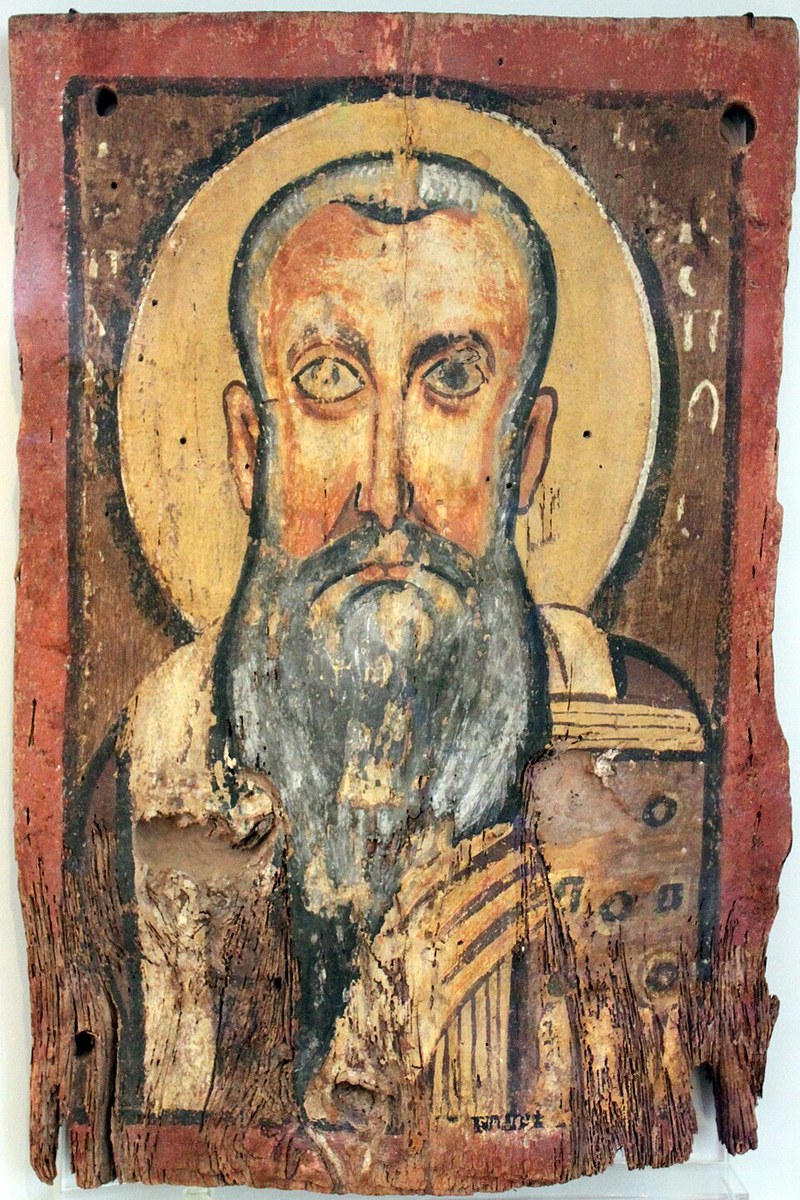 Source: Bishop Abraham of Hermonthis, Egypt, c. 590–600, Bode Museum, inv. 6114, photograph by Anagoria, CC BY 3.0; resized without cropping.
Icons belong to the Church’s prayer
In a Coptic church, the iconostasis, or icon-bearing screen, marks the sanctuary containing the altar. It is not merely a gallery. The Southern Diocese explains its icons as witnesses to the saints and heavenly beings who join the Church’s praise. Christ and the Virgin carrying Christ occupy prominent places beside its central entrance.4
That setting matters. Hebrews 12:22-24 describes the faithful approaching the heavenly Jerusalem, angels, the assembly of the firstborn, the righteous made perfect, and Jesus the Mediator. The congregation is not inventing a private spiritual world. She prays within a communion larger than the people physically present.
During the Raising of Incense, a service distinct from the Eucharistic Liturgy, the priest offers incense before icons and among the congregation. Incense also appears within the Liturgy. Revelation 8:3-4 associates it with the prayers of the saints before God. Why, then, did Hezekiah destroy the serpent? The people were burning incense to it; it had become an object of worship. The priest censes the congregation as well as the icons. Neither the worshippers nor the painted figures are being treated as gods. The incense belongs to the Church’s prayer and worship of God.5
Icons can also travel through the church in procession. The Southern Diocese’s guidance, for example, names the Resurrection icon in the Pentecost Matins procession. What the congregation sees is an image of the risen Christ at the feast that celebrates the gift of His Spirit.6
The icon is not the Eucharist and is not itself a sacrament. It serves the Church’s worship rather than competing with the altar.
A Coptic image worth looking at slowly
 Source: Christ and Abbot Mena, Louvre E 11565, photograph by Clio20, CC BY-SA 3.0, resized without cropping.
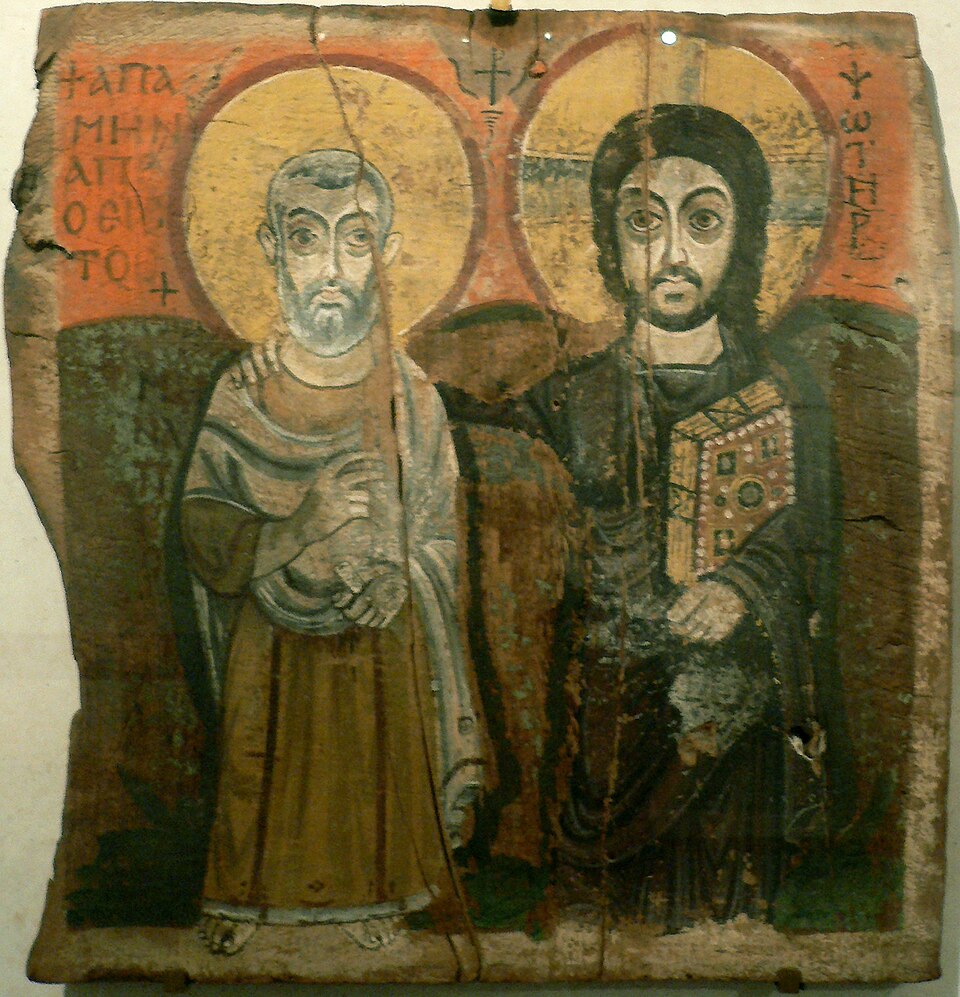
This Coptic panel comes from Bawit in Egypt. The Louvre’s current catalogue dates it to the eighth century, though older descriptions give earlier dates.7
Christ stands on the viewer’s right, holding an ornate book. His halo contains a cross. Mena stands beside Him, and Christ’s hand rests on his shoulder. Both face outward.
Their nearness does not erase the distinction between Savior and saint. Read devotionally, the image invites us to see holiness as belonging to Christ, not becoming His replacement. Its tenderness is not sentimental self-sufficiency. The saint stands with the Lord who saves him.
The Louvre titles the work Christ and Abbot Mena. Its catalogue identifies the figure beside Christ as Apa Mena, the abbot, rather than naming him as the soldier-martyr St. Menas.7 The tradition is still alive: Isaac Fanous’s Mother of God, 1964, figure 18 is one example of how modern Coptic artists have continued it.
If you are visiting, or beginning again
You do not have to kiss an icon before you understand why Christians do so. Observe respectfully, ask the priest about one image, and learn whom it depicts. Avoid walking around to inspect icons during Scripture readings or solemn prayers. A parish host can help you choose an appropriate moment.8
At home, an icon can gather distracted attention for prayer. Begin simply: stand or sit before an icon of Christ, read a short Gospel passage, and address the living Lord. Do not wait for a special sensation.
Then let the prayer test your conduct. Honoring a saint while refusing mercy to a neighbor misses the point of remembering holiness. Hebrews 13:7 calls us to remember those who spoke God’s word to us and to imitate their faith. Pope Shenouda sees icons as a way to keep such examples before us.1 Ask your parish host, “What did this saint do that I could imitate?”
The question is finally not whether we can possess enough sacred pictures. It is whether, looking toward Christ, we are learning to belong to Him.
Sources
Footnotes
-
Pope Shenouda III, Comparative Theology, “Pictures and Icons,” pp. 181-187, especially points 3-8 and 12-13; for intercession, see the same book’s “Intercession” section. ↩ ↩2 ↩3 ↩4 ↩5
-
St. Athanasius, On the Incarnation 42.6, translated by Archibald Robertson, NPNF, second series, volume 4 (1892). ↩
-
St. Basil, On the Holy Spirit 18.45, translated by Blomfield Jackson, NPNF, second series, volume 8 (1895). The king/image analogy serves his Trinitarian argument; its use here for painted icons is an application, not his original subject. ↩
-
Southern Diocese, Mighty Arrows, October 2001, “Icon” and “Iconostasis,” pp. 20-22. ↩
-
Southern Diocese, RIT 101: Liturgy, Agpeya and Praises, “The Ritual of the Raising of Incense,” “The Incense of the Praxis,” and “Censer and Censing.” ↩
-
Coptic Orthodox Diocese of the Southern United States, Q&A on processions between Ascension and Pentecost, which specifies the Resurrection icon at Pentecost Matins. ↩
-
Louvre, Le Christ et l’abbé Ména, E 11565, current object record: Bawit; 700-799. The photograph’s older dating is not followed here. ↩ ↩2
-
Los Angeles Diocese, “Visiting an Orthodox Church,” “Lighting candles?”, advises against devotional movement for candle-lighting during readings and the sermon; the same attentiveness guides this practical suggestion. ↩