
Coptic remains in the Coptic Orthodox Church because it carries an inheritance the Church still prays: scriptural language, hymns, and a distinctly Egyptian Christian memory. It survives not as the ordinary household language of most worshippers, but as a language of worship, study, and deliberate preservation. Those are different kinds of life, and confusing them makes the question harder than it needs to be.1
If most people need a translation, why keep singing it?
St. Paul gives us a question worth asking first: can the person beside me understand the thanksgiving well enough to say “Amen” (1 Corinthians 14:16)? The reason to keep singing Coptic is not that old words are better. It is that these particular words carry prayers worth learning, and worth helping our neighbor to pray.
Egyptian, written differently
Coptic is the latest phase of the ancient Egyptian language, not a foreign language that replaced Egyptian. Its alphabet adapts Greek letters, adding signs derived from Demotic, an earlier Egyptian script, for sounds Greek could not adequately represent. Greek letters do not make Coptic Greek, any more than English letters make a sentence in French into English.231
Nor was there only one form of Coptic. Sahidic became a major literary dialect, while Bohairic is the dialect preserved in the modern Coptic Church’s liturgical tradition. Someone studying a Sahidic biblical manuscript and someone learning Bohairic hymns are working within the same linguistic inheritance, but not with identical forms of it.2
This matters spiritually. Coptic was not originally valuable because ordinary people could not understand it. Its Christian literary growth included the translation of Scripture into Egyptian vernacular dialects. The language now associated with ancient worship once helped make the Gospel accessible.1
Preserving Coptic well should honor that original generosity.
How a household language became a church language
Arabic did not replace Coptic overnight when Egypt came under Arab rule in the seventh century. Language change unfolded over centuries, across administration, literature, and daily life. Coptic books continued to be copied under Islamic rule. From the eleventh century onward, Christian material increasingly appeared in Arabic, sometimes beside Coptic.4
The medieval response was more creative than simple surrender. Ramona Teepe’s research at Yale examines thirteenth-century scholars who wrote Coptic grammars in Arabic. They used the language their readers understood to teach a language those readers were losing. Preservation and translation were already partners.5
The broad transition is clearer than its endpoint. A manuscript, a memorized prayer, and a conversation at home tell us different things about how a language survives. The evidence for Coptic’s medieval decline as an everyday language does not give us a reliable date for its last native speaker, or establish that a village still transmits it as an uninterrupted mother tongue.15
What is secure is the larger story: Arabic became the ordinary language of Egypt’s Christians, while Coptic continued through the Church’s worship and teaching. The people did not cease to be Coptic Christians because their everyday speech changed.
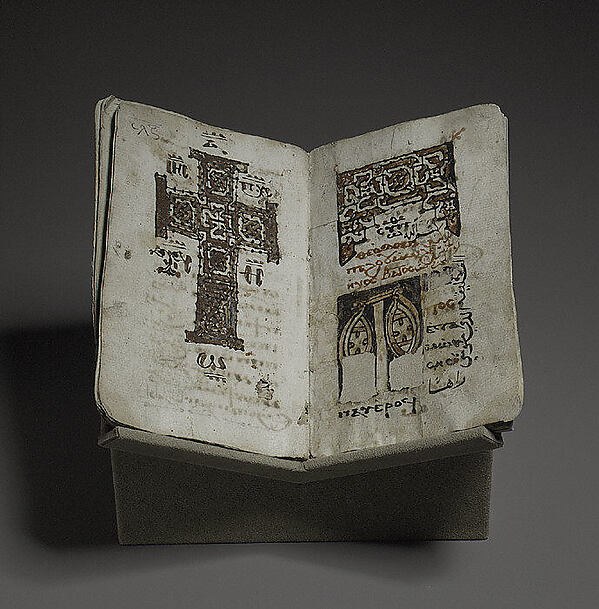 Source: Coptic Liturgical Codex, 17th–18th century, 19.196.5, The Metropolitan Museum of Art, Rogers Fund, 1919, Open Access / CC0.
Coptic and Arabic share the pages of this liturgical book. The Met notes that the Arabic helped readers who no longer read Coptic easily. Long before a parish could put translations on a screen, the two languages could already sit side by side on the page.
Who speaks it now?
It depends what we mean by speaks.
Clergy, cantors, deacons, and lay worshippers retain different degrees of familiarity with liturgical Coptic. Scholars study its texts. Church classes and modern learners seek greater competence, and revival efforts have encouraged renewed interest. But chanting a memorized hymn, understanding its grammar, and holding a spontaneous conversation represent different abilities. None alone establishes the survival of a community transmitting Coptic as its ordinary vernacular from parents to children.1
Calling it simply “dead” can therefore mislead a visitor who hears it sung every Sunday. Calling it an ordinary living mother tongue can mislead just as much. It is a historical language with continuing liturgical life and active learners.
St. Mary’s in Kensington explicitly describes both English services and mixed English, Arabic, and Coptic services. St. Demiana’s in San Antonio describes Sunday worship primarily in English with traditional Coptic chanting, and mixed-language weekday services. These are parish examples, not a universal formula. The balance varies with the congregation and its pastoral circumstances.67
A visitor preparing for a first Divine Liturgy should ask the parish which service is easiest to follow, rather than assume that an “English Liturgy” contains no Coptic, or that a Coptic church will be inaccessible to an English speaker.
A prayer should become more than familiar sound
There is real beauty in learning words that generations before us prayed. Their melodies can carry memory beyond what an explanation alone conveys. Yet familiarity is not the same as attention. One can sing an English response absent-mindedly too.
St. Paul holds spirit and understanding together in 1 Corinthians 14:15–19. He asks how an uninformed listener can answer “Amen” to thanksgiving he does not understand, and prefers five intelligible words that teach others to ten thousand in a tongue. His immediate subject is the exercise of spiritual gifts in the assembly, not a decree against inherited liturgical languages. Still, the pastoral principle reaches our question: the other person’s edification matters.
St. John Chrysostom, explaining this passage, says that “both the tongue may speak, and the understanding may not be ignorant of the things spoken.”8 That is not an argument for contempt toward Coptic. It is an argument for teaching it, translating it, and helping people pray what they sing.
Listen to the seventh part of the Sunday Theotokia, a hymn to the Mother of God in Midnight Praise. It opens with a greeting Pope Shenouda III renders shara na Maria, “Hail to Mary.” English transliterations vary.910 This is the Church’s greeting to Mary, not a verbatim quotation of Gabriel. It echoes his greeting in Luke 1:28, and in Luke 1:48 Mary tells us why the Church can join in: generations will call her blessed. The point is not merely to pronounce the syllables correctly. It is to recognize the woman through whom the Son of God truly became man, and to join the Church’s grateful wonder.
A few understood words can become a doorway into an entire prayer.
A future worth working for
No responsible answer can forecast precisely how much Coptic every parish will use in coming generations. Nor does a proposal for one congregation automatically settle the needs of another.
A fruitful direction would hold three things together: preserve the language and its musical inheritance, explain the meaning, and ensure that the congregation can genuinely participate. Parallel translations, brief hymn explanations, patient classes, and recordings paired with texts can serve that aim. These are practical proposals, not predictions or a substitute for pastoral guidance.
For a beginner, the next step can be small. Choose one recurring response. Ask a knowledgeable servant to explain its words. Read the translation before the service, then return to the chant. Do not try to master the entire language before allowing yourself to pray.
If you are helping a newcomer, explain what the congregation is saying before you coach the pronunciation. Then try singing the response together. Pronunciation is something to teach patiently, not a measure of belonging. Invite older worshippers to share what they have received, while making room for children and converts to understand it.
Coptic need not compete with comprehension. The Church can cherish Egypt’s Christian voice and offer its meaning generously. The inheritance is most fully honored when another person can join the prayer with an attentive heart and an honest “Amen.”
Sources
Footnotes
-
Candace Lukasik, “Coptic,” The Languages of Berkeley: An Online Exhibition, on linguistic history, modern teaching, hymnody, and community life. ↩ ↩2 ↩3 ↩4 ↩5
-
University College London, “Writing in Egypt: Coptic”, on the alphabet and Sahidic/Bohairic distinction. ↩ ↩2
-
Louise Bascombe, UCL Petrie Museum, “Egyptian Languages: Explained”, Coptic section. ↩
-
University College London, “Coptic Egypt: background information,” section on the Egyptian language. Used here for language history, not its older theological terminology. ↩
-
Ramona Teepe, The Death and Afterlife of the Coptic Language in Mamluk Egypt, Yale PhD dissertation, 2025, abstract. Her medieval dating describes the broad transition, not a securely identified last individual speaker. ↩ ↩2
-
St. Mary Coptic Orthodox Church, Kensington, “I’m New,” visiting-our-church section. ↩
-
St. Demiana Coptic Orthodox Church, San Antonio, “Our Church,” parish introduction. ↩
-
St. John Chrysostom, Homilies on First Corinthians 35.6, NPNF, first series, vol. 12, Oxford translation revised by Talbot W. Chambers, 1889. ↩
-
Pope Shenouda III, The Holy Virgin Saint Mary, “Her Blessings,” p. 19, English translation of the 1999 Arabic edition. The transliteration above follows this source. ↩
-
Tasbeha.org, “The Seventh Part: Shere ne Maria,” Sunday Midnight Praises, with Coptic and English texts and a recording by the Higher Institute of Coptic Studies. ↩