
Yes, there is another pope. The Coptic Orthodox Church is led by Pope Tawadros II, Pope of Alexandria and Patriarch of the See of St. Mark, officially counted as its 118th patriarch. He was chosen on November 4, 2012, and enthroned on November 18. His office is not a branch appointment from Rome, and the Coptic Church is not a subdivision of the Roman Catholic Church.1
The surprise usually comes from a familiar word. In much English-language news, the pope means the Bishop of Rome. Christian history has a wider vocabulary.
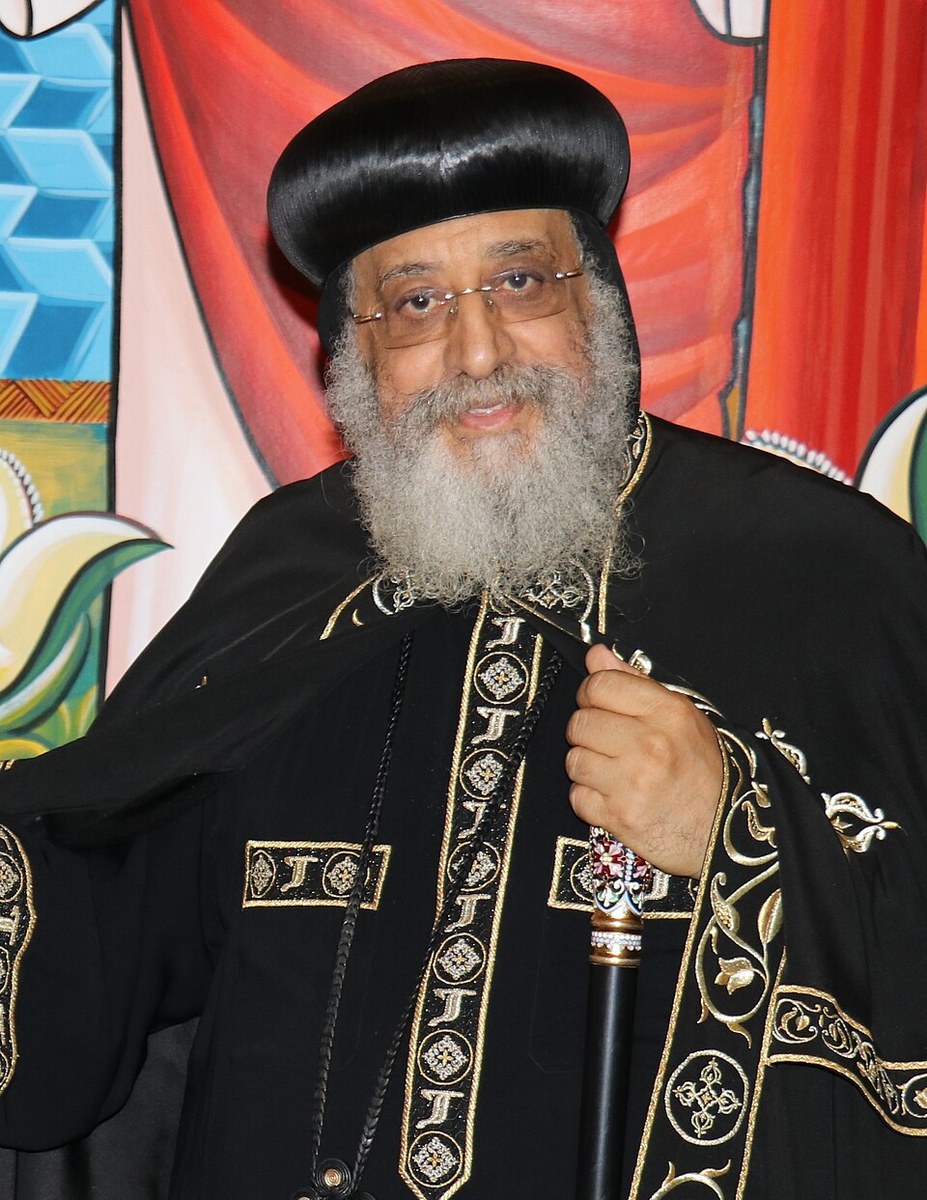 Source: Pope Tawadros II of Alexandria, 2019, OSCE Parliamentary Assembly, CC BY-SA 2.0; cropped in the source file and resized for the web.
One title, different churches
Pope comes through forms of the Greek word for father. In early Christianity, papas or pappas could honor bishops beyond Rome. The title’s history is therefore older and broader than its familiar modern English usage. We need not settle a competition over who used it first to recognize Alexandria’s authentic inheritance.2
There is another distinction worth making immediately: Alexandria itself has more than one patriarchal church. The Greek Orthodox Patriarchate of Alexandria and All Africa identifies its leader as Theodoros II, Pope and Patriarch. He is not Tawadros II. The Greek Orthodox patriarchate belongs to the Eastern Orthodox family; the Coptic Orthodox Church belongs to the Oriental Orthodox family. Similar names and shared ancient roots do not make these the same present-day institution.34
There is also a Coptic Catholic Patriarch of Alexandria, Ibrahim Isaac Sedrak. He leads the Coptic Catholic Church, an Eastern Catholic Church in communion with Rome. He is neither the Coptic Orthodox pope nor the Greek Orthodox pope of Alexandria.5
A shared title or city, in other words, does not establish shared jurisdiction.
Why the See of St. Mark?
A see is a bishop’s seat and its associated church. The Coptic Church receives St. Mark the Evangelist as Alexandria’s founder. The patriarch inherits that apostolic responsibility, not a family bloodline.16
Historical precision strengthens rather than diminishes this account. Eusebius’s Church History, written in the early fourth century, supplies the earliest surviving explicit literary witness commonly cited for Mark’s Alexandrian mission. In 2.16.1, he reports that Mark proclaimed his Gospel in Egypt and established churches in Alexandria. His introductory “they say” signals received testimony, not a claim to have witnessed first-century events. In 2.24.1, he names Annianus, also commonly called Anianus, as Mark’s successor.7
We should distinguish the Church’s received apostolic tradition from the date of our surviving written evidence.
Apostolic succession means the continuation of ordained ministry through the laying on of hands from the apostles onward. In Orthodox life it belongs with fidelity to the apostolic faith, sacramental communion, and responsibility for the flock. Paul describes the accompanying work of transmission when he tells Timothy to entrust what he has heard to faithful people able to teach others (2 Timothy 2:2). Succession is an inheritance to hand on, not merely an impressive list to display.6
Within the Coptic Church, the pope presides over the Holy Synod, the body of bishops. He has real authority, which he exercises within the shared life of the Church. At the May 2026 session, for example, bishops discussed committee recommendations and agreed on their final wording.8
Is Alexandria second, third, or something else?
The First Council of Nicaea in 325 recognized Alexandria’s longstanding regional authority. Canon 6 begins:
Let the ancient customs in Egypt, Libya and Pentapolis prevail, that the Bishop of Alexandria have jurisdiction in all these, since the like is customary for the Bishop of Rome also.9
The canon then preserves the privileges of Antioch and other provinces and addresses the consent required for appointing bishops. The canon recognizes ancient customs; it does not put the churches in numerical order. A historical order of honor is not a worldwide ranking of Christian leaders today.
Friendship is real. Full communion is not yet restored.
The division associated with the Council of Chalcedon in 451 stands behind the separate Coptic and Greek Orthodox patriarchal lines and the long estrangement between the Coptic Church and Rome. These histories involve theology, ecclesiastical authority, and political pressures. Reducing them to a quarrel about which leader deserves a title explains very little.410
Nor should we repeat the caricature that Copts deny Christ’s humanity. In their joint declaration of May 10, 1973, Pope Shenouda III and Pope Paul VI confessed Jesus Christ as perfect God and perfect man, His divinity and humanity united without confusion or separation. They also explicitly acknowledged continuing divisions and established a joint commission.10
That agreement was substantial, but it was not the restoration of full ecclesial communion. In 2023, Francis spoke with Tawadros of their friendship while still looking toward the day they could celebrate at one altar. In his letter for the May 2026 Day of Coptic-Catholic Friendship, Pope Leo XIV, the Bishop of Rome, prayed for both churches to move toward full communion. Later that month the Coptic Holy Synod decided to resume theological dialogue with the Catholic Church. A decision to resume talks does not mean communion has been restored.11128
A photograph of two popes embracing can show real friendship. It is not, by itself, an invitation to receive the Eucharist in one another’s churches. If you are planning a visit and have a question about receiving Communion, speak with the parish priest before the service.
The Shepherd above every shepherd
For a Christian, the deepest question is not whose title sounds highest. It is whom the office must serve.
In 1 Peter 5:1–4, Peter calls himself a fellow elder, charges the elders to shepherd God’s flock without greed or domination, and directs their hope toward the appearing of Christ, the “Chief Shepherd.” Authority is real precisely because the flock belongs to Another.
St. Cyril of Alexandria makes this searchingly concrete when explaining Christ’s command to Peter to feed His sheep (John 21:15–17). Teachers, he writes, cannot please Christ unless they care for “the health of the sheep of His fold, and their continuance in well-being.”13 Love for Christ becomes care for people. The apostolic office is not vindicated by ceremonial dignity alone.
That changes how ordinary parishioners receive it. Pray for the pope and bishops by name. Learn the faith they are charged to transmit. Refuse to turn loyalty into personality worship, gossip, or contempt for Christians outside your communion. Refusing to spread a rumor is not the same as keeping quiet about harm. If you have a concrete concern, raise it responsibly with someone who can address it. Peter’s warning against domination protects the flock as well as guiding its shepherds. If a conversation begins with “our pope versus yours,” bring it back to the Gospel each shepherd is accountable to serve.
We can confess the Coptic Church’s faith without pretending that divisions do not matter. We can desire the unity Christ prayed for in John 17:21 without pretending it has already been accomplished.
St. Mark’s inheritance is not a trophy that makes repentance unnecessary. It is a responsibility to receive Christ faithfully, live His commandments, and pass on His Gospel. The title means father. The task is to help the children know their Lord.
Sources
Footnotes
-
Coptic Orthodox Church, official biography of Pope Tawadros II, title, numbering, selection, and enthronement. ↩ ↩2
-
John Chapman, “Fathers of the Church,” opening historical discussion, Catholic Encyclopedia, 1909, on the wider use of papas. ↩
-
Greek Orthodox Patriarchate of Alexandria, official biography of Theodoros II. ↩
-
Candace Lukasik, “Coptic,” The Languages of Berkeley, Oriental Orthodox identity and the Chalcedonian division. ↩ ↩2
-
GCatholic, Coptic Catholic Church directory, identifying the patriarch and the Alexandrian see. ↩
-
Coptic Orthodox Diocese of the Southern United States, “What is Apostolic Succession?”. ↩ ↩2
-
Eusebius, Church History 2.16.1; 2.24.1, trans. Arthur Cushman McGiffert, NPNF, second series, vol. 1, 1890. See also the historical evidence discussion in “St. Mark,” Catholic Encyclopedia. ↩
-
Coptic Orthodox Church, Holy Synod session, May 2026, on the Synod’s deliberations and its decision to resume Catholic dialogue (point five). ↩ ↩2
-
First Council of Nicaea, canon 6, trans. Henry Percival, NPNF, second series, vol. 14, 1900. The quotation is the canon’s opening sentence, not its later editorial commentary. ↩
-
Paul VI and Shenouda III, Common Declaration, May 10, 1973. ↩ ↩2
-
Francis, address to Tawadros II, May 11, 2023. ↩
-
Pope Leo XIV, letter to Pope Tawadros II for the Day of Coptic-Catholic Friendship, dated May 4, 2026. ↩
-
St. Cyril of Alexandria, Commentary on John, book 12, on John 21:15–17, pp. 702–703, trans. T. Randell, 1885. ↩