
At a Coptic Orthodox funeral, expect prayer, Scripture, chanting, and the Church’s plea that Christ grant the departed rest and comfort those who mourn. You do not need to know the responses to attend respectfully. If you are arranging a funeral, contact the parish priest promptly, alongside the funeral director. Ask him about the church service, burial, and later memorial prayers before making firm arrangements.
A funeral does not require you to stop grieving. The Church brings grief into the presence of the Lord who wept at His friend’s tomb and called him back to life.
What happens at the funeral?
The funeral is a service of worship, not simply a gathering of tributes. Its language addresses God: we thank Him, hear His promises, ask His mercy, and entrust a person we love to Him.
The published Funeral Services: First Book, Laity from St. Bishoy Coptic Orthodox Church gives a concrete example. Its service for men includes the Prayer of Thanksgiving, psalms, a reading from St. Paul, the Gospel, the Creed, the Litany of the Departed, and absolutions, prayers asking God’s forgiveness. A litany is a series of petitions to which the congregation responds. The book also provides prayers at the burial site.1
This is an outline of a documented rite, not a promise that every funeral will follow an identical schedule. The same book contains distinct services for women and children and special provisions for Passion Week. Languages, pastoral arrangements, and opportunities for family tributes should be confirmed with the parish rather than assumed.
For the main funeral service for men, the appointed readings include 1 Corinthians 15:1-23 and John 5:19-29.2 Paul proclaims the risen Christ as the firstfruits of those who have fallen asleep. The Gospel announces that those in the graves will hear the Son’s voice and come forth. Beside a coffin, the Church speaks not only about the life that has ended, but about Christ’s authority over death.
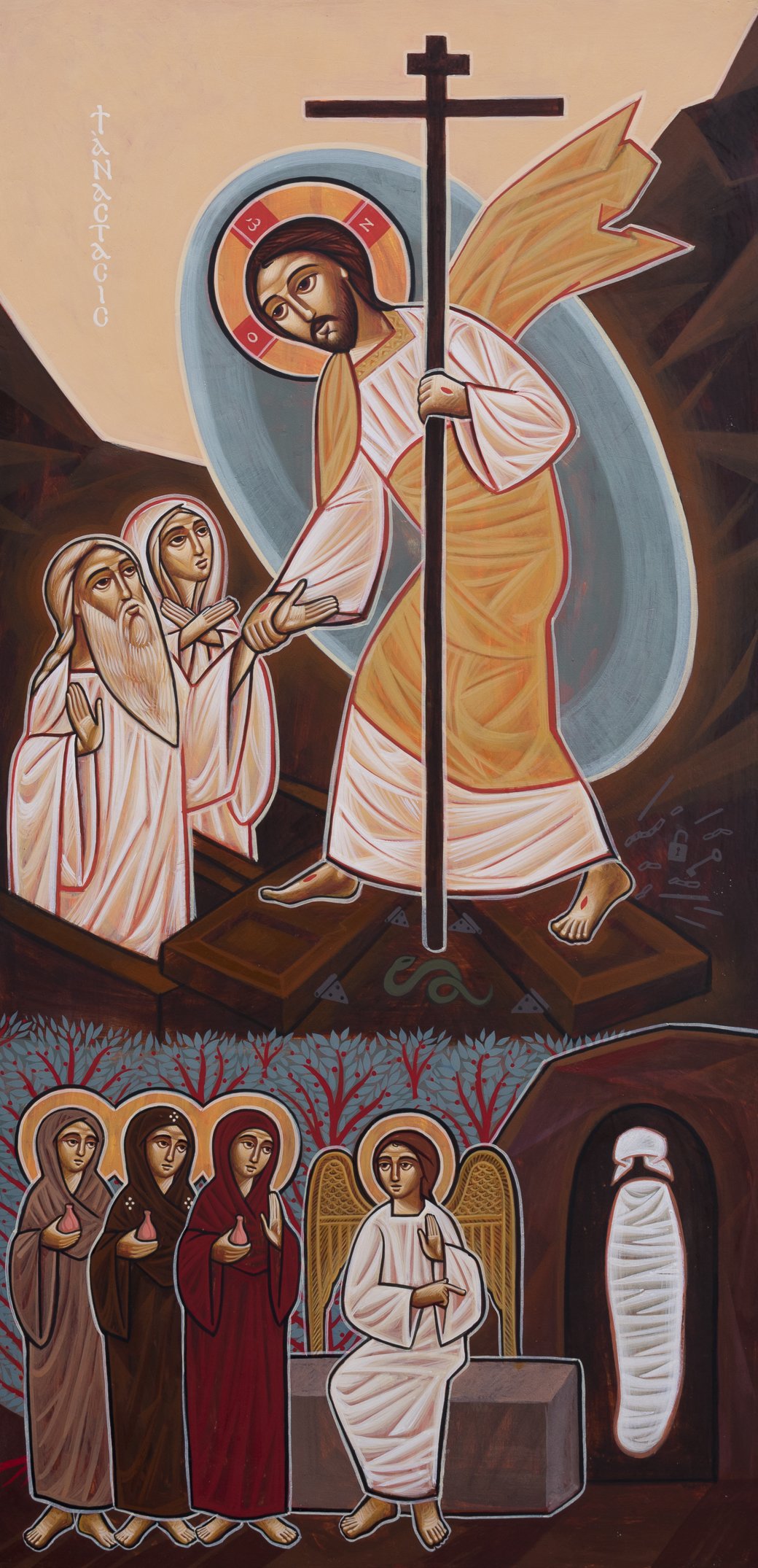 The Anastasis and the women at the empty tomb, two images of the Resurrection hope proclaimed at the funeral. Icon by Kirollos Kilada, used with permission.
If you are attending for the first time
Wear modest, respectful clothing and arrive early enough to settle quietly. Ask a church servant where to sit and whether a service text is available. You may hear English, Arabic, Coptic, or a combination. Follow the congregation as you are able, but sit when health or fatigue requires it. Quiet attention is participation, even when you cannot sing.
Keep your phone silent. Do not photograph the departed or grieving family without permission. A simple “I am sorry for your loss” is enough. Do not tell mourners that the death was God’s punishment or that you know exactly how they feel. You can listen without trying to explain why the person died.
Ask whether the announced time is for the funeral alone or also for a Divine Liturgy, the Eucharistic service. These are not interchangeable names. If a Liturgy is included in the arrangements, our first-visit guide to the Divine Liturgy explains its shape. You are welcome to attend the Liturgy. If you are unsure whether you may receive Communion, speak with the priest before approaching. See who can receive Communion for more on receiving Communion.
Why do we pray for the departed?
We pray because the departed are not beyond Christ’s love, and because the Church’s care for her members does not end at burial. In speaking about the resurrection, Jesus teaches that God is not the God of the dead but of the living (Matthew 22:31-32). In that hope, the Church does more than remember the departed: she asks God to grant them rest and forgiveness.
The funeral’s Litany of the Departed asks for rest, forgiveness, and a place with the righteous. Its prayers also turn toward the mourners and toward our own need for repentance.3 We do not tell God that our loved one had no sins. We appeal to the mercy of the Savior who knows the whole person more truly than we do.
This is neither a transaction that purchases salvation nor a claim that we can pronounce someone’s final judgment. We entrust the departed to God’s goodness without pretending to command it. We confess the resurrection of the body and await Christ’s judgment. Prayer gives love a faithful form while we wait.
What is the forty-day memorial?
A forty-day memorial is a commonly observed occasion for remembering the departed in prayer. Families should arrange its date and form with their priest. A meal, particular foods, or other family customs should not be confused with the prayer itself or treated as universal requirements.
The Coptic Orthodox Diocese of the Southern United States explains that the forty days recall the period during which the risen Christ appeared to His disciples before His Ascension (Acts 1:3). The diocese also explains the Christian spiritual meaning of third- and fortieth-day remembrance.4
The memorial date is an occasion for prayer, not a map of the afterlife. We should not tell a grieving child that the soul is trapped nearby until a service is completed, or burden a family with the fear that a scheduling difficulty places their loved one beyond mercy. Bring these anxieties to the priest. Other memorial observances, including third-day remembrance and anniversaries, may be kept according to parish and family practice. They do not make prayer on ordinary days less meaningful.
Hope does not forbid tears
Before raising Lazarus, Christ receives Martha’s grief and declares that He is the resurrection and the life (John 11:25). Then He weeps. His tears and His authority belong to the same encounter. Our studies of Christ’s promise to Martha and the Lord who weeps and calls forth life explore both sides of that consolation.
Paul does not command Christians never to sorrow. He distinguishes their sorrow from sorrow without hope (1 Thessalonians 4:13-18). Tears, exhaustion, and the need for help are not evidence that the Resurrection has been forgotten.
After the funeral, continue showing up. Offer a specific meal, a ride, help with paperwork, or company on a difficult anniversary. Ask before organizing anything large. Pray for the departed by name, and ask the priest how to include their remembrance in the Church’s prayer. The crowds may leave quickly; Christian love need not.
An ordinary personal prayer can be simple: “Lord Jesus Christ, grant rest to Your servant, forgive their sins, and comfort those who mourn.” This is suggested home prayer, not a replacement for the appointed service. When words fail, bring the name to Christ. The One who stood before Lazarus’s tomb is the One to whom the Church entrusts her departed.
Sources
Footnotes
-
Fr. Jacob Nadian, Funeral Services: First Book, Laity, St. Bishoy Coptic Orthodox Church, Part 1, pp. 13-54; see the contents for the distinct services and seasonal provisions. Church-published rite. ↩
-
For the main service for men, see Nadian, Funeral Services: First Book, Laity, Part 1, Pauline reading, p. 24, and Gospel, p. 31. The appointments are 1 Corinthians 15:1-23 and John 5:19-29. ↩
-
Nadian, Funeral Services: First Book, Laity, Part 1, “The Litany of the Departed,” pp. 43-45, and “The Absolutions,” pp. 48-51. Full rite. ↩
-
Coptic Orthodox Diocese of the Southern United States, Q&A 219, significance of the forty days, and Q&A 1705, the fortieth-day memorial. ↩