


Core burden
Numbers 34-36 closes the book with boundaries, refuge, blood, priestly death, and guarded inheritance. These chapters are not an anticlimax. They teach that promise must become ordered life. Land needs boundaries, justice needs refuge, bloodshed needs judgment, and inheritance must be preserved without turning the community into chaos.
Why this passage matters
This final unit matters because Numbers ends at the edge of fulfillment, not inside it. God defines the land, appoints leaders for allotment, provides cities for Levites, establishes cities of refuge, and resolves inheritance concerns for Zelophehad’s daughters. The book closes by preparing a people to inhabit mercy with justice.
1: And the Lord spoke to Moses, saying, 2: Charge the children of Israel, and thou shalt say to them, Ye are entering into the land of Chanaan: it shall be to you for an inheritance, the land of Chanaan with its boundaries. 3: And your southern side shall be from the wilderness of Sin to the border of Edom, and your border southward shall extend on the side of the salt sea eastward. 4: And your border shall go round you from the south to the ascent of Acrabin, and shall proceed by Ennac, and the going forth of it shall be southward to Cades Barne, and it shall go forth to the village of Arad, and shall proceed by Asemona. 5: And the border shall compass from Asemona to the river of Egypt, and the sea shall be the termination. 6: And ye shall have your border on the west, the great sea shall be the boundary: this shall be to you the border on the west. 7: And this shall be your northern border; from the great sea ye shall measure to yourselves, by the side of the mountain. 8: And ye shall measure to yourselves the mountain from mount Hor at the entering in to Emath, and the termination of it shall be the coasts of Saradac. 9: And the border shall go out to Dephrona, and its termination shall be at Arsenain; this shall be your border from the north. 10: And ye shall measure to yourselves the eastern border from Arsenain to Sepphamar. 11: And the border shall go down from Sepphamar to Bela eastward to the fountains, and the border shall go down from Bela behind the sea Chenereth eastward. 12: And the border shall go down to Jordan, and the termination shall be the salt sea; this shall be your land and its borders round about. 13: And Moses charged the children of Israel, saying, This is the land which ye shall inherit by lot, even as the Lord commanded us to give it to the nine tribes and the half-tribe of Manasse. 14: For the tribe of the children of Ruben, and the tribe of the children of Gad have received their inheritance according to their families; and the half-tribe of Manasse have received their inheritances. 15: Two tribes and half a tribe have received their inheritance beyond Jordan by Jericho from the south eastwards. 16: And the Lord spoke to Moses, saying, 17: These are the names of the men who shall divide the land to you for an inheritance; Eleazar the priest and Joshua the son of Naue. 18: And ye shall take one ruler from each tribe to divide the land to you by lot. 19: And these are the names of the men; of the tribe of Juda, Chaleb the son of Jephonne. 20: Of the tribe of Symeon, Salamiel the son of Semiud. 21: Of the tribe of Benjamin, Eldad the son of Chaslon. 22: Of the tribe of Dan the prince was Bacchir the son of Egli. 23: Of the sons of Joseph of the tribe of the sons of Manasse, the prince was Aniel the son of Suphi. 24: Of the tribe of the sons of Ephraim, the prince was Camuel the son of Sabathan. 25: Of the tribe of Zabulon, the prince was Elisaphan the son of Pharnac. 26: Of the tribe of the sons of Issachar, the prince was Phaltiel the son of Oza. 27: Of the tribe of the children of Aser, the prince was Achior the son of Selemi. 28: Of the tribe of Nephthali, the prince was Phadael the son of Jamiud. 29: These did the Lord command to distribute the inheritances to the children of Israel in the land of Chanaan.
1: And the Lord spoke to Moses to the west of Moab by Jordan near Jericho, saying, 2: Give orders to the children of Israel, and they shall give to the Levites cities to dwell in from the lot of their possession, and they shall give to the Levites the suburbs of the cities round about them. 3: And the cities shall be for them to dwell in, and their enclosures shall be for their cattle and all their beasts. 4: And the suburbs of the cities which ye shall give to the Levites, shall be from the wall of the city and outwards two thousand cubits round about. 5: And thou shalt measure outside the city on the east side two thousand cubits, and on the south side two thousand cubits, and on the west side two thousand cubits, and on the north side two thousand cubits; and your city shall be in the midst of this, and the suburbs of the cities as described. 6: And ye shall give the cities to the Levites, the six cities of refuge which ye shall give for the slayer to flee thither, and in addition to these, forty-two cities. 7: Ye shall give to the Levites in all forty-eight cities, them and their suburbs. 8: And as for the cities which ye shall give out of the possession of the children of Israel, from those that have much ye shall give much, and from those that have less ye shall give less: they shall give of their cities to the Levites each one according to his inheritance which they shall inherit. 9: And the Lord spoke to Moses, saying, 10: Speak to the children of Israel, and thou shalt say to them, Ye are to cross over Jordan into the land of Chanaan. 11: And ye shall appoint to yourselves cities: they shall be to you cities of refuge for the slayer to flee to, every one who has killed another unintentionally. 12: And the cities shall be to you places of refuge from the avenger of blood, and the slayer shall not die until he stands before the congregation for judgment. 13: And the cities which ye shall assign, even the six cities, shall be places of refuge for you. 14: Ye shall assign three cities on the other side of Jordan, and ye shall assign three cities in the land of Chanaan. 15: It shall be a place of refuge for the children of Israel, and for the stranger, and for him that sojourns among you; these cities shall be for a place of refuge, for every one to flee thither who has killed a man unintentionally. 16: And if he should smite him with an iron instrument, and the man should die, he is a murderer; let the murderer by all means be put to death. 17: And if he should smite him with a stone thrown from his hand, whereby a man may die, and he thus die, he is a murderer; let the murderer by all means be put to death. 18: And if he should smite him with an instrument of wood from his hand, whereby he may die, and he thus die, he is a murderer; let the murderer by all means be put to death. 19: The avenger of blood himself shall slay the murderer: whensoever he shall meet him he shall slay him. 20: And if he should thrust him through enmity, or cast any thing upon him from an ambuscade, and the man should die, 21: or if he have smitten him with his hand through anger, and the man should die, let the man that smote him be put to death by all means, he is a murderer: let the murderer by all means be put to death: the avenger of blood shall slay the murderer when he meets him. 22: But if he should thrust him suddenly, not through enmity, or cast any thing upon him, not from an ambuscade, 23: or smite him with any stone, whereby a man may die, unawares, and it should fall upon him, and he should die, but he was not his enemy, nor sought to hurt him; 24: then the assembly shall judge between the smiter and the avenger of blood, according to these judgments. 25: And the congregation shall rescue the slayer from the avenger of blood, and the congregation shall restore him to his city of refuge, whither he fled for refuge; and he shall dwell there till the death of the high-priest, whom they anointed with the holy oil. 26: But if the slayer should in any wise go out beyond the bounds of the city whither he fled for refuge, 27: and the avenger of blood should find him without the bounds of the city of his refuge, and the avenger of blood should kill the slayer, he is not guilty. 28: For he ought to have remained in the city of refuge till the high-priest died; and after the death of the high-priest the slayer shall return to the land of his possession. 29: And these things shall be to you for an ordinance of judgment throughout your generations in all your dwellings. 30: Whoever kills a man, thou shalt slay the murderer on the testimony of witnesses; and one witness shall not testify against a soul that he should die. 31: And ye shall not accept ransoms for life from a murderer who is worthy of death, for he shall be surely put to death. 32: Ye shall not accept a ransom to excuse his fleeing to the city of refuge, so that he should again dwell in the land, until the death of the high-priest. 33: So shall ye not pollute with murder the land in which ye dwell; for this blood pollutes the land, and the land shall not be purged from the blood shed upon it, but by the blood of him that shed it. 34: And ye shall not defile the land whereon ye dwell, on which I dwell in the midst of you; for I am the Lord dwelling in the midst of the children of Israel.
1: And the heads of the tribe of the sons of Galaad the son of Machir the son of Manasse, of the tribe of the sons of Joseph, drew near, and spoke before Moses, and before Eleazar the priest, and before the heads of the houses of the families of the children of Israel: 2: and they said, The Lord commanded our lord to render the land of inheritance by lot to the children of Israel; and the Lord appointed our lord to give the inheritance of Salpaad our brother to his daughters. 3: And they will become wives in one of the tribes of the children of Israel; so their inheritance shall be taken away from the possession of our fathers, and shall be added to the inheritance of the tribe into which the women shall marry, and shall be taken away from the portion of our inheritance. 4: And if there shall be a release of the children of Israel, then shall their inheritance be added to the inheritance of the tribe into which the women marry, and their inheritance shall be taken away from the inheritance of our family’s tribe. 5: And Moses charged the children of Israel by the commandment of the Lord, saying, Thus says the tribe of the children of Joseph. 6: This is the thing which the Lord has appointed the daughters of Salpaad, saying, Let them marry where they please, only let them marry men of their father’s tribe. 7: So shall not the inheritance of the children of Israel go about from tribe to tribe, for the children of Israel shall steadfastly continue each in the inheritance of his family’s tribe. 8: And whatever daughter is heiress to a property of the tribes of the children of Israel, such women shall be married each to one of her father’s tribe, that the sons of Israel may each inherit the property of his father’s tribe. 9: And the inheritance shall not go about from one tribe to another, but the children of Israel shall steadfastly continue each in his own inheritance. 10: As the Lord commanded Moses, so did they to the daughters of Salpaad. 11: So Thersa, and Egla, and Melcha, and Nua, and Malaa, the daughters of Salpaad, married their cousins; 12: they were married to men of the tribe of Manasse of the sons of Joseph; and their inheritance was attached to the tribe of their father’s family. 13: These are the commandments, and the ordinances, and the judgments, which the Lord commanded by the hand of Moses, at the west of Moab, at Jordan by Jericho.
Historical and Scriptural Context
Israel is still in the plains of Moab. The boundaries of Canaan are named. Leaders are appointed to divide the land. Levites receive cities, including six cities of refuge. Laws distinguish murder from manslaughter and require the manslayer to remain in refuge until the high priest’s death. Finally, inheritance law is clarified so tribal allotments remain intact.
Lesson Guide
- Key phrases: Promise needs ordered life. Refuge is not denial; it is mercy with truth. Release comes through the High Priest’s death.
- Emphasize: boundaries, refuge, justice, and inheritance fulfilled in Christ.
- Avoid: treating legal material as boring or using refuge language to evade accountability.
Light from the Word 🕯️
1. Boundaries make promise inhabitable
The land is not vague spiritual inspiration. It has borders. Boundaries are not always lack of love; they make life ordered and receivable. Without boundaries, inheritance dissolves into conflict.
2. Leaders distribute, not possess
Eleazar, Joshua, and tribal leaders oversee allotment. Their role is stewardship. Authority exists to help the people receive what God gives, not to turn inheritance into private control.
3. Levite cities place worship throughout the land
The Levites receive cities among the tribes. Holy service is distributed through the land, not isolated from the people’s life. The worship of God must shape the whole inheritance.
4. Cities of refuge protect justice from vengeance
The refuge cities distinguish manslaughter from murder and prevent blood vengeance from becoming immediate chaos. Mercy and justice meet: the killer is protected from mob vengeance but not treated as if bloodshed is nothing.
5. The high priest’s death releases the manslayer
This is one of the most profound details in Numbers. The manslayer remains until the death of the high priest. Christian readers rightly hear a typological echo: release comes through the death of the priest.
6. Inheritance is guarded across generations
The final clarification about Zelophehad’s daughters protects tribal inheritance while honoring the earlier judgment in their favor. The book closes with inheritance preserved, not erased.
Gems from the Fathers 💎
The Fathers often read refuge, priesthood, and inheritance through Christ. Origen’s spiritual reading sees places of refuge as images of the soul fleeing to God. St. Cyril’s Christological instinct helps with the high priest’s death: liberation is not abstract pardon but release through the priestly death of Christ. St. John Chrysostom’s pastoral concern for justice also matters: mercy must not become lawlessness, and justice must not become revenge.
Christological and ecclesial fulfillment
Christ is the true boundary of the people of God, the true inheritance, the true High Priest, and the true City of Refuge. In Him, sinners flee from death and find protection without denial of truth. His death releases those held under the power of bloodguilt and death. The Levite cities point toward the Church’s vocation to make worship present throughout human life, while the guarded inheritance points to the Kingdom that cannot be stolen or confused.
Iconography and Visual Teaching 🖼️
This closing guide benefits from two visuals: a broad tribal map for inheritance orientation and a simple cities-of-refuge schematic for mercy with judgment. The tribal map is a later orientation aid, not a precise Numbers-era photograph of settlement. The refuge schematic helps readers see the theological beauty of Numbers 35: justice is slowed down so truth can be judged, and release is tied to the high priest’s death.
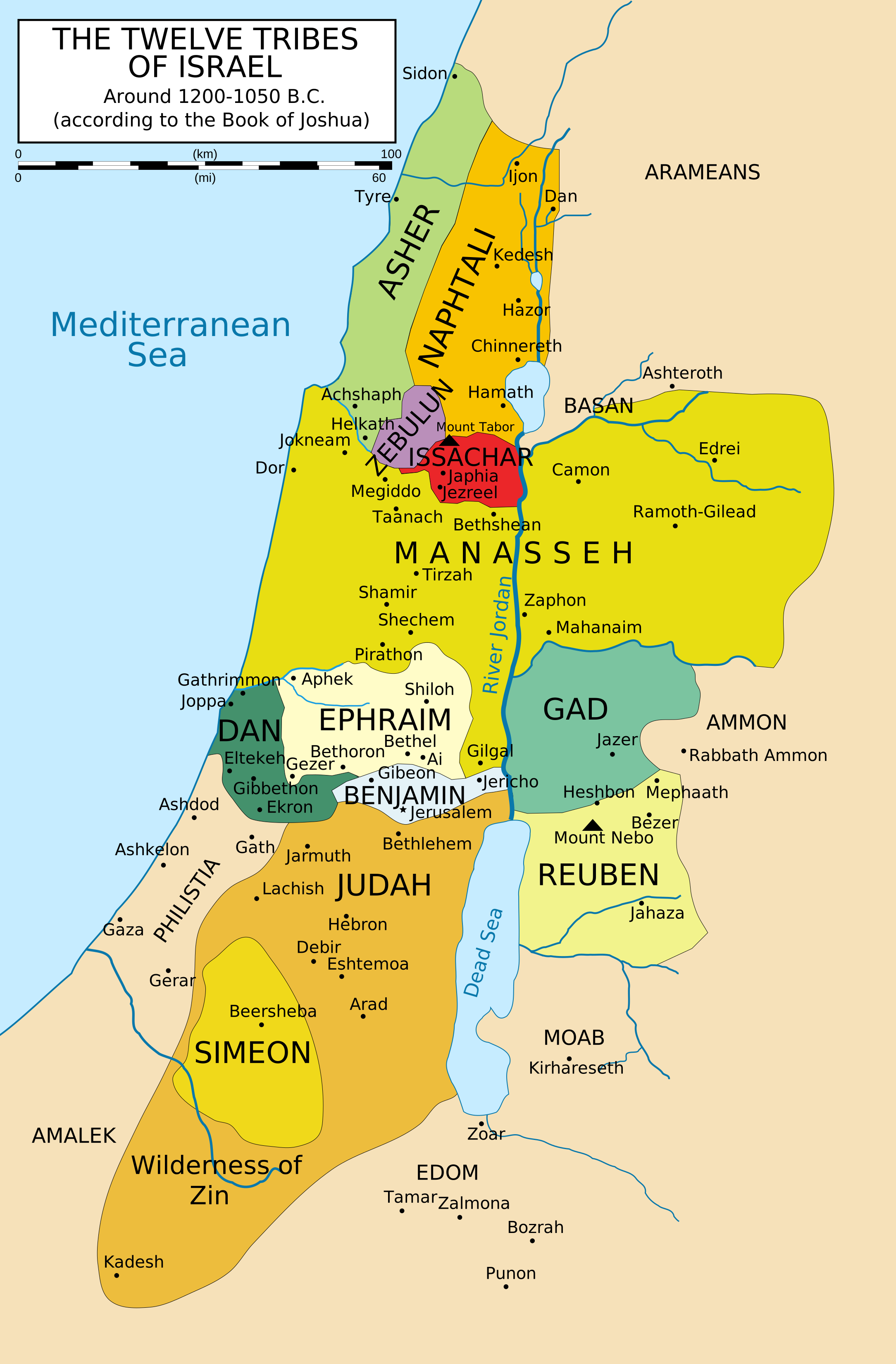 Source: 12 Tribes of Israel Map, CC BY-SA 3.0, via Wikimedia Commons. Use as a broad orientation aid, not a precise Numbers-era reconstruction.
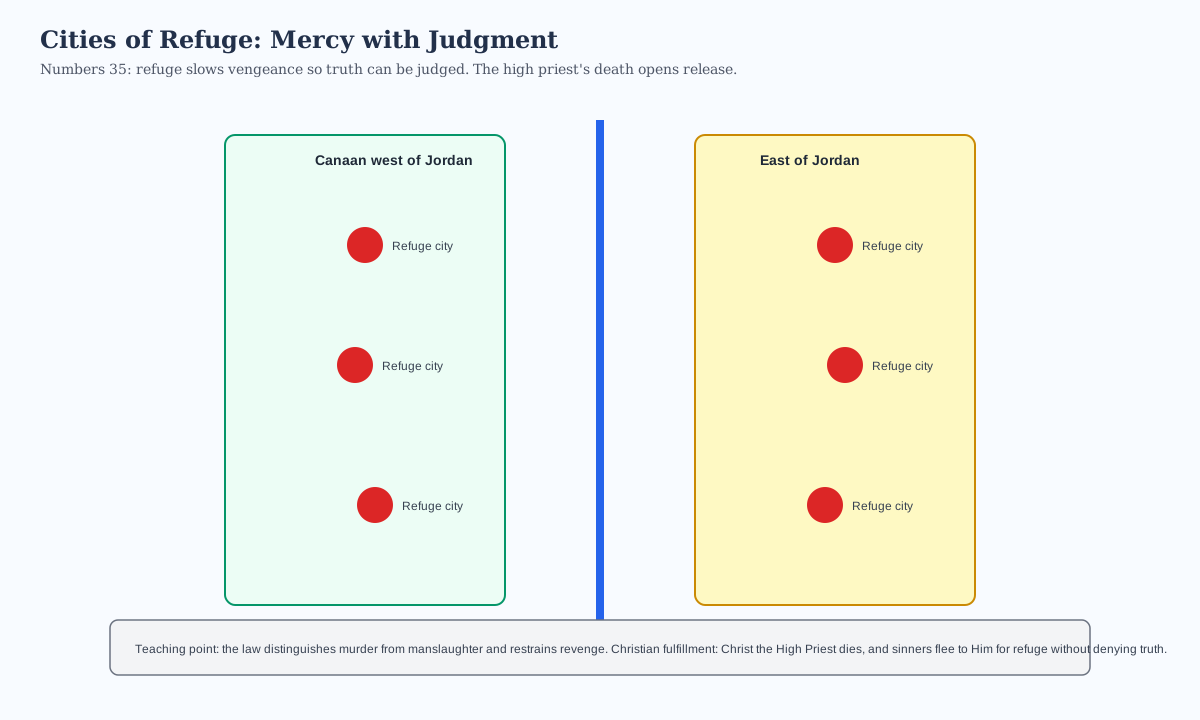 Source: Hermes-generated teaching schematic from Numbers 35, 2026-06-18. Locations are schematic.
The Church’s Voice in Worship ⛪
This passage has no established place in the Coptic Orthodox lectionary.
Deeper spiritual insight and teaching emphasis
The boundaries of the land teach that promise becomes livable through limits. Modern people often hear “boundary” as restriction, but in Scripture a holy boundary can be mercy. It gives shape to inheritance, protects responsibility, and prevents the strong from swallowing the weak. A land with no boundaries would not be freedom; it would become confusion and conflict.
The cities of refuge are one of the most beautiful legal institutions in the Torah. They restrain vengeance without denying bloodguilt. They protect the manslayer while the truth is examined. Justice is slowed down so anger does not become law. This has direct spiritual force for families, churches, and communities. The first reaction is often not the righteous one. Refuge gives truth time to breathe.
The high priest’s death releasing the manslayer opens a profound Christological door. The old covenant law ties release to the death of the high priest. In Christ, the true High Priest dies and rises, and His death becomes release for those who flee to Him. He is not only judge; He is refuge.
The daughters of Zelophehad return at the end, showing that inheritance must be guarded across generations. Freedom is not merely personal. My choices affect my household, tribe, parish, and those who come after me. For teaching, end the book here: God has brought the people to the edge of promise, and now they must receive inheritance with justice, refuge, limits, and memory.
Second-pass teaching refinement
The final chapters are about inheritance with mercy built into its borders. Boundaries matter because gift must take shape. Cities of refuge matter because justice must make room for protection, investigation, and mercy. Inheritance laws matter because land, family, memory, and covenant are bound together. Numbers ends not with vague spirituality, but with ordered life in the promised gift.
The cities of refuge are especially rich for Christian teaching. The manslayer lives under protection until the death of the high priest. This opens a profound typological door: Christ the High Priest dies, and His death changes the condition of the guilty who flee for refuge. Teach this carefully, without erasing the plain legal sense. The Church is called to be a refuge that does not deny justice and a place of justice that does not crush the penitent. The book ends by asking whether the people can receive inheritance without losing mercy, order, or holiness.
Spiritual Fruit 🍇
- Receive boundaries as mercy. Some limits make love livable and inheritance peaceful.
- Run to refuge without lying. A city of refuge is not denial. It is protection while truth is discerned.
- Reject revenge as justice. Blood vengeance is restrained because anger cannot be trusted to judge alone.
- See release through the High Priest. The manslayer’s release at the priest’s death points toward Christ’s freeing death.
- Guard inheritance without possessiveness. What God gives must be preserved for communion, not hoarded in fear.
Discussion Questions
- Why does Numbers end with boundaries and legal structures rather than a dramatic miracle?
- How can boundaries be merciful rather than restrictive?
- What do cities of refuge teach about justice and vengeance?
- Why is the high priest’s death spiritually significant?
- How does this ending prepare Israel to live in the promise?
Teaching Notes
Timing: 10 minutes boundaries, 10 minutes Levite cities, 20 minutes cities of refuge/high priest, 10 minutes inheritance ending.
Where to linger: the high priest’s death releasing the manslayer.
Where to compress: geographical boundary details if time is short.
Pastoral warnings: teach carefully around accidental death, trauma, and guilt. Do not flatten refuge into cheap forgiveness or revenge into justice.
Key sentence to say slowly: The book ends by teaching that mercy must become a habitable order.
This passage has no established place in the Coptic Orthodox lectionary.
Show: the tribal map for inheritance and the refuge schematic for justice restrained by mercy until the high priest’s death.
Glossary
- Boundary: defined limit of inheritance, spiritually a mercy that orders life.
- City of refuge: designated place protecting a manslayer from blood vengeance while justice is discerned.
- Blood avenger: kinsman associated with avenging shed blood in ancient legal custom.
- High priest’s death: event that releases the manslayer from refuge, typologically fulfilled in Christ.
Sources
Primary sources
- Scripture: Numbers in Brenton’s English Septuagint; brief New Testament cross-references where noted.
- Origen, Homilies on Numbers, used cautiously for spiritual and typological interpretation of the wilderness narratives.
- St. Gregory of Nyssa, The Life of Moses, for the wilderness as purification, ascent, and training in desire for God.
- St. Cyril of Alexandria, Christological and sacramental interpretation of Old Testament signs where relevant.
- St. John Chrysostom, pastoral teaching on repentance, humility, obedience, speech, leadership, and the passions.
- St. John Cassian, Conferences and Institutes, for ascetic discernment, murmuring, watchfulness, and obedience.
- Hebrews 6:18; Hebrews 7:23-28; Hebrews 9:11-15; Colossians 1:12.
Secondary academic sources
Jacob Milgrom, Numbers, JPS Torah Commentary.
Baruch A. Levine, Numbers 1-20 and Numbers 21-36, Anchor Yale Bible.
Gordon J. Wenham, Numbers, Tyndale Old Testament Commentaries.
Timothy R. Ashley, The Book of Numbers, NICOT.
Dennis T. Olson, Numbers, Interpretation Commentary.
Coptic Orthodox / pastoral sources
The Orthodox Study Bible, notes on Numbers and New Testament fulfillment.
Fr. Tadros Yacoub Malaty, pastoral and patristic-style reflections on the Pentateuch.
Pope Shenouda III, pastoral teaching on repentance, obedience, humility, and wilderness testing.
Fr. Bishoy Kamel, pastoral themes of liturgy, service, repentance, and the healing life of the Church.
Web pages and non-academic sources cited
- CCEL and New Advent Fathers as public-domain access points for patristic texts.
- Coptic Orthodox lectionary reference tables, used only where exact placements are stated.